SIE vs Series 63
The SIE is a FINRA-administered federal-level exam that tests foundational securities industry knowledge and serves as a prerequisite for all FINRA representative exams. The Series 63 is a NASAA-administered state-level exam that tests knowledge of the Uniform Securities Act and state securities regulations. These exams are administered by different regulatory bodies (FINRA vs NASAA) and serve different purposes (federal prerequisite vs state registration). Neither exam alone authorizes you to conduct securities business — you need both the SIE and a representative exam (Series 6 or Series 7) plus a state registration exam (Series 63 or Series 66) to be fully licensed.
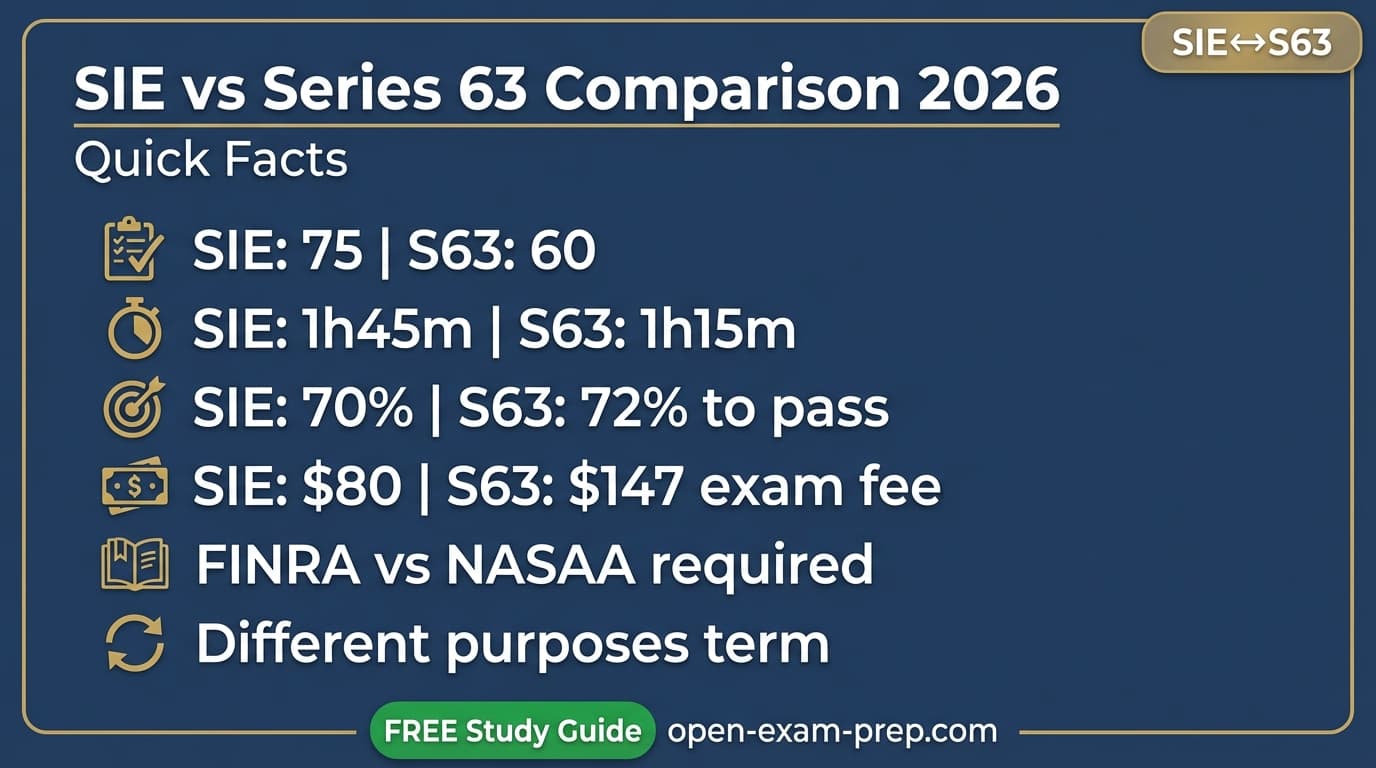
Side-by-Side Comparison
| Feature | SIE | Series 63 |
|---|---|---|
| Full Name | Securities Industry Essentials Exam | Uniform Securities Agent State Law Exam |
| Exam Cost | $80 | $147 |
| Passing Score | 70% (56 of 80 scored questions) | 72% (43 of 60 scored questions) |
| Questions | 85 (75 scored + 10 unscored) | 65 (60 scored + 5 unscored) |
| Time Limit | 1 hour 45 minutes | 1 hour 15 minutes |
| Study Time | 40 - 60 hours over 2 - 4 weeks | 20 - 30 hours over 1 - 2 weeks |
| Difficulty | Entry-level | Moderate (memorization-heavy) |
| Prerequisites | None — anyone 18+ can take it without firm sponsorship | No formal prerequisites, but typically taken after or alongside a representative exam (Series 6 or Series 7). Firm sponsorship required in most states. |
| Exam Body | FINRA | NASAA (North American Securities Administrators Association) |
Key Differences
- 1The SIE is administered by FINRA (federal self-regulatory organization); the Series 63 is administered by NASAA (state-level regulators). They exist in completely separate regulatory frameworks.
- 2The SIE tests securities product knowledge, capital markets, and federal regulatory concepts; the Series 63 tests state securities law under the Uniform Securities Act, including registration requirements and anti-fraud provisions.
- 3The SIE is taken FIRST in the licensing sequence as a prerequisite; the Series 63 is typically taken AFTER or alongside a representative exam (Series 6 or Series 7).
- 4The SIE can be taken by anyone 18+ without firm sponsorship; the Series 63 generally requires firm sponsorship for registration, though some states allow pre-registration testing.
- 5The SIE costs $80 with 75 scored questions in 1 hour 45 minutes; the Series 63 costs $147 with 60 scored questions (55 scored in some sources) in 1 hour 15 minutes.
- 6The SIE has a 70% passing score; the Series 63 has a higher 72% passing score, despite being considered the easier exam overall.
- 7The SIE requires 40-60 hours of study with a ~74% pass rate; the Series 63 requires only 20-30 hours with a higher ~82% pass rate, reflecting its narrower and more memorization-based content.
- 8The SIE result is valid for 4 years without firm association; the Series 63 registration is tied to your firm and must be maintained through ongoing employment at a registered broker-dealer.
What Each Exam Allows You To Do
SIE
- Demonstrate foundational knowledge of the securities industry to employers
- Satisfy the prerequisite for all FINRA representative-level exams (Series 6, 7, 57, 79, etc.)
- Signal career commitment to broker-dealer hiring managers during job interviews
- Begin the multi-exam licensing sequence on your own timeline before securing firm sponsorship
Series 63
- Register as a securities agent at the state level, satisfying state-law requirements to transact business
- Combined with the SIE and Series 7, legally solicit, purchase, and sell securities in states where you are registered
- Combined with the SIE and Series 6, sell packaged products (mutual funds, variable annuities) at the state level
- Meet the state registration requirement at broker-dealers that do not require the broader Series 66
Who Should Take Each Exam?
Take the SIE if you...
- →Career changers exploring a transition into financial services
- →College students or recent graduates building a credential before graduation
- →Job seekers who want to pass a FINRA exam before landing a sponsoring firm
- →Anyone preparing for the Series 6, Series 7, or another FINRA representative exam
Take the Series 63 if you...
- →Candidates who have passed (or are about to pass) the Series 6 or Series 7 and need state registration
- →Broker-dealer employees whose firms require the Series 63 rather than the Series 66
- →Professionals who only need agent registration (not investment adviser representative registration)
- →Anyone completing the standard SIE → S7 → S63 licensing sequence at a traditional brokerage firm
Which Should You Take First?
You should take the SIE first — it is the mandatory prerequisite for all FINRA representative-level exams, and the typical licensing sequence is SIE → Series 6 or Series 7 → Series 63. The SIE comes first because it establishes foundational securities knowledge that both the representative exam and the Series 63 build upon. Most candidates take the SIE while job hunting (since it requires no sponsorship), then pass their representative exam (Series 6 or Series 7) within the firm's training window, and take the Series 63 last or concurrently with the representative exam. Some firms have candidates study for the Series 7 and Series 63 simultaneously, since the Series 63 requires significantly less study time (20-30 hours) and can be prepared for in parallel without overloading the study schedule. The critical point is that none of these exams — SIE, representative exam, or Series 63 — is useful in isolation. You need all three to legally transact securities business in any state.
At a Glance: SIE vs Series 63
Exam Cost
$80
SIE
$147
Series 63
Pass Rate
~74%
SIE
~82%
Series 63
Study Time
40-60 hrs
SIE
20-30 hrs
Series 63
Median Salary
N/A (prerequisite)
SIE
N/A (state registration)
Series 63
SIE
Career changers exploring finance, college students, and anyone wanting to demonstrate securities knowledge before firm sponsorship
Series 63
Candidates who already passed the SIE and a representative exam (S6/S7) and need state-level registration to transact business
Start preparing today:
Key Facts: SIE vs Series 63
- 1The SIE is administered by FINRA and tests federal-level securities knowledge, while the Series 63 is administered by NASAA and tests state-level securities law under the Uniform Securities Act.
- 2The SIE costs $80 with 75 scored questions in 1 hour 45 minutes; the Series 63 costs $147 with 60 scored questions in 1 hour 15 minutes.
- 3The SIE has an approximately 74% first-time pass rate, while the Series 63 has a higher approximately 82% first-time pass rate, making it the most passable standard securities exam.
- 4The SIE requires a 70% passing score, while the Series 63 requires a higher 72% passing score despite being considered the easier exam overall.
- 5Neither the SIE nor the Series 63 alone authorizes you to conduct securities business — you need both plus a representative exam (Series 6 or Series 7) to be fully licensed.
- 6The typical licensing sequence is SIE first (no sponsorship needed), then Series 7 or Series 6 (firm sponsorship required), then Series 63 (state registration) — all usually completed within a firm's 120-day training window.
- 7The SIE requires 40-60 hours of study focused on securities products and markets, while the Series 63 requires only 20-30 hours focused on memorizing state registration requirements and exemptions.
- 8Securities sales agents holding the complete licensing package (SIE + Series 7 + Series 63 or 66) earn a median salary of $78,140 per year, with the top 10% earning over $215,210 according to BLS May 2024 data.
- 9The Series 63 is evenly divided across four content areas at 25% each: regulation of securities, regulation of persons, regulation of transactions, and communication with customers.
- 10An estimated 30-40% of financial advisors will retire by 2030, creating significant opportunities for newly licensed professionals entering the industry.
Why This Comparison Matters
Federal vs State
Two Regulatory Layers
The SIE covers federal securities regulation administered by FINRA, while the Series 63 covers state-level securities law under the Uniform Securities Act administered by NASAA. You need both layers to legally sell securities.
82% Pass Rate
Series 63 Accessibility
The Series 63 has an approximately 82% first-time pass rate, making it the highest pass rate among standard securities exams. However, its 72% passing score is stricter than the SIE's 70%.
$78,140 Median
Full Package Earnings
Neither the SIE nor the Series 63 alone generates income. Combined with the Series 7, the complete SIE + S7 + S63 package unlocks a median salary of $78,140 for securities sales agents (BLS, May 2024).
The SIE and the Series 63 represent two fundamentally different layers of securities regulation in the United States, and understanding why both exist is essential to navigating the licensing process. The SIE, administered by FINRA, tests your knowledge of federal-level concepts: securities products, capital markets structure, trading mechanics, and the federal regulatory framework. The Series 63, administered by NASAA, tests your understanding of state-level securities law — specifically the Uniform Securities Act, which governs how securities are registered, sold, and regulated within individual states.
This dual regulatory structure exists because the U.S. securities industry operates under both federal and state oversight. The SEC and FINRA handle federal regulation, while each state's securities administrator enforces state-specific rules (often called "blue sky laws"). The Series 63 ensures that every registered representative understands the state-level rules that apply to their practice — registration requirements, exemptions, prohibited practices, and disclosure obligations — on top of the federal knowledge tested by the SIE and representative exams.
The most important thing candidates should understand is that neither exam alone lets you do anything. The SIE is a prerequisite that opens the door to representative exams. The Series 63 is a state registration exam that complements a representative license. The complete package — SIE + representative exam (Series 6 or Series 7) + state exam (Series 63 or Series 66) — is what actually authorizes you to conduct securities business. Planning the full sequence upfront, rather than viewing each exam in isolation, is the key to an efficient and successful licensing journey.
What Each Exam Covers
SIE Exam Topics
Pass Rate: ~74% first-time pass rate (FINRA data, 2023-2024)
Series 63 Exam Topics
Pass Rate: ~82% first-time pass rate (NASAA data, 2023-2024)
Salary & Income Comparison
SIE Credential Holder (Pre-License)
N/A — SIE alone is not a license
Median Annual Salary
Range: $40,000 - $55,000 (entry-level trainee positions)
ZipRecruiter, 2025; reflects trainee/associate roles that value SIE completion
The SIE is a prerequisite exam, not a standalone license. It does not authorize you to conduct any securities business. However, having "SIE Passed" on your resume can help secure trainee positions at broker-dealers, where you will then sit for a representative exam (Series 6 or Series 7) and a state registration exam (Series 63 or Series 66).
Series 63 Holder (State Registration Component)
N/A — Series 63 alone is not a standalone license
Median Annual Salary
Range: $78,140 median when combined with Series 7 (BLS, May 2024)
BLS Occupational Employment Statistics, May 2024 (SOC 41-3031); Series 63 is one component of a multi-exam licensing package
The Series 63 is a state-level registration exam, not a standalone credential that generates income. It is always paired with a FINRA representative exam (Series 6 or Series 7) and the SIE. The salary data for securities sales agents — median $78,140, top 10% over $215,210 — reflects the combined value of the full licensing package (SIE + representative exam + state registration).
Neither the SIE nor the Series 63 independently generates earning power. Both are components of a multi-exam licensing package, and salary data reflects the combined value of the full credential set. According to BLS May 2024 data (SOC 41-3031), securities, commodities, and financial services sales agents — professionals who hold the complete SIE + Series 7 + Series 63 (or Series 66) package — earn a median salary of $78,140 per year. The 10th percentile earns $47,080, while the 90th percentile earns over $215,210.
The Series 63 is sometimes perceived as a "minor" exam in the licensing sequence because of its shorter study time and higher pass rate, but it is an absolute requirement for conducting business. Without state registration, a Series 7 holder cannot legally solicit or transact securities with clients. In terms of career economics, the Series 63 is the final gate that unlocks your ability to earn — it is the difference between being licensed on paper and being licensed to produce revenue. For firms operating in multiple states, representatives must register in each state where they have clients, making the Series 63 knowledge foundational to understanding where and how you can do business.
Total Cost to Get Licensed
| Expense | SIE | Series 63 |
|---|---|---|
| Pre-Licensing Education | $0 (no pre-licensing course required, though $150-$400 for optional prep course recommended) | $50 - $200 (Series 63 prep course: Kaplan $129, Achievable $49-$99, ExamFX $99-$179) |
| Exam Fee | $80 (FINRA) | $147 (NASAA, administered at Prometric) |
| License Fee | N/A (SIE is not a license) | $25 - $200 (state registration fees vary by state; some states charge nothing, others up to $200) |
| Background Check | N/A (no Form U4 filing for SIE alone) | $50 - $100 (fingerprinting and background check via Form U4, if not already completed for representative exam) |
| Total Investment | $80 - $480 (exam fee + optional prep course) | $272 - $647 (exam fee + prep course + state registration + background check) |
A Day in the Life
SIE Professional
A recent college graduate who passed the SIE three months ago is interviewing at a regional broker-dealer. During the interview, the branch manager asks about his understanding of securities products, and he confidently discusses equity and debt instruments, mutual fund share classes, and the basics of options — all topics he studied for the SIE. The manager explains that once hired, he will have 120 days to pass the Series 7 and Series 63. The candidate asks intelligent questions about the firm's licensing sequence, noting that he has already researched the Uniform Securities Act topics covered on the Series 63. He receives an offer that afternoon, with his start date set for two weeks out and a study schedule already mapped for his Series 7 and Series 63 exams.
Series 63 Professional
A newly licensed financial advisor who completed her SIE, Series 7, and Series 63 last month is preparing for her first full week of client-facing activity. On Monday morning, she reviews the list of states where she is registered — her firm filed her Series 63 in three states (New York, New Jersey, and Connecticut) because her branch serves clients in the tri-state area. She knows from her Series 63 study that she cannot solicit clients in states where she is not registered, so she flags two prospect leads from Pennsylvania for her manager to reassign or to initiate a state registration request. During a team meeting, her compliance officer reminds the group about the state-level anti-fraud provisions and record-keeping requirements — topics she studied extensively for the Series 63. By Wednesday, she is making her first client calls, confident that she understands both the federal regulations (from the SIE and Series 7) and the state-level rules (from the Series 63) that govern her interactions.
Career Paths & Progression
SIE Career Path
0 years
SIE Credential Holder (Job Seeker)
$0 (credential only)
0-1 years
Trainee at Broker-Dealer (studying for S7 + S63)
$45K-$55K
Series 63 Career Path
0-2 years
Fully Registered Representative (SIE + S7 + S63)
$50K-$80K base
2-5 years
Financial Advisor / Account Executive
$80K-$150K
5-10 years
Senior Financial Advisor / Producing Manager
$150K-$300K
10+ years
Branch Manager / Managing Director
$250K-$500K+
The SIE is the entry point of the FINRA licensing system — a foundational credential that demonstrates you understand securities basics. After the SIE, the career path splits depending on which representative exam you pursue: Series 7 for general securities or Series 6 for packaged products (mutual funds, variable annuities). Both paths ultimately require a state registration exam, and the Series 63 is the most common choice.
The typical career trajectory after completing the SIE + Series 7 + Series 63 package follows three primary tracks: (1) Wirehouse financial advisor — building a client book at firms like Morgan Stanley, Merrill Lynch, or UBS, earning grid-based compensation of 35-51% of revenue generated; (2) Regional or independent broker-dealer representative — affiliating with firms like Edward Jones, Raymond James, or LPL Financial, often with higher payout ratios (80-95%) but more personal overhead costs; (3) Institutional sales or trading — working at the firm level servicing institutional clients, with compensation structures that include significant bonuses. For candidates who complete SIE + Series 6 + Series 63 instead, the career path typically focuses on insurance-based financial planning at firms like Northwestern Mutual, New York Life, or MassMutual, selling mutual funds and variable annuities alongside insurance products.
Start preparing today:
Series 63 vs Series 66: Which State Exam Do You Need?
Benefits
- +The Series 63 satisfies state agent registration requirements and is sufficient if your firm only requires you to sell securities (brokerage activities) without providing investment advice for a fee
- +The Series 63 is shorter and easier to pass than the Series 66 (60 questions vs 100 questions, 82% pass rate vs ~73% pass rate), making it a quicker path to full licensing
- +Some broker-dealers that do not offer advisory services require only the Series 63, keeping the licensing process streamlined
- +Candidates who pass the Series 63 can always add the Series 65 later to become an investment adviser representative, providing a flexible staged approach
- +The Series 63 + Series 65 combination covers the same ground as the Series 66 but allows candidates to tackle each exam separately on a more manageable timeline
Considerations
- !The industry trend is overwhelmingly toward fee-based advisory services, making the Series 66 (which combines agent registration + investment adviser representative registration) more valuable long-term than the Series 63 alone
- !If your firm is dual-registered (broker-dealer + RIA), you will almost certainly need the Series 66 rather than just the Series 63 — check with your compliance department before choosing
- !Switching from Series 63 to Series 66 later means taking the Series 65 as a separate exam ($187 fee, 130 questions, 2 hours 10 minutes) rather than having completed everything in one combined exam
The Verdict: If your firm requires only the Series 63, take it and move on — you can always add the Series 65 later. However, if you have the option, the Series 66 is the more future-proof choice because it combines state agent registration (Series 63 content) with investment adviser representative registration (Series 65 content) in a single exam. The standard modern career path is SIE → Series 7 → Series 66, but many traditional brokerage firms still use the SIE → Series 7 → Series 63 sequence. Ask your firm which exam they require before making a decision.
Job Outlook & Industry Trends
N/A (prerequisite exam)
SIE Job Growth (2024-2034)
3% (2024-2034, BLS — applies to fully licensed securities agents)
Series 63 Job Growth (2024-2034)
The BLS projects 3% growth for securities, commodities, and financial services sales agents through 2034, with approximately 38,100 annual openings driven by retirements and transfers to other occupations. This growth rate applies to the complete licensing package (SIE + representative exam + state registration), not to either the SIE or Series 63 individually. The most significant workforce trend is the retirement wave: an estimated 30-40% of financial advisors are expected to retire by 2030, creating substantial opportunities for new entrants to acquire existing client books and build practices. Additionally, the ongoing shift from commission-based sales to fee-based advisory models means firms increasingly value advisors who hold both brokerage and advisory registrations — making the choice between Series 63 and Series 66 a consequential long-term career decision.
Study Strategy & Tips
SIE Preparation
Foundational securities knowledge (federal level)
- Complete an SIE prep course (Kaplan, Achievable, ExamFX, or similar)
- Study Products and Their Risks (44% of exam) — equities, bonds, options basics, mutual funds, ETFs, and alternative investments
- Review Trading, Accounts, and Prohibited Activities (31%) — order types, account types, suitability basics, and insider trading rules
- Take 3+ full-length practice exams, scoring 80%+ consistently before scheduling the SIE
Pass SIE + Begin Job Search
Pass SIE exam and secure firm sponsorship
- Schedule and pass the SIE exam at a Prometric testing center
- Update resume with SIE credential and begin applying to broker-dealer trainee programs
- Research which representative exam your target firms require (Series 6 vs Series 7)
- Begin preliminary review of Series 7 or Series 6 material while interviewing
Representative Exam Preparation
Series 7 or Series 6 intensive study (within firm training program)
- Complete your firm-provided or independent prep course for the Series 7 or Series 6
- For Series 7: master options, bonds, suitability analysis, and margin requirements
- For Series 6: focus on mutual funds, variable annuities, retirement plans, and insurance concepts
- Take 5+ full-length practice exams scoring 80%+ before scheduling
Series 63 Preparation + Final Licensing
State law memorization and final exam
- Begin Series 63 study immediately after passing your representative exam (or study concurrently during the final 2 weeks)
- Focus on the Uniform Securities Act: registration requirements for securities, agents, broker-dealers, and investment advisers
- Memorize exemptions from registration — federal-covered securities, exempt transactions, and excluded persons
- Take 2-3 full-length practice exams scoring 80%+ before scheduling the Series 63
Total Duration: 6-10 weeks for SIE + representative exam + Series 63 (sequential study)
SIE Study Tips
- 1Prioritize Products and Their Risks — at 44% of the exam, this section alone determines pass or fail. Know the characteristics, risks, and basic suitability of equities, debt securities, mutual funds, ETFs, options, and alternative investments.
- 2Understand the structure of capital markets: primary vs secondary markets, the role of market makers and specialists, how IPOs work, and the difference between exchange-traded and OTC securities.
- 3Memorize the roles of key regulatory bodies: FINRA regulates broker-dealers, the SEC oversees federal securities law, MSRB governs municipal securities, and state regulators enforce blue sky laws. This 9% regulatory section is the easiest to master through pure memorization.
- 4Take at least 3 full-length practice exams under timed conditions (1 hour 45 minutes). The SIE tests breadth, not depth — you need to recognize concepts rapidly across many topics rather than calculate complex answers.
- 5Do not over-study. The SIE is designed as an introductory exam. If you are deep into options strategies or bond duration calculations, you have gone beyond SIE scope — save that material for the Series 7.
Series 63 Study Tips
- 1The Series 63 is heavily memorization-based. Focus on the definitions and registration requirements in the Uniform Securities Act (USA): who must register, who is exempt, and under what circumstances. Understanding the exemption framework is the single most important study task.
- 2Know the difference between federal-covered securities (regulated by SEC, exempt from state registration) and state-registered securities. The interplay between federal and state jurisdiction is tested repeatedly.
- 3Memorize the key persons and their registration requirements: agents, broker-dealers, investment advisers, and investment adviser representatives. Understand when each must register, when they are exempt, and what triggers registration in a state.
- 4Study the anti-fraud provisions and ethical practices heavily. The exam tests scenarios involving churning, unsuitable recommendations, selling away, borrowing from clients, and other prohibited activities under state law.
- 5Take at least 2-3 full-length practice exams. The Series 63 has only 60 scored questions in 75 minutes, giving you about 75 seconds per question. Many questions use double-negative phrasing or "all of the following EXCEPT" format — practice reading carefully under time pressure.
Ready to Start Studying?
Free practice questions, study guides, and AI tutoring for the matching exam resources.
Frequently Asked Questions
QDo I need both the SIE and the Series 63 to sell securities?
Yes, but you also need a representative-level exam in between. The complete licensing package requires three exams: the SIE (federal prerequisite), a representative exam like the Series 7 or Series 6 (federal license), and a state registration exam like the Series 63 (state authorization). The SIE proves foundational knowledge, the representative exam authorizes specific types of securities transactions, and the Series 63 registers you as an agent at the state level. Without all three, you cannot legally solicit, recommend, or transact securities with clients in any state.
QIs the Series 63 harder than the SIE?
Most candidates find the Series 63 easier than the SIE. The Series 63 has an approximately 82% first-time pass rate compared to the SIE's approximately 74%, and it requires roughly half the study time (20-30 hours vs 40-60 hours). The Series 63 content is narrower and more memorization-based — focused primarily on the Uniform Securities Act's registration requirements and exemptions. However, the Series 63 does have a higher passing score (72% vs 70%), and many candidates struggle with its nuanced wording and "all of the following EXCEPT" question format. The key is disciplined memorization of state-level definitions and exemption categories.
QWhat is the difference between FINRA and NASAA?
FINRA (Financial Industry Regulatory Authority) is a self-regulatory organization that oversees broker-dealers and their registered representatives at the federal level — it administers exams like the SIE, Series 6, Series 7, and others. NASAA (North American Securities Administrators Association) is the association of state and provincial securities regulators that administers state-level exams like the Series 63, Series 65, and Series 66. The U.S. securities industry operates under dual regulation: FINRA handles federal broker-dealer oversight, while each state's securities administrator enforces state-specific securities laws. This is why you need exams from both organizations to be fully licensed.
QShould I take the Series 63 or the Series 66?
It depends on your career path and your firm's requirements. The Series 63 covers only state agent registration (the right to sell securities in a state), while the Series 66 combines agent registration with investment adviser representative (IAR) registration. If your firm is a traditional brokerage that does not offer advisory services, the Series 63 is sufficient. If your firm is dual-registered as both a broker-dealer and an RIA — which is the growing industry standard — you will likely need the Series 66. The Series 66 is a longer and harder exam (100 questions, 2 hours 30 minutes, ~73% pass rate) but it eliminates the need to take the Series 65 separately later. Ask your firm's compliance department which exam they require before committing to a study plan.
QCan I take the Series 63 before the SIE?
Technically, the Series 63 does not have the SIE as a formal prerequisite — it is administered by NASAA, not FINRA, so FINRA's prerequisite rules do not directly apply. However, this order makes little practical sense. The Series 63 is a state registration exam designed to complement a representative license, and you cannot use the Series 63 registration without also holding a representative license (Series 6 or Series 7), which requires the SIE. In practice, nearly all candidates follow the sequence SIE → representative exam → Series 63. Some firms have candidates study for the representative exam and Series 63 concurrently, taking both within a short window, but the SIE always comes first.
QHow long is the Series 63 valid, and do I need continuing education?
The Series 63 registration remains valid as long as you are associated with a FINRA-member broker-dealer. If you leave your firm, your Series 63 registration typically remains on file and can be transferred to a new firm within 2 years (the same window as FINRA representative licenses). After 2 years of non-association, you would need to re-take the exam. Unlike FINRA exams, the Series 63 does not have a separate continuing education (CE) requirement — however, FINRA's Regulatory Element CE (required annually since the 2022 CE restructuring) covers both federal and state-level topics, so you are effectively maintaining your state-law knowledge through that program.
10 free AI interactions per day
Free exam resources
Start Studying the Exact Exam
Use the comparison to choose a path, then move into the matching practice questions, study guide, and flashcards.
 Buy on Amazon
 Flashcards on Mometrix
 Take courses on Udemy
 Prep course on Achievable
 Practice exams on ExamEdge
Related Exam Comparisons
Stay Updated
Get free exam tips and study guides delivered to your inbox.