Series 6 vs Series 7
The Series 6 is a limited securities license that authorizes the sale of packaged investment products only — mutual funds, variable annuities, variable life insurance, 529 plans, and unit investment trusts. The Series 7 is the general securities license that authorizes the sale of virtually ALL securities, including everything a Series 6 covers plus individual stocks, bonds, options, ETFs, direct participation programs, and more. Both exams require passing the SIE and being sponsored by a FINRA-member firm. The critical question is whether your career will ever require selling individual securities or ETFs — if so, the Series 7 is the only path.
Watch: Series 6 vs Series 7 Explained
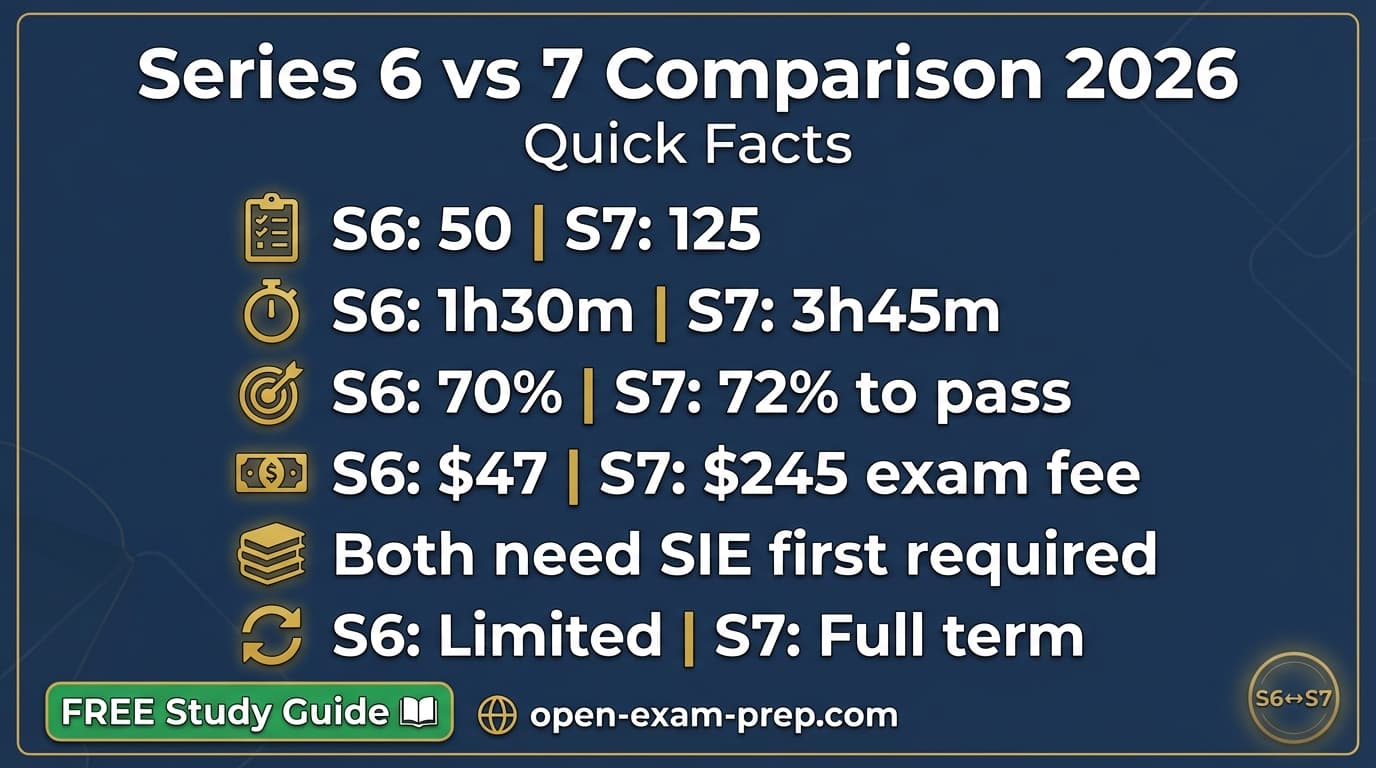
Side-by-Side Comparison
| Feature | Series 6 | Series 7 |
|---|---|---|
| Full Name | Investment Company and Variable Contracts Products Representative Exam | General Securities Representative Exam |
| Exam Cost | $47 | $245 |
| Passing Score | 70% (35 of 50 scored questions) | 72% (83 of 115 scored questions) |
| Questions | 55 (50 scored + 5 unscored) | 135 (125 scored + 10 unscored) |
| Time Limit | 1 hour 30 minutes | 3 hours 45 minutes |
| Study Time | 30 - 50 hours over 2 - 4 weeks | 80 - 120 hours over 4 - 8 weeks |
| Difficulty | Moderate | Challenging |
| Prerequisites | SIE exam passed + sponsorship by a FINRA-member firm (Form U4 filing) required | SIE exam passed + sponsorship by a FINRA-member firm (Form U4 filing) required |
| Exam Body | FINRA | FINRA |
Key Differences
- 1The Series 6 only authorizes sales of packaged products (mutual funds, variable annuities, variable life, 529 plans, UITs); the Series 7 authorizes sales of ALL securities including individual stocks, bonds, options, and ETFs.
- 2Series 6 holders CANNOT sell individual stocks, corporate bonds, municipal bonds, government bonds, options contracts, or ETFs — the Series 7 is required for all of these.
- 3The Series 6 costs $47 with 50 scored questions in 1 hour 30 minutes; the Series 7 costs $245 with 125 scored questions in 3 hours 45 minutes — roughly 5x more expensive and 2.5x longer.
- 4The Series 6 has a lower pass rate (~58%) than the Series 7 (~74%), which is counterintuitive — many attribute this to less preparation time and the false assumption that a "limited" exam is easy.
- 5Series 7 holders can do everything Series 6 holders can do and more — the Series 7 is a complete superset of the Series 6 in terms of product authorization.
- 6ETFs are increasingly replacing mutual funds, and Series 6 holders cannot sell ETFs. This is arguably the most significant limitation of the Series 6 in the modern investment landscape.
- 7Series 6 holders typically earn salary-plus-bonus compensation at banks ($40,000-$86,000); Series 7 holders can earn grid-based wirehouse compensation ($78,140 median, $200,000-$500,000+ for top performers).
- 8The Series 7 requires roughly 2-3x more study time (80-120 hours vs 30-50 hours) and covers substantially more complex topics including options strategies, bond pricing, and margin calculations.
What Each Exam Allows You To Do
Series 6
- Sell mutual fund shares (open-end investment company products)
- Sell variable annuities and variable life insurance policies
- Sell 529 college savings plans and other municipal fund securities
- Sell unit investment trusts (UITs)
- Work as an investment representative at banks, credit unions, and insurance companies
Series 7
- Sell ALL types of securities: stocks, bonds, options, mutual funds, ETFs, variable annuities, direct participation programs, and more
- Recommend investment strategies and execute trades for retail and institutional clients
- Sell every product a Series 6 holder can sell PLUS individual equities, corporate and government bonds, options contracts, and ETFs
- Work as a registered representative (stockbroker) at any FINRA-member broker-dealer
- Act as a financial advisor at wirehouses like Morgan Stanley, Merrill Lynch, UBS, and Wells Fargo
- Earn commissions on securities transactions or manage fee-based accounts (with Series 66 or 65)
Who Should Take Each Exam?
Take the Series 6 if you...
- →Bank investment representatives selling mutual funds and annuities to depositors
- →Insurance agents adding variable annuity and variable life products to their offerings
- →Credit union financial advisors recommending 529 plans and mutual funds
- →Professionals who work at firms that only sell packaged investment products
- →Those whose employer specifically requires only the Series 6 and not the Series 7
Take the Series 7 if you...
- →Aspiring stockbrokers and registered representatives at full-service broker-dealers
- →Financial advisors at wirehouses and independent broker-dealers
- →Anyone wanting the broadest securities license available — the Series 7 covers everything the Series 6 does and far more
- →Career changers targeting high-income financial services roles with uncapped earning potential
Which Should You Take First?
If your employer specifically requires the Series 6 and your role is exclusively focused on packaged products (typical at banks and insurance companies), take the Series 6. However, if there is any chance your career will evolve to include individual securities, ETFs, or options — or if you want maximum flexibility — take the Series 7 instead. The Series 7 covers everything the Series 6 does and more, so passing the Series 7 makes the Series 6 redundant. Many industry professionals and career coaches advise taking the Series 7 even if your current role only requires the Series 6, because the incremental study time (an additional 30-70 hours) opens doors that the Series 6 permanently closes. The one exception is if your firm will only sponsor you for the Series 6 and you need to start working immediately — in that case, take the Series 6 now and plan to take the Series 7 later at a firm that sponsors it. Be aware that passing the Series 6 does NOT give you credit toward the Series 7; you would need to study for and pass the Series 7 as a separate exam from scratch. The SIE is a prerequisite for both exams, so start there if you have not passed it yet.
At a Glance: Series 6 vs Series 7
Exam Cost
$47
Series 6
$245
Series 7
Pass Rate
~58%
Series 6
~74%
Series 7
Study Time
30-50 hrs
Series 6
80-120 hrs
Series 7
Median Salary
~$61,000
Series 6
$78,140
Series 7
Series 6
Bank investment reps, insurance agents adding mutual funds/variable annuities, and professionals who only need to sell packaged products
Series 7
Aspiring stockbrokers, full-service financial advisors, and anyone wanting the broadest securities license to sell stocks, bonds, options, ETFs, and everything else
Start preparing today:
Key Facts: Series 6 vs Series 7
- 1The Series 6 authorizes sales of packaged products only (mutual funds, variable annuities, variable life insurance, 529 plans, UITs), while the Series 7 authorizes sales of ALL securities including individual stocks, bonds, options, and ETFs.
- 2Series 6 holders CANNOT sell ETFs — a critical limitation as U.S. ETF assets surpassed $10 trillion in 2024, increasingly replacing mutual funds as the preferred investment vehicle.
- 3The Series 7 is a complete superset of the Series 6: every product a Series 6 holder can sell is also authorized under the Series 7, making holding both licenses redundant.
- 4The Series 6 has a lower first-time pass rate (~58%) than the Series 7 (~74%) despite being a shorter, less expensive exam — often attributed to less rigorous preparation by candidates.
- 5Series 6 holders working as bank investment representatives earn a median of approximately $61,000/year, while Series 7 holders earn a median of $78,140/year according to BLS data, with top wirehouse advisors earning $200,000-$500,000+.
- 6The Series 6 exam costs $47 for 50 scored questions in 1 hour 30 minutes; the Series 7 costs $245 for 125 scored questions in 3 hours 45 minutes.
- 7Passing the Series 6 provides NO credit toward the Series 7 — candidates who want to upgrade must study for and pass the Series 7 as a completely separate exam.
- 8Both the Series 6 and Series 7 require passing the SIE as a prerequisite and being sponsored by a FINRA-member broker-dealer via Form U4.
- 9The total cost to become fully licensed ranges from $350-$750 for the Series 6 path vs $550-$1,100 for the Series 7 path, including SIE, exam fees, state registration, prep courses, and background checks.
- 10The BLS projects 38,100 annual openings for securities sales agents through 2034, but demand is shifting toward Series 7-licensed advisors as bank branches decline and ETF adoption accelerates.
Why This Comparison Matters
ETFs Excluded
The Critical Series 6 Gap
Series 6 holders cannot sell ETFs, which are rapidly replacing mutual funds as the preferred investment vehicle. This single limitation increasingly narrows the Series 6 career path.
$78,140
Series 7 Median Salary (BLS)
Securities sales agents with the Series 7 earn a median of $78,140/year per BLS, with top earners at wirehouses exceeding $200,000-$500,000+ through grid-based compensation.
100% Overlap
Series 7 Covers Everything
Every product a Series 6 holder can sell is also covered by the Series 7. The Series 7 is a strict superset — there is nothing a Series 6 can do that a Series 7 cannot.
The Series 6 vs Series 7 debate is one of the most consequential decisions in early financial services careers — and it is often made for the wrong reasons. Too many candidates default to the Series 6 because it seems "easier" or because their bank employer only requires it, without understanding the long-term career implications of carrying a limited license.
Here is the uncomfortable truth: the Series 6 is a shrinking license. The products it authorizes — primarily mutual funds and variable annuities — are facing existential competitive pressure from ETFs, which Series 6 holders cannot sell. In 2024, U.S. ETF assets surpassed $10 trillion, while mutual fund assets have been in relative decline as investors shift to lower-cost, more tax-efficient ETF structures. A Series 6 holder watching clients ask about ETFs must either refer them to a Series 7-licensed colleague or explain why they cannot help — neither scenario is good for building a client relationship.
The salary gap tells the story clearly. Series 6 holders working as bank investment representatives earn a median of approximately $61,000, with a ceiling around $86,000 even at top performers. Series 7 holders earn a median of $78,140 according to BLS data, with virtually no ceiling — top wirehouse advisors routinely earn $200,000-$500,000+. The additional 30-70 hours of study time to pass the Series 7 instead of the Series 6 may be the highest-ROI investment of your entire career.
What Each Exam Covers
Series 6 Exam Topics
Pass Rate: ~58% first-time pass rate (FINRA data, 2023-2024)
Series 7 Exam Topics
Pass Rate: ~74% first-time pass rate (FINRA data, 2023-2024)
Salary & Income Comparison
Bank Investment Representative / Limited Securities Agent
$61,000
Median Annual Salary
Range: $40,000 - $86,000
Glassdoor and ZipRecruiter data, 2024-2025; reflects bank investment rep and limited securities agent roles
Series 6 holders typically work in salaried positions at banks and insurance companies with modest commission or bonus components. Top earners at large banks (JPMorgan Chase, Bank of America, Wells Fargo) with strong cross-selling records can reach $80,000-$90,000 including bonuses, but the ceiling is significantly lower than Series 7 roles because the product set is limited to packaged products with smaller commissions.
Registered Representative / Securities Sales Agent
$78,140
Median Annual Salary
Range: $47,080 - $215,210+
BLS Occupational Employment Statistics, May 2024 (SOC 41-3031)
Top-performing registered representatives at wirehouses can earn $200,000-$450,000+ through grid-based compensation (35-51% of revenue generated). An advisor managing $100M in client assets producing $1M in annual revenue earns $350,000-$510,000 from the grid alone. Independent broker-dealer reps keep 80-95% of revenue but cover their own overhead. Wirehouse trainees start with a full salary and transition to grid-based pay over 18-24 months.
| Commission Detail | Series 6 | Series 7 |
|---|---|---|
| First-Year Commission | Salary-based ($40,000-$55,000 base) plus modest commissions on mutual fund and annuity sales | Trainee salary ($50,000-$80,000 base) transitioning to grid-based payout over 18-24 months |
| Renewal Commission | Trail commissions of 0.25%-1.0% annually on mutual fund AUM; renewal commissions on variable annuity contracts | 35-51% of revenue at wirehouses; 80-95% at independent broker-dealers |
| Income Model | Most Series 6 holders work in a bank or insurance channel where compensation is primarily salary plus incentive bonuses. Mutual fund sales generate upfront sales charges (loads) of 0-5.75% split between the advisor and the firm, plus 12b-1 trail fees of 0.25-1.0% on assets under management. Variable annuity commissions range from 1-8% upfront depending on the product and share class. The compensation model rewards gathering assets in packaged products rather than active trading, producing stable but relatively modest income compared to full-service brokerage. | Wirehouse compensation follows a "grid" system: you earn 35-51% of the revenue you generate from client trading commissions, advisory fees, and product sales. A new advisor generating $300,000 in annual revenue would take home approximately $105,000-$153,000. Independent broker-dealer (IBD) reps keep 80-95% of revenue but pay their own overhead (office, compliance, technology). The economics heavily favor experienced advisors with large client books — the same grid percentage on $1M in revenue produces $350,000-$510,000 in take-home pay. |
Series 6 holders typically work in bank and insurance channels where compensation follows a salary-plus-bonus model. Bank investment representatives earn a median of approximately $61,000 per year, with a range of $40,000 to $86,000 depending on the institution, geographic market, and sales performance. Compensation includes base salary, mutual fund and annuity sales bonuses, and trail commissions (12b-1 fees of 0.25-1.0% on mutual fund assets). Variable annuity sales generate upfront commissions of 1-8% depending on share class, which can meaningfully boost income for active sellers. However, the ceiling is constrained by the limited product set and the salaried nature of most bank positions.
Series 7 holders operate in a fundamentally different compensation universe. According to BLS May 2024 data (SOC 41-3031), securities sales agents earn a median of $78,140, with the 10th percentile at $47,080 and the 90th percentile exceeding $215,210. But BLS data dramatically understates top earner compensation. Wirehouse financial advisors at Morgan Stanley, Merrill Lynch, UBS, and Wells Fargo earn 35-51% of the revenue they generate through grid-based compensation. An advisor producing $500,000 in annual revenue takes home $175,000-$255,000; at $1M in revenue, the take-home reaches $350,000-$510,000. Independent broker-dealer reps keep 80-95% of revenue but cover their own expenses. The bottom line: the Series 7 has a significantly higher earning ceiling because it unlocks product types (stocks, bonds, options, ETFs) that generate higher commissions and advisory fees than packaged products alone.
Total Cost to Get Licensed
| Expense | Series 6 | Series 7 |
|---|---|---|
| Pre-Licensing Education | $100 - $350 (prep course: Kaplan $275, ExamFX $109-$299, Achievable $149, Securities Training Corporation $195+) | $150 - $500 (prep course: Kaplan $349, Achievable $149, ExamFX $199-$349, Knopman $350+) |
| Exam Fee | $47 (FINRA) + $80 SIE if not already passed = $47-$127 | $245 (FINRA) + $80 SIE if not already passed = $245-$325 |
| License Fee | $147-$177 (Series 63 at $147 or Series 66 at $177 typically required for state registration) | $147-$177 (Series 63 at $147 or Series 66 at $177 typically required for state registration) |
| Background Check | $50 - $100 (fingerprinting and background check via Form U4) | $50 - $100 (fingerprinting and background check via Form U4) |
| Total Investment | $350 - $750 (SIE + Series 6 + state exam + prep courses + Form U4 processing) | $550 - $1,100 (SIE + Series 7 + state exam + prep courses + Form U4 processing) |
A Day in the Life
Series 6 Professional
A Series 6-licensed bank investment representative at a regional bank arrives at 8:30 AM and reviews the mutual fund and annuity performance reports her compliance team generated overnight. At 9:00 AM, she meets with a bank customer referred by a teller — a 55-year-old teacher looking to roll over a $120,000 403(b) into an IRA. She recommends a suite of target-date mutual funds and a fixed-indexed annuity with a guaranteed income rider. At 10:30, she follows up with three existing clients whose variable annuity surrender periods are expiring, discussing whether to reinvest or take distributions. Over lunch, a client calls asking about buying shares of Apple stock — she has to explain that her license only covers mutual funds and annuities, and refers the client to the bank's Series 7-licensed wealth management team upstairs. In the afternoon, she presents a 529 college savings plan to a young couple with a newborn, walking them through contribution limits and tax benefits. She ends the day with 4 new account applications processed and $340,000 in pending rollovers.
Series 7 Professional
A Series 7-licensed financial advisor at a wirehouse starts the day at 7:30 AM reviewing overnight market movements, pre-market earnings reports, and portfolio alerts. At 9:00 AM, she executes several rebalancing trades — selling 200 shares of an overweight tech stock, buying a municipal bond for a client in the 37% tax bracket, and rolling a client's maturing CD into a diversified ETF portfolio. At 10:00 AM, she meets with a new prospect — a retired executive with $2.5M in investable assets — and conducts a comprehensive needs analysis covering income needs, tax planning, estate considerations, and risk tolerance. She recommends a mix of individual bonds for income, dividend-paying stocks for growth, covered call options for enhanced yield, and a variable annuity for tax-deferred accumulation. After lunch, she presents a 401(k) plan to a business owner with 25 employees. At 3:00 PM, she reviews her book of business: $85M in client assets generating $750,000 in annual revenue, putting her at a 42% grid payout of $315,000. She ends the day preparing for a referral dinner with a CPA who sends her high-net-worth clients.
Career Paths & Progression
Series 6 Career Path
0-1 years
Bank Investment Representative (Trainee)
$40K-$50K
2-4 years
Bank Investment Representative / Financial Specialist
$55K-$70K
5-10 years
Senior Investment Rep / Branch Investment Manager
$70K-$86K
5+ years
Upgrade to Series 7 for broader career options
$78K+ (with Series 7)
Series 7 Career Path
0-2 years
Registered Representative (Wirehouse Trainee)
$50K-$80K base
3-5 years
Financial Advisor / Wealth Manager
$100K-$200K
5-10 years
Senior Financial Advisor / Team Lead
$200K-$400K
10+ years
Managing Director / Branch Manager
$300K-$600K+
The Series 6 career path is concentrated in the bank and insurance channels. Most Series 6 holders work as bank investment representatives at institutions like JPMorgan Chase, Bank of America, Wells Fargo, or regional/community banks, selling mutual funds and annuities to existing bank depositors. The career ceiling in this channel is typically a senior investment representative or branch investment manager role, earning $70,000-$86,000. Some Series 6 holders work at insurance companies selling variable annuities and variable life insurance alongside traditional insurance products. The common thread: Series 6 careers are stable but capped.
The Series 7 opens three distinct high-growth career tracks: (1) Wirehouse advisor — building a client book at Morgan Stanley, Merrill Lynch, UBS, or Wells Fargo, earning 35-51% of revenue generated, with top advisors earning $300,000-$600,000+; (2) Independent broker-dealer rep — affiliating with LPL, Raymond James, or Cetera, keeping 80-95% of revenue while managing your own practice; (3) Hybrid advisor — combining brokerage commissions and advisory fees at a dual-registered firm, which is the fastest-growing segment of the industry. Many Series 6 holders eventually realize the ceiling in their bank role and transition to the Series 7 to access these higher-income paths — but that transition requires additional study and a new exam, making it more efficient to start with the Series 7 when possible.
Start preparing today:
Should You Get Both the Series 6 and Series 7?
Benefits
- +There is NO benefit to holding both licenses — the Series 7 is a complete superset of the Series 6, authorizing everything the Series 6 does and more
- +If you already have the Series 6 and want to expand, taking the Series 7 gives you full securities authority without needing to maintain the Series 6 separately
- +The Series 7 + Series 66 (or Series 63) is the industry standard combination for full-service financial advisors, covering both brokerage and advisory activities
- +Upgrading from Series 6 to Series 7 immediately unlocks ETFs, individual stocks, bonds, and options — products that are increasingly in demand from clients
Considerations
- !If your firm only sponsors Series 6, you may need to change employers or negotiate for Series 7 sponsorship to upgrade your license
- !Passing the Series 6 does NOT give you credit toward the Series 7 — you must study for and pass the Series 7 as a completely separate exam
- !The Series 7 requires significantly more study time (80-120 hours vs 30-50 hours) and covers complex topics like options and bond pricing not tested on the Series 6
- !Some bank-based roles genuinely only require the Series 6 — if you are certain you will stay in the bank channel, the Series 7 may be unnecessary for your current role
The Verdict: In almost all cases, the Series 7 is the better long-term choice. If you must take the Series 6 now for employment reasons, plan to upgrade to the Series 7 as soon as possible. The additional 30-70 hours of study is a small price for unlocking the full spectrum of securities products and dramatically higher earning potential. The only scenario where the Series 6 alone makes long-term sense is if you are certain you will spend your entire career in a bank investment role selling only mutual funds and annuities — and even then, the growing dominance of ETFs makes this a risky bet.
Job Outlook & Industry Trends
Declining demand (bank investment rep roles contracting as branch networks shrink)
Series 6 Job Growth (2024-2034)
3% (2024-2034, BLS)
Series 7 Job Growth (2024-2034)
The BLS projects 3% growth for securities, commodities, and financial services sales agents through 2034, with approximately 38,100 annual openings. However, the outlook diverges sharply between Series 6 and Series 7 holders. Series 6-focused roles in bank branches are under pressure as banks close physical locations and shift to digital platforms — the number of U.S. bank branches has declined from over 85,000 in 2019 to roughly 78,000 in 2024. Meanwhile, demand for Series 7-licensed advisors remains strong, driven by the ongoing retirement of baby boomer advisors (30-40% of financial advisors expected to retire by 2030), the growth of fee-based advisory models, and increasing household wealth. The shift from mutual funds to ETFs further disadvantages Series 6 holders: as ETF assets surpassed $10 trillion in 2024, firms increasingly need representatives who can sell ETFs — which requires the Series 7.
Study Strategy & Tips
Foundation — Shared Concepts
Core concepts that overlap between the Series 6 and Series 7
- Complete study materials on mutual funds: share classes (A, B, C), NAV calculations, loads, 12b-1 fees, breakpoints, rights of accumulation, letters of intent
- Study variable annuities and variable life insurance: accumulation vs. annuitization, death benefits, surrender charges, 1035 exchanges, suitability rules
- Review 529 plans: qualified vs. non-qualified expenses, contribution limits, tax advantages, Coverdell ESA comparisons
- Master suitability rules and customer account fundamentals: investment objectives, risk tolerance, account types (cash, margin, retirement)
Series 6 Specific — Packaged Products Deep Dive
Series 6 exam content and practice (skip if going straight to Series 7)
- Study the 62% Recommendations section in depth — know every detail of mutual fund taxation, distribution types, and reinvestment plans
- Review FINRA rules on suitability, communications with the public, and prohibited activities related to packaged product sales
- Take 3+ full-length Series 6 practice exams under timed conditions (1 hour 30 minutes)
- Score 80%+ consistently before scheduling; remember you can only miss 15 of 50 scored questions
Series 7 Expansion — Equities, Bonds & Options
Series 7 content beyond Series 6 scope: individual securities, options, and bonds
- Master options: four basic positions, breakeven calculations, max gain/max loss, spreads (bull/bear, debit/credit), straddles, combinations — dedicate 30-40% of study time here
- Study bonds: pricing, yield calculations (current yield, YTM, YTC), bond ratings, duration, convexity, municipal bonds (GO vs. revenue), corporate bonds, government securities
- Learn equity analysis: fundamental analysis (P/E, EPS, book value), technical analysis basics, market orders vs. limit orders, short selling, margin requirements (Reg T, maintenance)
- Study ETFs, REITs, direct participation programs (DPPs), and other products not covered by the Series 6
Series 7 Practice & Pass
Full-length practice exams and targeted weak-area review
- Take 5-8 full-length timed Series 7 practice exams (3 hours 45 minutes each) to build stamina
- Score 80%+ consistently before scheduling the real exam
- Focus extra time on weak areas — options and bonds are the most common failure points
- Review margin calculations, tax rules, and regulatory requirements one final time before exam day
Total Duration: 6-10 weeks (for Series 7; 2-4 weeks for Series 6)
Series 6 Study Tips
- 1Focus 62% of your time on the Recommendations and Investments section — this is nearly two-thirds of the exam. Know the characteristics, fees, risks, and suitability of mutual funds, variable annuities, variable life insurance, UITs, and 529 plans inside and out.
- 2Master mutual fund share classes (A, B, C shares): understand front-end loads, contingent deferred sales charges (CDSC), 12b-1 fees, breakpoints, rights of accumulation, and letters of intent. These are heavily tested concepts.
- 3Learn the taxation of mutual fund distributions: ordinary income dividends, qualified dividends, capital gains distributions, and the difference between realized and unrealized gains. Know how cost basis works with reinvested dividends.
- 4Understand variable annuity mechanics: accumulation vs. annuitization phases, death benefits, surrender charges, 1035 exchanges, and the 10% early withdrawal penalty before age 59½. FINRA loves testing suitability of annuities for different client profiles.
- 5Take at least 3 full-length practice exams. The Series 6 is shorter than the Series 7, but the 70% passing requirement with only 50 scored questions means you can only miss 15 questions — there is less room for error per question than you might expect.
Series 7 Study Tips
- 1Spend at least 30-40% of your study time on options. Options questions are the #1 reason people fail the Series 7. Master the four basic positions (long call, short call, long put, short put), breakeven calculations, max gain, max loss, and multi-leg strategies (spreads, straddles, combinations).
- 2Understand bond pricing inside and out: the inverse relationship between price and yield, current yield calculations, yield to maturity, discount vs. premium bonds, and duration concepts. Bond questions appear throughout the exam and are absent from the Series 6.
- 3Master suitability and know-your-customer rules. The exam will present client scenarios and ask which investment is most suitable. Consider the client's age, risk tolerance, time horizon, liquidity needs, tax situation, and investment objectives in every question.
- 4Learn the tax implications of securities transactions: capital gains (short-term vs. long-term), wash sale rules, cost basis methods (FIFO, specific identification), and the taxation of dividends, interest, and municipal bond income.
- 5Take at least 5-8 full-length practice exams. The Series 7 is a marathon (3 hours 45 minutes), and you need to build both content mastery and testing stamina. Review every wrong answer thoroughly — the exam tests the same concepts from different angles.
Ready to Start Studying?
Free practice questions, study guides, and AI tutoring for the matching exam resources.
Frequently Asked Questions
QCan a Series 6 holder sell ETFs?
No. Series 6 holders cannot sell ETFs (exchange-traded funds). ETFs are classified as individual securities that trade on an exchange like stocks, not as investment company products like mutual funds. Since the Series 6 only authorizes the sale of packaged investment company products (open-end mutual funds, UITs, 529 plans) and variable contracts (variable annuities and variable life insurance), ETFs fall outside its scope. This is one of the most significant limitations of the Series 6, especially as ETFs have grown to over $10 trillion in U.S. assets and are increasingly preferred over mutual funds due to lower costs and tax efficiency. To sell ETFs, you need the Series 7.
QIs the Series 6 easier than the Series 7?
The Series 6 is shorter and covers fewer topics, but it is not necessarily "easier." In fact, the Series 6 has a lower first-time pass rate (~58%) compared to the Series 7 (~74%), which surprises many candidates. Industry observers attribute this to several factors: candidates often underestimate the Series 6 because it is labeled a "limited" exam and prepare less rigorously; the 50 scored questions mean each question carries more weight (missing just 16 fails you); and the variable annuity and mutual fund content is tested in depth. The Series 7 covers more material overall (stocks, bonds, options, plus everything on the Series 6) and requires 80-120 hours of study, but candidates tend to take it more seriously and prepare more thoroughly.
QShould I take the Series 6 or Series 7 for my career?
In most cases, the Series 7 is the better long-term choice. The Series 7 authorizes everything the Series 6 does plus individual stocks, bonds, options, and ETFs — giving you maximum career flexibility. The only reason to take the Series 6 instead is if your employer specifically requires it and will not sponsor you for the Series 7. Even then, plan to upgrade to the Series 7 when you can, because the Series 6's limitation on ETFs is an increasingly significant career constraint. The additional 30-70 hours of study time for the Series 7 unlocks a median salary increase from approximately $61,000 to $78,140, with far higher upside potential at wirehouses and independent broker-dealers.
QIf I have the Series 6, do I still need the Series 7?
It depends on your career plans, but for most professionals the answer is yes. The Series 6 limits you to selling mutual funds, variable annuities, variable life insurance, 529 plans, and UITs. If you ever want to sell individual stocks, bonds, options, or ETFs, you will need the Series 7. Importantly, passing the Series 6 does NOT give you any credit toward the Series 7 — you must study for and pass the Series 7 as a completely separate exam. The Series 7 makes the Series 6 redundant because it covers all the same products plus everything else. Many bank investment reps eventually take the Series 7 to move into full-service advisory roles with higher earning potential.
QWhy does the Series 6 have a lower pass rate than the Series 7?
The Series 6's ~58% first-time pass rate versus the Series 7's ~74% rate is one of the most counterintuitive statistics in FINRA licensing. Several factors contribute: first, many candidates assume the "limited" exam is easy and underinvest in preparation, studying only 20-30 hours instead of the recommended 30-50. Second, with only 50 scored questions, each question is worth 2% of your score — there is very little margin for error. Third, the Series 6 is disproportionately taken by bank employees and insurance agents who may have less securities background than Series 7 candidates at broker-dealers. Finally, employer-provided study resources at banks are sometimes less comprehensive than the intensive training programs wirehouses provide for Series 7 candidates.
QHow much more does a Series 7 holder earn than a Series 6 holder?
Series 7 holders earn significantly more on average. Bank investment representatives with the Series 6 earn a median of approximately $61,000/year, with a practical ceiling around $86,000 at major institutions. Series 7-licensed securities sales agents earn a median of $78,140/year according to BLS May 2024 data — roughly 28% more at the median. But the real gap is at the top end: Series 7 holders at wirehouses who build substantial client books can earn $200,000-$500,000+ through grid-based compensation (35-51% of revenue), while Series 6 holders are generally capped by their salaried bank compensation structure. The additional 30-70 hours of Series 7 study time represents one of the highest return-on-investment career decisions in financial services.

Your AI study companion · 10 free interactions a day
Free exam resources
Start Studying the Exact Exam
Use the comparison to choose a path, then move into the matching practice questions, study guide, and flashcards.
Third-party resources · We may earn a commission from purchases.

Series 6 Exam Secrets Study Guide: Series 6 Test Review for the Investment Company Products/Variable Contracts Limited Representative Qualification Exam
By Series 6 Exam Secrets Test Prep Team
$56.99 · 
 Prep course on Achievable
 Study guide on Mometrix
 Practice exams on ExamEdge
Third-party resources · We may earn a commission from purchases.

Series 7 Study Guide 2025-2026: Complete Prep Book for the FINRA General Securities Representative Certification with 10 Full Length Practice Tests and 1500+ Questions & Detailed Answers.
By Solway, Marin K.
$29.99 ·
Practice exams on ExamEdge Take courses on UdemyPrep course on Achievable
Related Exam Comparisons
Stay Updated
Get free exam tips and study guides delivered to your inbox.