SIE vs Series 65
The SIE and Series 65 represent two fundamentally different career paths in financial services. The SIE is a FINRA prerequisite exam that opens the door to the broker-dealer world — you must pass it before taking the Series 7 to sell securities on commission. The Series 65 is a NASAA exam that is a completely standalone license, requiring NO SIE and NO firm sponsorship, allowing you to work as an Investment Adviser Representative (IAR) at a fee-only RIA firm under the fiduciary standard. This is the single most important career path decision in the financial services licensing world: commissions (SIE→S7) vs. fees (S65).
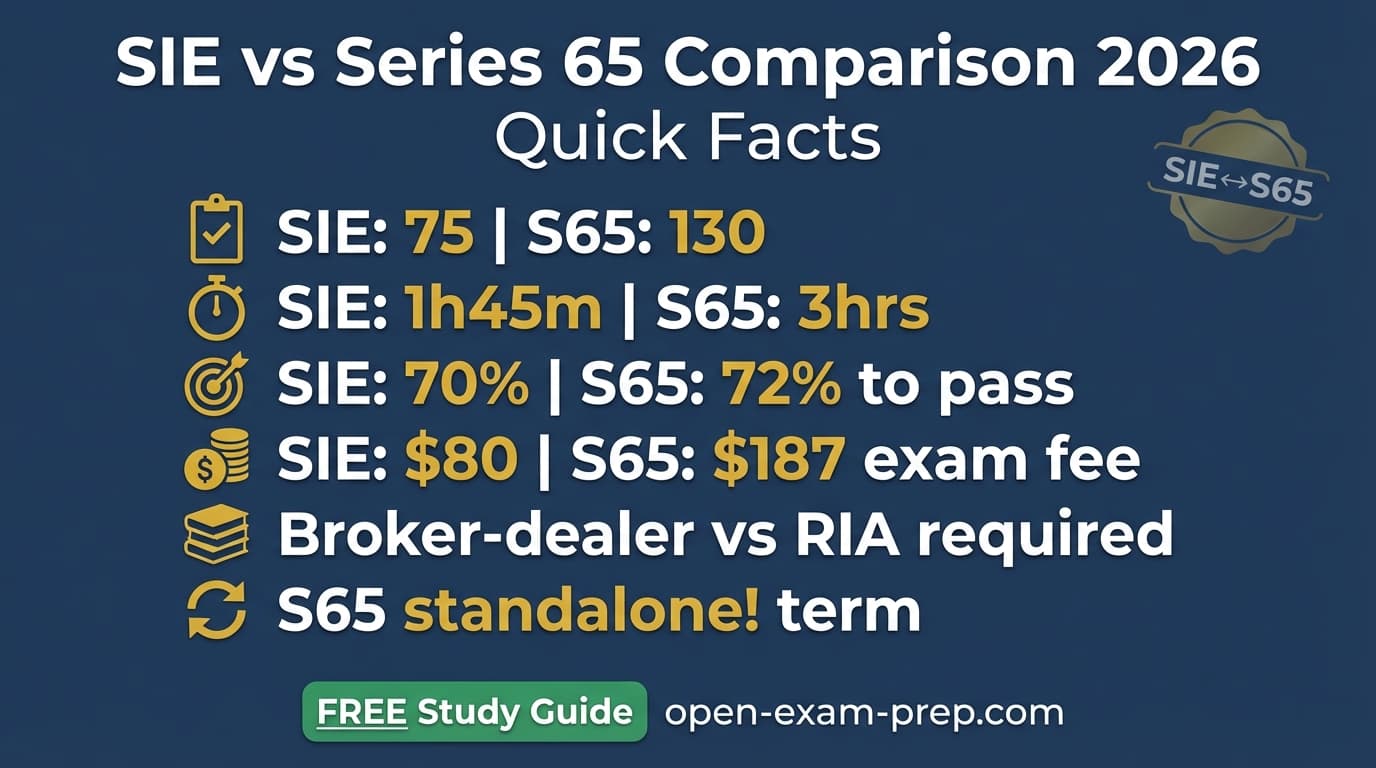
Side-by-Side Comparison
| Feature | SIE | Series 65 |
|---|---|---|
| Full Name | Securities Industry Essentials Exam | Uniform Investment Adviser Law Exam |
| Exam Cost | $80 | $187 |
| Passing Score | 70% (56 of 80 scored questions) | 72% (94 of 130 scored questions) |
| Questions | 85 (75 scored + 10 unscored) | 140 (130 scored + 10 unscored) |
| Time Limit | 1 hour 45 minutes | 3 hours |
| Study Time | 40 - 60 hours over 2 - 4 weeks | 60 - 80 hours over 4 - 6 weeks |
| Difficulty | Entry-level | Moderate to Challenging |
| Prerequisites | None — anyone 18+ can take it without firm sponsorship | None — no SIE, no firm sponsorship, no prior licenses required. Anyone can register to take it. |
| Exam Body | FINRA | NASAA (North American Securities Administrators Association) |
Key Differences
- 1The SIE is a prerequisite exam with zero standalone earning power; the Series 65 is a standalone license that immediately qualifies you to work as an Investment Adviser Representative (IAR) at an RIA firm and charge fees for investment advice.
- 2The SIE is administered by FINRA and feeds into the broker-dealer/commission-based system; the Series 65 is administered by NASAA and feeds into the RIA/fee-based advisory system — these are two entirely separate regulatory frameworks.
- 3The Series 65 does NOT require the SIE, firm sponsorship, or any prior license. Anyone can register and take it. This makes it the #1 choice for career changers who want to bypass the FINRA system entirely.
- 4The SIE path leads to a suitability standard (recommending "suitable" investments); the Series 65 path leads to a fiduciary standard (legally required to act in the client's best interest at all times).
- 5The SIE costs $80 with 75 scored questions in 1 hour 45 minutes; the Series 65 costs $187 with 130 scored questions in 3 hours — the Series 65 is a longer, more demanding exam with a lower pass rate (66% vs 74%).
- 6Revenue models differ fundamentally: the SIE→Series 7 path earns commissions on transactions; the Series 65 path earns AUM-based fees (typically 0.75%-1.25% of assets managed), hourly fees, or flat planning fees — recurring revenue that compounds over time.
- 7The SIE result is valid for 4 years and requires a subsequent top-off exam (Series 7, 6, etc.); the Series 65 license is immediately active upon passing and state registration, with no additional exams required.
- 8The RIA/fee-only model (Series 65 path) is the fastest-growing segment of financial services, with RIA assets reaching $128.4 trillion in 2024 — the industry is shifting decisively toward fee-based advice and away from commission-based sales.
What Each Exam Allows You To Do
SIE
- Demonstrate foundational knowledge of the securities industry to prospective employers
- Satisfy the prerequisite for all FINRA representative-level exams (Series 6, 7, 57, 79, etc.)
- Signal to broker-dealer hiring managers that you are prepared and committed to a finance career
- Begin the licensing pipeline at a FINRA-member firm — the SIE is step one on the broker-dealer path
Series 65
- Work as an Investment Adviser Representative (IAR) at a state-registered or SEC-registered RIA firm
- Provide personalized investment advice and charge fees (AUM-based, hourly, flat-fee, or financial planning fees)
- Manage client portfolios on a discretionary or non-discretionary basis under the fiduciary standard
- Operate as a fee-only financial planner — no commissions, no conflicts of interest, pure fiduciary advice
- Serve as the qualifying individual to register your own RIA firm with your state securities regulator
Who Should Take Each Exam?
Take the SIE if you...
- →People who want to work at a broker-dealer selling securities on commission
- →College students targeting wirehouse training programs at Morgan Stanley, Merrill Lynch, or UBS
- →Anyone planning to take the Series 7 for the full general securities license
- →Job seekers who want to prove initiative to FINRA-member firms before being hired
Take the Series 65 if you...
- →Career changers who want to become financial advisors without entering the FINRA broker-dealer system
- →CFP candidates and fee-only financial planners who need the Series 65 for state registration
- →Professionals at RIA firms (Vanguard Personal Advisor Services, Buckingham Strategic Wealth, fee-only shops)
- →CPAs, attorneys, and other professionals adding investment advisory services to their existing practice
- →Anyone who wants a standalone license to give investment advice — the Series 65 is the fastest path
Which Should You Take First?
This is not a "which comes first" question — it is a career path decision. If you want to work at a broker-dealer selling securities on commission (the traditional Wall Street path), take the SIE first, then the Series 7 with firm sponsorship. If you want to work at a fee-only RIA firm providing fiduciary investment advice, skip the SIE entirely and take the Series 65. The Series 65 requires NO SIE, NO firm sponsorship, and NO prior licenses. For career changers coming from outside financial services, the Series 65 is almost always the better choice because: (1) you can take it immediately without finding a sponsoring firm, (2) it qualifies you for the fastest-growing segment of the industry (fee-only advisory), and (3) RIA firms actively recruit career changers with diverse professional backgrounds (CPAs, attorneys, engineers, educators). The only reason to start with the SIE is if you specifically want to sell securities on commission at a FINRA-member broker-dealer.
At a Glance: SIE vs Series 65
Exam Cost
$80
SIE
$187
Series 65
Pass Rate
~74%
SIE
~66%
Series 65
Study Time
40-60 hrs
SIE
60-80 hrs
Series 65
Standalone Earning Power
None (prerequisite only)
SIE
$78,695 median IAR
Series 65
SIE
People committed to the broker-dealer path who want to sell securities on commission — the SIE is step one toward the Series 7 and the traditional Wall Street career track
Series 65
Career changers, CFP candidates, and anyone who wants to provide fee-only investment advice at an RIA without ever entering the FINRA exam system
Start preparing today:
Key Facts: SIE vs Series 65
- 1The Series 65 does NOT require the SIE exam, firm sponsorship, or any prior license — anyone can register and take it, making it the fastest path to a financial advisory license for career changers.
- 2The SIE and Series 65 represent two completely different career paths: the SIE feeds into the FINRA broker-dealer system (commissions), while the Series 65 feeds into the NASAA/RIA system (fee-based fiduciary advice).
- 3The Series 65 has a first-time pass rate of approximately 66% (NASAA/Prometric data, 2023-2024), compared to approximately 74% for the SIE — the Series 65 is the more challenging exam despite being entry-level for its path.
- 4Investment Adviser Representatives (Series 65 holders) earn a median of $78,695 per year according to ZipRecruiter 2025 data, with experienced RIA advisors averaging $151,000 per the InvestmentNews Compensation Study.
- 5RIA firms manage over $128.4 trillion in assets as of 2024 (IAA Industry Snapshot), and the fee-only advisory model is growing at 2-3x the rate of traditional broker-dealer firms.
- 6The Series 65 exam is administered by NASAA and costs $187, while the SIE is administered by FINRA and costs $80 — they are governed by entirely separate regulatory organizations.
- 7Series 65 holders operate under a fiduciary standard, legally required to act in the client's best interest, whereas the broker-dealer path (SIE→Series 7) operates under a suitability standard for commission-based transactions.
- 8The BLS projects 13% growth for personal financial advisors (the Series 65 career path) through 2034, compared to just 3% growth for securities sales agents (the SIE→Series 7 career path).
- 9An estimated 30-40% of financial advisors will retire by 2030, creating over $2 trillion in managed assets that need to transition to younger advisors — a massive opportunity for new Series 65 holders at RIA firms.
- 10The total cost to become a fully licensed IAR through the Series 65 path ranges from $337 to $837 (exam fee + prep course + state registration), significantly less than the $550-$1,100 required for the full SIE + Series 7 + state exam broker-dealer path.
Why This Comparison Matters
Fiduciary Standard
Series 65 = Fiduciary Duty
Series 65 holders operate under a fiduciary standard, legally required to act in the client's best interest — not just recommend "suitable" investments like broker-dealer reps.
$128.4 Trillion
RIA Assets Under Management
RIA firms manage over $128.4 trillion in assets (IAA 2024 report). The fee-only advisory model is the fastest-growing segment of financial services, driving massive demand for Series 65 holders.
$151K Avg
RIA Advisor Compensation
Financial advisors at RIA firms earn an average of $151,000/year (InvestmentNews Compensation Study), with experienced advisors managing $100M+ in AUM earning $200K-$400K+.
The SIE vs Series 65 comparison is not about which exam is harder or cheaper — it is about choosing between two fundamentally different business models in financial services. The SIE is the gateway to FINRA's broker-dealer ecosystem, where registered representatives earn commissions by executing trades and selling products. The Series 65 is the gateway to the RIA (Registered Investment Adviser) ecosystem, where investment adviser representatives earn fees by managing assets and providing fiduciary advice. These are not two steps on the same ladder — they are two different ladders entirely.
This distinction matters enormously because the financial services industry is in the midst of a structural shift from commissions to fees. RIA firms now manage over $128.4 trillion in assets (IAA 2024 Investment Adviser Industry Snapshot), and the fee-only advisory model has grown at roughly 2-3x the rate of the traditional broker-dealer model over the past decade. For career changers evaluating how to enter the industry in 2026, this trend is impossible to ignore. The Series 65 lets you enter the faster-growing side of the industry without ever touching the FINRA exam system.
The most underappreciated advantage of the Series 65 is its accessibility for career changers. Unlike the Series 7 — which requires both the SIE and firm sponsorship via Form U4 — the Series 65 has zero prerequisites. No SIE. No sponsoring firm. No prior licenses. You register with NASAA, pay $187, pass the exam, and you are qualified to work as an IAR at any RIA firm in the country (subject to state registration). This makes the Series 65 the single fastest path from "no financial licenses" to "licensed to give investment advice."
What Each Exam Covers
SIE Exam Topics
Pass Rate: ~74% first-time pass rate (FINRA data, 2023-2024)
Series 65 Exam Topics
Pass Rate: ~66% first-time pass rate (NASAA/Prometric data, 2023-2024)
Salary & Income Comparison
SIE Credential Holder (Pre-License)
N/A — SIE alone is not a license
Median Annual Salary
Range: $40,000 - $55,000 (entry-level trainee positions)
ZipRecruiter, 2025; reflects trainee/associate roles that value SIE completion
The SIE is a prerequisite, not a standalone license. By itself it does not authorize you to conduct any securities business or provide investment advice. Its value is entirely strategic — it starts the clock on your 4-year validity window and signals readiness to employers. To earn money in securities, you must pass a top-off exam like the Series 7 (broker-dealer) or choose the entirely separate Series 65 path (RIA advisory).
Investment Adviser Representative (IAR)
$78,695
Median Annual Salary
Range: $52,000 - $151,000+ (varies widely by AUM, firm size, and experience)
ZipRecruiter, 2025 (IAR roles); InvestmentNews Compensation Study 2024 (RIA firm advisors)
Compensation at RIA firms varies enormously based on assets under management. A junior advisor managing $25M at a 1% AUM fee generates $250,000 in firm revenue — their share depends on the firm's compensation model (typically 30-50% of revenue for employees, or 100% for firm owners minus overhead). Senior advisors managing $100M-$200M+ at fee-only firms routinely earn $200,000-$400,000. RIA firm owners managing $500M+ can earn $500,000-$1M+. The fee-only model rewards long-term client retention because AUM fees compound as markets grow.
The salary comparison between the SIE and Series 65 paths is not straightforward because the SIE alone has no earning power — it is a prerequisite, not a license. The real comparison is between the broker-dealer path (SIE → Series 7) and the RIA advisory path (Series 65). Series 65 holders working as Investment Adviser Representatives earn a median of $78,695 according to ZipRecruiter 2025 data, while experienced advisors at RIA firms earn an average of $151,000 per the InvestmentNews Compensation Study. For comparison, the broker-dealer path (via SIE → Series 7) produces a median of $78,140 per BLS May 2024 data (SOC 41-3031) — remarkably similar at the median, but the compensation models diverge significantly at the top.
The key salary difference lies in the revenue model, not the starting pay. Broker-dealer reps earn commissions on transactions — income is episodic and requires constant new sales activity. RIA advisors earn AUM-based fees (typically 0.75%-1.25% of assets managed annually) — income is recurring and grows automatically as client portfolios appreciate. An RIA advisor managing $50M at a 1% fee generates $500,000 in annual firm revenue without executing a single trade. Senior advisors at fee-only firms managing $100M-$200M+ routinely earn $200,000-$400,000+, and RIA firm owners can earn significantly more. The compounding nature of AUM fees means that RIA advisors who build and retain client relationships see their income grow steadily over time, whereas broker-dealer reps must continuously generate new transaction revenue.
Total Cost to Get Licensed
| Expense | SIE | Series 65 |
|---|---|---|
| Pre-Licensing Education | $0 (no pre-licensing course required, though $150-$400 for optional prep course recommended) | $150 - $400 (prep course: Kaplan $299-$349, Achievable $149, ExamFX $199-$349, STC $249-$349) |
| Exam Fee | $80 (FINRA) | $187 (NASAA/Prometric) |
| License Fee | N/A (SIE is not a license — additional exams required) | $25 - $200 (state IAR registration fee varies by state; e.g., California $50, New York $200, Texas $25) |
| Background Check | N/A (no Form U4 filing for SIE alone) | $0 - $50 (some states require a background check for IAR registration; many do not) |
| Total Investment | $80 - $480 (exam fee + optional prep course). Note: the SIE alone does not allow you to earn money in financial services. | $337 - $837 (exam fee + prep course + state registration). This is the complete cost to become a licensed Investment Adviser Representative — no SIE or additional FINRA exams required. |
A Day in the Life
SIE Professional
A recent college graduate who passed the SIE last month arrives at a campus career fair. He stops at the Edward Jones and Ameriprise booths, mentioning that he already holds the SIE credential. Recruiters are visibly impressed — most college applicants have not taken the initiative to pass any FINRA exam on their own. Over lunch, he reviews options pricing formulas from his Series 7 study guide, knowing he will need to master that material once he secures firm sponsorship. In the afternoon, he has a video interview with a regional broker-dealer. The hiring manager explains the 120-day training window: "We sponsor you for the Series 7 and Series 66, cover all exam fees, and give you a $55,000 base salary during training." By the end of the week, he receives an offer. His SIE credential made the difference — it showed he was already invested in the career before the firm invested in him.
Series 65 Professional
A former CPA who passed the Series 65 three months ago starts her day at a fee-only RIA firm managing $450M in client assets. At 8:30 AM, she reviews overnight market movements and checks her calendar — two client reviews and a new prospect meeting today. At 9:30, she meets with a retired couple whose $1.2M portfolio is up 12% this year; she recommends rebalancing into more fixed income as they approach their distribution phase, walking them through the tax implications of each trade. There are no commissions to consider — every recommendation is made solely in the client's interest under the fiduciary standard. After lunch, she conducts a comprehensive financial plan presentation for a 45-year-old surgeon earning $650,000/year, covering retirement projections, tax optimization strategies, college funding for three children, and estate planning. The surgeon signs an advisory agreement for ongoing portfolio management at 0.80% of AUM. At 3:00 PM, she joins a team meeting where the firm's chief investment officer reviews the quarterly model portfolio changes. She ends the day feeling confident — no sales quotas, no product pushing, just advice that genuinely helps clients build wealth.
Career Paths & Progression
SIE Career Path
0 years
SIE Credential Holder (Job Seeker)
$0 (credential only)
0-1 years
Trainee at Broker-Dealer (studying for Series 7)
$45K-$55K
1-3 years
Registered Rep (after SIE + Series 7)
$78K-$120K
5-10 years
Senior Financial Advisor (broker-dealer)
$150K-$300K
Series 65 Career Path
0-2 years
Junior IAR / Associate Advisor at RIA
$55K-$75K
2-5 years
Lead Advisor / Financial Planner at RIA
$90K-$151K
5-10 years
Senior Advisor / Partner at RIA Firm
$151K-$300K
10+ years
RIA Firm Owner / Managing Partner
$300K-$1M+
The SIE path leads to the broker-dealer world, which is the traditional Wall Street career track. After passing the SIE, you need a FINRA-member firm to sponsor you for the Series 7, which authorizes you to sell all types of securities. Most broker-dealer careers follow one of three routes: (1) wirehouse advisor at Morgan Stanley, Merrill Lynch, UBS, or Wells Fargo, earning 35-51% of revenue through grid compensation; (2) independent broker-dealer rep at LPL, Raymond James, or Cetera, keeping 80-95% of revenue; or (3) institutional sales/trading, where you sell securities to hedge funds, pension funds, and other institutional buyers.
The Series 65 path leads to the RIA (Registered Investment Adviser) world — the fastest-growing segment of financial services. Series 65 holders work as IARs at fee-only or fee-based advisory firms, providing fiduciary investment advice and financial planning. Career tracks include: (1) fee-only financial planner at firms like Buckingham Strategic Wealth, Plancorp, or local independent RIAs, earning flat fees or AUM-based fees with zero conflicts of interest; (2) robo-advisor/hybrid advisor at firms like Vanguard Personal Advisor Services, Betterment, or Wealthfront, combining technology with human advice; or (3) RIA firm owner, starting your own advisory practice — the Series 65 is often the qualifying exam needed to register an RIA with your state. The key advantage of the RIA path is recurring revenue: AUM fees compound as markets grow and clients add assets, creating a business with genuine enterprise value that can be sold at 2-3x annual revenue upon retirement.
Start preparing today:
Should You Get Both the SIE (→Series 7) AND the Series 65?
Benefits
- +Holding both the Series 7 and Series 65 (or the combined Series 66, which requires the Series 7) allows you to work at dual-registered firms that offer both brokerage and advisory services — the fastest-growing business model in financial services
- +The Series 7 + Series 66 combination (which includes Series 65 equivalent content) is the gold standard for full-service financial advisors who want maximum career flexibility
- +Some advisory services — like selling variable annuities or executing trades for advisory clients — require both a brokerage license (Series 7) and advisory registration (Series 65/66)
- +Dual licensing maximizes your employability: you can work at broker-dealers, RIA firms, AND dual-registered/hybrid firms
- +If you start at a broker-dealer and later want to move to a fee-only RIA, having the Series 65 already eliminates a licensing hurdle
Considerations
- !If you only want to provide fee-only advice at an RIA firm, the Series 65 alone is sufficient — there is no need to take the SIE or Series 7, saving you $325+ in exam fees and 120-180 hours of additional study time
- !The Series 7 requires firm sponsorship, so you cannot independently pursue it like the Series 65 — you must be employed by a FINRA-member broker-dealer
- !The fee-only RIA model is growing faster than the broker-dealer model, and many fee-only firms specifically do NOT want advisors with brokerage licenses because it creates potential conflicts of interest
- !If you are a career changer with limited time, the Series 65 alone gets you licensed and employable in 4-6 weeks vs 10-14 weeks for the SIE + Series 7 + Series 66 combination
The Verdict: For most career changers entering financial services in 2026, the Series 65 alone is the fastest and most practical path. It requires no prerequisites, no firm sponsorship, and qualifies you for the fastest-growing segment of the industry. However, if you want maximum long-term flexibility — or if you plan to work at a wirehouse or full-service broker-dealer — the full SIE → Series 7 → Series 66 path gives you the broadest possible authority. The key question is: do you want to sell securities on commission (Series 7 path), provide fee-only advice (Series 65 path), or do both (Series 7 + Series 66)? Answer that question first, and the exam choice becomes obvious.
Job Outlook & Industry Trends
N/A (prerequisite exam — see Series 7 for broker-dealer job outlook)
SIE Job Growth (2024-2034)
13% for Personal Financial Advisors (2024-2034, BLS SOC 13-2052)
Series 65 Job Growth (2024-2034)
The job outlook for Series 65 holders is exceptionally strong. The BLS projects 13% growth for personal financial advisors through 2034 — significantly faster than the 4% average for all occupations and well above the 3% growth projected for securities sales agents (the broker-dealer/Series 7 path). This growth is driven by three converging forces: (1) the ongoing shift from commission-based to fee-based advice, as consumers and regulators demand the fiduciary standard; (2) the retirement wave among existing advisors — an estimated 30-40% of financial advisors will retire by 2030, with over $2 trillion in managed assets set to transition to younger advisors; and (3) the explosion of the RIA model, with RIA firm registrations growing at 3-5% annually and RIA assets reaching $128.4 trillion in 2024. For career changers, the fee-only advisory space offers the rare combination of strong job growth, rising wages, and low barriers to entry (no SIE or firm sponsorship required).
Study Strategy & Tips
Career Path Decision
Decide between broker-dealer (SIE→S7) and RIA advisory (S65) career paths
- Research the difference between broker-dealer and RIA business models — commissions vs. fees, suitability vs. fiduciary
- Identify target employers: broker-dealers (Morgan Stanley, LPL) vs. RIA firms (Vanguard PAS, Buckingham, local fee-only shops)
- Talk to professionals in both paths — LinkedIn informational interviews are invaluable
- If choosing the RIA/fee-only path, proceed directly to Series 65 preparation and skip the SIE entirely
Series 65 Core Study (if choosing RIA path)
Master the four content areas of the Series 65
- Complete a Series 65 prep course (Kaplan, Achievable, ExamFX, or STC)
- Study Investment Vehicle Characteristics (25%) and Client Recommendations (30%) — this is 55% of the exam and requires solid investment knowledge
- Study Laws, Regulations, and Ethics (30%) — memorize the Investment Advisers Act of 1940, state registration rules, Form ADV requirements, and prohibited practices
- Review Economic Factors (15%) — GDP, CPI, yield curves, monetary/fiscal policy, business cycle indicators
Series 65 Practice & Pass
Full-length practice exams and weak-area remediation
- Take 4-5 full-length timed practice exams (130 questions, 3 hours)
- Target 78%+ on practice exams before scheduling the real exam (passing is 72%, but build a buffer for NASAA's tricky question style)
- Focus extra study on your weakest section — most candidates struggle with the regulatory content in Section 4
- Schedule and pass the Series 65 exam at a Prometric testing center
SIE Preparation (if choosing broker-dealer path)
Foundational securities knowledge for the FINRA path
- Complete an SIE prep course — focus on Products and Their Risks (44% of exam)
- Study Trading, Accounts, and Prohibited Activities (31%) — order types, account types, insider trading
- Review Capital Markets (16%) and Regulatory Framework (9%)
- Take 3+ full-length practice exams scoring 80%+ before scheduling
Total Duration: 4-6 weeks (single exam) or 8-10 weeks (if studying for both paths)
SIE Study Tips
- 1Focus 44% of your study time on Products and Their Risks — this is nearly half the exam. Know the characteristics, risks, and suitability of equities, debt securities, packaged products (mutual funds, ETFs), options basics, and alternative investments.
- 2Understand the difference between primary and secondary markets, market maker roles, and how securities are issued. Capital Markets questions are straightforward if you understand the flow of money from issuer to investor.
- 3Memorize the regulatory bodies and their jurisdictions: FINRA regulates broker-dealers, SEC oversees the markets, MSRB governs municipal securities, and state regulators enforce blue sky laws. This is 9% of the exam but it is easy points if you study it.
- 4Take at least 3 full-length practice exams under timed conditions. The SIE tests breadth over depth — you need rapid concept recognition across a wide range of topics rather than deep calculation skills.
- 5Do NOT over-study. The SIE is designed as an entry-level exam. If you are spending time on options strategies, bond duration calculations, or complex suitability scenarios, you have gone too deep — save that for the Series 7.
Series 65 Study Tips
- 1The Series 65 is 60% investment knowledge (Sections 2 and 3) and 40% regulatory/ethical content (Sections 1 and 4). Unlike the Series 7 which is calculation-heavy, the Series 65 emphasizes understanding of fiduciary duty, the Investment Advisers Act of 1940, and state registration requirements. Study both halves equally.
- 2Master the legal and regulatory content — 30% of the exam covers laws, regulations, and ethical practices. Know the difference between federal-covered and state-registered advisors, registration requirements, brochure delivery rules (Form ADV Parts 2A and 2B), and prohibited practices like churning, front-running, and commingling client funds.
- 3Understand Modern Portfolio Theory, asset allocation, and portfolio management concepts thoroughly. The exam tests your ability to recommend suitable investment strategies based on client objectives, risk tolerance, time horizon, and liquidity needs — all under the fiduciary standard.
- 4Learn the economic indicators and their implications: GDP, CPI, unemployment rate, yield curves, monetary and fiscal policy. Section 1 (15%) is the most conceptual part of the exam and rewards candidates with a solid economics foundation.
- 5Take at least 4-5 full-length practice exams under timed conditions. The Series 65 has 130 scored questions in 3 hours, which gives you about 1 minute 23 seconds per question — time management is critical. Many candidates report the exam feels more difficult than practice tests because NASAA questions are notoriously tricky with subtle answer distinctions.
Ready to Start Studying?
Free practice questions, study guides, and AI tutoring for the matching exam resources.
Frequently Asked Questions
QDo I need the SIE to take the Series 65?
No. The Series 65 is administered by NASAA (North American Securities Administrators Association) and is completely independent of the FINRA exam system. You do not need the SIE, firm sponsorship, or any prior license to take the Series 65. You simply register through NASAA's Electronic Filing Depository (EFD) or FINRA's enrollment system, pay the $187 exam fee, and schedule your test at a Prometric center. This is one of the biggest advantages of the Series 65 for career changers — you can go from zero licenses to fully qualified Investment Adviser Representative in as little as 4-6 weeks of study.
QWhat is the difference between the broker-dealer path and the RIA path?
The broker-dealer path (SIE → Series 7) allows you to sell securities on commission as a registered representative at a FINRA-member firm. You earn money each time a client buys or sells a security, and you operate under a suitability standard — meaning your recommendations must be "suitable" but not necessarily in the client's best interest. The RIA path (Series 65) allows you to provide investment advice for fees as an Investment Adviser Representative at a Registered Investment Adviser firm. You earn recurring AUM-based fees (typically 0.75%-1.25% of assets managed), hourly fees, or flat planning fees, and you operate under a fiduciary standard — meaning you are legally required to act in the client's best interest at all times. The industry trend is decisively moving toward the fee-based RIA model.
QWhich exam should a career changer take — the SIE or Series 65?
For most career changers, the Series 65 is the better choice. It requires no prerequisites (no SIE, no firm sponsorship), can be passed in 4-6 weeks of study, and immediately qualifies you for roles at RIA firms — the fastest-growing segment of financial services. The SIE, by contrast, is merely a prerequisite that does not authorize you to do anything on its own; you would still need firm sponsorship and the Series 7 (another 80-120 hours of study) to actually work in the industry. RIA firms also actively recruit career changers with diverse backgrounds — CPAs, attorneys, educators, engineers — because advisory work values life experience and relationship skills, not just financial knowledge.
QHow much do Series 65 holders earn compared to Series 7 holders?
At the median level, compensation is remarkably similar: Series 65 IARs earn approximately $78,695 (ZipRecruiter 2025), while Series 7 registered reps earn $78,140 (BLS May 2024). However, the compensation trajectories differ significantly. Series 7 holders earn commissions on each transaction, creating episodic income that requires constant sales activity. Series 65 holders at RIA firms earn AUM-based fees — recurring revenue that grows automatically as client portfolios appreciate and clients add assets. An RIA advisor managing $100M at a 1% fee generates $1M in annual firm revenue without executing a single trade. Senior RIA advisors and firm owners managing $200M+ routinely earn $200,000-$400,000+, and the business itself has enterprise value that can be sold at 2-3x annual revenue upon retirement.
QIs the Series 65 harder than the SIE?
Yes, the Series 65 is meaningfully more difficult. It has a lower first-time pass rate (approximately 66% vs 74% for the SIE), more questions (130 scored vs 75 scored), a longer testing time (3 hours vs 1 hour 45 minutes), and a higher passing score (72% vs 70%). The content is also more demanding: the Series 65 requires understanding of Modern Portfolio Theory, portfolio management, the Investment Advisers Act of 1940, state registration requirements, and complex suitability analysis under the fiduciary standard. NASAA is known for writing tricky questions with subtle answer distinctions. Most candidates need 60-80 hours of study compared to 40-60 hours for the SIE. However, the Series 65 is considered easier than the Series 7, which requires 80-120 hours and covers options calculations, bond pricing, and margin requirements in much greater depth.
QCan I work at a fee-only RIA firm with just the Series 65?
Yes — the Series 65 is the only exam required to work as an Investment Adviser Representative (IAR) at a fee-only RIA firm. After passing, you register as an IAR in your state (registration fees range from $25-$200 depending on the state), and you are fully authorized to provide personalized investment advice, manage client portfolios, create financial plans, and charge fees for your services. You do not need the SIE, Series 7, or any other FINRA exam. Many of the most respected fee-only advisory firms in the country — including firms managing billions in client assets — employ advisors whose only securities license is the Series 65. If the firm also has a broker-dealer affiliation (a dual-registered or hybrid firm), you may eventually need the Series 7 to execute certain transactions, but pure fee-only RIA firms require only the Series 65.
10 free AI interactions per day
Free exam resources
Start Studying the Exact Exam
Use the comparison to choose a path, then move into the matching practice questions, study guide, and flashcards.

 Buy on Amazon
 Flashcards on Mometrix
 Take courses on Udemy
 Prep course on Achievable
 Practice exams on ExamEdge
Related Exam Comparisons
Stay Updated
Get free exam tips and study guides delivered to your inbox.