Series 65 vs Series 66
The Series 65 is a standalone exam with no prerequisites that qualifies you as an Investment Adviser Representative (IAR) — ideal for fee-only advisors, career changers, and CFP professionals who do not need a brokerage license. The Series 66 requires a Series 7 but combines state securities agent registration and IAR registration into one exam — replacing the need for both the Series 63 and Series 65 separately. Your choice depends on whether you need brokerage (commission-based) capabilities: if yes, the Series 7 + Series 66 path is more efficient; if no, the Series 65 alone gets you advisory registration faster and cheaper.
Watch: Series 65 vs Series 66 Explained
Side-by-Side Comparison
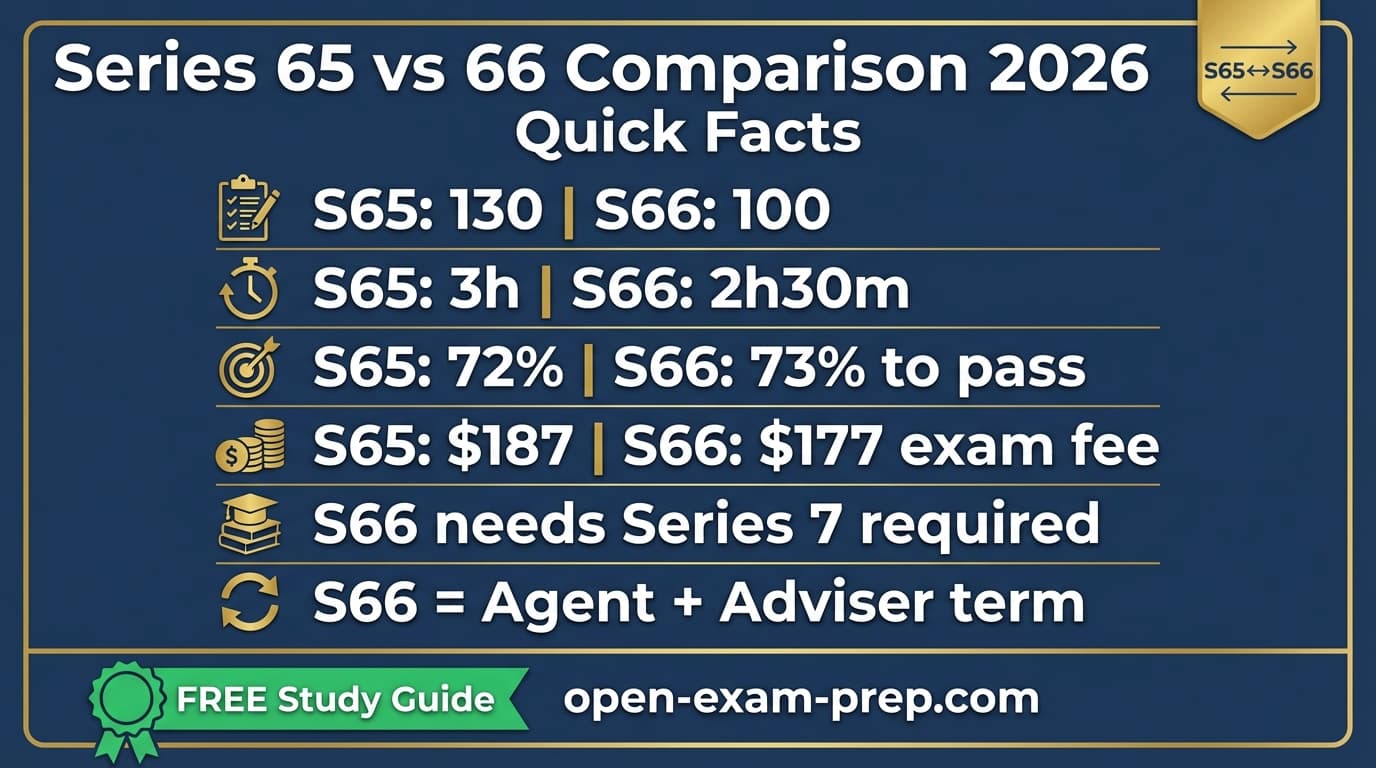
| Feature | Series 65 | Series 66 |
|---|---|---|
| Full Name | Uniform Investment Adviser Law Examination | Uniform Combined State Law Examination |
| Exam Cost | $187 | $177 |
| Passing Score | 72% (94 of 130 scored questions) | 73% (62 of 85 scored questions) |
| Questions | 130 (120 scored + 10 unscored pretest) | 100 (85 scored + 15 unscored pretest) |
| Time Limit | 3 hours | 2 hours 30 minutes |
| Study Time | 60 - 80 hours over 4 - 6 weeks | 50 - 70 hours over 3 - 5 weeks |
| Difficulty | Moderate-to-Challenging | Moderate |
| Prerequisites | None — no SIE, no Series 7, no firm sponsorship required | Must pass the Series 7 exam (which itself requires the SIE) |
| Exam Body | NASAA (North American Securities Administrators Association) | NASAA (North American Securities Administrators Association) |
Key Differences
- 1The Series 65 has NO prerequisites — anyone can take it without the SIE, Series 7, or firm sponsorship. The Series 66 REQUIRES a passed Series 7 (which itself requires the SIE and firm sponsorship).
- 2The Series 65 registers you ONLY as an IAR (investment adviser). The Series 66 registers you as BOTH a securities agent AND an IAR, enabling dual brokerage + advisory work.
- 3The Series 66 replaces the need for both the Series 63 (state agent law) and Series 65 (adviser law) — it is a 2-in-1 exam for candidates who already hold the Series 7.
- 4The Series 65 has 130 questions (120 scored) in 3 hours; the Series 66 has 100 questions (85 scored) in 2.5 hours — the Series 66 is shorter but has a higher passing score (73% vs 72%).
- 5The Series 65 has a lower pass rate (~66%) than the Series 66 (~73%), partly because Series 65 candidates often lack the exam experience that Series 7 holders bring to the Series 66.
- 6The Series 65 is the preferred path for fee-only RIA advisors who will never sell commission-based products. The Series 66 is preferred for wirehouse and hybrid advisors who need both brokerage and advisory authority.
- 7Total cost to start advising: Series 65 can cost as little as $187 (exam fee only) with no other exams required. The Series 66 path requires SIE ($80) + Series 7 ($245) + Series 66 ($177) = $502 minimum in exam fees alone.
- 8The Series 66 is 65% focused on laws and regulations, while the Series 65 is more balanced — 30% laws/regulations, 30% client recommendations, 25% investment vehicles, and 15% economic factors.
What Each Exam Allows You To Do
Series 65
- Register as an Investment Adviser Representative (IAR) in your state
- Provide investment advice for compensation at a Registered Investment Adviser (RIA) firm
- Charge advisory fees (AUM-based, hourly, flat-fee, or financial planning fees)
- Operate as a fee-only financial advisor without selling commission-based products
- Work alongside CFP, CFA, or ChFC designations to provide holistic financial planning
Series 66
- Register as BOTH a securities agent AND an Investment Adviser Representative (IAR) in your state
- Sell securities on a commission basis (brokerage) AND provide investment advice for fees (advisory)
- Work in fee-based (hybrid) advisory roles that combine commissions and advisory fees
- Replace the need for both the Series 63 and Series 65 with a single exam
- Operate at dual-registered firms (broker-dealer + RIA) with full agent and adviser authority
Who Should Take Each Exam?
Take the Series 65 if you...
- →Career changers entering financial services without a broker-dealer background
- →Fee-only financial planners and advisors at RIA firms
- →CFP professionals who need state IAR registration
- →CPAs, attorneys, and other professionals adding financial advisory services
- →Anyone seeking advisory registration without the SIE or Series 7 exams
Take the Series 66 if you...
- →Series 7 holders who need both agent and adviser registration in one exam
- →Wirehouse financial advisors transitioning to fee-based advisory models
- →Broker-dealer representatives adding advisory capabilities
- →Hybrid advisors at dual-registered firms (broker-dealer + RIA)
- →Anyone in a wirehouse training program (SIE → Series 7 → Series 66 is the standard path)
Which Should You Take First?
The answer depends entirely on your career path and whether you need brokerage capabilities. If you want to be a fee-only financial advisor, financial planner, or IAR at an RIA firm — and you have NO interest in selling securities on commission — take the Series 65. It is a standalone exam with zero prerequisites, meaning you can register as an IAR without ever taking the SIE, Series 7, or any other FINRA exam. This is the fastest and cheapest path to advisory registration, and it is increasingly popular as the RIA industry grows at roughly 12% per year. Career changers, CFP professionals, CPAs, and attorneys who want to add advisory services should strongly consider the Series 65 standalone route. However, if you plan to work at a wirehouse (Morgan Stanley, Merrill Lynch, UBS, Wells Fargo) or a hybrid broker-dealer/RIA firm where you will BOTH sell securities and provide advisory services, then you need the Series 7 + Series 66 combination. The Series 66 is more efficient than taking the Series 63 and Series 65 separately because it covers both state agent law and adviser law in a single exam. Most wirehouse training programs prescribe the SIE → Series 7 → Series 66 sequence, completed within 120 days of hire. If you already hold the Series 7 and are deciding between adding the Series 65 or Series 66, choose the Series 66 — it gives you both agent and adviser registration, whereas the Series 65 only adds adviser registration (and you would still need the Series 63 for state agent registration).
At a Glance: Series 65 vs Series 66
Exam Cost
$187
Series 65
$177
Series 66
Pass Rate
~66%
Series 65
~73%
Series 66
Study Time
60-80 hrs
Series 65
50-70 hrs
Series 66
Prerequisites
None (standalone)
Series 65
Series 7 required
Series 66
Series 65
Career changers, fee-only RIA advisors, CFP professionals, and anyone who wants IAR registration without taking the SIE or Series 7
Series 66
Wirehouse and hybrid advisors who already hold the Series 7 and need the most efficient path to dual agent + adviser registration
Start preparing today:
Key Facts: Series 65 vs Series 66
- 1The Series 65 requires NO prerequisites — no SIE, no Series 7, no firm sponsorship — making it the only standalone path to Investment Adviser Representative (IAR) registration.
- 2The Series 66 combines the Series 63 (state agent law) and Series 65 (adviser law) into a single exam, but it requires a passed Series 7 as a prerequisite.
- 3The Series 65 has a lower first-time pass rate (~66%) than the Series 66 (~73%), partly because Series 66 candidates have already proven exam competency by passing the Series 7.
- 4The Series 65 costs $187 for 130 questions in 3 hours with a 72% passing score; the Series 66 costs $177 for 100 questions in 2.5 hours with a 73% passing score.
- 5RIAs manage over $9.3 trillion in assets as of 2024, with the fee-only advisory model growing at approximately 12% annually — driving unprecedented demand for Series 65 holders.
- 6The total exam fee cost for the Series 66 path is $502 (SIE $80 + Series 7 $245 + Series 66 $177), compared to just $187 for the Series 65 standalone path.
- 7Series 65 holders at fee-only RIA firms earn a median of approximately $78,695 (ZipRecruiter), while experienced RIA advisors average approximately $151,000 (InvestmentNews 2024 Compensation Study).
- 8The BLS projects 13% growth for personal financial advisors through 2034 — significantly faster than the average for all occupations — with an estimated 30-40% of current advisors retiring by 2030.
- 9The Series 66 exam is 65% focused on laws, regulations, and guidelines, making it overwhelmingly a regulatory exam compared to the more balanced Series 65.
- 10Over 90% of wirehouse revenue now comes from fee-based advisory accounts, meaning virtually all Series 7 holders eventually need the Series 66 to participate in the advisory business.
Why This Comparison Matters
Zero Prerequisites
Series 65 Standalone Path
The Series 65 requires no SIE, no Series 7, and no firm sponsorship — making it the fastest on-ramp for career changers, CFP holders, and fee-only advisors entering the RIA space.
$9.3 Trillion
RIA Industry AUM
Registered Investment Advisers manage over $9.3 trillion in assets (IAA 2024 report), with the fee-only advisory model growing at roughly 12% annually — fueling demand for Series 65 holders.
2-in-1 Exam
Series 66 Efficiency
The Series 66 replaces the need for both the Series 63 and the Series 65, combining state securities agent registration and IAR registration into a single 100-question exam.
The Series 65 vs Series 66 decision is fundamentally a question about your business model: will you charge fees only, or will you also earn commissions? This distinction drives virtually every aspect of the comparison — prerequisites, cost, career path, and long-term earning potential.
The Series 65 has emerged as one of the most important exams in financial services because of the explosive growth of the RIA model. Registered Investment Advisers now manage over $9.3 trillion in assets (IAA 2024 Industry Snapshot), and the fee-only advisory sector is growing at approximately 12% annually. This structural shift means more advisors are choosing the standalone Series 65 path — bypassing the traditional SIE → Series 7 → Series 66 pipeline entirely. For career changers, CFP holders, and professionals from adjacent fields (CPAs, attorneys, insurance agents), the Series 65 offers a remarkably efficient entry point: one exam, $187, no prerequisites, and you can register as an IAR.
The Series 66, meanwhile, remains the standard for wirehouse and hybrid advisors who need the full toolkit. Combined with the Series 7, it enables dual registration as both a securities agent and an IAR — critical for advisors at firms like Morgan Stanley, LPL Financial, or Raymond James where fee-based accounts coexist with commission-based business. The Series 66 is also more efficient than taking the Series 63 and Series 65 as separate exams: one exam replaces two, saving time, money, and testing fatigue. With a 73% pass rate versus the Series 65's 66%, the Series 66 is statistically easier — though this is partly because its candidates have already demonstrated competency by passing the Series 7.
What Each Exam Covers
Series 65 Exam Topics
Pass Rate: ~66% first-time pass rate (NASAA data, 2023-2024)
Series 66 Exam Topics
Pass Rate: ~73% first-time pass rate (NASAA data, 2023-2024)
Salary & Income Comparison
Investment Adviser Representative (Fee-Only RIA)
$78,695
Median Annual Salary
Range: $42,000 - $151,000+
ZipRecruiter, 2024; IAA/NRS Investment Adviser Industry Snapshot, 2024
Senior advisors at established RIA firms managing $100M+ in client assets often earn $150,000-$300,000+ through a combination of salary, bonus, and profit-sharing. RIA firm owners with substantial AUM can earn $300,000-$750,000+. The average RIA advisor compensation was approximately $151,000 per the 2024 InvestmentNews Advisor Compensation Study.
Financial Advisor (Wirehouse/Hybrid, Series 7 + 66)
$131,000
Median Annual Salary
Range: $60,000 - $400,000+
BLS SOC 41-3031, May 2024; InvestmentNews 2024 Advisor Compensation Study
Series 66 holders typically also hold the Series 7 and work at wirehouses or hybrid firms. Wirehouse advisors earning grid-based compensation of 35-51% of revenue routinely earn $200,000-$500,000+. The Series 66 itself does not unlock the highest salaries — the Series 7 does — but the 66 enables fee-based business that is increasingly the dominant revenue model. Top dual-registered advisors at firms like Raymond James or LPL earn $300,000-$600,000+ combining brokerage commissions and advisory fees.
Salary comparisons between the Series 65 and Series 66 are nuanced because the exams serve different business models. Series 65 holders working at fee-only RIA firms earn a median of approximately $78,695 (ZipRecruiter, 2024), though experienced advisors at established RIAs managing significant AUM earn considerably more. The 2024 InvestmentNews Advisor Compensation Study reported average RIA advisor compensation of approximately $151,000, and RIA firm owners with $200M+ in AUM commonly earn $300,000-$750,000+. The fee-only model produces steadier, more predictable income through recurring AUM-based fees — typically 0.75%-1.25% of assets under management — creating a compounding revenue stream that grows as client portfolios appreciate.
Series 66 holders almost always also hold the Series 7, placing them in wirehouse and hybrid advisory roles with significantly higher ceiling compensation. BLS data reports a median of $78,140 for securities sales agents (SOC 41-3031, May 2024), but this dramatically understates wirehouse earnings. Advisors at dual-registered firms earn through a combination of brokerage commissions, advisory fees, and product revenue, with wirehouse grid payouts of 35-51% of total revenue. A hybrid advisor generating $800,000 in annual revenue (split between commissions and advisory fees) earns $280,000-$408,000 from the grid alone. The trade-off: wirehouse income is higher-ceiling but more variable, while RIA income is more predictable and increasingly competitive as AUM-based fee models gain market share.
Total Cost to Get Licensed
| Expense | Series 65 | Series 66 |
|---|---|---|
| Pre-Licensing Education | $0 (no pre-licensing course required, though $150-$400 for an optional prep course is recommended) | $150 - $500 (prep course for Series 66; does not include Series 7 or SIE prep) |
| Exam Fee | $187 (NASAA/Prometric) | $177 (Series 66) + $245 (Series 7) + $80 (SIE) = $502 total exam fees |
| License Fee | $50 - $200 (state IAR registration fee varies by state) | $50 - $200 (state registration fee; covers both agent and IAR registration) |
| Background Check | $0 - $75 (varies by state; some states require fingerprinting for IARs) | $50 - $100 (Form U4 fingerprinting and background check) |
| Total Investment | $187 - $862 (exam fee + optional prep course + state registration + background check) | $752 - $1,302 (SIE + Series 7 + Series 66 + prep courses + state registration + background check) |
A Day in the Life
Series 65 Professional
A Series 65-licensed financial planner at a fee-only RIA starts her day at 8:00 AM reviewing the firm's model portfolios and checking for any rebalancing triggers after yesterday's market close. At 9:30, she meets with a new prospect — a couple in their early 50s with $1.2 million in retirement savings — to conduct a comprehensive financial planning discovery session covering retirement projections, Social Security optimization, tax planning, estate planning, and insurance needs. She uses financial planning software to model scenarios and commits to delivering a written plan within two weeks. After lunch, she holds two annual review meetings with existing clients, walking them through portfolio performance, progress toward goals, and any needed adjustments to their financial plans. At 3:00 PM, she spends an hour on continuing education — studying for her CFP exam, which will complement her Series 65 and enhance her credibility. She ends the day preparing a quarterly client newsletter and responding to three client emails about Roth conversion strategies for 2026.
Series 66 Professional
A Series 7 + 66-licensed financial advisor at a wirehouse begins at 7:45 AM reviewing overnight market activity and scanning research reports from the firm's equity and fixed-income analysts. At 9:00 AM, she executes two client trades — rotating a retiree's portfolio from individual bonds to a bond ladder strategy — and processes an account transfer from a competitor firm. At 10:30, she meets with a business owner who wants to establish a 401(k) plan for 25 employees, recommending the firm's retirement plan platform and discussing both the brokerage and advisory fee structures available. After lunch, she conducts three phone reviews with clients, discussing Q4 performance, tax-loss harvesting opportunities, and the firm's 2026 market outlook. At 2:30 PM, she attends the weekly team meeting where her branch manager discusses production targets and a new structured product offering. She wraps up by 5:00 PM after submitting two fee-based account proposals and scheduling a prospecting dinner with a CPA referral partner who has been sending her high-net-worth clients.
Career Paths & Progression
Series 65 Career Path
0-2 years
Associate Advisor / Paraplanner at RIA
$45K-$65K
2-5 years
Financial Planner / Lead Advisor at RIA
$75K-$120K
5-10 years
Senior Advisor / Partner at RIA
$120K-$250K
10+ years
RIA Firm Owner / Managing Partner
$250K-$750K+
Series 66 Career Path
0-2 years
Financial Advisor Trainee (Wirehouse)
$55K-$85K base
2-5 years
Financial Advisor (Hybrid/Fee-Based)
$100K-$250K
5-10 years
Senior VP / Senior Financial Advisor
$250K-$450K
10+ years
Managing Director / Team Lead
$400K-$700K+
The Series 65 career path centers on the RIA ecosystem. Entry-level roles include paraplanner, associate advisor, or client service associate at an established RIA firm, typically earning $45,000-$65,000. Within 2-5 years, advisors advance to lead advisor or financial planner roles earning $75,000-$120,000, often while pursuing the CFP designation which dramatically enhances credibility and earning power. The long-term play for Series 65 holders is equity ownership in an RIA — either building your own firm or becoming a partner at an existing one. RIA firm owners managing $200M+ in AUM routinely earn $300,000-$750,000+, and the recurring fee-based revenue model creates significant enterprise value when it comes time to sell the practice.
The Series 66 career path typically runs through the wirehouse and hybrid broker-dealer channel. Series 7 + 66 holders enter as financial advisor trainees at firms like Morgan Stanley, Merrill Lynch, or Wells Fargo, with 18-24 month training programs offering $55,000-$85,000 base salaries. After training, compensation shifts to grid-based payouts (35-51% of revenue), and advisors building $500,000+ annual revenue within 3-5 years earn $175,000-$255,000. The dual-registration capability — being both a securities agent and an IAR — is increasingly critical as over 90% of wirehouse revenue has shifted to fee-based advisory accounts. Some Series 66 holders eventually transition to the independent channel (LPL, Raymond James, Cetera) where they keep 80-95% of revenue but manage their own overhead.
Start preparing today:
Series 65 + Series 7, or Just the Series 66?
Benefits
- +If you already hold the Series 7, the Series 66 is strictly more efficient — it gives you BOTH state agent registration (replacing the Series 63) AND IAR registration (replacing the Series 65) in a single exam
- +The Series 66 saves time and money compared to taking the Series 63 ($147) and Series 65 ($187) separately — one exam at $177 instead of two exams at $334 combined
- +Dual registration (agent + IAR) via Series 7 + 66 lets you work at any dual-registered firm, accessing both commission-based and fee-based revenue streams
- +The Series 66 has a higher pass rate (~73%) than the Series 65 (~66%), making it statistically easier for candidates who already hold the Series 7
- +If you hold the Series 65 and later decide to add the Series 7, you would still need the Series 63 for state agent registration — whereas the Series 66 covers both in one shot
Considerations
- !If you will NEVER sell commission-based securities products, the Series 65 standalone path avoids the significant time and cost of the SIE + Series 7 (160-200+ hours of study and $325 in exam fees)
- !Some states have specific requirements that may not accept the Series 66 — always verify with your state securities regulator before choosing your exam path
- !The Series 65 standalone path is growing faster than the Series 66 path due to the RIA industry boom — more firms are hiring advisors who only need IAR registration
- !Career changers without broker-dealer sponsorship cannot take the Series 66 (because they cannot get Series 7 sponsorship), making the Series 65 the only viable option
The Verdict: If you already hold the Series 7 or are in a wirehouse training program, take the Series 66 — it is unambiguously more efficient than the Series 63 + Series 65 combination and gives you maximum career flexibility. If you do NOT hold the Series 7 and your career goal is fee-only financial planning at an RIA, take the Series 65 as a standalone exam. The RIA industry is booming, and the Series 65 standalone path is increasingly the preferred route for new advisors entering the fee-only space. Only consider adding the Series 7 later if you want to transition to a hybrid or wirehouse model — and at that point, you would take the Series 63 (not the Series 66) alongside it, since the Series 66 requires the Series 7 as a corequisite, not a prerequisite you can backfill.
Job Outlook & Industry Trends
13% (2024-2034, BLS — Personal Financial Advisors SOC 13-2052)
Series 65 Job Growth (2024-2034)
13% (2024-2034, BLS — same category, plus 3% for Securities Sales Agents SOC 41-3031)
Series 66 Job Growth (2024-2034)
The BLS projects 13% growth for personal financial advisors through 2034 — significantly faster than the average for all occupations — driven by an aging population that needs retirement planning guidance, the ongoing shift from commission-based brokerage to fee-based advisory, and the growing complexity of financial products and tax law. The RIA channel is growing even faster: the number of SEC-registered investment advisers has increased by over 30% in the past decade, and state-registered RIAs (where most Series 65 holders work) are growing at an even higher rate. For Series 66 holders, the outlook combines advisory growth with the steady demand for securities sales agents (38,100 annual openings, BLS). The most powerful trend is the convergence of brokerage and advisory: over 90% of wirehouse revenue now comes from fee-based accounts, meaning virtually all Series 7 holders are being pushed toward adding the Series 66 for advisory capabilities. An estimated 30-40% of financial advisors will retire by 2030, creating massive succession opportunities for young professionals in both the RIA and wirehouse channels.
Study Strategy & Tips
Foundation & Assessment
Establish baseline and study framework
- Take a diagnostic practice exam to identify strengths and weaknesses
- Enroll in a prep course (Kaplan, Achievable, ExamFX, or Knopman Marks)
- Begin studying Investment Vehicle Characteristics (25% of S65 / 10% of S66) — leverage any existing Series 7 knowledge
- Review Economic Factors and Business Information (15% of S65 / 5% of S66) — GDP, monetary policy, fiscal policy, business cycles
Core Content Mastery
Client Recommendations and Strategies + Regulatory Framework
- Study Client Investment Recommendations and Strategies (30% of S65 / 20% of S66) — asset allocation, Modern Portfolio Theory, risk metrics, portfolio management
- Begin Laws, Regulations, and Guidelines (30% of S65 / 65% of S66) — this is the highest-weighted section for BOTH exams
- Master the Uniform Securities Act: definitions, registration requirements, exemptions, and prohibited practices
- Understand fiduciary duty, suitability requirements, disclosure obligations, and the difference between broker-dealer vs. adviser regulation
Regulatory Deep Dive
Complete regulatory content and begin intensive review
- Finish all Laws, Regulations, and Guidelines content — this section determines pass/fail for most candidates
- Memorize registration requirements: who must register, exemptions from registration, notice filing requirements for federal-covered securities
- Study ethical practices and prohibited conduct: churning, commingling, front-running, insider trading, Ponzi schemes
- Review state vs. federal jurisdiction: when does the SEC regulate vs. the state administrator?
Practice Exams & Final Review
Timed practice exams and targeted remediation
- Take 4-5 full-length timed practice exams (3 hours for S65, 2.5 hours for S66)
- Score 78%+ consistently before scheduling the real exam (aim above the passing score)
- Review all incorrect answers — create flashcards for regulatory details you keep missing
- Focus final review on the Laws section: it is the most heavily tested and most commonly failed area
Total Duration: 4-6 weeks (Series 65) or 3-5 weeks (Series 66, assuming recent Series 7 completion)
Series 65 Study Tips
- 1Dedicate 60% of your study time to the two heaviest sections: Client Investment Recommendations and Strategies (30%) and Laws, Regulations, and Guidelines (30%). Together these comprise 60% of the exam and contain the most nuanced content.
- 2Master the regulatory framework: know the difference between federal-covered advisors (SEC-registered, $100M+ AUM) and state-registered advisors (under $100M AUM), registration requirements, exemptions, and the fiduciary duty owed by IARs.
- 3Learn the Uniform Securities Act inside and out — definitions of "investment adviser," "investment adviser representative," exemptions from registration, prohibited practices, and enforcement actions. This is the legal backbone of the exam.
- 4Understand Modern Portfolio Theory, asset allocation strategies, risk metrics (alpha, beta, standard deviation, Sharpe ratio), and the efficient frontier. The exam tests conceptual understanding, not complex calculations.
- 5Take at least 4-5 full-length practice exams under timed conditions (3 hours). The Series 65 has a lower pass rate (~66%) than the Series 66 (~73%), partly because many candidates underestimate the legal and regulatory depth required.
Series 66 Study Tips
- 1The Series 66 is 65% laws, regulations, and guidelines — this is overwhelmingly a regulatory exam. Spend at least half your study time on the Uniform Securities Act, state registration requirements, fiduciary duties, prohibited practices, and enforcement actions.
- 2Know the distinction between broker-dealer agents and investment adviser representatives under state law. The Series 66 tests both roles because it registers you for both. Understand the different registration requirements, exemptions, and prohibited conduct for each.
- 3Study the difference between federal-covered securities (exempt from state registration) and state-registered securities. Know which offerings require state notice filings, which are exempt, and the coordination, qualification, and filing methods of registration.
- 4If you recently passed the Series 7, start Series 66 prep immediately. The investment product knowledge and suitability concepts from your Series 7 study cover the 35% non-regulatory portion of the Series 66. The overlap is significant — do not let it fade.
- 5Take at least 3-4 full-length practice exams. The Series 66 has a higher pass rate (~73%) than the Series 65 (~66%), partly because Series 66 candidates have already proven themselves on the Series 7. Do not let this higher pass rate make you complacent — the regulatory content is dense and detail-oriented.
Ready to Start Studying?
Free practice questions, study guides, and AI tutoring for the matching exam resources.
Frequently Asked Questions
QCan I take the Series 66 without the Series 7?
No. The Series 66 explicitly requires a passed Series 7 exam as a prerequisite. You cannot sit for the Series 66 until NASAA can verify your Series 7 result. This is because the Series 66 is designed as a "combined" exam that adds state-level agent and adviser registration on top of the federal securities license provided by the Series 7. If you do not hold (or plan to obtain) the Series 7, the Series 65 is your only option for IAR registration. Some candidates take the Series 7 and Series 66 on the same day or within the same week during their firm's training program.
QIs the Series 65 easier or harder than the Series 66?
Statistically, the Series 65 is harder — it has a ~66% first-time pass rate compared to the Series 66's ~73%. However, this comparison is misleading because the candidate pools are different. Series 66 candidates have already passed the Series 7, meaning they have proven exam-taking ability and carry over significant investment knowledge. Series 65 candidates often include career changers with no prior securities exam experience. In terms of content, the Series 65 is more balanced across four topic areas, while the Series 66 is heavily concentrated on regulations (65% of the exam). Many test-prep instructors consider the Series 65 content slightly broader but the Series 66 regulatory depth more challenging for candidates who dislike memorizing legal details.
QI already have the Series 63. Should I take the Series 65 or Series 66?
If you already hold the Series 63 and Series 7, take the Series 65 to add IAR registration. There is no benefit to taking the Series 66 because you already have state agent registration through the Series 63 — the Series 66 would be redundant. If you hold the Series 63 but NOT the Series 7, and you want to add advisory capabilities, the Series 65 is your only option since the Series 66 requires the Series 7. However, if you hold only the Series 63 (no Series 7) and are considering whether to add advisory capability via the Series 65, or instead pursue the Series 7 + switch from Series 63 to Series 66, the answer depends on whether you need brokerage capabilities or just advisory registration.
QHow much do Series 65 holders earn compared to Series 66 holders?
Direct salary comparison is tricky because the exams lead to different business models. Series 65 holders at fee-only RIAs earn a median of approximately $78,695 (ZipRecruiter, 2024), with experienced advisors averaging around $151,000 and RIA firm owners earning $300,000-$750,000+. Series 66 holders typically also hold the Series 7 and work at wirehouses or hybrid firms, earning $100,000-$400,000+ through grid-based compensation. The ceiling is higher in the wirehouse channel, but the RIA model produces more predictable recurring revenue and is growing faster. Over a 20-30 year career, the total compensation difference often narrows as RIA advisors build substantial AUM-based practices with high enterprise value.
QCan I switch from Series 65 to Series 66 later, or vice versa?
Yes, but with important caveats. If you hold the Series 65 and later pass the Series 7, you would NOT take the Series 66 — instead, you would take the Series 63 for state agent registration (since you already have IAR registration from the Series 65). If you hold the Series 66 and leave your broker-dealer (losing your Series 7 registration), your Series 66 registration also lapses because it depends on an active Series 7. In that case, you could take the standalone Series 65 to maintain IAR registration at an RIA without needing the Series 7. This is a common transition for wirehouse advisors who move to the fee-only RIA channel — they take the Series 65 as a "replacement" for their lapsed Series 66.
QWhat is the best exam path for someone changing careers into financial planning?
For career changers, the Series 65 standalone path is almost always the best choice. It requires no prerequisites, no firm sponsorship, and no prior securities industry experience. You can study on your own timeline, pass the exam for $187, and immediately qualify for IAR positions at RIA firms. Many career changers pair the Series 65 with the CFP certification process, which requires coursework, a comprehensive exam, and 6,000 hours of professional experience (or 4,000 hours in an apprenticeship). The CFP + Series 65 combination is the gold standard for fee-only financial planners. The Series 66 path is impractical for most career changers because it requires the Series 7, which requires firm sponsorship — and most broker-dealers will not sponsor someone without a finance background unless they apply to a formal training program.

Your AI study companion · 10 free interactions a day
Free exam resources
Start Studying the Exact Exam
Use the comparison to choose a path, then move into the matching practice questions, study guide, and flashcards.

Third-party resources · We may earn a commission from purchases.

Series 66 Study Guide 2025–2026: 10 Full-Length Practice Tests, 1600+ Realistic Questions, Detailed Answer Explanations, and Proven Strategies to Pass the Uniform Combined State Law Exam
By Bean, Charles K.
$29.99 · 
 Study guide on Mometrix
 Prep course on Achievable
 Practice exams on ExamEdge
Related Exam Comparisons
Stay Updated
Get free exam tips and study guides delivered to your inbox.