Series 6 vs Series 65
The Series 6 and Series 65 represent two fundamentally different business models in financial services: **commission-based product sales** vs. **fee-based investment advice**. The Series 6 (FINRA) licenses you to sell a limited set of packaged products — mutual funds, variable annuities, variable life insurance, and 529 plans — for commissions at a broker-dealer. The Series 65 (NASAA) qualifies you to provide personalized investment advice for fees as a fiduciary at a Registered Investment Adviser (RIA). Critically, the Series 65 requires no SIE exam and no firm sponsorship, making it the most accessible entry point for career changers. These exams serve different masters: Series 6 serves the broker-dealer's product shelf; Series 65 serves the client's best interest.
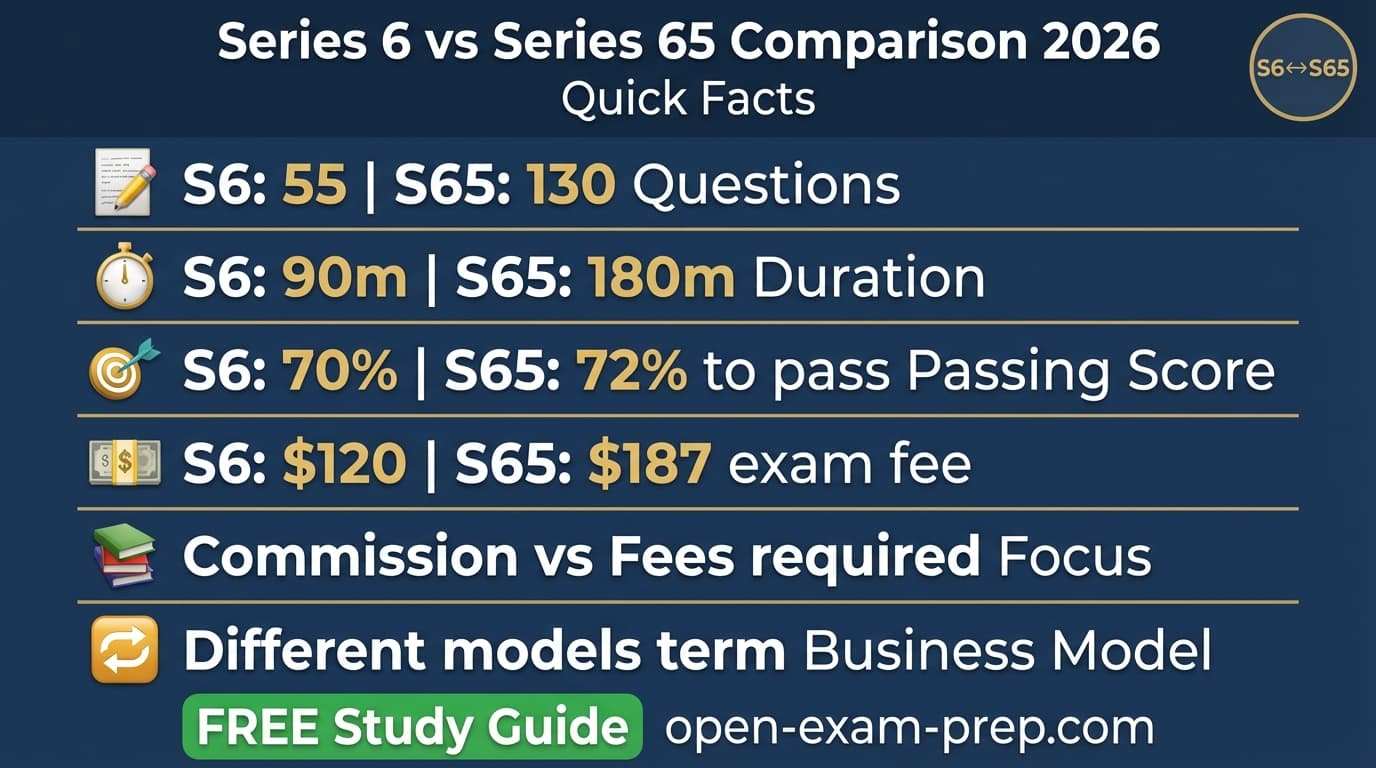
Side-by-Side Comparison
| Feature | Series 6 | Series 65 |
|---|---|---|
| Full Name | Investment Company and Variable Contracts Products Representative Exam | Uniform Investment Adviser Law Exam |
| Exam Cost | $47 | $187 |
| Passing Score | 70% (35 of 50 scored questions) | 72% (94 of 130 scored questions) |
| Questions | 55 (50 scored + 5 unscored) | 140 (130 scored + 10 unscored) |
| Time Limit | 1 hour 30 minutes | 3 hours |
| Study Time | 30 - 50 hours over 2 - 4 weeks | 60 - 80 hours over 4 - 8 weeks |
| Difficulty | Moderate | Moderate-to-Challenging |
| Prerequisites | SIE exam passed + firm sponsorship (Form U4 filing) required | None — no SIE exam, no firm sponsorship, and no prior licenses required. Anyone can register and sit for the Series 65 independently. |
| Exam Body | FINRA | NASAA (North American Securities Administrators Association) |
Key Differences
- 1The Series 6 authorizes **commission-based sales** of packaged products (mutual funds, variable annuities, 529s); the Series 65 authorizes **fee-based investment advice** on any investment as a fiduciary — two entirely different compensation models.
- 2The Series 6 requires both the **SIE exam and firm sponsorship** (Form U4); the Series 65 requires **neither** — anyone can register and sit for it independently, making it the preferred path for career changers.
- 3Series 6 holders follow a **suitability standard** (and Reg BI): recommendations must be suitable for the client. Series 65 holders follow a **fiduciary standard**: advice must be in the client's best interest at all times, a higher legal obligation.
- 4The Series 6 limits you to **packaged products only** — no individual stocks, bonds, options, or direct participation programs. The Series 65 places **no product limitations** on what you can advise clients about.
- 5The Series 6 is administered by **FINRA** ($47 fee); the Series 65 is administered by **NASAA** ($187 fee) — they are governed by entirely different regulatory bodies.
- 6Study time differs significantly: **30-50 hours** for the Series 6 vs. **60-80 hours** for the Series 65, reflecting the broader scope of the Series 65 curriculum.
- 7The Series 6 has a lower pass rate (**~58%**) despite being shorter, partly because many test-takers are bank employees with limited securities backgrounds. The Series 65 has a higher pass rate (**~66%**) but covers more advanced material including portfolio theory, economics, and state securities law.
- 8The industry is **shifting from commission-based to fee-based advisory**, making the Series 65 increasingly valuable. Assets in fee-based accounts surpassed commission-based accounts at major wirehouses in 2019 and continue to grow.
What Each Exam Allows You To Do
Series 6
- Sell mutual fund shares (open-end investment company securities)
- Sell variable annuities and variable life insurance products
- Sell 529 college savings plans and other municipal fund securities
- Sell unit investment trusts (UITs)
- Process purchase and redemption orders for packaged investment products
Series 65
- Serve as an Investment Adviser Representative (IAR) at a state-registered or SEC-registered RIA firm
- Provide personalized investment advice for a fee (hourly, flat fee, or assets under management)
- Create and deliver comprehensive financial plans to clients
- Manage client portfolios on a discretionary or non-discretionary basis
- Operate under a fiduciary standard — legally required to act in the client's best interest
- Charge advisory fees based on assets under management (AUM), hourly rates, or flat retainer fees
Who Should Take Each Exam?
Take the Series 6 if you...
- →Bank-based investment representatives selling packaged products
- →Insurance agents adding variable annuities and variable life to their practice
- →Entry-level representatives at broker-dealers with limited product offerings
- →Professionals who only need to sell mutual funds and variable contracts, not individual stocks or bonds
Take the Series 65 if you...
- →Career changers entering financial advisory without prior securities licenses
- →CFP professionals, CPAs, and attorneys who want to offer investment advice for fees
- →Fee-only financial planners at RIA firms who do not sell commission-based products
- →Entrepreneurs launching their own RIA or fee-based advisory practice
- →Professionals who want to bypass the SIE and FINRA sponsorship requirements entirely
Which Should You Take First?
This depends entirely on your desired career model, not difficulty. If you want to **sell packaged investment products for commissions** at a bank, insurance company, or broker-dealer — and your employer is sponsoring you — take the Series 6 (along with the SIE prerequisite). If you want to **provide investment advice for fees** as a fiduciary, especially if you are a career changer without an existing securities license, take the Series 65. The Series 65 is increasingly the better long-term play for most people because: (1) it requires no SIE or sponsorship, so you can get licensed on your own timeline; (2) the fee-based advisory model is where the industry is heading; and (3) it carries a higher salary ceiling. If you already hold the Series 6 and want to transition into advisory work, you have two paths: add the Series 65 to become a dual-registered representative, or upgrade to the Series 7 + Series 66 combination for the broadest possible authority.
At a Glance: Series 6 vs Series 65
Exam Cost
$47
Series 6
$187
Series 65
Pass Rate
~58%
Series 6
~66%
Series 65
Study Time
30-50 hrs
Series 6
60-80 hrs
Series 65
Median Salary
~$61,000
Series 6
~$78,695
Series 65
Series 6
Selling mutual funds, variable annuities, and 529 plans on commission at banks, insurance companies, and broker-dealers with limited product shelves
Series 65
Providing fee-based investment advice as a fiduciary at RIAs, independent advisory firms, and financial planning practices — no SIE or firm sponsorship required
Start preparing today:
Key Facts: Series 6 vs Series 65
- 1The Series 6 (FINRA, $47) authorizes commission-based sales of mutual funds, variable annuities, variable life insurance, and 529 plans, while the Series 65 (NASAA, $187) authorizes fee-based investment advice as a fiduciary on any type of investment.
- 2The Series 65 requires no SIE exam and no firm sponsorship — anyone can register and sit for it independently, making it the most accessible entry point for career changers entering the advisory industry.
- 3Series 6 holders follow a suitability standard (and Reg BI), while Series 65 holders are bound by a fiduciary standard requiring them to act in the client's best interest at all times — a higher legal obligation.
- 4The Series 6 has a first-time pass rate of approximately 58%, while the Series 65 has a first-time pass rate of approximately 66%, despite covering more advanced material including portfolio theory and state securities law.
- 5Series 6 representatives earn a median of approximately $61,000 per year through commissions on product sales, while Series 65 investment adviser representatives earn a median of approximately $78,695 through advisory fees (ZipRecruiter, 2024-2025).
- 6The fee-based advisory model (Series 65) generates recurring revenue through AUM fees — an advisor managing $20M at 1% earns $200,000 annually without new sales — while the commission model (Series 6) requires continuous new product sales to maintain income.
- 7The RIA channel (where Series 65 holders operate) has been the fastest-growing segment of wealth management for over a decade, adding over $10 trillion in AUM, and now manages more assets than traditional wirehouses.
- 8Series 6 holders who want to add advisory capabilities can take the Series 65 ($187, no prerequisites beyond the existing Series 6), or upgrade to the broader Series 7 + Series 66 combination for full securities and advisory authority.
- 9BLS projects 7% growth for personal financial advisors (Series 65-related roles) through 2034, compared to just 3% growth for securities sales agents (Series 6-related roles), reflecting the industry shift from commissions to fees.
- 10The total cost to become a licensed Series 65 investment adviser representative ranges from $187 to $837 — significantly lower than most other financial services licenses because no SIE, no sponsorship fees, and no FINRA registration costs are required.
Why This Comparison Matters
Fiduciary Standard
Series 65 = Fiduciary Duty
Series 65 holders are held to a fiduciary standard, meaning they must act in the client's best interest at all times — not merely recommend "suitable" products like Series 6 holders.
No SIE Needed
Series 65 Standalone Access
Unlike the Series 6, the Series 65 requires no SIE exam and no firm sponsorship. Career changers can sit for it independently, making it the fastest path into the advisory industry.
$78,695
Median Advisory Salary
Investment adviser representatives (Series 65 holders) earn a median salary of approximately $78,695 per year according to ZipRecruiter data, with experienced advisors at established RIAs earning well above six figures.
This comparison highlights the most important strategic decision in the early-career financial services landscape: do you want to sell products for commissions, or advise clients for fees? The Series 6 and Series 65 are not just different exams — they represent different philosophies, different regulatory frameworks, and different career trajectories.
The Series 6 was once the standard entry point for bank-based investment representatives and insurance agents adding variable products. It remains relevant at institutions with limited product shelves where representatives sell only mutual funds, variable annuities, and 529 plans. However, the Series 6 is an increasingly narrow license in a broadening industry. You cannot sell individual stocks, bonds, ETFs, or options with a Series 6. You cannot charge advisory fees. You are limited to commission-based compensation on packaged products.
The Series 65, by contrast, has become the gateway to the fastest-growing segment of financial services: fee-based advisory. According to Cerulli Associates, fee-based advisory assets surpassed $30 trillion in 2024, and the RIA channel has been the fastest-growing segment of the advisory industry for over a decade. The Series 65 requires no SIE, no firm sponsorship, and opens the door to fiduciary advisory at any RIA — making it the most accessible and strategically valuable license for career changers, CFP candidates, CPAs, and attorneys entering wealth management.
What Each Exam Covers
Series 6 Exam Topics
Pass Rate: ~58% first-time pass rate (FINRA historical data, estimated 2023-2024)
Series 65 Exam Topics
Pass Rate: ~66% first-time pass rate (NASAA historical data, estimated 2023-2024)
Salary & Income Comparison
Investment Company Products Representative / Mutual Fund Sales Agent
~$61,000
Median Annual Salary
Range: $38,000 - $95,000+
ZipRecruiter and Glassdoor aggregated data, 2024-2025; BLS SOC 41-3031 (broader securities sales agent category)
Top Series 6 earners are typically bank-based investment specialists or insurance agents who layer variable product commissions on top of a base salary. However, the Series 6 limits you to packaged products only — no individual stocks, bonds, or options — which caps upside compared to Series 7 holders. The highest-earning Series 6 representatives often eventually upgrade to a Series 7 to access the full product shelf.
Investment Adviser Representative (IAR)
~$78,695
Median Annual Salary
Range: $50,000 - $130,000+
ZipRecruiter, 2024-2025; supplemented by BLS SOC 13-2052 (Personal Financial Advisors) median of $99,580 (May 2024)
The Series 65 salary range is heavily influenced by business model. Salaried IARs at large RIA firms earn $60,000-$100,000. However, the real earning power comes from building AUM. An independent advisor charging 1% on $50M in AUM generates $500,000 in gross revenue. BLS data for personal financial advisors (SOC 13-2052) shows a median of $99,580 with the top 10% exceeding $208,000 — and these figures skew toward the advisory side of the industry where Series 65 holders operate.
| Commission Detail | Series 6 |
|---|---|
| First-Year Commission | 3-5.75% front-end load on mutual fund sales (A shares); 1-2% on variable annuity premiums |
| Renewal Commission | 0.25% annual 12b-1 trail on mutual fund assets; renewal commissions on variable annuity contracts |
| Income Model | Series 6 representatives earn commissions primarily through front-end loads on Class A mutual fund shares (typically 3-5.75%), contingent deferred sales charges on Class B/C shares, and commissions on variable annuity premium payments. Ongoing trail commissions (12b-1 fees of 0.25%) provide recurring income on existing assets. At banks, representatives typically receive a base salary ($35,000-$50,000) plus production bonuses rather than pure commission. At insurance companies, the commission structure mirrors insurance sales with first-year and renewal percentages on variable product premiums. |
Series 6 and Series 65 holders occupy different compensation models that produce meaningfully different income outcomes. Series 6 representatives earn commissions on product sales — typically 3-5.75% front-end loads on mutual fund purchases and 0.25% annual trail commissions (12b-1 fees) on existing assets. At banks, Series 6 holders often receive a base salary of $35,000-$50,000 plus production bonuses, with total compensation averaging approximately $61,000 per year according to aggregated salary data from ZipRecruiter and Glassdoor.
Series 65 holders working as Investment Adviser Representatives (IARs) earn advisory fees — typically 0.75-1.25% of assets under management (AUM) annually. The median salary for Series 65 holders is approximately $78,695 per year (ZipRecruiter, 2024-2025). However, the BLS reports that personal financial advisors (SOC 13-2052) — the broader category that includes many Series 65 holders — earn a median of $99,580 with the top 10% exceeding $208,000.
The critical difference is scalability. Commission income resets each year: a Series 6 representative must sell new products every month to maintain income. Advisory fee income is recurring: an advisor managing $20M in AUM at 1% earns $200,000 annually without making a single new sale, as long as clients stay. This recurring revenue model is why advisory firms are valued at 2-3x revenue while commission-based books are valued at 1-1.5x trailing 12-month production. Over a 10-20 year career, the compounding effect of recurring AUM fees dramatically outpaces commission-based income.
Total Cost to Get Licensed
| Expense | Series 6 | Series 65 |
|---|---|---|
| Pre-Licensing Education | $0 required (though $100-$350 for recommended prep course: Kaplan $300, Achievable $149, STC $200) | $0 required (though $150-$400 for recommended prep course: Kaplan $349, Achievable $149, STC $249) |
| Exam Fee | $47 (FINRA Series 6) + $80 (FINRA SIE prerequisite) = $127 total exam fees | $187 (NASAA Series 65) — no SIE or other prerequisite exam fees |
| License Fee | $63 (Series 63, required for state registration in most states) | $0-$200 (state IA registration fee varies by state; some states charge $0, others up to $200) |
| Background Check | $50-$100 (fingerprinting and background check via Form U4) | $0-$50 (background check may be required by some states or RIA firms) |
| Total Investment | $240-$640 (SIE + Series 6 + Series 63 + optional prep courses + Form U4; typically employer-paid) | $187-$837 (Series 65 exam + optional prep course + state registration; often self-paid since no firm sponsorship is required) |
A Day in the Life
Series 6 Professional
A Series 6-licensed investment representative at a regional bank arrives at 8:30 AM and reviews the morning's product wholesaler emails — a fund company is offering a 25-basis-point bonus commission on a new target-date fund series this quarter. At 9:00, she meets with a bank customer referred by a teller: a 55-year-old couple with $120,000 in a savings account earning 0.5%. She runs a risk assessment, recommends a moderate-allocation mutual fund (Class A shares with a 4.5% front-end load at the $100K breakpoint), and processes the purchase order. At 11:00, she calls three existing clients about their annual variable annuity statements, looking for rollover opportunities. After lunch, she attends a compliance training on Reg BI documentation requirements. At 2:30, she meets a walk-in customer asking about 529 plans for his newborn, reviewing the state tax deduction benefits and age-based portfolio options. She ends the day entering activity notes into the CRM and reviewing her monthly sales production against the branch's mutual fund quota.
Series 65 Professional
A Series 65-licensed investment adviser representative at a fee-only RIA begins at 8:00 AM reviewing portfolio alerts — two client accounts have drifted beyond their target allocation due to last week's market rally and need rebalancing. She executes the trades through the custodian (Schwab), documenting the rationale in the compliance system. At 9:30, she has a video call with a new prospect: a 42-year-old physician earning $380,000 who wants comprehensive financial planning. She walks through the firm's discovery process — cash flow analysis, tax planning, investment management, insurance review, and estate planning — and quotes the firm's flat planning fee of $6,000/year plus 0.80% on assets under management. At 11:00, she prepares a quarterly performance report for the firm's largest client ($4.2M household). After lunch, she researches low-cost international small-cap ETFs for a model portfolio update the investment committee is considering. At 3:00, she meets with an existing client couple to review their retirement projection, adjusting the Monte Carlo simulation based on the husband's decision to retire at 62 instead of 65. She ends the day reviewing her pipeline: two prospects in the proposal stage and a referral from a CPA partner arriving next week.
Career Paths & Progression
Series 6 Career Path
0-1 years
Bank Investment Specialist Trainee
$38K-$48K
1-3 years
Licensed Bank Investment Representative
$50K-$70K
3-5 years
Senior Investment Specialist / Team Lead
$65K-$90K
5+ years
Upgrade to Series 7 → Full-Service Financial Advisor
$100K-$200K+
Series 65 Career Path
0-2 years
Associate Advisor / Paraplanner at RIA
$50K-$65K
2-5 years
Investment Adviser Representative (IAR)
$70K-$100K
5-10 years
Lead Advisor / Partner at RIA
$120K-$250K
10+ years
RIA Firm Owner / Managing Partner
$200K-$500K+
The Series 6 career track typically begins at a bank or insurance company where representatives sell mutual funds, variable annuities, and 529 plans to the institution's existing customer base. This is a comfortable, salaried environment with built-in foot traffic — but the ceiling is limited. Most ambitious Series 6 holders eventually upgrade to the Series 7 to access individual securities, or add the Series 65 to offer fee-based advice alongside product sales.
The Series 65 career track leads to the Registered Investment Adviser (RIA) channel — the fastest-growing segment of wealth management. Career paths include: (1) Salaried IAR at an established RIA — joining firms like Fisher Investments, Buckingham Strategic Wealth, or a regional RIA as a financial planner earning $60,000-$100,000; (2) Independent IAR building AUM — affiliating with a custodian (Schwab, Fidelity, Pershing) and building a fee-based practice from scratch, with income directly tied to assets gathered; (3) RIA firm owner — launching your own advisory firm, which is increasingly common given low startup costs ($5,000-$20,000 for state registration) compared to broker-dealer affiliation. Many CFP professionals, CPAs, and estate attorneys add the Series 65 specifically to offer holistic financial planning that includes investment management for fees.
The key career difference: Series 6 holders are typically employees selling their firm's products. Series 65 holders are often building a practice or a business around their clients' needs. This distinction matters enormously for long-term career satisfaction and income potential.
Start preparing today:
Can You Hold Both Series 6 and Series 65? Should You?
Benefits
- +Holding both licenses creates a dual-registered representative who can sell commission-based packaged products (Series 6) AND provide fee-based investment advice (Series 65) — offering maximum flexibility in how you serve and charge clients
- +The dual registration allows you to operate in both the broker-dealer channel (commissions on mutual fund sales) and the RIA channel (advisory fees on managed accounts) simultaneously
- +Adding the Series 65 to a Series 6 license gives bank-based representatives the ability to offer fee-based wrap accounts and financial planning services, which are higher-margin activities than one-time mutual fund sales
- +Many employer firms are transitioning their platform from pure commission to hybrid commission + advisory, making the Series 65 add-on increasingly expected for career advancement
- +The Series 65 also positions you for the future: if you leave the broker-dealer, your Series 65 allows you to join an RIA without needing additional licensing
Considerations
- !You will be subject to two regulatory frameworks simultaneously: FINRA rules for your brokerage activities and state/SEC rules for your advisory activities — increasing compliance complexity
- !Your firm must be dual-registered (both a broker-dealer and an RIA) for you to use both licenses, which not all firms are
- !An increasingly popular alternative path is upgrading from Series 6 to Series 7 + Series 66, which provides broader securities authority (all products, not just packaged) plus advisory authority in a single additional exam
- !If you plan to work exclusively in the fee-based advisory space, the Series 6 adds little value — the Series 65 alone (or Series 7 + Series 66) is more efficient
The Verdict: If you already hold the Series 6 and want to expand into advisory work, adding the Series 65 is a smart, low-cost move — the $187 exam fee and 60-80 hours of study unlock an entirely new compensation model. However, for maximum long-term flexibility, consider the Series 7 upgrade + Series 66 path instead. The Series 7 + Series 66 combination gives you both full securities authority (all products, not just packaged) and investment advisory authority, making it the most versatile licensing combination in the industry. The Series 6 + Series 65 combination is ideal if you want advisory authority without the effort of studying for the much harder Series 7 exam.
Job Outlook & Industry Trends
3% (2024-2034, BLS — securities sales agents broadly)
Series 6 Job Growth (2024-2034)
7% (2024-2034, BLS — personal financial advisors)
Series 65 Job Growth (2024-2034)
The job outlook for these two licenses diverges significantly because they serve different industry segments trending in opposite directions. Series 6-related roles in commission-based product sales are growing slowly at ~3% (BLS, securities sales agents SOC 41-3031), constrained by the ongoing industry shift away from commission compensation and the decline of front-end load mutual fund sales. In contrast, Series 65-related roles in fee-based advisory are growing at ~7% (BLS, personal financial advisors SOC 13-2052), driven by the explosive growth of the RIA channel, which has added over $10 trillion in AUM in the past decade. The RIA channel now manages more assets than wirehouses. Additionally, approximately 30-40% of financial advisors are expected to retire by 2030, creating massive succession opportunities — particularly at fee-based firms where client relationships and AUM transfer to successor advisors. For career longevity, the Series 65 aligns with the direction the industry is heading.
Study Strategy & Tips
Foundation & Assessment
Determine your path and establish baseline knowledge
- Decide: Series 6 (commission sales) or Series 65 (fee-based advisory) based on your career goals
- If pursuing Series 6: confirm your employer will sponsor you and file Form U4; verify you have passed or are studying for the SIE
- If pursuing Series 65: register directly at Prometric — no prerequisites needed
- Purchase a prep course (Kaplan, Achievable, ExamFX, or STC) and take a diagnostic practice exam to identify weak areas
Core Content Study
Master the primary exam content
- Series 6 path: Focus on mutual fund share classes (A/B/C), variable annuity features (accumulation/annuity phases, surrender charges, death benefits), 529 plans, and suitability analysis — this covers 62% of the exam
- Series 65 path: Study investment vehicle characteristics (25%), client recommendations and portfolio theory (30%), and begin the laws/regulations section (30%)
- Complete chapter quizzes after each content area — aim for 75%+ before moving on
- Create flashcards for key formulas: current yield, tax-equivalent yield, alpha, beta, Sharpe ratio, standard deviation
Regulations & Advanced Topics
Regulatory framework and exam-specific nuances
- Series 6 path: Study Reg BI, suitability obligations, anti-money laundering rules, customer account types, and FINRA regulations
- Series 65 path: Master the Uniform Securities Act — IA/IAR definitions, registration requirements, exemptions, fiduciary duty, custody rules, and prohibited practices (this is 30% of the exam)
- Take 2 full-length timed practice exams and analyze every wrong answer
- Focus extra time on your weakest content area identified by practice exam results
Practice Exams & Pass
Intensive practice and exam day
- Series 6 path: Take 3+ full-length practice exams, scoring 78%+ consistently before scheduling (target above 70% passing score with margin)
- Series 65 path: Take 4-5 full-length practice exams, scoring 80%+ consistently before scheduling (target above 72% passing score with margin)
- Review all commonly missed question types in the final 3-5 days before the exam
- Schedule and pass the exam — arrive early, pace yourself, and flag difficult questions for review
Total Duration: 6-10 weeks (Series 65 standalone or Series 6 + Series 65 sequential)
Series 6 Study Tips
- 1Focus 62% of your study time on the "Provides Information and Makes Recommendations" section — this is the bulk of the exam. Know the characteristics, fees, risks, and suitability of mutual funds (Class A, B, C shares), variable annuities, variable life insurance, UITs, and 529 plans inside and out.
- 2Master the fee structures of mutual funds: front-end loads, contingent deferred sales charges (CDSC), 12b-1 fees, expense ratios, and breakpoint schedules. Exam questions frequently test whether you can identify the most cost-effective share class for a given investment amount and time horizon.
- 3Understand variable annuity features thoroughly: accumulation vs. annuity phase, death benefits, surrender charges, tax treatment of withdrawals (LIFO for gains), the 10% IRS penalty before age 59½, and the role of separate accounts vs. the general account.
- 4Study suitability rules and Regulation Best Interest (Reg BI). The exam will present customer profiles and ask which product is most suitable — always consider the customer's age, risk tolerance, time horizon, liquidity needs, and existing holdings.
- 5Take at least 3 full-length practice exams under timed conditions. At only 50 scored questions in 90 minutes, you have less margin for error than on longer exams — every question counts.
Series 65 Study Tips
- 1Allocate 60% of your study time to the two largest sections: "Client Recommendations and Strategies" (30%) and "Laws, Regulations, and Guidelines" (30%). Combined, these represent 60% of the exam and are where most candidates struggle — especially on state vs. federal regulatory jurisdiction questions.
- 2Master the Uniform Securities Act (USA) and its definitions: who is an "investment adviser" vs. an "investment adviser representative," the de minimis exemptions, federal covered advisors vs. state-registered advisors, and custody and recordkeeping requirements. This is heavily tested.
- 3Study modern portfolio theory, asset allocation, and risk metrics (alpha, beta, standard deviation, Sharpe ratio, R-squared). The exam expects you to understand portfolio construction concepts, not just product features. Know the efficient frontier, CAPM, and how to calculate risk-adjusted returns.
- 4Understand fiduciary duty thoroughly: the duty of loyalty, duty of care, best execution, proxy voting responsibilities, soft dollar arrangements, and the differences between the fiduciary standard (advisors) and suitability/Reg BI standard (broker-dealers).
- 5Take at least 4-5 full-length practice exams. The Series 65 has 130 scored questions in 3 hours, requiring steady pacing (about 1.4 minutes per question). Many candidates run out of time on their first attempt because they spend too long on regulatory interpretation questions.
- 6If you are a career changer with no finance background, budget extra time (80+ hours) for the economics and investment vehicle sections. The exam assumes working knowledge of economic indicators, monetary policy, bond valuation, and options basics.
Ready to Start Studying?
Free practice questions, study guides, and AI tutoring for the matching exam resources.
Frequently Asked Questions
QCan I take the Series 65 without the SIE exam?
Yes — and this is one of the Series 65's most significant advantages. The Series 65 is administered by NASAA, not FINRA, and has absolutely no prerequisite exams. You do not need the SIE, a firm sponsor, or any prior securities license to sit for the Series 65. You simply register through Prometric, pay the $187 fee, and schedule your exam. This makes the Series 65 the preferred entry point for career changers, CFP candidates, CPAs, and attorneys who want to offer investment advice without navigating the FINRA licensing framework. By contrast, the Series 6 requires both the SIE exam ($80) and sponsorship by a FINRA-member broker-dealer.
QWhich pays more: Series 6 or Series 65?
The Series 65 path offers higher median compensation and significantly greater long-term earning potential. Series 6 representatives earn a median of approximately $61,000 per year, primarily through commissions on mutual fund and variable annuity sales, often supplemented by a base salary at banks. Series 65 investment adviser representatives earn a median of approximately $78,695, with the BLS reporting that personal financial advisors (the broader category) earn a median of $99,580. The more important difference is the compensation model: Series 65 advisory fees are recurring (you earn them every year on existing assets), while Series 6 commissions largely reset each year. An advisor managing $50M at 1% AUM generates $500,000 in annual revenue without making a single new sale.
QIs the Series 65 harder than the Series 6?
The Series 65 is a more demanding exam in terms of content breadth, but it actually has a higher pass rate (~66% vs ~58% for the Series 6). The Series 65 covers modern portfolio theory, economic analysis, statistical risk measures (alpha, beta, Sharpe ratio), the Uniform Securities Act, fiduciary duty, and investment strategies across all security types — requiring 60-80 hours of study. The Series 6 is narrower (mutual funds, variable products, 529 plans) with 30-50 hours of study, but its lower pass rate reflects the fact that many test-takers are bank employees who may have less intensive preparation. Both exams require dedicated study, but the Series 65 rewards candidates who have a broader financial knowledge base.
QCan I hold both the Series 6 and Series 65 at the same time?
Yes, and many professionals do. Holding both licenses creates a dual-registered representative who can sell commission-based packaged products (mutual funds, variable annuities) through a broker-dealer while also providing fee-based investment advice through an RIA. This is common at firms that are dual-registered as both a broker-dealer and an RIA, such as many bank-affiliated wealth management divisions. The dual registration gives you maximum flexibility in how you serve clients and structure your compensation. However, you will be subject to both FINRA and state/SEC advisory regulations simultaneously, which increases compliance obligations.
QShould I get the Series 6 or go straight to the Series 65 as a career changer?
For most career changers, the Series 65 is the better choice. The Series 6 requires you to first pass the SIE exam ($80) and then find a FINRA-member broker-dealer willing to sponsor you — a significant barrier when you have no industry experience. The Series 65 requires no SIE, no sponsorship, and no prior licenses. You can study on your own schedule, pass the exam, and immediately seek employment at any RIA firm. Additionally, the fee-based advisory model (Series 65) is where the industry is heading — RIA assets have grown faster than any other channel for over a decade, and the demand for fiduciary advisors continues to accelerate. The Series 65 also opens doors to roles at robo-advisors, financial planning firms, family offices, and wealth management divisions that operate under the advisory model.
QIf I have a Series 6, how do I transition to fee-based advisory?
You have two main paths. The first and simplest is to add the Series 65 directly — since you already hold a FINRA license, you simply register for the Series 65 through Prometric ($187), study for 60-80 hours, and pass the exam. This gives you advisory authority while keeping your Series 6 for commission-based product sales. The second path is to upgrade from Series 6 to Series 7 and then take the Series 66 (which combines the Series 63 and Series 65 content into one exam requiring the Series 7 as a prerequisite). The Series 7 + Series 66 combination is more comprehensive because it gives you full securities authority on all products, not just packaged products. The right choice depends on your goals: if you want to stay focused on mutual funds and add advisory fees, Series 65 is sufficient. If you want full product authority plus advisory, the Series 7 + Series 66 upgrade is worth the additional effort.
10 free AI interactions per day
Free exam resources
Start Studying the Exact Exam
Use the comparison to choose a path, then move into the matching practice questions, study guide, and flashcards.
Third-party resources · We may earn a commission from purchases.

Series 6 Exam Secrets Study Guide: Series 6 Test Review for the Investment Company Products/Variable Contracts Limited Representative Qualification Exam
By Series 6 Exam Secrets Test Prep Team
$56.99 · 
 Study guide on Mometrix
 Practice exams on ExamEdge
 Prep course on Achievable
Related Exam Comparisons
Stay Updated
Get free exam tips and study guides delivered to your inbox.