Series 7 vs Series 66
The Series 7 is the FEDERAL license administered by FINRA that authorizes you to sell virtually all types of securities — stocks, bonds, options, mutual funds, and more. The Series 66 is the STATE registration exam administered by NASAA that, when combined with the Series 7, registers you as both a securities agent and an investment adviser representative at the state level. You MUST pass the Series 7 before taking the Series 66. Together, the S7 + S66 combination is the gold standard licensing path for full-service financial advisors at wirehouses and broker-dealers, enabling both commission-based securities transactions and fee-based investment advice. The Series 66 effectively replaces the need to take both the Series 63 and Series 65 as separate exams.
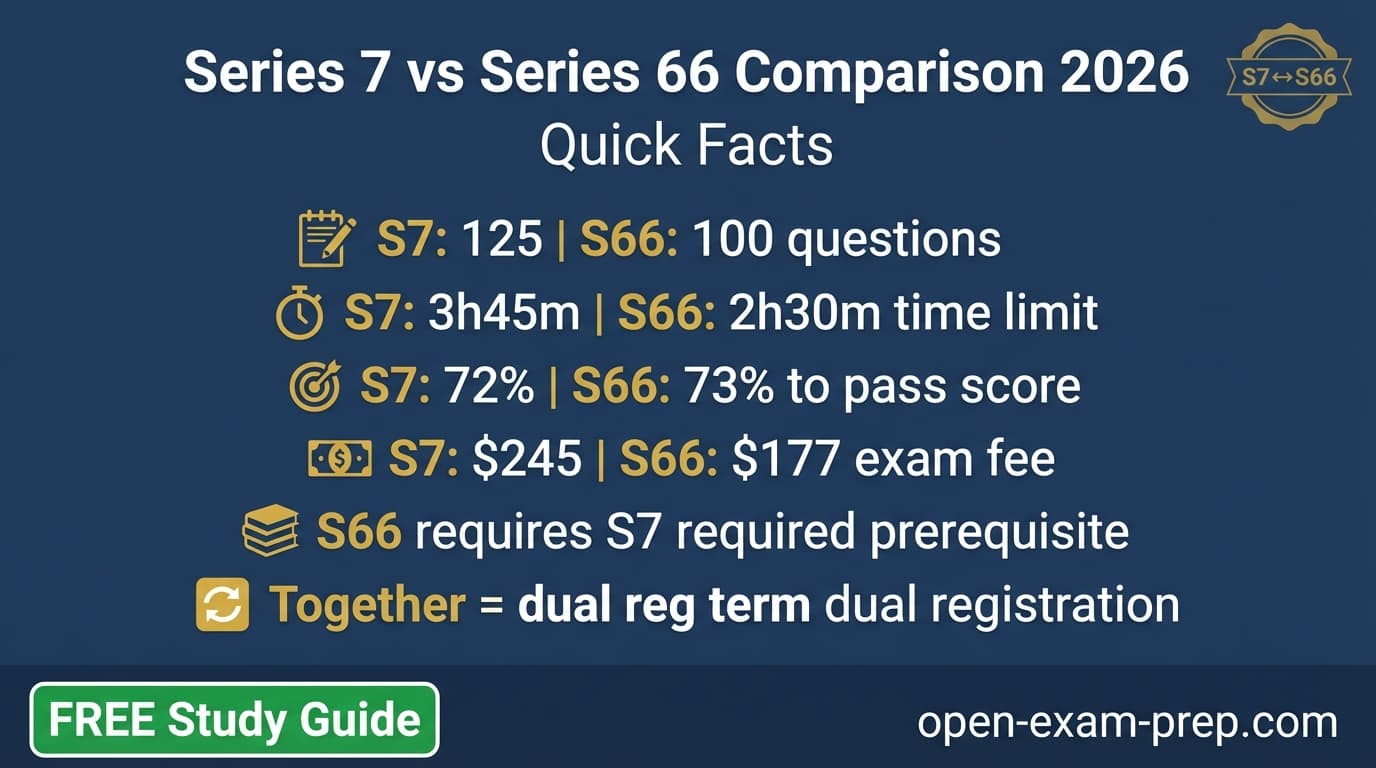
Side-by-Side Comparison
| Feature | Series 7 | Series 66 |
|---|---|---|
| Full Name | General Securities Representative Exam | Uniform Combined State Law Exam |
| Exam Cost | $245 | $177 |
| Passing Score | 72% (83 of 115 scored questions) | 73% (62 of 85 scored questions) |
| Questions | 135 (125 scored + 10 unscored) | 100 (85 scored + 15 unscored) |
| Time Limit | 3 hours 45 minutes | 2 hours 30 minutes |
| Study Time | 80 - 120 hours over 4 - 8 weeks | 50 - 70 hours over 3 - 5 weeks |
| Difficulty | Challenging | Moderate to Challenging |
| Prerequisites | SIE exam passed + firm sponsorship (Form U4 filing) required | Series 7 exam passed (Series 7 is a mandatory corequisite — you must pass the Series 7 before or concurrently with the Series 66) |
| Exam Body | FINRA | NASAA (North American Securities Administrators Association) |
Key Differences
- 1The Series 7 is a FINRA-administered federal license; the Series 66 is a NASAA-administered state registration exam. They operate at different regulatory levels and serve different purposes.
- 2The Series 7 authorizes you to sell securities (transaction-based); the Series 66 adds the ability to provide investment advice for fees (advisory-based) AND registers you as a state securities agent — neither capability exists with the Series 7 alone.
- 3The Series 7 requires the SIE as a prerequisite; the Series 66 requires the Series 7 as a prerequisite. The mandatory sequence is SIE → Series 7 → Series 66.
- 4The Series 7 has 125 scored questions in 3 hours 45 minutes ($245); the Series 66 has 85 scored questions in 2 hours 30 minutes ($177). The Series 7 is the longer and more expensive exam.
- 5The Series 7 focuses 73% on investment products and recommendations; the Series 66 focuses 49% on laws, regulations, and guidelines — it is fundamentally a regulatory and legal exam.
- 6The Series 66 replaces the need for both the Series 63 (state agent registration) and Series 65 (investment adviser representative) as separate exams, saving one exam fee and additional study time.
- 7A Series 7 holder without the Series 66 (or Series 63) cannot legally solicit securities business in most states; the Series 66 is what makes your Series 7 license operational at the state level.
- 8Study time is 80-120 hours for the Series 7 vs 50-70 hours for the Series 66, but the Series 66 is not easier — its regulatory content requires a completely different study approach than the product-focused Series 7.
What Each Exam Allows You To Do
Series 7
- Sell virtually all types of securities: stocks, bonds, options, mutual funds, ETFs, variable annuities, and direct participation programs
- Recommend investment strategies and execute trades for retail and institutional clients
- Work as a registered representative (stockbroker) at any FINRA-member broker-dealer
- Earn commissions on securities transactions at full-service and discount broker-dealers
- Act as the foundation for additional state registrations (Series 63, 65, or 66)
Series 66
- Register as a securities agent at the state level — required in addition to the Series 7 to legally solicit securities transactions in most states
- Register as an investment adviser representative (IAR) — legally allowed to provide investment advice for a fee and manage client portfolios for compensation
- Work in a fee-based advisory capacity at dual-registered firms (broker-dealer + RIA) without needing the Series 65 separately
- Replace the need for both the Series 63 AND Series 65 with a single exam — saving time and money
- Meet state registration requirements in all 50 states, the District of Columbia, and Puerto Rico (though a few states have additional requirements)
Who Should Take Each Exam?
Take the Series 7 if you...
- →Aspiring stockbrokers and registered representatives at broker-dealers
- →Financial advisors targeting full-service wirehouses and regional firms
- →Anyone wanting the broadest federal securities license available
- →Career changers targeting high-income financial services roles
Take the Series 66 if you...
- →Series 7 holders who want to add both state agent and investment adviser representative registration in one exam
- →Wirehouse trainees completing the standard SIE → Series 7 → Series 66 licensing sequence
- →Financial advisors planning to offer fee-based advisory services in addition to commission-based brokerage
- →Anyone who wants to avoid taking the Series 63 and Series 65 as two separate exams
Which Should You Take First?
You MUST take the Series 7 first — the Series 66 requires the Series 7 as a mandatory prerequisite (corequisite). The optimal and industry-standard sequence is: (1) Pass the SIE (no sponsorship required). (2) Get hired by a broker-dealer and have them sponsor you via Form U4. (3) Pass the Series 7 within your firm's training window. (4) Pass the Series 66 immediately after the Series 7, while regulatory concepts and suitability analysis are still fresh. Most wirehouse training programs (Morgan Stanley, Merrill Lynch, UBS, Wells Fargo) require all three exams — SIE, Series 7, and Series 66 — within 120 days of hire. The most efficient study strategy is to begin Series 66 prep during the final 1-2 weeks of Series 7 study, since roughly 30% of Series 66 content overlaps with Series 7 material (especially investment recommendations and suitability). Taking the Series 66 within 2-4 weeks of passing the Series 7 maximizes knowledge retention and pass probability.
At a Glance: Series 7 vs Series 66
Exam Cost
$245
Series 7
$177
Series 66
Pass Rate
~74%
Series 7
~73%
Series 66
Study Time
80-120 hrs
Series 7
50-70 hrs
Series 66
Questions (Scored)
125 scored
Series 7
85 scored
Series 66
Series 7
Anyone who wants the broadest federal securities license — required before you can trade stocks, bonds, options, or mutual funds for clients at a broker-dealer
Series 66
Series 7 holders who need state registration as BOTH a securities agent AND an investment adviser representative — the standard add-on for fee-based advisory work
Start preparing today:
Key Facts: Series 7 vs Series 66
- 1The Series 7 is a FINRA-administered federal license costing $245 that authorizes securities transactions, while the Series 66 is a NASAA-administered state registration exam costing $177 that adds both state agent and investment adviser representative registration.
- 2The Series 7 requires the SIE as a prerequisite; the Series 66 requires the Series 7 as a prerequisite. The mandatory sequence is SIE → Series 7 → Series 66.
- 3The Series 66 replaces the need for both the Series 63 (state agent) and Series 65 (investment adviser representative) as separate exams — saving $157 in exam fees and additional study time.
- 4Series 7 holders earn a median of $78,140 per year (BLS, SOC 41-3031), while personal financial advisors holding both S7 + S66 earn a median of $99,580 per year (BLS, SOC 13-2052).
- 5Wirehouse financial advisors with the S7 + S66 combination earn 35-51% of revenue through grid-based compensation — an advisor managing $100M in client assets producing $1M in annual revenue earns $350,000-$510,000.
- 6The Series 66 exam is 49% focused on laws, regulations, and guidelines — it is fundamentally a regulatory and legal exam, unlike the product-focused Series 7.
- 7The BLS projects 13% growth for personal financial advisors through 2034, significantly faster than the 4% average for all occupations, driven by retirement planning demand and wealth transfer advisory needs.
- 8An estimated 30-40% of current financial advisors (roughly 100,000 professionals) will retire by 2030, creating unprecedented succession opportunities for new S7 + S66 holders.
- 9Every major wirehouse — Morgan Stanley, Merrill Lynch, UBS, Wells Fargo, and Edward Jones — requires the S7 + S66 combination as a non-negotiable prerequisite for financial advisor roles.
- 10The total cost to become fully licensed with SIE + Series 7 + Series 66 + prep courses + state registration ranges from approximately $827 to $1,652, though many firms cover all exam fees and study materials.
Why This Comparison Matters
Gold Standard Combo
S7 + S66 = Complete Advisor
The Series 7 plus Series 66 is the industry-standard licensing combination at wirehouses like Morgan Stanley, Merrill Lynch, UBS, and Wells Fargo — enabling both securities transactions and fee-based investment advice.
$100K-$500K+
Full-Service Advisor Earnings
Financial advisors holding both the Series 7 and Series 66 at wirehouses earn $100,000 to $500,000+ annually through grid-based compensation, with top producers exceeding $1M in total compensation.
Replaces S63 + S65
Two-in-One State Exam
The Series 66 combines the Series 63 (state securities agent) and Series 65 (investment adviser representative) into a single exam — saving you one exam fee and weeks of additional study time.
The Series 7 and Series 66 are not competing exams — they are complementary halves of the same licensing framework. The Series 7 gives you the federal authority to transact in securities under FINRA supervision. The Series 66 gives you state-level registration as both a securities agent and an investment adviser representative under NASAA and state securities regulator oversight. Without both, you are operating with an incomplete license.
Here is the critical distinction most candidates misunderstand: the Series 7 alone does NOT allow you to charge advisory fees, manage discretionary accounts for compensation, or hold yourself out as an investment adviser representative. In today's advisory industry — where fee-based assets under management now exceed commission-based revenue at every major wirehouse — the Series 66 is not optional. It is the license that unlocks the advisory side of the business, which is where the industry is headed and where the highest compensation resides.
The strategic advantage of the Series 66 over taking the Series 63 and Series 65 separately cannot be overstated. The Series 66 combines both state registrations into a single 100-question exam costing $177, versus taking the Series 63 ($147, 65 questions) and Series 65 ($187, 130 questions) separately — which would cost $334 total and require studying for two exams. For any Series 7 holder who plans to offer advisory services (and in 2026, that should be virtually everyone), the Series 66 is the clear choice.
What Each Exam Covers
Series 7 Exam Topics
Pass Rate: ~74% first-time pass rate (FINRA data, 2023-2024)
Series 66 Exam Topics
Pass Rate: ~73% first-time pass rate (NASAA data, 2023-2024)
Salary & Income Comparison
Registered Representative / Securities Sales Agent
$78,140
Median Annual Salary
Range: $47,080 - $215,210+
BLS Occupational Employment Statistics, May 2024 (SOC 41-3031)
The Series 7 alone authorizes securities transactions but does NOT allow you to charge advisory fees. Most Series 7 holders quickly add the Series 66 to unlock fee-based advisory work. The salary range above reflects Series 7 holders broadly; those who add the Series 66 and build advisory practices typically earn significantly more — $100,000-$500,000+ at wirehouses.
Investment Adviser Representative / Financial Advisor (S7 + S66)
$99,580
Median Annual Salary
Range: $49,580 - $208,000+
BLS Occupational Employment Statistics, May 2024 (SOC 13-2052, Personal Financial Advisors)
The Series 66 alone has no independent salary value — it requires the Series 7 as a prerequisite and is always held in combination. The salary data here reflects personal financial advisors (BLS SOC 13-2052), which more accurately captures the earning potential of S7 + S66 holders who provide fee-based advisory services. Wirehouse advisors with both licenses managing $50M-$200M+ in client assets routinely earn $200,000-$500,000+ through combined commission and advisory fee revenue.
| Commission Detail | Series 7 |
|---|---|
| First-Year Commission | Trainee salary ($50,000-$80,000 base) transitioning to grid-based payout |
| Renewal Commission | 35-51% of revenue at wirehouses; 80-95% at independent broker-dealers |
| Income Model | Wirehouse compensation follows a "grid" system: you earn 35-51% of the revenue you generate from client trading commissions, advisory fees, and product sales. A new advisor generating $300,000 in annual revenue would take home approximately $105,000-$153,000. Independent broker-dealer (IBD) reps keep 80-95% of revenue but pay their own overhead. The Series 7 alone limits you to commission-based revenue — adding the Series 66 unlocks fee-based advisory revenue, which is more predictable and increasingly preferred by both clients and firms. |
With the Series 7 alone, you are limited to commission-based securities transactions. According to BLS May 2024 data (SOC 41-3031), securities sales agents earn a median of $78,140, with the 10th percentile at $47,080 and the 90th percentile at $215,210. However, this data captures all securities sales agents, many of whom have not yet built substantial client books.
Adding the Series 66 transforms your earning potential by unlocking fee-based advisory revenue. BLS data for personal financial advisors (SOC 13-2052) — which more accurately reflects S7 + S66 holders providing ongoing advisory services — shows a median of $99,580, with the top 10% earning over $208,000. But even these figures understate real-world compensation at wirehouses. A financial advisor at Morgan Stanley or Merrill Lynch with $100M in client assets under management generating $1M in annual revenue earns $350,000-$510,000 through the grid payout system (35-51% of revenue). The advisory fee component — typically 1.0-1.25% of AUM — provides predictable, recurring revenue that compounds as you accumulate assets. This is why the S7 + S66 combination is the foundation for careers that regularly produce $200,000-$500,000+ in annual compensation within 5-10 years.
Total Cost to Get Licensed
| Expense | Series 7 | Series 66 |
|---|---|---|
| Pre-Licensing Education | $150 - $500 (prep course: Kaplan $349, Achievable $149, ExamFX $199-$349, Knopman $350+) | $100 - $350 (prep course: Kaplan $249, Achievable $99, ExamFX $149-$249, Knopman $200+) |
| Exam Fee | $245 (FINRA) + $80 SIE prerequisite = $325 total exam fees | $177 (NASAA) — requires Series 7 as prerequisite (Series 7 cost not included here) |
| License Fee | N/A (Series 7 is the federal license — state registration requires Series 63 or 66 separately) | Varies by state ($25-$200 state registration fee — check with your state securities regulator) |
| Background Check | $50 - $100 (fingerprinting and background check via Form U4) | N/A (already completed via Form U4 for Series 7) |
| Total Investment | $525 - $925 (SIE + Series 7 + prep course + Form U4, NOT including state registration exam) | $302 - $727 (Series 66 exam + prep course + state registration fee) |
A Day in the Life
Series 7 Professional
A Series 7-only registered representative at a regional broker-dealer starts the day at 7:45 AM reviewing market news and overnight developments. At 9:30 AM when markets open, she processes a queue of client orders — 15 shares of Apple here, a bond purchase there — earning a commission on each transaction. Between trades, she cold-calls prospects from a firm-provided lead list, trying to open new accounts. A client calls at 11:00 AM asking whether he should sell his tech stocks and invest in municipal bonds for tax-free income — but she hesitates. Without the Series 66, she can execute the trades if he decides, but she cannot formally recommend a comprehensive investment strategy or charge an ongoing advisory fee for portfolio management. She refers the client to a colleague who holds the Series 66 and manages fee-based accounts. By 4:00 PM, she reflects on a day of transactions: productive, but each commission is a one-time event. Her income resets to zero each month.
Series 66 Professional
A financial advisor holding both the Series 7 and Series 66 at a wirehouse arrives at 7:30 AM and reviews her $120M book of business. She checks overnight performance of her managed accounts, noting that a model portfolio rebalancing triggered for 23 client accounts — generating advisory fee revenue automatically without any client phone calls. At 9:00 AM, she meets with a new prospect couple: a dual-income household with $1.2M in investable assets seeking retirement planning. Because she holds the Series 66, she presents a comprehensive financial plan and proposes a 1.1% AUM advisory fee — a $13,200 annual recurring revenue stream from this single relationship. At 11:00, she holds quarterly reviews with three existing clients via video call, reinforcing relationships that produce ongoing advisory fees. After lunch, she processes a few commission-based transactions for clients who prefer trading individual securities. By 4:00 PM, she reviews her practice metrics: $120M in AUM generating roughly $1.3M in annual advisory fee revenue, plus $200K in commission-based revenue. Her grid payout on $1.5M total revenue: approximately $550,000-$750,000 in annual compensation.
Career Paths & Progression
Series 7 Career Path
0-2 years
Registered Representative (Wirehouse Trainee)
$50K-$80K base
2-5 years
Commission-Based Broker (Series 7 only)
$75K-$150K
5-10 years
Senior Broker / Institutional Sales
$150K-$300K
10+ years
Branch Manager / Sales Director
$200K-$400K+
Series 66 Career Path
0-2 years
Financial Advisor Trainee (S7 + S66)
$55K-$85K base
2-5 years
Financial Advisor / Wealth Manager
$100K-$250K
5-10 years
Senior VP / Senior Financial Advisor
$250K-$500K
10+ years
Managing Director / Private Wealth Advisor
$500K-$1M+
With the Series 7 alone, your career is limited to transaction-based roles: executing trades on behalf of clients and earning commissions on each transaction. While this can be lucrative — particularly in institutional sales or active trading environments — it creates income volatility tied directly to market activity and client trading frequency.
Adding the Series 66 opens the full spectrum of advisory career paths. The three dominant tracks are: (1) Wirehouse financial advisor — building a book of fee-based managed accounts at Morgan Stanley, Merrill Lynch, UBS, or Wells Fargo, earning grid-based compensation of 35-51% on a mix of commission and advisory fee revenue; (2) Independent advisor at a dual-registered firm — affiliating with an IBD like LPL, Raymond James, or Cetera that operates both a broker-dealer and an RIA, keeping 80-95% of revenue while accessing advisory platforms; (3) Hybrid RIA — leveraging the Series 7 for occasional commission-based transactions while operating primarily as a fee-based investment adviser. The industry trend is unmistakable: fee-based advisory assets now exceed $10 trillion at the major wirehouses, and firms actively incentivize advisors to convert commission-based accounts to managed advisory accounts. The Series 66 is the license that makes this transition possible.
Start preparing today:
The S7 + S66 Combination: Why You Need Both
Benefits
- +The S7 + S66 gives you the most complete registration available: federal authority to transact in securities (FINRA) plus state registration as both a securities agent AND an investment adviser representative (state regulators)
- +You can legally offer both commission-based brokerage AND fee-based advisory services — the dual revenue model that dominates the modern wealth management industry
- +The Series 66 replaces the need for both the Series 63 ($147) and Series 65 ($187) separately — saving $157 in exam fees and weeks of additional study time
- +Every major wirehouse (Morgan Stanley, Merrill Lynch, UBS, Wells Fargo, Edward Jones) requires the S7 + S66 combination for financial advisor roles — it is a non-negotiable hiring prerequisite
- +Fee-based advisory accounts produce recurring, predictable revenue (typically 1.0-1.25% of AUM annually) — the Series 66 is what unlocks this revenue stream and creates long-term practice value
- +Holding both licenses makes you eligible for dual-registered firms (broker-dealer + RIA), the fastest-growing segment of the financial advisory industry
Considerations
- !The Series 66 has a 49% regulatory/legal content focus that requires a completely different study approach than the product-heavy Series 7 — do not underestimate the mental shift
- !Some states have additional requirements beyond the Series 66 (check with your state securities regulator) — though the S66 is accepted in all 50 states, DC, and Puerto Rico
- !The combined study time for S7 + S66 is 130-190 hours total, and most firms expect you to pass both within 120 days of hire — plan your study schedule carefully
- !If you already hold the Series 63 and only need advisory registration, the Series 65 alone may be more efficient than the full Series 66 — consult your compliance department
The Verdict: The S7 + S66 combination is not just recommended — it is effectively required for any serious financial advisory career in 2026. The industry has moved decisively toward fee-based advice, and the Series 66 is the license that authorizes it. Taking the SIE → Series 7 → Series 66 path within your firm's 120-day training window is the standard and most efficient approach. If you have any intention of building a long-term advisory practice, the S66 is a non-negotiable addition to your Series 7.
Job Outlook & Industry Trends
3% (2024-2034, BLS — Securities Sales Agents)
Series 7 Job Growth (2024-2034)
13% (2024-2034, BLS — Personal Financial Advisors)
Series 66 Job Growth (2024-2034)
The job outlook for Series 7 + Series 66 holders is exceptionally strong, driven by two converging forces. First, the BLS projects 13% growth for personal financial advisors through 2034 — significantly faster than the 4% average for all occupations — fueled by aging baby boomers requiring retirement planning, wealth transfer advisory, and increasingly complex financial needs. Second, an estimated 30-40% of current financial advisors (roughly 100,000 professionals) will retire by 2030, creating unprecedented succession and book-of-business acquisition opportunities. The Series 66 specifically benefits from the industry's structural shift toward fee-based advisory: wirehouses now generate more revenue from advisory fees than commissions, and regulators continue to push the industry toward a fiduciary standard that favors adviser-registered professionals. For candidates entering the industry in 2026, the S7 + S66 combination positions you to capture both the growing advisory market and the client relationships being vacated by retiring advisors.
Study Strategy & Tips
Series 7 Core Content
Investment products, suitability, and options mastery
- Complete a Series 7 prep course (Kaplan, Achievable, ExamFX, Knopman Marks, or similar)
- Master the 73% "Recommendations" section: equities, debt securities, options, packaged products, municipal securities, and suitability analysis
- Deep-dive into options: 4 basic positions, breakeven formulas, max gain/loss, spreads, straddles, and combinations
- Study bond pricing, yields, duration, and the inverse price-yield relationship
Series 7 Practice & Exam
Intensive practice exams and exam day
- Take 5-8 full-length timed practice exams (3 hours 45 minutes each) — target 80%+ consistently
- Review all incorrect answers and create a focused review sheet for weak topics
- Dedicate extra sessions to your weakest areas (typically options and bonds)
- Schedule and pass the Series 7 exam
Series 66 Regulatory Deep Dive
State securities law, adviser regulations, and ethical practices
- Complete a Series 66 prep course — shift your mindset from products (S7) to regulation and law (S66)
- Study the Uniform Securities Act (USA): registration requirements for broker-dealers, agents, investment advisers, and IARs
- Master fiduciary duty, conflicts of interest disclosure, prohibited practices, and the differences between state and federal regulation
- Review exemptions from registration: federal covered securities, de minimis exemptions, excluded vs exempt persons
Series 66 Practice & Exam
Practice exams and pass the Series 66
- Take 3-5 full-length timed practice exams (2 hours 30 minutes each) — target 80%+ consistently
- Focus on the 49% Laws/Regulations section — this is where most S7 passers struggle on the S66
- Review client investment recommendations (30%) — leverage your Series 7 knowledge here for quick wins
- Schedule and pass the Series 66 exam — ideally within 2-4 weeks of passing the Series 7 to maximize retention
Total Duration: 10-14 weeks for Series 7 + Series 66 (sequential study after SIE)
Series 7 Study Tips
- 1Spend 30-40% of your study time on options. Options questions are the #1 reason candidates fail the Series 7. Master the four basic positions (long call, short call, long put, short put), breakeven calculations, max gain/loss, and multi-leg strategies (spreads, straddles, combinations).
- 2Understand bond pricing thoroughly: the inverse relationship between price and yield, current yield vs yield to maturity, discount vs premium bonds, and duration concepts. Bond questions appear throughout the exam and require both conceptual understanding and calculation skills.
- 3Master suitability analysis — 73% of the exam involves making recommendations. For every practice question, consider the client's age, risk tolerance, time horizon, liquidity needs, tax situation, and investment objectives before selecting an answer.
- 4Learn the tax implications of securities transactions: short-term vs long-term capital gains, wash sale rules, cost basis methods (FIFO, specific identification), taxation of dividends and interest, and the tax advantages of municipal bonds.
- 5Take at least 5-8 full-length timed practice exams (3 hours 45 minutes each). The Series 7 is a marathon — you need both content mastery and stamina. Review every wrong answer to identify patterns in your weak areas.
Series 66 Study Tips
- 1Dedicate roughly half your study time to Laws, Regulations, and Guidelines — at 49% of the exam, regulatory content is by far the largest section. Know the Uniform Securities Act (USA), state registration requirements for broker-dealers, agents, investment advisers, and IARs, and the differences between state and federal regulation.
- 2Understand the fiduciary duty of investment advisers vs the suitability standard of broker-dealers. The exam tests extensively on when an adviser must disclose conflicts of interest, how advisory fees must be structured, and prohibited practices like churning, front-running, and commingling client funds.
- 3Study the registration and exemption rules for securities, broker-dealers, agents, and investment advisers. Know which entities must register with the state vs the SEC, de minimis exemptions, and federal covered securities that are exempt from state registration.
- 4Master client investment recommendations (30% of exam): asset allocation, modern portfolio theory basics, risk-adjusted return concepts, and suitability for different client profiles. This section overlaps meaningfully with Series 7 material, giving you a head start.
- 5Take at least 3-5 full-length practice exams. The Series 66 has a deceptively high difficulty level because of the legal and regulatory content — candidates who scored well on the Series 7 sometimes underestimate this exam. Score 80%+ consistently before scheduling.
Ready to Start Studying?
Free practice questions, study guides, and AI tutoring for the matching exam resources.
Frequently Asked Questions
QCan I take the Series 66 without the Series 7?
No. The Series 66 has an absolute prerequisite: you must hold an active Series 7 registration or pass the Series 7 before or concurrently with the Series 66. NASAA designed the Series 66 as a companion to the Series 7 — it assumes you already have the product knowledge tested on the Series 7 and focuses instead on state law, regulations, and advisory standards. Without the Series 7, the Series 66 has no standalone value. If you want investment adviser representative registration without the Series 7, you would need the Series 65 instead, which has no prerequisite exam.
QWhat is the difference between the Series 66 and taking the Series 63 + Series 65 separately?
The Series 66 combines the Series 63 (Uniform Securities Agent State Law Exam, $147) and Series 65 (Uniform Investment Adviser Law Exam, $187) into a single 100-question exam for $177. The combined cost of Series 63 + Series 65 separately is $334 — nearly double the Series 66 fee. The Series 66 also requires less total study time than preparing for two separate exams. The one caveat: the Series 66 requires the Series 7 as a prerequisite, while the Series 65 has no prerequisite. If you do not plan to hold the Series 7 (for example, if you are joining an RIA-only firm that does not conduct brokerage), the Series 65 alone is the appropriate exam. For anyone holding or pursuing the Series 7, the Series 66 is the clear choice.
QHow soon after the Series 7 should I take the Series 66?
Take the Series 66 as soon as possible after passing the Series 7 — ideally within 2-4 weeks. There is meaningful content overlap between the two exams, particularly in the areas of suitability analysis, investment recommendations, and client account management (roughly 30% of Series 66 content). This overlap gives Series 7 passers a significant head start on the Series 66. Waiting too long risks losing that knowledge retention advantage. Most wirehouse training programs schedule the Series 66 within 2-3 weeks of the Series 7 for exactly this reason. Begin your Series 66 prep during the final week of Series 7 study, focusing on the regulatory and legal content that is unique to the Series 66.
QIs the Series 66 harder than the Series 7?
The Series 66 is shorter and has fewer questions (85 scored vs 125 scored), but it is not necessarily easier. The Series 7 is primarily a product knowledge and suitability exam — if you understand investments, you can reason through most questions. The Series 66 is 49% regulatory and legal content — the Uniform Securities Act, state registration requirements, exemptions, and fiduciary standards — which requires rote memorization of rules and distinctions that cannot be derived from first principles. Many candidates who score well on the Series 7 are surprised by the difficulty of the Series 66 because the study approach is fundamentally different. The Series 66 has a slightly lower pass rate (~73%) compared to the Series 7 (~74%), reflecting this challenge.
QWhat can I do with the Series 7 + Series 66 that I cannot do with the Series 7 alone?
The Series 7 alone authorizes you to sell securities and earn commissions on transactions — but it does NOT allow you to charge ongoing advisory fees, manage discretionary accounts for compensation, or register as an investment adviser representative at the state level. Adding the Series 66 unlocks three critical capabilities: (1) you can charge advisory fees (typically 1.0-1.25% of assets under management annually) for ongoing portfolio management and financial planning; (2) you are registered as a state securities agent, which is required in most states to legally solicit securities transactions; and (3) you can operate in a dual-registered capacity (brokerage + advisory) at firms that offer both services. In practice, the advisory fee revenue unlocked by the Series 66 is what transforms a transactional broker earning $75,000-$150,000 into a full-service advisor earning $200,000-$500,000+.
QDo I need the Series 66 if my firm only requires the Series 63?
If your firm only requires the Series 63 for your current role, that is sufficient for state securities agent registration in the short term. However, the Series 63 does NOT give you investment adviser representative registration — meaning you cannot charge advisory fees or manage fee-based accounts. Given the industry's decisive shift toward fee-based advisory (wirehouses now generate more advisory fee revenue than commission revenue), limiting yourself to the Series 63 may cap your long-term earning potential. Many advisors who initially took only the Series 63 later add the Series 65 to gain advisory authority — but this means passing two separate exams instead of one Series 66. If there is any possibility you will want advisory capabilities in the future, taking the Series 66 instead of the Series 63 from the start is the more strategic and cost-effective choice.
10 free AI interactions per day
Free exam resources
Start Studying the Exact Exam
Use the comparison to choose a path, then move into the matching practice questions, study guide, and flashcards.
Third-party resources · We may earn a commission from purchases.

Series 7 Study Guide 2025-2026: Complete Prep Book for the FINRA General Securities Representative Certification with 10 Full Length Practice Tests and 1500+ Questions & Detailed Answers.
By Solway, Marin K.
$29.99 · 
 Study guide on Mometrix
 Practice exams on ExamEdge
 Take courses on Udemy
Third-party resources · We may earn a commission from purchases.

Series 66 Study Guide 2025–2026: 10 Full-Length Practice Tests, 1600+ Realistic Questions, Detailed Answer Explanations, and Proven Strategies to Pass the Uniform Combined State Law Exam
By Bean, Charles K.
$29.99 ·
Practice exams on ExamEdgeStudy guide on Mometrix Prep course on Achievable
Related Exam Comparisons
Stay Updated
Get free exam tips and study guides delivered to your inbox.