Series 7 vs Series 65
The Series 7 and Series 65 represent the two fundamentally different business models in the financial services industry: commission-based brokerage vs. fee-based advisory. The Series 7 (FINRA) licenses you as a General Securities Representative to sell securities and earn commissions at a broker-dealer, operating under the suitability standard. The Series 65 (NASAA) qualifies you as an Investment Adviser Representative to charge fees for investment advice at an RIA, operating under the fiduciary standard. The Series 7 requires the SIE exam plus firm sponsorship; the Series 65 is completely standalone with no prerequisites. Many advisors eventually obtain both licenses for maximum career flexibility.
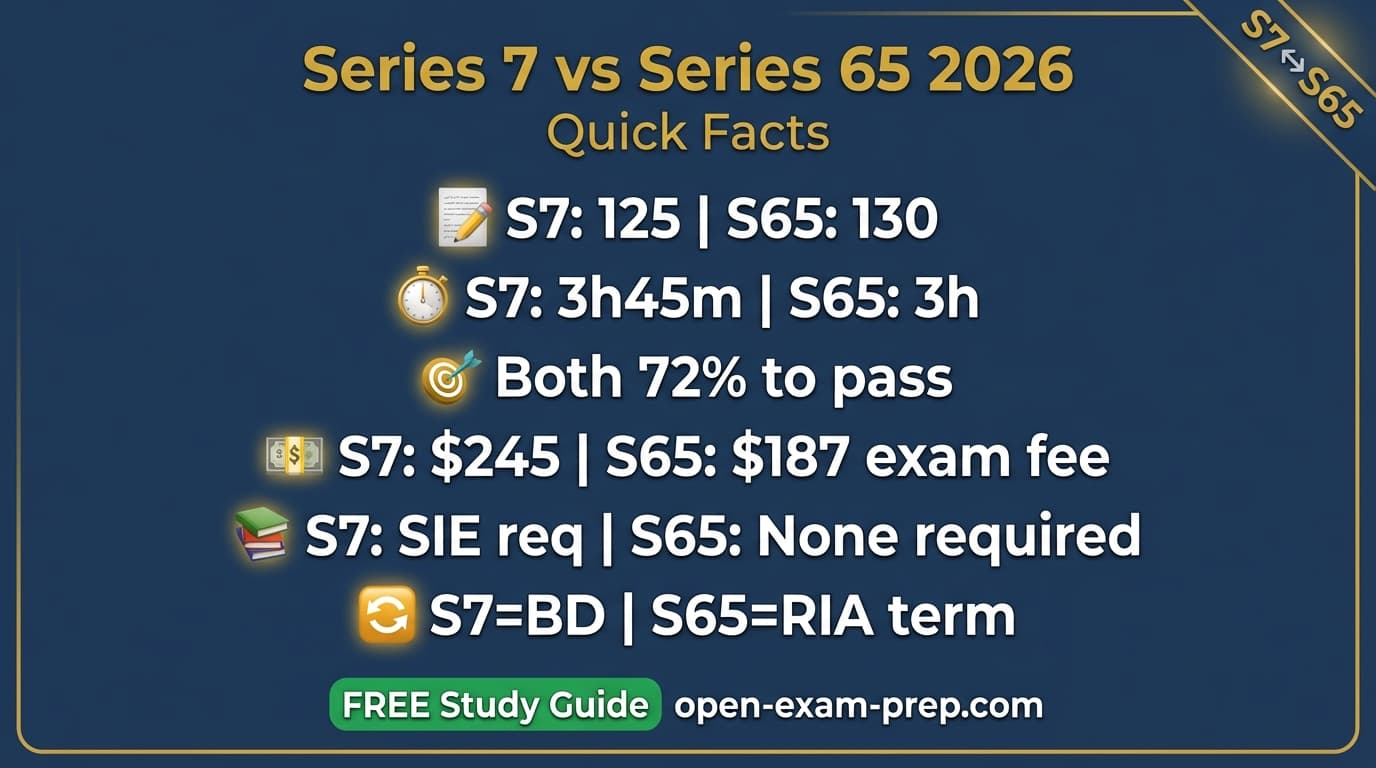
Side-by-Side Comparison
| Feature | Series 7 | Series 65 |
|---|---|---|
| Full Name | General Securities Representative Exam | Uniform Investment Adviser Law Exam |
| Exam Cost | $245 | $187 |
| Passing Score | 72% (83 of 115 scored questions) | 72% (94 of 130 scored questions) |
| Questions | 135 (125 scored + 10 unscored) | 130 (120 scored + 10 unscored pretest items) |
| Time Limit | 3 hours 45 minutes | 3 hours |
| Study Time | 80 - 120 hours over 4 - 8 weeks | 60 - 80 hours over 3 - 6 weeks |
| Difficulty | Challenging | Moderate to Challenging |
| Prerequisites | SIE exam passed + firm sponsorship (Form U4 filing) required | None — no SIE exam, no firm sponsorship, no Form U4 required. Anyone can register and take it. |
| Exam Body | FINRA | NASAA (North American Securities Administrators Association) |
Key Differences
- 1The Series 7 is administered by FINRA and licenses you to sell securities for commissions; the Series 65 is administered by NASAA and qualifies you to provide investment advice for fees — two completely different business models.
- 2The Series 7 requires passing the SIE exam and sponsorship by a FINRA-member broker-dealer; the Series 65 has zero prerequisites — no SIE, no sponsorship, and no Form U4 required.
- 3Series 7 holders operate under the suitability standard (investments must be "suitable" for the client); Series 65 holders at RIAs operate under the fiduciary standard (legally required to act in the client's best interest at all times).
- 4The Series 7 is a FINRA exam focused on securities products, options, bonds, and trade execution; the Series 65 is a NASAA exam focused on investment advisory law, fiduciary duty, portfolio theory, and the Uniform Securities Act.
- 5Series 7 compensation is typically commission-based (35-51% grid at wirehouses, 80-95% payout at IBDs); Series 65/RIA compensation is typically fee-based (0.75-1.25% of AUM, hourly fees, or flat retainers).
- 6The Series 7 has 125 scored questions in 3 hours 45 minutes; the Series 65 has 130 questions (120 scored) in 3 hours — similar length but different content emphasis.
- 7The Series 7 has a higher first-time pass rate (~74%) than the Series 65 (~66%), partly because Series 7 candidates are typically sponsored and studying full-time within a firm's training program.
- 8Many CFP professionals need only the Series 65 — they do not need the SIE or Series 7 unless they want to earn commissions on product sales in addition to advisory fees.
What Each Exam Allows You To Do
Series 7
- Sell all types of securities: stocks, bonds, options, mutual funds, ETFs, variable annuities, and direct participation programs
- Recommend investment strategies and execute trades on behalf of retail and institutional clients
- Work as a registered representative (stockbroker) at any FINRA-member broker-dealer
- Earn transaction-based commissions and markups on securities trades
- Act as a financial advisor at wirehouses like Morgan Stanley, Merrill Lynch, UBS, and Wells Fargo
Series 65
- Act as an Investment Adviser Representative (IAR) at a Registered Investment Adviser (RIA) firm
- Charge fees for investment advice — hourly, flat-fee, or as a percentage of assets under management (AUM)
- Provide holistic financial planning and ongoing portfolio management under a fiduciary duty
- Operate under the fiduciary standard — legally required to act in the client's best interest at all times
- Serve as the licensing requirement for CFP professionals who provide investment advice
Who Should Take Each Exam?
Take the Series 7 if you...
- →Aspiring stockbrokers and registered representatives at full-service broker-dealers
- →Financial advisors who want to earn commissions on product sales and trade execution
- →Candidates targeting wirehouse training programs with high base salaries
- →Anyone wanting the broadest securities transaction license available
Take the Series 65 if you...
- →Aspiring investment adviser representatives at RIA firms
- →CFP professionals who need a securities license to provide investment advice
- →Fee-only financial planners who do not want to sell products for commissions
- →Career changers who want a standalone license without needing SIE or firm sponsorship
- →Anyone pursuing the growing fee-based advisory model over traditional commission-based brokerage
Which Should You Take First?
It depends entirely on your career model. If you want to work at a broker-dealer and earn commissions on securities transactions, you need the Series 7 path (SIE → Series 7 → Series 63 or 66). If you want to work at an RIA and charge fees for investment advice under a fiduciary standard, the Series 65 alone gets you there — no SIE, no sponsorship required. If you want maximum flexibility to do both, the most efficient path is SIE → Series 7 → Series 66 (which combines Series 63 + Series 65 content). Many career changers and CFP candidates start with the Series 65 because it has no barriers to entry: you can study on your own schedule, take the exam whenever you are ready, and begin working at an RIA without waiting for a broker-dealer to sponsor you. The industry trend strongly favors fee-based advisory, making the Series 65 an increasingly attractive starting point.
At a Glance: Series 7 vs Series 65
Exam Cost
$245
Series 7
$187
Series 65
Pass Rate
~74%
Series 7
~66%
Series 65
Prerequisites
SIE + Sponsorship
Series 7
None
Series 65
Avg RIA Advisor Salary
$78,140 (median)
Series 7
$151,000 (avg)
Series 65
Series 7
Aspiring stockbrokers and registered reps at broker-dealers who want to sell all types of securities for transaction-based commissions
Series 65
Aspiring investment adviser representatives at RIAs, CFP professionals, and anyone wanting a standalone license to charge fees for investment advice
Start preparing today:
Key Facts: Series 7 vs Series 65
- 1The Series 7 (FINRA, $245) licenses you to sell securities for commissions at a broker-dealer, while the Series 65 (NASAA, $187) qualifies you to provide investment advice for fees at a Registered Investment Adviser (RIA).
- 2The Series 7 requires passing the SIE exam and obtaining firm sponsorship via Form U4; the Series 65 has zero prerequisites — no SIE, no sponsorship, and anyone can register and take it independently.
- 3Series 7 holders operate under the suitability standard; Series 65 holders at RIAs operate under the fiduciary standard, which legally requires acting in the client's best interest at all times.
- 4The Series 7 has a first-time pass rate of approximately 74% (FINRA, 2023-2024), while the Series 65 has a lower pass rate of approximately 66% (NASAA, 2023-2024) despite being considered moderately easier in content difficulty.
- 5Securities sales agents (Series 7 holders) earn a median of $78,140/year per BLS May 2024 data, while RIA advisors (Series 65 holders) earn an average of $151,000/year according to InvestmentNews 2024 compensation data.
- 6The RIA channel manages over $9 trillion in assets and has been growing at approximately 12% annually, making it the fastest-growing segment of the financial advisory industry.
- 7The Series 66 exam combines Series 63 and Series 65 content into one test — it is available only to candidates who have already passed the Series 7, providing an efficient path to dual brokerage + advisory licensing.
- 8Many CFP (Certified Financial Planner) professionals need only the Series 65 to provide investment advice — they do not need the SIE or Series 7 unless they want to earn commissions on product sales.
- 9The BLS projects 17% growth for personal financial advisors (many of whom are Series 65 holders at RIAs) through 2034, compared to only 3% growth for securities sales agents (Series 7 roles).
- 10The total cost to become a licensed IAR (Series 65 path) is $387-$787, significantly less than the $670-$1,200 required for the full Series 7 licensing path (SIE + Series 7 + state exam + sponsorship fees).
Why This Comparison Matters
Fiduciary vs Suitability
Different Legal Standards
Series 65 holders at RIAs are held to the fiduciary standard — legally required to act in the client's best interest. Series 7 holders at broker-dealers operate under the less stringent suitability standard, only needing to recommend "suitable" investments.
$151,000 Avg
RIA Advisor Compensation
Investment adviser representatives at RIAs earn an average of $151,000 per year according to industry compensation surveys, with top advisors managing $100M+ in AUM earning $300,000-$500,000+.
No Sponsorship Needed
Series 65 Standalone Access
Unlike the Series 7, the Series 65 requires no SIE exam, no firm sponsorship, and no Form U4 filing. Anyone can register, pay $187, and sit for the exam — making it the most accessible path to a securities-related license.
The Series 7 vs Series 65 comparison is really a debate about the future of financial advice itself: commission-based brokerage vs. fee-based fiduciary advisory. For decades, the Series 7 was the default license for anyone entering financial services. You got hired by a broker-dealer, passed the SIE and Series 7, and earned your living from transaction commissions and product sales. That model is not disappearing, but it is shrinking. The explosive growth of the RIA channel — now managing over $9 trillion in assets — has made the Series 65 the license of the future for many advisors.
The distinction matters beyond compensation structure. Series 7 holders at broker-dealers operate under the suitability standard, meaning they must recommend investments that are "suitable" given a client's profile, but they are not required to minimize costs or avoid conflicts of interest. Series 65 holders at RIAs operate under the fiduciary standard, which legally requires them to act in the client's best interest at all times, disclose all conflicts, and charge reasonable fees. The SEC's Regulation Best Interest (Reg BI) has narrowed this gap for broker-dealers since 2020, but a meaningful legal distinction remains.
For career planning, the most important difference may be accessibility. The Series 7 requires you to pass the SIE exam first and then find a FINRA-member broker-dealer willing to sponsor you — a process that can take months. The Series 65 has zero prerequisites: no SIE, no sponsorship, no Form U4. You can register at Prometric, pay $187, and sit for the exam on your own timeline. This makes the Series 65 particularly attractive for career changers, CFP professionals, and anyone who wants to start advising clients without waiting for institutional gatekeepers.
What Each Exam Covers
Series 7 Exam Topics
Pass Rate: ~74% first-time pass rate (FINRA data, 2023-2024)
Series 65 Exam Topics
Pass Rate: ~66% first-time pass rate (NASAA data, 2023-2024)
Salary & Income Comparison
Registered Representative / Securities Sales Agent
$78,140
Median Annual Salary
Range: $47,080 - $215,210+
BLS Occupational Employment Statistics, May 2024 (SOC 41-3031)
Top wirehouse advisors earn $200,000-$500,000+ through grid-based compensation (35-51% of revenue generated). An advisor managing $100M in client assets generating $1M in annual revenue earns $350,000-$510,000 from the grid alone. Independent broker-dealer reps keep 80-95% of revenue but pay their own overhead.
Investment Adviser Representative / Financial Advisor (RIA)
$78,695
Median Annual Salary
Range: $55,000 - $200,000+
ZipRecruiter, 2025 (IAR median); InvestmentNews RIA Compensation Study, 2024 (RIA advisor average $151,000)
RIA advisors managing $100M+ in client assets typically earn $200,000-$500,000+. The AUM-based fee model (typically 0.75-1.25% of assets) creates recurring revenue that compounds as client portfolios grow. A solo RIA advisor managing $50M in AUM at 1% generates $500,000 in annual revenue, retaining 60-80% as personal income after overhead. RIA firm owners with $500M+ AUM can earn $1M+.
| Commission Detail | Series 7 |
|---|---|
| First-Year Commission | Trainee salary ($50,000-$80,000 base) transitioning to grid-based payout over 18-24 months |
| Renewal Commission | 35-51% of revenue at wirehouses; 80-95% at independent broker-dealers |
| Income Model | Wirehouse compensation follows a "grid" system: you earn 35-51% of the revenue you generate from client trading commissions, markups, advisory fees, and product sales. New advisors generating $300,000 in annual revenue take home approximately $105,000-$153,000. Independent broker-dealer reps keep 80-95% of revenue but pay their own office, compliance, and technology costs. The commission-based model directly rewards transaction volume and product sales, which creates inherent conflicts of interest that the fiduciary movement seeks to address. |
Compensation for Series 7 and Series 65 holders follows fundamentally different economic models. Series 7 registered representatives earn through commissions: BLS May 2024 data reports a median of $78,140 for securities sales agents (SOC 41-3031), with the top 10% earning over $215,210. Wirehouse advisors earn 35-51% of revenue generated through the grid system, meaning an advisor producing $500,000 in annual revenue takes home $175,000-$255,000. The commission model rewards transaction volume and product sales, producing volatile income that is heavily front-loaded toward new asset gathering.
Series 65 holders at RIAs earn through fees — typically 0.75-1.25% of assets under management (AUM), hourly fees ($150-$400/hour), or flat retainers ($2,000-$10,000/year). According to the InvestmentNews RIA Compensation Study (2024), the average RIA advisor earns approximately $151,000 per year, while ZipRecruiter reports a median of $78,695 for investment adviser representatives broadly. The fee-based model produces more predictable, recurring revenue that compounds as client portfolios grow: a solo advisor managing $50M in AUM at 1% generates $500,000 in annual revenue before overhead. RIA firm owners managing $200M+ routinely earn $300,000-$700,000+. The trade-off is that fee-based income takes longer to build — you need significant AUM before the math works — whereas commission-based reps can earn substantial income from day one by selling high-commission products.
Total Cost to Get Licensed
| Expense | Series 7 | Series 65 |
|---|---|---|
| Pre-Licensing Education | $150 - $500 (prep course: Kaplan $349, Achievable $149, ExamFX $199-$349, Knopman $350+) | $150 - $400 (prep course: Kaplan $279, Achievable $149, ExamFX $179-$299, Knopman $300+) |
| Exam Fee | $325 ($80 SIE + $245 Series 7) | $187 (NASAA — single exam, no SIE required) |
| License Fee | $147-$177 (Series 63 at $147 or Series 66 at $177 for state registration) | $0 - $100 (state IAR registration fees vary; some states have no additional fee) |
| Background Check | $50 - $100 (fingerprinting and background check via Form U4) | $50 - $100 (fingerprinting via Form U4 when associating with an RIA) |
| Total Investment | $670 - $1,200 (SIE + Series 7 + state exam + prep courses + Form U4 processing) | $387 - $787 (Series 65 exam + prep course + state registration + background check) |
A Day in the Life
Series 7 Professional
A Series 7-licensed registered representative at a wirehouse arrives at 7:30 AM to review overnight market movements and pre-market earnings reports. At 9:00 AM, she executes several rebalancing trades for clients and follows up on a pending municipal bond allocation. At 10:00 AM, she calls a prospect — a dentist with $600,000 in a rollover IRA — and pitches a managed account with an upfront commission on a variable annuity allocation. After lunch, she meets with an existing client couple to review their quarterly performance and recommend adding international equity exposure. At 2:30 PM, she joins a product wholesaler presentation on a new structured note offering. She ends the day at 5:00 PM reviewing her production numbers: $18,000 in gross commissions this week, putting her on pace for $280,000 in annual production at a 42% grid payout — roughly $117,600 in take-home compensation.
Series 65 Professional
A Series 65-licensed investment adviser representative at a fee-only RIA starts her morning at 8:30 AM reviewing client financial plans and preparing for two comprehensive planning meetings. At 9:30 AM, she meets with a newly retired couple to walk through their retirement income strategy — Social Security optimization, Roth conversion schedule, and a dynamic withdrawal plan from their $1.2M portfolio. She charges a 0.85% AUM fee, generating $10,200 annually from this relationship. At 11:00 AM, she reviews the firm's model portfolios and initiates tax-loss harvesting trades across 12 client accounts. After lunch, she conducts a discovery meeting with a prospective client — a 42-year-old tech executive with $900,000 in stock options and RSUs — discussing equity concentration risk, tax planning, and estate considerations. At 3:00 PM, she works on two financial plans, running Monte Carlo simulations and adjusting assumptions. She ends the day knowing her 68-client book generates $285,000 in annual recurring revenue for the firm, of which she earns $165,000 in salary plus performance bonus.
Career Paths & Progression
Series 7 Career Path
0-2 years
Registered Rep Trainee (Wirehouse)
$50K-$80K base
3-5 years
Financial Advisor / Wealth Manager
$100K-$200K
5-10 years
Senior Financial Advisor / Team Lead
$200K-$400K
10+ years
Managing Director / Branch Manager
$300K-$600K+
Series 65 Career Path
0-2 years
Associate Advisor / Paraplanner (RIA)
$50K-$70K
3-5 years
Lead Advisor / Financial Planner (RIA)
$90K-$150K
5-10 years
Senior Advisor / Partner (RIA)
$150K-$300K
10+ years
RIA Firm Owner / Managing Partner
$300K-$1M+
Series 7 holders typically follow the broker-dealer track: (1) Wirehouse advisor — building a client book at Morgan Stanley, Merrill Lynch, UBS, or Wells Fargo, earning grid-based compensation of 35-51% of revenue with firm-provided infrastructure, brand recognition, and warm leads; (2) Independent broker-dealer rep — affiliating with LPL Financial, Raymond James, or Cetera, keeping 80-95% of revenue but managing your own practice; (3) Institutional sales — working on a trading desk or in institutional distribution, where the Series 7 covers the securities you trade and sell.
Series 65 holders follow the RIA advisory track: (1) RIA employee advisor — joining an established RIA firm as a lead advisor or financial planner, earning a salary plus bonus based on client retention and AUM growth; (2) Solo RIA owner — launching your own fee-only practice, keeping 100% of revenue minus overhead (compliance, technology, E&O insurance); (3) Hybrid advisory — working at a dual-registered firm that operates as both a broker-dealer and an RIA, offering both commission and fee-based services. The RIA channel has grown at roughly 12% annually over the past decade, making it the fastest-growing segment of the advisory industry. Many experienced Series 7 holders eventually transition to the RIA model for its higher long-term economics and stronger client alignment.
Start preparing today:
Should You Get Both Series 7 and Series 65?
Benefits
- +Holding both licenses gives you maximum flexibility: you can earn commissions on product sales (Series 7) AND charge advisory fees (Series 65) — the "hybrid" model used by the largest advisory firms
- +The Series 66 exam (which combines Series 63 + 65 content) is available to Series 7 holders, providing an efficient path to dual licensing in a single additional exam
- +Dual-licensed advisors at dual-registered firms (broker-dealer + RIA) can choose the most appropriate compensation model for each client relationship
- +The industry trend is toward fee-based advisory, so even commission-based reps benefit from adding Series 65 capability to future-proof their careers
- +Many wirehouse and independent broker-dealer training programs now require SIE + Series 7 + Series 66 as the baseline licensing package
Considerations
- !The Series 66 requires the Series 7 as a prerequisite — you cannot take the Series 66 without first passing the Series 7, meaning the standalone Series 65 is more accessible for those without broker-dealer sponsorship
- !Dual licensing means dual regulatory oversight: you must comply with both FINRA rules (for brokerage activities) and SEC/state regulations (for advisory activities), increasing compliance burden
- !If you are certain you want a fee-only RIA career with no commission-based business, the Series 65 alone is sufficient and the Series 7 adds unnecessary cost and complexity
- !Maintaining both licenses requires ongoing continuing education for FINRA registration plus separate requirements for state IAR registration
The Verdict: For maximum career flexibility, the optimal path is SIE → Series 7 → Series 66 — this gives you both the broadest securities transaction authority and full advisory capability in a single efficient sequence. However, if you are specifically targeting a fee-only RIA career, want to avoid the SIE and sponsorship requirements, or are pursuing the CFP designation alongside advisory work, the standalone Series 65 is a perfectly valid and increasingly popular choice. The industry is moving toward fee-based advisory, so a Series 65-only path is not a limitation — it is a strategic decision aligned with where the profession is headed.
Job Outlook & Industry Trends
3% (2024-2034, BLS)
Series 7 Job Growth (2024-2034)
17% (projected for personal financial advisors, 2024-2034, BLS)
Series 65 Job Growth (2024-2034)
The BLS projects 3% growth for securities sales agents (Series 7 roles) through 2034, reflecting the mature broker-dealer market. However, the BLS projects 17% growth for personal financial advisors (SOC 13-2052) — a category heavily populated by Series 65/IAR roles — significantly faster than the average for all occupations. The RIA channel has been the fastest-growing segment of financial services for over a decade, now managing over $9 trillion in assets. An estimated 30-40% of financial advisors will retire by 2030, creating massive book-of-business acquisition opportunities. The secular shift from commission-based brokerage to fee-based advisory — driven by regulatory pressure (Reg BI, DOL fiduciary rule), consumer preference for transparency, and the economics of recurring AUM fees — structurally favors Series 65 holders. That said, broker-dealers remain critical to capital markets, and the 38,100 annual openings projected for securities sales agents ensure continued demand for Series 7 holders.
Study Strategy & Tips
Decide Your Path
Determine whether you need Series 7, Series 65, or both
- Research whether your target employer is a broker-dealer (Series 7) or an RIA (Series 65)
- If pursuing CFP and fee-only planning, the Series 65 alone is likely sufficient
- If you want both brokerage and advisory capability, plan for SIE → Series 7 → Series 66 (which covers Series 63 + 65)
- If taking Series 65 standalone, skip to Phase 3 — no SIE or sponsorship needed
Series 7 Path: SIE + Series 7 Preparation
Pass SIE prerequisite and then the Series 7 exam
- Complete an SIE prep course and pass the SIE exam (40-60 hours study, ~3 weeks)
- Secure broker-dealer sponsorship and file Form U4
- Begin intensive Series 7 study: focus 73% of effort on the Recommendations section
- Master options (4 basic positions, breakeven, spreads, straddles), bonds (pricing, yields), and suitability analysis
- Take 5-8 full-length timed practice exams scoring 80%+ before scheduling
Series 65 Path: Standalone Preparation
Pass the Series 65 exam — no prerequisites needed
- Complete a Series 65 prep course (Kaplan, Achievable, ExamFX, or similar)
- Study Laws, Regulations, and Ethics (30%) — master the Uniform Securities Act, registration requirements, and prohibited practices
- Study Client Recommendations and Strategies (30%) — portfolio theory, asset allocation, risk management, fiduciary duty
- Study Investment Vehicle Characteristics (25%) — stocks, bonds, options, alternatives, insurance products
- Take 4-6 full-length timed practice exams scoring 78%+ before scheduling the real exam
Post-Exam: State Registration & Career Launch
Complete state registration and begin practicing
- Series 7 holders: pass Series 63 or Series 66 for state registration as a securities agent (and IAR if Series 66)
- Series 65 holders: file Form U4 through your RIA firm for state registration as an Investment Adviser Representative
- Complete any firm-required compliance training and onboarding
- Begin client-facing work under supervision as required by your firm
Total Duration: 8-14 weeks (depending on which exam or both)
Series 7 Study Tips
- 1Dedicate 30-40% of your study time to options. Options questions are the #1 reason candidates fail. Master the four basic positions (long call, short call, long put, short put), breakeven formulas, max gain/loss calculations, and multi-leg strategies including spreads, straddles, and combinations.
- 2Master bond pricing: the inverse relationship between price and yield, current yield calculations, yield to maturity, discount vs. premium bonds, and duration concepts. Bond questions appear throughout the exam and are often calculation-heavy.
- 3Learn suitability inside and out. The exam presents client scenarios and asks which investment is most suitable. Always consider the client's age, risk tolerance, time horizon, liquidity needs, tax situation, and investment objectives.
- 4Understand margin account mechanics: Regulation T (50% initial margin), minimum maintenance (25%), margin call calculations, and restricted account rules. Margin questions are heavily tested and often trip up candidates.
- 5Take 5-8 full-length timed practice exams. At 3 hours and 45 minutes, the Series 7 is a marathon — you need both content mastery and testing stamina. Review every wrong answer to understand the reasoning, not just the correct choice.
Series 65 Study Tips
- 1Focus 60% of your study time on the two 30% sections: Client Investment Recommendations and Strategies, and Laws/Regulations/Ethics. Together they represent 60% of scored questions and cover the concepts most unique to the Series 65 (fiduciary duty, Uniform Securities Act, state registration requirements).
- 2Master the Uniform Securities Act (USA) — this is the backbone of the regulatory section. Know the definitions of "investment adviser," "investment adviser representative," "broker-dealer," and "agent" under the USA, including all exemptions and exclusions.
- 3Understand the difference between federal and state registration thresholds: RIAs with $100M+ AUM register with the SEC; those under $100M register with the state. Know the "switching" provisions and de minimis exemptions for multi-state advisors.
- 4Learn modern portfolio theory, efficient market hypothesis, alpha, beta, standard deviation, Sharpe ratio, and capital asset pricing model (CAPM). The exam tests investment theory more heavily than the Series 7, which focuses on product mechanics.
- 5Do not underestimate the ethical and fiduciary duty questions. The exam heavily tests prohibited practices, conflicts of interest, disclosure requirements, and the difference between the fiduciary standard (Series 65/RIA) and the suitability standard (Series 7/broker-dealer).
Ready to Start Studying?
Free practice questions, study guides, and AI tutoring for the matching exam resources.
Frequently Asked Questions
QCan I take the Series 65 without the SIE exam?
Yes — this is one of the biggest advantages of the Series 65. Unlike the Series 7 (which requires both the SIE and firm sponsorship), the Series 65 has absolutely no prerequisites. You do not need to pass the SIE, you do not need a sponsoring firm, and you do not need to file Form U4 to sit for the exam. Anyone can register at a Prometric testing center, pay the $187 exam fee, and take the Series 65 on their own timeline. This makes it the most accessible path to a securities-related license in the industry.
QWhat is the difference between the suitability standard and the fiduciary standard?
The suitability standard (which applies to Series 7 holders at broker-dealers) requires that investment recommendations be "suitable" for a client based on their financial profile — but it does not require the advisor to act in the client's best interest or to choose the lowest-cost option. The fiduciary standard (which applies to Series 65 holders at RIAs) is a higher legal obligation that requires the advisor to act in the client's best interest at all times, disclose all material conflicts of interest, and charge only reasonable fees. The SEC's Regulation Best Interest (Reg BI), effective since June 2020, has raised the bar for broker-dealers beyond basic suitability, but most legal experts agree it still falls short of the full fiduciary standard that RIAs must follow.
QShould I get the Series 65 or the Series 66?
It depends on whether you have the Series 7. The Series 66 combines the content of the Series 63 (state securities law) and Series 65 (investment adviser law) into a single exam — but it requires the Series 7 as a prerequisite. If you already have the Series 7, the Series 66 is more efficient than taking the Series 63 and Series 65 separately. If you do not have the Series 7 and do not plan to get it, the standalone Series 65 is your only option for IAR licensing. Many CFP professionals and fee-only advisors take the Series 65 alone because they have no need for the Series 7 brokerage license.
QWhich exam leads to higher income: Series 7 or Series 65?
Both can lead to very high incomes, but through different models. Series 7 compensation is commission-driven: BLS reports a median of $78,140 for securities sales agents, with top wirehouse advisors earning $300,000-$500,000+ via grid-based payouts. Series 65/RIA compensation is fee-driven: the average RIA advisor earns $151,000 per year, with top advisors managing $100M+ in AUM earning $300,000-$700,000+. The key difference is trajectory: commission income is volatile and front-loaded (you earn big on product sales immediately), while fee-based income is slower to build but creates compounding recurring revenue over time. Many of the highest-earning advisors in the industry started on the Series 7 commission track, then transitioned to fee-based advisory as their client books matured.
QDo CFP professionals need the Series 7?
Not necessarily. CFP professionals who work at fee-only RIA firms typically need only the Series 65 to provide investment advice. The Series 7 is only required if the CFP professional also wants to execute securities transactions for commissions — for example, selling mutual funds with a sales load or recommending variable annuities. Many CFP professionals deliberately choose fee-only practices specifically to avoid the conflicts of interest inherent in commission-based compensation, making the Series 65 their only licensing requirement. However, CFP professionals at dual-registered firms (broker-dealer + RIA) generally need both the Series 7 and Series 65 (or Series 66) to operate in both capacities.
QIs the Series 65 harder than the Series 7?
The Series 65 has a lower first-time pass rate (~66%) compared to the Series 7 (~74%), which surprises many candidates. However, this difference is largely attributable to preparation context rather than raw difficulty. Series 7 candidates are almost always sponsored by a broker-dealer, studying full-time within a structured training program with dedicated resources and accountability. Series 65 candidates often study independently, on their own schedule, without employer support — leading to more inconsistent preparation. Content-wise, the Series 7 is generally considered more technically demanding (options calculations, bond pricing, margin mechanics), while the Series 65 is more conceptually challenging (investment theory, fiduciary law, Uniform Securities Act). With 60-80 hours of focused study, most candidates can pass the Series 65 comfortably.
10 free AI interactions per day
Free exam resources
Start Studying the Exact Exam
Use the comparison to choose a path, then move into the matching practice questions, study guide, and flashcards.
Third-party resources · We may earn a commission from purchases.

Kaplan Series 7 License Exam Manual, 2nd Edition - Comprehensive Exam Prep for the Series 7 General Securities Representative Exam
By Kaplan Financial Education
$127.33 · 
 Practice exams on ExamEdge
 Take courses on Udemy
 Prep course on Achievable
 Flashcards on Mometrix
Related Exam Comparisons
Stay Updated
Get free exam tips and study guides delivered to your inbox.