CMA vs Series 7
The CMA (Certified Management Accountant) and Series 7 (General Securities Representative) lead to completely different careers with virtually no overlap. The CMA is a professional certification for corporate finance professionals who work inside companies — managing budgets, analyzing costs, forecasting revenue, and advising executives on strategic financial decisions. The Series 7 is a FINRA license for investment sales professionals who work at broker-dealers — selling stocks, bonds, mutual funds, and other securities to external clients. A CMA will never need a Series 7, and a Series 7 holder will never need a CMA. This comparison helps people deciding between a corporate finance career path (controller, FP&A director, CFO) and an investment sales career path (financial advisor, stockbroker, wealth manager).
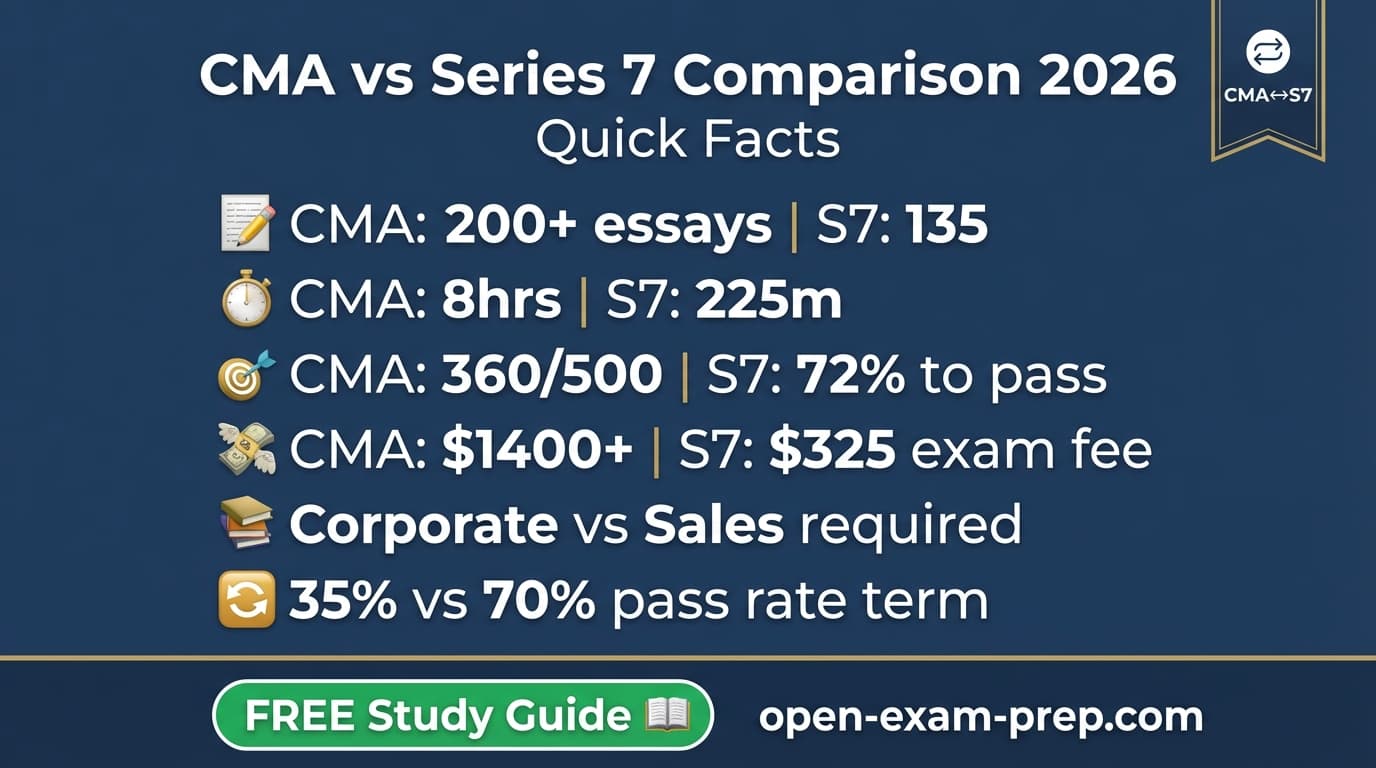
Side-by-Side Comparison
| Feature | CMA | Series 7 |
|---|---|---|
| Full Name | Certified Management Accountant | General Securities Representative Exam |
| Exam Cost | $545 per part ($1,090 total exam fees) + IMA professional membership ($280/year) + exam entrance fee ($280 per part for non-IMA members, waived with membership) | $245 (+ $80 for SIE prerequisite exam) |
| Passing Score | 360 out of 500 (scaled score) | 72% (83 of 115 scored questions) |
| Questions | 100 multiple-choice questions + 2 essay questions per part (two parts total) | 135 (125 scored + 10 unscored) |
| Time Limit | 4 hours per part (8 hours total across both parts) | 3 hours 45 minutes |
| Study Time | 300 - 400 hours over 6 - 12 months (150-200 hours per part) | 80 - 120 hours over 4 - 8 weeks |
| Difficulty | Very Challenging | Challenging |
| Prerequisites | Bachelor's degree from an accredited institution + 2 years of continuous professional experience in management accounting or financial management (can be completed within 7 years of passing the exam) | SIE exam passed + sponsorship by a FINRA-member broker-dealer (Form U4 filing required) |
| Exam Body | IMA (Institute of Management Accountants) | FINRA (Financial Industry Regulatory Authority) |
Key Differences
- 1The CMA is a professional certification for working inside corporations (internal finance, budgeting, cost analysis, strategic planning); the Series 7 is a regulatory license for selling securities to external clients at broker-dealers. These are completely separate career tracks.
- 2The CMA is administered by IMA (Institute of Management Accountants) and is a voluntary professional credential; the Series 7 is administered by FINRA and is a mandatory regulatory license — you cannot legally sell securities without it.
- 3The CMA has a 35-45% first-time pass rate, making it dramatically harder than the Series 7 at ~74%. The CMA requires mastery of essays, financial analysis, and strategic reasoning, while the Series 7 focuses on product knowledge and suitability analysis.
- 4CMA preparation requires 300-400 hours across two exam parts (each 4 hours with essays); the Series 7 requires 80-120 hours for a single 3-hour-45-minute multiple-choice exam — roughly 3x the study investment for the CMA.
- 5The CMA requires a bachelor's degree plus 2 years of management accounting experience; the Series 7 requires only a passed SIE exam and sponsorship by a broker-dealer — no degree or prior experience necessary.
- 6CMA holders earn a median of $90,000-$120,000 in stable, salaried corporate roles with predictable income; Series 7 holders earn a BLS median of $78,140 but with wide variance — top wirehouse advisors earn $200,000-$500,000+ while many early-career reps wash out.
- 7The CMA career trajectory is predictable and hierarchical: staff accountant → senior accountant → FP&A manager → controller → VP of Finance → CFO. The Series 7 career is entrepreneurial: trainee → building a client book → independent advisor, with income determined by sales ability.
- 8CMA exam fees total $1,090 plus $280/year IMA membership; Series 7 fees are $245 plus $80 for the SIE — but the CMA requires a college degree and years of experience that the Series 7 does not.
What Each Exam Allows You To Do
CMA
- Lead financial planning and analysis (FP&A) teams, building budgets, forecasts, and variance analyses that drive corporate decision-making
- Serve as a corporate controller managing all internal accounting, financial reporting, and compliance functions
- Advance toward CFO and VP of Finance positions — the CMA is the most recognized credential for the corporate finance leadership track
- Perform cost accounting, profitability analysis, and capital budgeting to optimize business operations
- Provide strategic financial counsel to C-suite executives and boards of directors on mergers, investments, and resource allocation
- Work in internal audit, risk management, or corporate treasury functions within Fortune 500 companies and mid-market firms
Series 7
- Sell all types of securities to clients: stocks, bonds, options, mutual funds, ETFs, variable annuities, and direct participation programs
- Recommend investment strategies, execute trades, and manage client portfolios at any FINRA-member broker-dealer
- Work as a registered representative (stockbroker) at wirehouses like Morgan Stanley, Merrill Lynch, UBS, or Wells Fargo
- Build a client book generating commissions on securities transactions or manage fee-based accounts (with Series 66/65)
- Prospect for new clients, conduct financial needs analyses, and present comprehensive financial plans
Who Should Take Each Exam?
Take the CMA if you...
- →Accounting and finance professionals targeting corporate FP&A, controller, or CFO roles
- →Mid-career professionals in management accounting seeking a credential that accelerates promotion
- →MBA graduates who want to complement their degree with a specialized financial management certification
- →International finance professionals — the CMA is globally recognized in over 100 countries
Take the Series 7 if you...
- →Aspiring stockbrokers and registered representatives who want to sell securities
- →Financial advisors at full-service broker-dealers and wirehouses
- →Sales-oriented professionals targeting high-income client-facing financial services roles
- →Anyone wanting the broadest securities license to sell virtually all investment products
Which Should You Take First?
You should not take both — choose the credential that matches your desired career path. If you want to work inside corporations managing financial operations, building budgets, performing cost analysis, and advancing toward controller or CFO roles, pursue the CMA. If you want to work at a broker-dealer selling investments to clients, building a book of business, and earning commissions or advisory fees, pursue the Series 7. The two credentials serve entirely different industries. In the rare case that someone wants exposure to both (for example, a corporate treasurer who also needs to understand investment products), the CMA should come first because it requires a degree and years of experience — by contrast, you can obtain the Series 7 relatively quickly once you have firm sponsorship. However, this scenario is exceptionally uncommon, and most professionals will never need both.
At a Glance: CMA vs Series 7
Exam Cost
$1,090 (+ $280/yr dues)
CMA
$245 (+ $80 SIE)
Series 7
Pass Rate
~35-45%
CMA
~74%
Series 7
Study Time
300-400 hrs
CMA
80-120 hrs
Series 7
Median Salary
$90K-$120K
CMA
$78,140
Series 7
CMA
Professionals pursuing corporate finance careers — FP&A analysts, controllers, CFOs — who want to work inside companies managing budgets, forecasts, and strategic financial decisions
Series 7
Aspiring stockbrokers, financial advisors at broker-dealers, and anyone wanting to sell securities to external clients at wirehouses or independent firms
Start preparing today:
Key Facts: CMA vs Series 7
- 1The CMA and Series 7 lead to completely different careers with virtually zero overlap: CMA holders work inside corporations managing budgets and financial strategy, while Series 7 holders work at broker-dealers selling investments to external clients.
- 2The CMA has a 35-45% first-time pass rate according to IMA candidate performance data, making it dramatically harder than the Series 7 at approximately 74% (FINRA data, 2023-2024).
- 3CMA preparation requires 300-400 hours of study across two 4-hour exam parts (each with 100 MCQs + 2 essays), compared to 80-120 hours for the single Series 7 exam of 125 scored multiple-choice questions.
- 4IMA reports that CMA holders earn 31% more in total compensation than non-certified management accountants, with U.S. median salaries of $90,000-$120,000 for mid-career professionals.
- 5Series 7 holders (securities sales agents) earn a BLS median of $78,140 per year (May 2024), but top wirehouse advisors earn $200,000-$500,000+ through grid-based compensation of 35-51% of revenue generated.
- 6The CMA requires a bachelor's degree from an accredited institution plus 2 years of continuous management accounting experience; the Series 7 requires only a passed SIE exam and broker-dealer sponsorship with no degree requirement.
- 7CMA total costs are $2,570-$3,870 (prep courses + exam fees + IMA membership) with $280/year ongoing dues, compared to $675-$1,100 for Series 7 (SIE + exam + state license + prep course), with many firms reimbursing Series 7 costs.
- 8The BLS projects 11% growth for financial managers (CMA career path) through 2034, compared to 3% growth for securities sales agents (Series 7 career path), though Series 7 roles have higher turnover creating persistent entry-level demand.
- 9CMA career progression follows a predictable corporate ladder (analyst → controller → CFO) with stable salaries, while Series 7 careers are entrepreneurial and sales-driven, with 60-70% of wirehouse trainees leaving the industry within 3 years.
- 10The CMA is globally recognized in over 100 countries by IMA, while the Series 7 is a U.S.-specific FINRA license that has no direct equivalent outside the United States.
Why This Comparison Matters
0% Overlap
Completely Different Careers
The CMA and Series 7 lead to entirely separate industries. CMAs work inside corporations on budgets and strategy. Series 7 holders work at broker-dealers selling investments to clients. You will never need both.
31% Premium
CMA Salary Advantage
IMA reports that CMA holders earn 31% more than non-certified management accountants. Controllers earn $120K-$200K, and CFOs at mid-to-large companies earn $200K-$400K+.
35-45%
CMA Pass Rate
The CMA is dramatically harder to pass than the Series 7 (~74%). Each CMA part combines 100 MCQs with 2 essay questions requiring in-depth financial analysis and written communication skills.
This comparison exists not because the CMA and Series 7 are similar — they are not — but because career changers frequently ask whether they should enter corporate finance or investment sales. The two paths diverge so completely that choosing the wrong one can cost years of misdirected effort.
The CMA credential signals mastery of management accounting: budgeting, forecasting, cost analysis, performance management, and corporate finance. CMAs work inside companies, sitting in the finance department alongside the CFO, analyzing internal data to drive strategic decisions. IMA reports that CMA holders earn 31% more than their non-certified peers, and the credential is recognized in over 100 countries. The career trajectory is structured and predictable — you climb the corporate ladder from analyst to controller to CFO.
The Series 7 license is an entirely different animal. It is a regulatory requirement for anyone who wants to sell securities to clients at a FINRA-member broker-dealer. Series 7 holders work in client-facing, sales-driven roles — prospecting for new clients, recommending investments, executing trades, and managing relationships. The BLS reports a median salary of $78,140 for securities sales agents, but compensation is wildly variable. Top wirehouse advisors earn $200,000-$500,000+, while many trainees wash out within the first two years because they cannot build a sufficient client base. The career rewards salesmanship and relationship-building, not technical accounting skills.
What Each Exam Covers
CMA Exam Topics
Pass Rate: ~35-45% first-time pass rate (IMA candidate performance data, 2023-2024; Part 1 is historically slightly easier than Part 2)
Series 7 Exam Topics
Pass Rate: ~74% first-time pass rate (FINRA data, 2023-2024)
Salary & Income Comparison
Management Accountant / Financial Manager (CMA Certified)
$90,000 - $120,000
Median Annual Salary
Range: $65,000 - $400,000+ (staff accountant to CFO)
IMA Global Salary Survey, 2024; BLS Financial Managers SOC 11-3031, May 2024
IMA reports that CMA holders earn 31% more in total compensation than non-certified management accountants globally. In the U.S., controllers at mid-size companies earn $120,000-$200,000, VP of Finance roles pay $150,000-$250,000, and CFOs at companies with $100M-$1B in revenue earn $200,000-$400,000+. At Fortune 500 companies, CFO total compensation (salary + bonus + equity) routinely exceeds $1M.
Registered Representative / Securities Sales Agent
$78,140
Median Annual Salary
Range: $47,080 - $215,210+
BLS Occupational Employment Statistics, May 2024 (SOC 41-3031)
BLS data significantly understates top earner compensation. Wirehouse financial advisors earn 35-51% of revenue through grid-based compensation. An advisor managing $100M in client assets producing $1M in annual revenue earns $350,000-$510,000 from the grid alone. Senior advisors at wirehouses routinely earn $200,000-$500,000+, and top producers exceed $1M in total compensation.
| Commission Detail | Series 7 |
|---|---|
| First-Year Commission | Trainee salary ($50,000-$80,000 base) transitioning to grid-based payout over 18-24 months |
| Renewal Commission | 35-51% of revenue at wirehouses; 80-95% at independent broker-dealers |
| Income Model | Wirehouse compensation follows a grid system: you earn 35-51% of the revenue you generate from client trading commissions, advisory fees, and product sales. Independent broker-dealer reps keep 80-95% of revenue but pay their own overhead. Income is directly proportional to the size and activity of your client book — the same grid percentage on $500K in revenue produces $175,000-$255,000 in take-home pay. |
CMA and Series 7 salaries reflect fundamentally different compensation models. CMA holders earn stable, salaried income that increases predictably with experience and title. Series 7 holders earn variable income tied to sales production, with enormous upside but significant downside risk in early years.
CMA salary data: According to the IMA 2024 Global Salary Survey and BLS Financial Managers data (SOC 11-3031), CMA holders in the U.S. earn a median of $90,000-$120,000. IMA reports that CMA holders earn 31% more in total compensation than non-certified management accountants. Senior-level roles pay substantially more: controllers at mid-size companies earn $120,000-$200,000, VP of Finance roles command $150,000-$250,000, and CFOs at companies with $100M-$1B in revenue earn $200,000-$400,000+. At Fortune 500 companies, CFO total compensation (salary + bonus + equity) routinely exceeds $1M. CMA income is highly predictable — salaries are set annually, bonuses are formula-driven, and job security in corporate finance is strong.
Series 7 salary data: According to BLS May 2024 data (SOC 41-3031), securities sales agents earn a median of $78,140, with the 10th percentile at $47,080 and the 90th percentile at $215,210. However, BLS data understates top earner compensation. Wirehouse advisors operating on grid-based compensation (earning 35-51% of revenue generated) can earn $200,000-$500,000+ once established. An advisor producing $1M in annual revenue takes home $350,000-$510,000. The catch: most wirehouse trainees start at $50,000-$80,000 base salary, and industry washout rates during the first 2-3 years exceed 60-70%. Series 7 income is high-ceiling but high-variance — the best earn more than most CMAs, but many early-career reps earn less.
Total Cost to Get Licensed
| Expense | CMA | Series 7 |
|---|---|---|
| Pre-Licensing Education | $1,200 - $2,500 (Gleim $1,599, Wiley $1,350-$2,400, Hock $1,199-$2,499 for full review courses covering both parts) | $150 - $500 (prep course: Kaplan $349, Achievable $149, ExamFX $199-$349, Knopman $350+) |
| Exam Fee | $1,090 ($545 per part x 2 parts — IMA member pricing) | $325 ($245 Series 7 + $80 SIE) |
| License Fee | $280/year (IMA professional membership, required to maintain CMA credential) + initial IMA entrance fee may apply | $147-$177 (Series 63 at $147 or Series 66 at $177 for state registration) |
| Background Check | N/A (IMA verifies education and experience but does not require fingerprinting or background checks) | $50 - $100 (fingerprinting and background check via Form U4) |
| Total Investment | $2,570 - $3,870 (prep course + both exam parts + first year IMA membership), plus $280/year ongoing dues and 30 hours/year CPE | $675 - $1,100 (SIE + Series 7 + state exam + prep course + background check); many broker-dealers reimburse all costs |
A Day in the Life
CMA Professional
A CMA-certified FP&A manager at a mid-size technology company starts her day at 8:00 AM reviewing the monthly variance report she built over the weekend. Revenue came in 4% above forecast, but R&D spending is 8% over budget — she needs to understand why before the 10:00 AM executive team meeting. She pulls cost center data, identifies that the overage is driven by a new product development sprint the CTO approved mid-quarter, and prepares a one-page analysis with recommendations for adjusting the Q3 forecast. In the executive meeting, the CFO asks her to model three scenarios for the upcoming board presentation: aggressive growth (30% revenue increase with higher burn), moderate growth (15% with current team), and steady-state. After lunch, she meets with the VP of Sales to review pipeline data for next quarter's revenue forecast, then spends two hours building the scenario models in Excel. She ends the day reviewing capital expenditure requests from three department heads, running NPV calculations on each to recommend which investments to approve.
Series 7 Professional
A Series 7-licensed financial advisor at a wirehouse starts at 7:30 AM reviewing overnight market movements, Asian and European market closes, and pre-market earnings reports for stocks his clients hold. At 9:00 AM, he calls a retiree client whose portfolio dropped 2% yesterday to reassure her that her asset allocation is appropriate for her risk tolerance and time horizon. At 10:00 AM, he meets with a new prospect — a business owner who just sold his company for $3M and needs a comprehensive investment strategy. He conducts a detailed needs analysis: risk tolerance, income needs, tax situation, estate planning goals, and time horizon. After lunch, he prepares a proposal combining taxable brokerage, IRA, and municipal bond allocations tailored to the prospect's 37% tax bracket. At 2:00 PM, he conducts three quarterly portfolio reviews by phone. At 4:00 PM, he makes prospecting calls to 15 leads from a recent seminar he hosted on retirement planning. He ends the day reviewing his pipeline: $5M in pending proposals, 2 account transfers in progress, and a client appreciation dinner next Tuesday.
Career Paths & Progression
CMA Career Path
0-2 years
Staff Accountant / Junior Financial Analyst
$55K-$70K
2-5 years
Senior Accountant / FP&A Analyst (CMA earned)
$75K-$100K
5-8 years
FP&A Manager / Assistant Controller
$100K-$140K
8-12 years
Controller / Director of Finance
$130K-$200K
12+ years
VP of Finance / CFO
$200K-$400K+
Series 7 Career Path
0-2 years
Registered Representative (Wirehouse Trainee)
$50K-$80K base
2-5 years
Financial Advisor (Building Client Book)
$80K-$150K
5-10 years
Senior Financial Advisor / Wealth Manager
$200K-$400K
10+ years
Managing Director / Top Producer
$400K-$1M+
The CMA and Series 7 lead to careers that barely intersect. Understanding the day-to-day reality of each path is critical before committing years of study and effort.
CMA career path: CMAs follow the corporate finance ladder. You start as a staff accountant or financial analyst, earn your CMA after gaining 2 years of management accounting experience, and begin climbing: FP&A analyst → FP&A manager → assistant controller → controller → VP of Finance → CFO. At each level, your work centers on internal financial operations — building annual budgets, performing variance analysis, managing cost centers, evaluating capital investments, and advising senior leadership on strategic financial decisions. The CMA is the gold standard credential for this path, particularly valued at manufacturing, technology, and healthcare companies where cost management is mission-critical. Career stability is high, hours are generally predictable (except during quarter-end close), and compensation grows steadily with tenure and title.
Series 7 career path: Series 7 holders follow an entrepreneurial, sales-driven trajectory. You start as a trainee at a broker-dealer, spend your first 2-3 years aggressively prospecting for clients (cold calling, networking, seminars, referrals), and gradually build a "book of business" — the roster of clients whose assets you manage. Your income is directly tied to the size of your book. The early years are brutal: 60-70% of wirehouse trainees leave the industry within 3 years because they cannot generate enough revenue to survive the transition from salary to commission. But those who break through earn exceptional income — a $100M book producing $1M in revenue yields $350,000-$510,000 at wirehouse grid rates. The career rewards persistence, relationship skills, and sales ability far more than technical knowledge.
Start preparing today:
Do You Need Both a CMA and Series 7?
Benefits
- +In nearly all cases, you do not need both — these credentials serve completely different career tracks with virtually zero overlap in job requirements
- +A corporate treasurer or director of investments at a corporation could theoretically benefit from understanding securities markets (Series 7 knowledge) while managing company finances (CMA knowledge), but this scenario is exceedingly rare
- +Some CMA holders who transition to financial advisory later in their careers find the corporate finance background helpful for serving business owner clients, but they would pursue the Series 7 as a career change, not a complement
- +Having both credentials would signal unusual breadth to employers, but most hiring managers would question why you pursued both rather than deepening expertise in one area
Considerations
- !The total study investment for both is 380-520 hours (300-400 for CMA + 80-120 for Series 7) — this is time that could be spent deepening expertise in your chosen career path
- !The CMA requires a bachelor's degree and 2 years of management accounting experience; the Series 7 requires firm sponsorship — satisfying prerequisites for both means maintaining dual career tracks simultaneously
- !CMA annual IMA membership dues ($280/year) plus continuing education requirements (30 hours per year) represent an ongoing investment that is wasted if you are not working in management accounting
- !Series 7 licenses lapse after 2 years of non-association with a broker-dealer — if you are working as a corporate controller, your Series 7 will expire
The Verdict: Choose one path: CMA for corporate finance or Series 7 for investment sales. Pursuing both is not a strategic career move — it is an expensive distraction. The CMA and Series 7 serve different employers, different job functions, and different compensation models. If you are unsure which career you want, spend time shadowing professionals in both fields before committing to either credential. The rare exception might be someone transitioning from corporate finance to financial advisory (or vice versa), but even then, the credentials are sequential career moves, not complementary qualifications.
Job Outlook & Industry Trends
11% (2024-2034, BLS — Financial Managers)
CMA Job Growth (2024-2034)
3% (2024-2034, BLS — Securities Sales Agents)
Series 7 Job Growth (2024-2034)
The job outlook for CMA holders is significantly stronger than for Series 7 holders by the numbers. The BLS projects 11% growth for financial managers (the category encompassing controllers, FP&A directors, and treasurers) through 2034, much faster than the national average, with approximately 71,300 annual openings. By contrast, the BLS projects only 3% growth for securities sales agents through 2034, with 38,100 annual openings. However, raw growth rates do not tell the full story. The Series 7 path has high turnover — 60-70% of wirehouse trainees leave within 3 years — creating persistent demand for new entrants. The CMA path has lower turnover but intense competition for senior roles (controller, CFO), where the CMA credential provides a meaningful edge over non-certified candidates. Both paths benefit from baby boomer retirements: an estimated 30-40% of financial advisors and a similar percentage of corporate finance leaders will retire by 2030-2035.
Study Strategy & Tips
CMA Part 1 Preparation
Financial Planning, Performance, and Analytics
- Enroll in Gleim, Wiley, or Hock CMA prep course — budget 150-200 study hours for Part 1
- Study Planning, Budgeting & Forecasting (20%) and Performance Management (20%) first — these are the highest-weighted sections
- Master cost management concepts: job costing, process costing, standard costing, activity-based costing, and cost-volume-profit analysis
- Practice essay writing under timed conditions — Part 1 essays often cover variance analysis, budget preparation, and internal control evaluations
- Take 4+ full-length practice exams, scoring 70%+ consistently before scheduling (you need 360/500 to pass)
CMA Part 2 Preparation
Strategic Financial Management
- Begin Part 2 study 2-4 weeks after passing Part 1 to maintain momentum
- Focus on Decision Analysis (25%) — the heaviest-weighted section covering CVP, marginal analysis, and pricing decisions
- Master Corporate Finance (20%): capital budgeting (NPV, IRR, payback), cost of capital (WACC), working capital management, and capital structure
- Study Financial Statement Analysis (20%): ratio analysis, trend analysis, and analytical frameworks used in management decision-making
- Practice Part 2 essays — these are more strategic and often require recommending a course of action with supporting financial analysis
Series 7 Preparation (Alternative Track)
Intensive content study
- Complete a Series 7 prep course (Kaplan, Achievable, Knopman, or ExamFX)
- Focus on the 73% "Recommendations" section: product knowledge, suitability, and investment strategies
- Master options: 4 basic positions, breakeven calculations, max gain/loss, spreads, straddles, combinations
- Study bonds: pricing, yields, duration, suitability, municipal bond tax treatment
Series 7 Practice & Pass (Alternative Track)
Practice exams and final review
- Take 5-8 full-length timed practice exams (3 hours 45 minutes each)
- Score 80%+ consistently before scheduling the real exam
- Focus on weak areas — most candidates need extra options and bond review
- Schedule and pass the Series 7 exam at a Prometric testing center
Total Duration: 8-14 months for CMA (both parts) or 6-10 weeks for Series 7
CMA Study Tips
- 1Tackle Part 1 first if you have a strong accounting background — the cost management and budgeting topics build on concepts you already know. If your background is in finance or strategy, start with Part 2 (corporate finance and decision analysis) to build momentum with familiar material.
- 2Do not underestimate the essay questions. They account for 25% of each part's score and require you to write structured, analytical responses under time pressure. Practice writing out full essay answers by hand — explaining variance analyses, capital budgeting decisions, or ethical dilemmas in clear, organized paragraphs.
- 3Master the time value of money and capital budgeting techniques cold: NPV, IRR, payback period, and profitability index. These concepts appear across multiple topic areas in Part 2 and are heavily tested in both MCQ and essay formats.
- 4Use the Gleim or Wiley CMA prep courses — both are highly regarded and provide the depth needed for this exam. Budget 150-200 study hours per part, and schedule each part 3-4 months apart to avoid burnout.
- 5Study cost accounting formulas until they are second nature: contribution margin, breakeven analysis, standard cost variances (material price, material quantity, labor rate, labor efficiency, overhead spending, overhead volume). These are the backbone of Part 1 and appear in essay questions.
Series 7 Study Tips
- 1Dedicate 30-40% of your study time to options — they are the #1 reason candidates fail. Master the four basic positions (long call, short call, long put, short put), breakeven formulas, max gain/loss, and multi-leg strategies like spreads, straddles, and combinations.
- 2Understand bond pricing thoroughly: inverse price-yield relationship, current yield calculations, yield to maturity, discount vs. premium bonds, and the tax advantages of municipal bonds. Bonds appear throughout the exam in various contexts.
- 3Focus heavily on suitability analysis — 73% of the exam centers on making appropriate recommendations. For every practice question, consider the client's age, risk tolerance, time horizon, liquidity needs, tax bracket, and investment objectives.
- 4Learn margin account mechanics: Reg T (50% initial margin), maintenance requirements (25% minimum), and margin call calculations. These are tested as standalone questions and within broader account management scenarios.
- 5Take 5-8 full-length timed practice exams to build stamina for the 3-hour-45-minute marathon. Review every wrong answer — the exam tests the same concepts from multiple angles.
Ready to Start Studying?
Free practice questions, study guides, and AI tutoring for the matching exam resources.
Frequently Asked Questions
QCan a CMA sell securities or work as a financial advisor?
No. The CMA is a professional certification for management accounting, not a regulatory license to sell securities. To sell stocks, bonds, mutual funds, or any other securities to clients, you must hold the Series 7 license (and pass the SIE prerequisite) issued by FINRA. The CMA and Series 7 serve completely different functions — the CMA certifies expertise in corporate financial management (budgeting, cost analysis, strategic planning), while the Series 7 legally authorizes you to conduct securities transactions. A CMA holder who wants to sell investments would need to obtain Series 7 sponsorship from a broker-dealer, which would effectively represent a career change from corporate finance to investment sales.
QWhich credential pays more — CMA or Series 7?
The answer depends on career stage and individual performance. At the mid-career level, CMA holders earn a median of $90,000-$120,000 in stable salaried positions, while Series 7 holders earn a BLS median of $78,140 with much wider variance. At senior levels, CMA holders who reach controller earn $120,000-$200,000 and CFOs earn $200,000-$400,000+. Top wirehouse advisors with the Series 7 can earn $200,000-$500,000+ through grid-based compensation. The key difference is predictability: CMA income grows steadily with promotions and is largely independent of market conditions, while Series 7 income is commission-driven, highly variable, and depends entirely on your ability to build and retain a client book. Most Series 7 trainees earn less than their CMA counterparts in the first 3-5 years.
QIs the CMA harder than the Series 7?
Yes, significantly. The CMA has a first-time pass rate of roughly 35-45% compared to approximately 74% for the Series 7. The CMA requires 300-400 hours of study across two separate exam parts, each lasting 4 hours and including both 100 multiple-choice questions and 2 written essay questions. The Series 7 requires 80-120 hours of study for a single 3-hour-45-minute exam of 125 scored multiple-choice questions with no essays. Beyond the exam itself, the CMA requires a bachelor's degree and 2 years of management accounting experience — prerequisites that represent years of investment before you can even sit for the exam. The Series 7 requires only a passed SIE and firm sponsorship.
QShould I get a CMA or Series 7 if I have an accounting degree?
If you have an accounting degree and enjoy analytical work — building financial models, analyzing variances, evaluating business performance, and working within corporate teams — the CMA is the natural choice. It will accelerate your path from staff accountant to controller or CFO and increase your earning potential by an estimated 31% according to IMA data. If you have an accounting degree but prefer client-facing work, sales, and relationship-building — and are comfortable with commission-based income — the Series 7 opens the door to financial advisory roles. Many accounting graduates do transition successfully into investment sales, where their analytical skills help them understand products and serve clients effectively. The deciding factor is not your degree but your personality: do you want to work behind the scenes analyzing numbers (CMA) or in front of clients selling solutions (Series 7)?
QDo I need both a CMA and Series 7?
In virtually all cases, no. The CMA and Series 7 serve completely separate career paths that do not overlap in day-to-day job requirements. A corporate controller or FP&A director (CMA path) never needs to sell securities to clients. A financial advisor or stockbroker (Series 7 path) never needs to perform cost variance analysis or build corporate budgets. The exceedingly rare exception might be a corporate treasurer who oversees both internal financial management and the company's investment portfolio, but even this role typically does not require personally executing securities trades. If you are undecided between corporate finance and investment sales, spend time researching the daily realities of each career before committing to either credential. Pursuing both would cost $3,245-$4,970 in exam and prep fees, require 380-520 hours of study, and signal career indecision rather than strategic planning.
QHow long does it take to get a CMA compared to a Series 7?
The timelines are dramatically different. The Series 7 can be obtained in as little as 6-10 weeks: pass the SIE (2-4 weeks of study), secure firm sponsorship, then pass the Series 7 (4-8 weeks of study). The CMA takes 1-3 years from start to finish. You must first meet the education requirement (bachelor's degree), then study for and pass Part 1 (3-4 months of study), then study for and pass Part 2 (another 3-4 months), and complete 2 years of management accounting experience (which can be done before, during, or within 7 years after passing the exams). Most candidates complete the CMA in 12-18 months of active study while working full-time. The Series 7 is a sprint; the CMA is a marathon — but the CMA's difficulty and time investment also make it a more exclusive and career-differentiating credential.
10 free AI interactions per day
Free exam resources
Start Studying the Exact Exam
Use the comparison to choose a path, then move into the matching practice questions, study guide, and flashcards.
Third-party resources · We may earn a commission from purchases.

Kaplan Series 7 License Exam Manual, 2nd Edition - Comprehensive Exam Prep for the Series 7 General Securities Representative Exam
By Kaplan Financial Education
$127.33 · 
 Practice exams on ExamEdge
 Take courses on Udemy
 Prep course on Achievable
Related Exam Comparisons
Stay Updated
Get free exam tips and study guides delivered to your inbox.