Series 6 vs Series 63
The Series 6 and Series 63 are complementary exams — not alternatives. The Series 6 is a FINRA product license that authorizes you to sell mutual funds, variable annuities, variable life insurance, and 529 plans. The Series 63 is a NASAA state registration exam that authorizes you to act as a securities agent within individual states under the Uniform Securities Act. You need BOTH to legally sell packaged investment products to clients in most states. The typical licensing path is SIE → Series 6 → Series 63, all completed within 120 days of hire at your sponsoring firm.
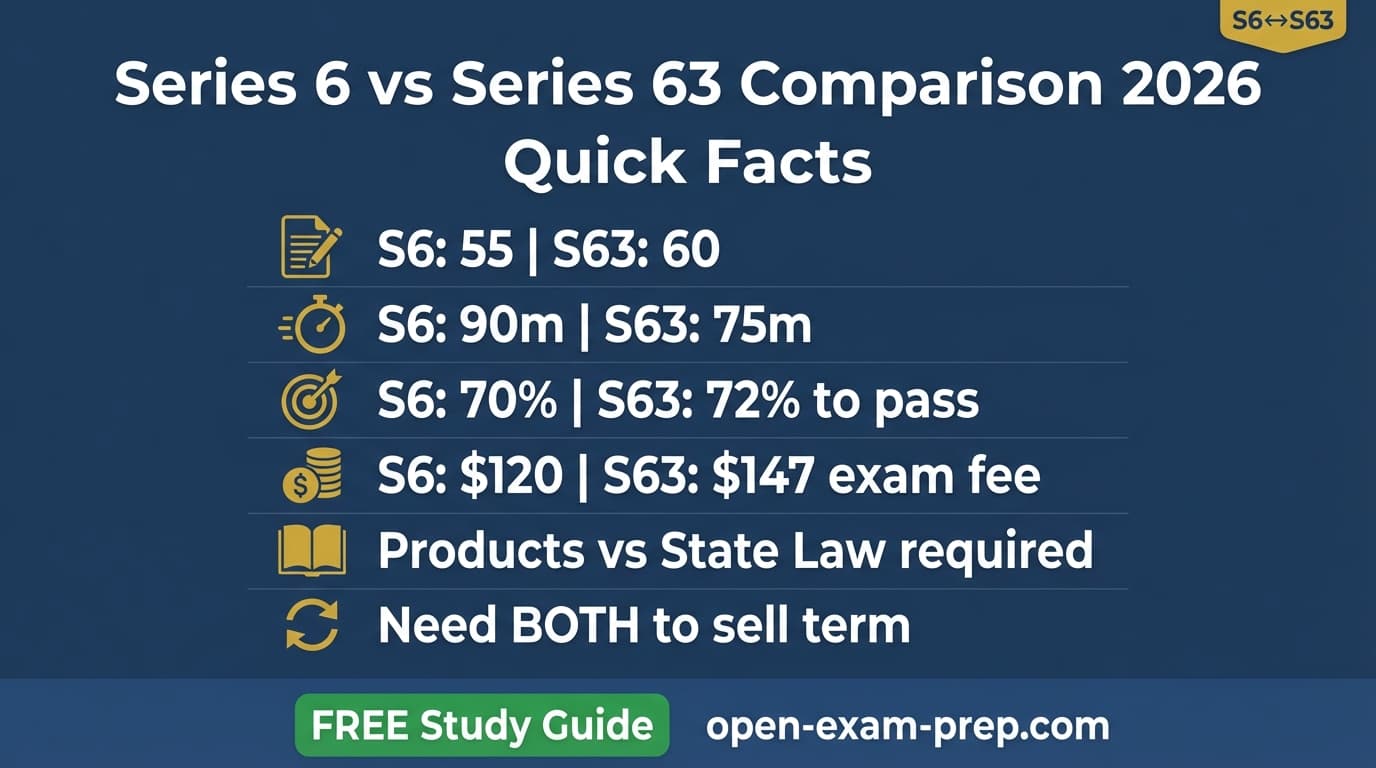
Side-by-Side Comparison
| Feature | Series 6 | Series 63 |
|---|---|---|
| Full Name | Investment Company and Variable Contracts Products Representative Exam | Uniform Securities Agent State Law Exam |
| Exam Cost | $47 | $147 |
| Passing Score | 70% (35 of 50 scored questions) | 72% (43 of 60 scored questions) |
| Questions | 55 (50 scored + 5 unscored) | 65 (60 scored + 5 unscored) |
| Time Limit | 1 hour 30 minutes | 1 hour 15 minutes |
| Study Time | 30 - 50 hours over 2 - 4 weeks | 20 - 30 hours over 1 - 3 weeks |
| Difficulty | Moderate | Moderate (conceptual, not calculation-heavy) |
| Prerequisites | SIE exam passed + sponsorship by a FINRA-member firm (Form U4 filing) | No formal prerequisite, but almost always taken alongside or shortly after a FINRA representative exam (Series 6 or Series 7) |
| Exam Body | FINRA | NASAA (North American Securities Administrators Association) |
Key Differences
- 1The Series 6 is a federal product license issued by FINRA; the Series 63 is a state registration exam administered by NASAA. They operate at different regulatory levels and serve different purposes.
- 2The Series 6 authorizes you to sell specific products (mutual funds, variable annuities, variable life, 529 plans, UITs); the Series 63 authorizes you to transact securities business within a specific state. One defines WHAT you can sell; the other defines WHERE you can sell it.
- 3The Series 6 costs $47 and has 50 scored questions in 90 minutes; the Series 63 costs $147 and has 60 scored questions in 75 minutes.
- 4The Series 6 has a ~58% first-time pass rate, making it harder than the Series 63 at ~82%. The Series 6 tests product knowledge and suitability analysis, while the Series 63 tests regulatory concepts and ethics.
- 5The Series 6 requires SIE passage + firm sponsorship; the Series 63 has no formal prerequisite but is almost always taken alongside a FINRA representative exam.
- 6The Series 6 focuses heavily on investment products (62% of the exam is "Recommendations"); the Series 63 focuses on state law (registration requirements, exemptions, prohibited practices).
- 7Without the Series 63, your Series 6 license cannot be activated in most states — think of the S6 as the product authority and the S63 as the state permission slip.
- 8The Series 6 requires more study time (30-50 hours) because of its product-specific depth; the Series 63 requires less (20-30 hours) because it is conceptual rather than calculation-heavy.
What Each Exam Allows You To Do
Series 6
- Sell mutual funds (open-end investment company shares) to retail clients
- Sell variable annuities and variable life insurance products
- Sell 529 college savings plans and other education savings vehicles
- Sell unit investment trusts (UITs)
- Process purchase and redemption orders for packaged investment products
- Provide basic suitability recommendations for packaged products
Series 63
- Register as a securities agent at the state level under the Uniform Securities Act
- Legally transact securities business within any state where you are registered
- Satisfy the state-level licensing requirement that complements your FINRA representative license (Series 6 or Series 7)
- Demonstrate knowledge of state securities regulations, fiduciary concepts, and ethical obligations to clients
Who Should Take Each Exam?
Take the Series 6 if you...
- →Bank investment representatives and financial consultants at retail banks
- →Insurance agents expanding into securities products (variable annuities and variable life)
- →Financial services representatives at firms like Edward Jones, Primerica, or Northwestern Mutual
- →Anyone focused specifically on selling mutual funds, variable products, and 529 plans rather than individual stocks and bonds
Take the Series 63 if you...
- →Anyone who has passed (or is studying for) the Series 6 — you need the S63 to actually use your S6 in most states
- →Series 7 holders who need state registration but do not plan to provide investment advisory services (otherwise take the Series 66)
- →Professionals at firms that require only agent registration, not investment adviser representative registration
- →Anyone working in states that require the Uniform Securities Agent State Law exam for securities agent registration
Which Should You Take First?
Most firms and study programs recommend taking the Series 6 before the Series 63 (after passing the SIE). The standard sequence is SIE → Series 6 → Series 63, all within your firm's 120-day training window. The rationale: the Series 6 builds your product knowledge foundation, and some of that knowledge (particularly around registration requirements and ethical practices) carries over into the Series 63. That said, some candidates prefer to take the Series 63 first because of its higher pass rate and shorter study time — getting it "out of the way" to focus fully on the Series 6. Either order works, but taking them in close succession is critical. The content overlap in areas like registration and prohibited practices means you lose efficiency if you wait months between exams. Many successful candidates study for both simultaneously over 6-8 weeks and schedule them 1-2 weeks apart.
At a Glance: Series 6 vs Series 63
Exam Cost
$47
Series 6
$147
Series 63
Pass Rate
~58%
Series 6
~82%
Series 63
Study Time
30-50 hrs
Series 6
20-30 hrs
Series 63
Combined Salary
$50,500 median (with S63)
Series 6
$50,500 median (with S6)
Series 63
Series 6
Bank investment reps, insurance agents adding mutual funds, and anyone selling packaged products (mutual funds, variable annuities, 529 plans) at the federal level
Series 63
Anyone who needs state-level registration to transact securities — required in most states alongside the Series 6 (or Series 7) to legally operate
Start preparing today:
Key Facts: Series 6 vs Series 63
- 1The Series 6 and Series 63 are complementary exams — you need BOTH to legally sell mutual funds, variable annuities, and 529 plans in most states. Series 6 is the federal product license; Series 63 is the state registration.
- 2The Series 6 exam costs $47 (FINRA) and has 50 scored questions with a 70% passing score, while the Series 63 costs $147 (NASAA) and has 60 scored questions (55 scored) with a 72% passing score.
- 3The Series 6 has a significantly lower pass rate (~58%) than the Series 63 (~82%), primarily because the S6 requires deeper product knowledge and suitability analysis while the S63 is more conceptual.
- 4Combined S6 + S63 holders earn a median salary of approximately $50,500 per year according to ZipRecruiter, with a range of $40,000-$86,000 for bank investment representatives and mutual fund sales agents.
- 5The standard licensing path is SIE ($80) → Series 6 ($47) → Series 63 ($147), totaling just $274 in exam fees — one of the most affordable licensing packages in financial services.
- 6Most firms expect new hires to complete the SIE, Series 6, and Series 63 within 120 days, with a combined study time of approximately 90-130 hours (including SIE preparation).
- 7The Series 6 limits holders to packaged products only: mutual funds, variable annuities, variable life insurance, 529 plans, and UITs. For individual stocks, bonds, and options, you need the Series 7 instead.
- 8The variable annuity market generates approximately $230 billion in annual sales (LIMRA, 2024), making Series 6 holders essential for insurance companies and banks serving retiring baby boomers.
- 9Without the Series 63, your Series 6 license cannot be activated in most states — 47 out of 50 states require state-level securities agent registration under the Uniform Securities Act.
- 10Upgrading from Series 6 to Series 7 later requires passing a completely separate exam — there is no bridge exam. However, your SIE and Series 63 remain valid, so only one additional exam is needed.
Why This Comparison Matters
Required Pair
Complementary, Not Competing
Series 6 and Series 63 are not alternatives — you need BOTH. Series 6 is your federal product license; Series 63 is your state registration. Without the Series 63, your Series 6 cannot be used in most states.
$50,500
Combined Median Salary
Bank investment representatives and mutual fund sales agents holding both S6 and S63 earn a median of $50,500/year per ZipRecruiter, with top earners reaching $86,000+.
120 Days
Typical Licensing Window
Most firms expect new hires to pass the SIE, Series 6, and Series 63 within 120 days. The combined study time of 50-80 hours is very manageable within this window.
The Series 6 vs Series 63 question is fundamentally different from most exam comparisons because these two exams are not alternatives — they are two halves of a required licensing package. If you want to sell mutual funds, variable annuities, or 529 plans to retail clients, you need both. The Series 6 is your FINRA product license, granting authority to sell specific packaged investment products. The Series 63 is your state registration under the Uniform Securities Act, granting permission to operate as a securities agent within individual states. Without the S63, your S6 is effectively useless in 47 out of 50 states that require state-level agent registration.
The path most new hires follow is straightforward: SIE → Series 6 → Series 63, all completed within 120 days of joining their sponsoring firm. Combined study time is 50-80 hours, which is very achievable within a standard training program. The total exam cost is just $274 ($80 SIE + $47 S6 + $147 S63), making this one of the most affordable licensing paths in financial services. This combination is especially popular at banks, insurance companies, and firms like Edward Jones, Primerica, and Northwestern Mutual that focus on packaged products rather than individual securities.
The strategic question most candidates should be asking is not "Series 6 or Series 63?" but rather "Series 6 or Series 7?" The Series 6 limits you to packaged products — mutual funds, variable annuities, variable life, 529 plans, and UITs. The Series 7 covers everything the Series 6 does plus individual stocks, bonds, options, and direct participation programs. If your firm offers the choice, the Series 7 provides a broader license with higher earning potential. However, many bank and insurance-based roles specifically require the Series 6 because packaged products are all the firm sells. Either way, the Series 63 comes along for the ride as your mandatory state registration.
What Each Exam Covers
Series 6 Exam Topics
Pass Rate: ~58% first-time pass rate (FINRA data, 2023-2024)
Series 63 Exam Topics
Pass Rate: ~82% first-time pass rate (NASAA data, 2023-2024)
Salary & Income Comparison
Bank Investment Representative / Mutual Fund Sales Agent
$50,500
Median Annual Salary
Range: $40,000 - $86,000
ZipRecruiter, 2025; reflects combined S6 + S63 licensed roles
Top earners in bank investment programs and insurance-based securities roles can exceed $86,000 annually, especially when variable annuity and variable life commissions are factored in. However, the Series 6 has a lower ceiling than the Series 7 because it limits you to packaged products — you cannot sell individual stocks, bonds, or options.
Securities Agent (State-Registered)
$50,500
Median Annual Salary
Range: $40,000 - $86,000
ZipRecruiter, 2025; reflects combined S6 + S63 or S7 + S63 licensed roles
The Series 63 by itself does not directly increase your salary — it is a regulatory requirement, not a skill credential. However, without it, you cannot legally operate as a securities agent in most states. Think of it as the "on switch" for your Series 6 or Series 7 license: no S63 means no state registration means no client transactions.
Professionals holding both the Series 6 and Series 63 — the minimum licensing package for selling packaged investment products — earn a median salary of approximately $50,500 per year according to ZipRecruiter 2025 data. The range spans from $40,000 at the entry level to $86,000+ for experienced bank investment representatives and insurance-based securities agents. These figures reflect roles at retail banks, credit unions, insurance companies, and financial services firms that focus on mutual funds and variable products.
It is important to note that Series 6 + Series 63 compensation tends to be lower than Series 7 + Series 63 (or Series 66) compensation because the product scope is narrower. Bank investment representatives typically earn a base salary plus modest commissions or bonuses tied to mutual fund and annuity sales. Variable annuity commissions can range from 4-7% of the premium, providing meaningful upside for active sellers. However, the ceiling is lower than full-service brokerage because you cannot sell individual stocks, bonds, or options. Professionals who find the S6 ceiling limiting often upgrade to the Series 7 later in their career, which opens the door to wirehouse advisory roles with median compensation of $78,140 (BLS) and significantly higher top-end earnings.
Total Cost to Get Licensed
| Expense | Series 6 | Series 63 |
|---|---|---|
| Pre-Licensing Education | $150 - $350 (prep course: Kaplan, ExamFX, Achievable, or firm-provided at $0) | $50 - $200 (prep course: Kaplan $100-$200, ExamFX $99-$199, or firm-provided at $0) |
| Exam Fee | $47 (FINRA) + $80 SIE prerequisite = $127 | $147 (NASAA, administered via Prometric) |
| License Fee | $0 (FINRA registration is through sponsoring firm) | $0 - $100 (state registration fees vary by state) |
| Background Check | $50 - $100 (fingerprinting and background check via Form U4) | Included in Form U4 processing (shared with Series 6) |
| Total Investment | $177 - $577 (SIE + Series 6 + prep course + Form U4 processing) | $147 - $447 (Series 63 exam + prep course + state fees) |
A Day in the Life
Series 6 Professional
A Series 6-licensed bank investment representative at a major retail bank starts her day at 8:30 AM reviewing the overnight performance of the bank's recommended mutual fund families and checking which maturing CDs might present rollover opportunities into mutual fund or annuity products. At 9:00 AM, she meets with a bank customer referred by a teller — a couple in their 50s with $120,000 in low-yield savings accounts looking for better returns. She conducts a needs analysis, assesses their risk tolerance, and recommends a diversified portfolio of Class A mutual fund shares with breakpoint pricing. At 11:00 AM, she processes a variable annuity application for a retiring teacher rolling over a 403(b), explaining the surrender schedule, death benefit, and tax-deferred growth. After lunch, she follows up with three existing clients whose annual reviews are due, checking that their fund allocations still match their investment objectives. She ends the day with a team meeting where the branch manager reviews mutual fund sales targets and upcoming 529 plan season marketing.
Series 63 Professional
The same bank investment representative relies on her Series 63 state registration every single day, though she rarely thinks about it directly. Her Series 63 is what makes her a state-registered securities agent — without it, every mutual fund sale, every variable annuity application, and every 529 plan enrollment she processes would be illegal in her state. When a client who recently moved from another state wants to open an account, she checks whether her firm has her registered in the new state and initiates a state registration transfer if needed. When reviewing marketing materials for a Saturday seminar on retirement planning, she recalls Series 63 rules about communications with the public and ensures the materials comply with state advertising regulations. The Series 63 operates invisibly in the background of her daily work — but it is the legal foundation that makes everything she does possible.
Career Paths & Progression
Series 6 Career Path
0-1 years
Bank Investment Representative Trainee
$38K-$45K
1-3 years
Bank Investment Representative / Financial Consultant
$48K-$62K
3-7 years
Senior Investment Specialist / Branch Investment Lead
$60K-$80K
7+ years
Regional Investment Program Manager (or upgrade to Series 7)
$75K-$100K+
Series 63 Career Path
0-1 years
State-Registered Securities Agent (with S6 or S7)
$38K-$50K
1-3 years
Registered Representative / Financial Services Rep
$48K-$65K
3-7 years
Senior Securities Agent / Client Relationship Manager
$60K-$80K
7+ years
Branch Manager / Upgrade to S66 for Advisory Roles
$75K-$110K+
Because the Series 6 and Series 63 are complementary, career paths are best understood as a single combined license rather than two separate tracks. The S6 + S63 combination opens three primary career paths: (1) Bank investment representative — selling mutual funds and annuities through a bank's investment program (Chase, Wells Fargo, Bank of America), earning a base salary plus sales incentives; (2) Insurance-based securities agent — at firms like Northwestern Mutual, Primerica, or New York Life, selling variable annuities and variable life insurance alongside traditional insurance products, earning commissions in the 4-7% range on annuity premiums; (3) Financial services representative — at firms like Edward Jones or Ameriprise, focusing on mutual fund portfolios and retirement planning for retail clients.
The key career decision facing S6 + S63 holders is whether to stay in the packaged-products lane or upgrade to the Series 7 for a broader license. Many bank investment reps find the S6 sufficient for their entire career — banks primarily sell mutual funds and annuities, and the compensation structure rewards volume within that product set. However, professionals who want to move to full-service brokerage, offer individual stock and bond portfolios, or pursue wirehouse advisory roles will eventually need the Series 7. The good news: your SIE and Series 63 remain valid, so upgrading means studying for and passing only one additional exam.
Start preparing today:
Series 6 + Series 63: The Minimum Package — Should You Upgrade to Series 7?
Benefits
- +The S6 + S63 combination is the minimum licensing package required to sell mutual funds, variable annuities, variable life insurance, and 529 plans in most states — it gets you fully operational
- +Total exam costs of just $274 (SIE $80 + S6 $47 + S63 $147) make this one of the most affordable licensing paths in financial services
- +Combined study time of 50-80 hours (beyond SIE) is highly manageable within a standard 120-day training window
- +The S6 + S63 is perfectly sufficient for bank investment programs, insurance-based securities roles, and firms that exclusively sell packaged products
- +If you later decide to upgrade to the Series 7, your SIE and Series 63 remain valid — you only need to pass one additional exam
Considerations
- !The Series 6 limits you to packaged products only — no individual stocks, bonds, options, or direct participation programs. If clients ask about individual securities, you must refer them to a Series 7-licensed colleague.
- !The earning ceiling with S6 + S63 ($86K top end) is significantly lower than S7 + S63/S66 ($215K+ per BLS). If maximizing income is your priority, the Series 7 is the better long-term investment.
- !Some firms give new hires the choice between Series 6 and Series 7 — if your firm offers Series 7, take it. The Series 7 covers everything the Series 6 does plus much more, and the incremental study time (80-120 hours vs 30-50 hours) pays for itself in career flexibility.
- !Upgrading from Series 6 to Series 7 later requires passing a separate, full-length exam — there is no "upgrade" or "bridge" exam. You start from scratch with Series 7 prep.
The Verdict: The S6 + S63 is the right licensing package if your firm sells only packaged products (banks, insurance companies, mutual fund-focused firms) and you are comfortable within that product scope. However, if your firm offers the choice and you have the study capacity, choose the Series 7 over the Series 6 every time. The broader product authority, higher earning potential, and greater career flexibility of the Series 7 make the extra 50-70 hours of study time a worthwhile investment. Either way, the Series 63 is non-negotiable — you need it regardless of whether you hold the S6 or S7.
Job Outlook & Industry Trends
3% (2024-2034, BLS — securities sales agents category)
Series 6 Job Growth (2024-2034)
N/A (state registration requirement, not a standalone career category)
Series 63 Job Growth (2024-2034)
The BLS projects 3% growth for securities, commodities, and financial services sales agents through 2034, which includes Series 6 holders in packaged-product roles. Bank investment programs continue to be a stable employment channel as banks expand wealth management services to compete with independent advisory firms. The ongoing shift from defined-benefit pensions to defined-contribution retirement plans (401(k), 403(b), IRA) drives sustained demand for professionals who can help retail investors select and manage mutual fund portfolios. Additionally, the variable annuity market — a key product for S6 holders — generates approximately $230 billion in annual sales (LIMRA, 2024), fueled by aging demographics and demand for guaranteed income in retirement. The Series 63 will remain a mandatory requirement as long as states maintain securities agent registration under the Uniform Securities Act, which shows no signs of changing.
Study Strategy & Tips
SIE Preparation
Foundational securities knowledge (required prerequisite for Series 6)
- Complete an SIE prep course (Kaplan, Achievable, ExamFX, or similar)
- Focus on Products and Their Risks (44% of SIE) — mutual funds, variable annuities, equities, bonds
- Study regulatory framework basics — FINRA, SEC, NASAA, state regulators
- Take 3+ full-length practice exams, targeting 80%+ before scheduling
Pass SIE + Begin Series 6 Prep
Pass SIE and immediately transition to Series 6 study
- Schedule and pass the SIE exam
- Begin Series 6 prep course — leverage SIE overlap in mutual fund and variable product knowledge
- Focus on mutual fund share classes (A, B, C), breakpoints, letters of intent, and rights of accumulation
- Start memorizing variable annuity mechanics: accumulation/annuitization phases, surrender charges, 1035 exchanges
Series 6 Deep Study
Master packaged product knowledge and suitability analysis
- Study the 62% "Recommendations" section intensively — product suitability, customer profiles, investment objectives
- Master 529 plan rules, contribution limits, tax benefits, and state-specific considerations
- Learn account opening procedures, KYC requirements, and documentation standards (16% of exam)
- Take 3-4 full-length timed practice exams; the 58% pass rate means you must be thoroughly prepared
Pass Series 6 + Series 63 Blitz
Pass Series 6, then complete Series 63 preparation and pass
- Schedule and pass the Series 6 exam
- Immediately begin Series 63 prep — the Uniform Securities Act, registration requirements, and exemptions
- Focus on ethical practices and prohibited activities (30% of S63 exam)
- Memorize registration exemptions for broker-dealers, agents, advisers, and securities
- Take 3-4 full-length S63 practice exams and schedule the exam within 1-2 weeks of passing the S6
Total Duration: 6-10 weeks for SIE + Series 6 + Series 63 (sequential study)
Series 6 Study Tips
- 1Focus 62% of your study time on the "Recommendations" section — it covers mutual fund share classes (A, B, C), variable annuity mechanics, 529 plan rules, suitability, and product comparisons. This is the overwhelming majority of the exam.
- 2Master mutual fund share classes inside and out: front-end loads (Class A), contingent deferred sales charges (Class B), level loads (Class C), breakpoints, letters of intent, and rights of accumulation. Expect 8-12 questions on share class suitability alone.
- 3Understand variable annuity features: accumulation vs. annuitization phase, death benefits, surrender charges, 1035 exchanges, and the tax treatment of withdrawals (LIFO for gains, 10% penalty before 59 1/2).
- 4Learn the difference between open-end funds (mutual funds), closed-end funds, ETFs, and UITs. The exam tests whether you can distinguish these products and recommend the appropriate one based on a client scenario.
- 5Take at least 3-4 full-length practice exams under timed conditions. At only 50 scored questions in 90 minutes, the exam moves quickly and you cannot afford to waste time on questions you do not immediately understand.
Series 63 Study Tips
- 1Focus on ethical practices and prohibited activities — 30% of the exam covers business practices and ethics. Know what constitutes fraud, misrepresentation, churning, unauthorized trading, unsuitable recommendations, and sharing in client profits/losses.
- 2Memorize the registration requirements and exemptions for broker-dealers, agents, investment advisers, and investment adviser representatives. Understand when registration is required vs. exempt (e.g., federal covered advisers, institutional investors, no-place-of-business exemptions).
- 3Understand the Uniform Securities Act framework: which securities must be registered, which are exempt (government securities, bank securities), and which transactions are exempt (isolated non-issuer transactions, institutional buyer transactions).
- 4The Series 63 is more conceptual and less mathematical than the Series 6. Focus on "know-the-rules" memorization rather than calculations. The biggest challenge is distinguishing between similar-sounding regulations and exemptions.
- 5Take 3-4 full-length practice exams. The Series 63 has a reputation as "easy" but its 58% historical pass rate suggests otherwise — the tricky wording and close answer choices catch underprepared candidates off guard. Note: recent pass rates have improved to ~82%, but do not take this exam lightly.
Ready to Start Studying?
Free practice questions, study guides, and AI tutoring for the matching exam resources.
Frequently Asked Questions
QDo I need both the Series 6 and Series 63, or can I just take one?
In almost all cases, you need both. The Series 6 is your FINRA product license that authorizes you to sell mutual funds, variable annuities, variable life insurance, and 529 plans. The Series 63 is your state registration under the Uniform Securities Act that permits you to act as a securities agent in individual states. Without the Series 63, your Series 6 cannot be used in most states — 47 out of 50 states require state agent registration. Think of it this way: the Series 6 determines WHAT you can sell, and the Series 63 determines WHERE you can sell it. You need both pieces to operate legally.
QWhich exam should I take first — Series 6 or Series 63?
Most training programs recommend Series 6 first, then Series 63. The rationale is that the Series 6 builds your foundational product knowledge (mutual funds, variable annuities, suitability), and some of that knowledge carries over into Series 63 topics like registration requirements and prohibited practices. However, some candidates prefer to take the Series 63 first because of its higher pass rate (82% vs 58%) and shorter study time (20-30 hours vs 30-50 hours), which builds confidence before tackling the harder Series 6. Either order works well, but scheduling them 1-2 weeks apart is optimal to capitalize on content overlap in areas like prohibited practices and ethical standards.
QIs the Series 6 harder than the Series 63?
Yes, statistically the Series 6 is harder. The Series 6 has a first-time pass rate of approximately 58% compared to 82% for the Series 63. The Series 6 tests detailed product knowledge — mutual fund share classes, variable annuity mechanics, surrender charges, breakpoints, 1035 exchanges — and requires suitability analysis where you match products to client profiles. The Series 63 is more conceptual, testing your knowledge of state securities law, registration requirements, and ethical standards. The Series 63 has less math and more memorization. However, the Series 63 can trip up candidates who underestimate its tricky wording and closely worded answer choices, so neither exam should be taken lightly.
QShould I get the Series 6 or the Series 7?
If your firm gives you the choice, take the Series 7. The Series 7 covers everything the Series 6 does — mutual funds, variable annuities, 529 plans — plus individual stocks, bonds, options, direct participation programs, and more. The Series 7 requires more study time (80-120 hours vs 30-50 hours) and costs more ($245 vs $47), but it provides significantly broader product authority and higher earning potential (median $78,140 per BLS vs $50,500 for S6 roles). The Series 6 is the right choice when your firm exclusively sells packaged products (common at banks and insurance companies) and does not offer the Series 7 path. There is no bridge exam from S6 to S7 — upgrading later means passing the full Series 7 exam from scratch.
QHow much do Series 6 + Series 63 holders earn?
Professionals holding both the Series 6 and Series 63 earn a median salary of approximately $50,500 per year according to ZipRecruiter data, with a typical range of $40,000 to $86,000. Bank investment representatives at major retail banks fall in the $45,000-$65,000 range with sales incentives, while experienced insurance-based securities agents can exceed $75,000 through variable annuity commissions (typically 4-7% of premium). The earning ceiling is lower than Series 7 holders because the S6 limits you to packaged products. Professionals who want higher compensation often upgrade to the Series 7 to access full-service brokerage roles where median compensation is $78,140 per BLS data.
QWhat is the total cost and timeline to get both the Series 6 and Series 63?
The total exam fees for the full licensing sequence (SIE + Series 6 + Series 63) are $274 ($80 + $47 + $147). Adding prep courses ($200-$550 total) and Form U4 processing ($50-$100 for background check and fingerprinting) brings the all-in cost to approximately $524-$924. Many firms cover all exam fees and provide study materials as part of their training program, potentially reducing your out-of-pocket cost to $0. The typical timeline is 6-10 weeks from starting SIE prep to passing the Series 63, with most firms expecting completion within 120 days of hire. Combined study time across all three exams is approximately 90-130 hours.
10 free AI interactions per day
Free exam resources
Start Studying the Exact Exam
Use the comparison to choose a path, then move into the matching practice questions, study guide, and flashcards.

 Buy on Amazon
 Prep course on Achievable
 Flashcards on Mometrix
 Practice exams on ExamEdge
Related Exam Comparisons
Stay Updated
Get free exam tips and study guides delivered to your inbox.