Series 63 vs Series 66
The Series 63 is a state law exam that registers you as a securities agent only — it covers the Uniform Securities Act and enables you to sell securities at the state level when paired with a FINRA license (Series 6 or Series 7). The Series 66 is a combined state law exam that replaces both the Series 63 and the Series 65, granting dual registration as a securities agent AND an investment adviser representative (IAR). The critical distinction: the Series 66 requires a Series 7, while the Series 63 does not. If you hold only a Series 6, the Series 63 is your only option for state registration.
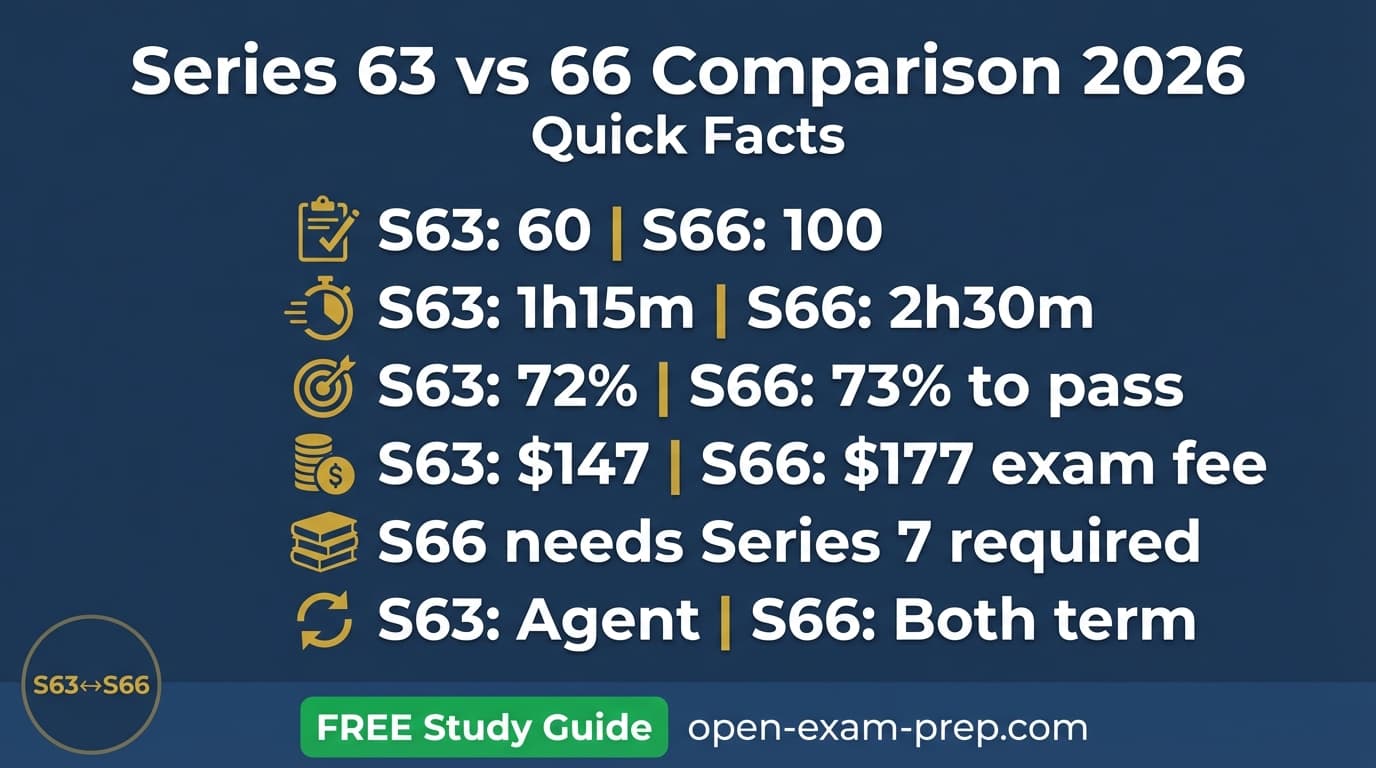
Watch: Series 63 vs Series 66 Explained
Side-by-Side Comparison
| Feature | Series 63 | Series 66 |
|---|---|---|
| Full Name | Uniform Securities Agent State Law Examination | Uniform Combined State Law Examination |
| Exam Cost | $147 | $177 |
| Passing Score | 72% (43 of 60 scored questions) | 73% (62 of 85 scored questions) |
| Questions | 60 (55 scored + 5 unscored) | 100 (85 scored + 15 unscored) |
| Time Limit | 1 hour 15 minutes | 2 hours 30 minutes |
| Study Time | 20 - 30 hours over 1 - 2 weeks | 50 - 70 hours over 3 - 5 weeks |
| Difficulty | Moderate | Challenging |
| Prerequisites | None required to sit for the exam, but typically paired with a FINRA representative exam (Series 6 or Series 7) for state registration | Must have passed the Series 7 exam (Series 7 corequisite — can take Series 66 before Series 7, but both must be passed for registration) |
| Exam Body | NASAA (North American Securities Administrators Association) | NASAA (North American Securities Administrators Association) |
Key Differences
- 1The Series 63 provides agent-only registration; the Series 66 provides dual registration as both a securities agent and an investment adviser representative (IAR) in a single exam.
- 2The Series 66 requires the Series 7 as a prerequisite (or corequisite); the Series 63 has no FINRA exam prerequisite and is commonly paired with either the Series 6 or Series 7.
- 3The Series 66 effectively replaces both the Series 63 and the Series 65 — if you pass the Series 66, you do NOT need to take the Series 63 or Series 65 separately.
- 4The Series 63 has 60 questions (55 scored) in 1 hour 15 minutes; the Series 66 has 100 questions (85 scored) in 2 hours 30 minutes — nearly double the content.
- 5The Series 63 requires 20-30 hours of study focused on state securities law; the Series 66 requires 50-70 hours covering both state law and investment advisory law and practice.
- 6The Series 63 has a higher pass rate (~82%) compared to the Series 66 (~73%), reflecting the broader and more complex content of the combined exam.
- 7The Series 66 has a higher passing score (73%) than the Series 63 (72%), requiring slightly greater mastery of the material.
- 8The Series 66 costs $177 vs $147 for the Series 63 — but the Series 66 replaces two exams (Series 63 at $147 + Series 65 at $187 = $334), making it the more cost-effective choice for Series 7 holders.
What Each Exam Allows You To Do
Series 63
- Register as a securities agent at the state level, allowing you to sell securities within your registered state(s)
- Meet state registration requirements when combined with a FINRA representative license (Series 6 or Series 7)
- Transact business in states that require the Series 63 for agent registration
- Work as a registered representative handling securities transactions for clients in multiple states
Series 66
- Register as both a securities agent AND an investment adviser representative (IAR) at the state level — dual registration in a single exam
- Charge fees for investment advice (financial planning, portfolio management, retirement planning) in addition to earning commissions on securities transactions
- Work at hybrid firms and dual-registered broker-dealer/RIA entities that offer both brokerage and advisory services
- Provide holistic financial planning services — combining product sales with fiduciary advice under the advisory registration
- Satisfy state registration requirements in lieu of taking both the Series 63 and Series 65 separately
Who Should Take Each Exam?
Take the Series 63 if you...
- →Series 6 holders who sell mutual funds, variable annuities, and other packaged products and need state agent registration
- →Series 7 holders who only plan to sell securities on a commission basis without offering fee-based advisory services
- →Registered representatives at broker-dealers that do not require advisory registration
- →Professionals in states that do not accept the Series 66 or who already hold a Series 65
Take the Series 66 if you...
- →Series 7 holders at wirehouses (Morgan Stanley, Merrill Lynch, UBS, Wells Fargo) who are required to have both agent and adviser registration
- →Financial advisors at dual-registered or hybrid firms who offer both commission-based and fee-based services
- →Aspiring wealth managers and financial planners who want the broadest state-level registration in a single exam
- →Anyone with a Series 7 who wants to future-proof their career as the industry shifts toward fee-based advisory models
Which Should You Take First?
The answer depends entirely on which FINRA representative exam you hold or plan to take. If you have (or are pursuing) the Series 7, the Series 66 is almost always the better choice — it grants dual registration as both a securities agent and an investment adviser representative in a single exam, replacing the need to take the Series 63 and Series 65 separately. This saves you approximately $157 in exam fees ($334 for both vs $177 for the Series 66 alone), 20-40 hours of additional study time, and one extra testing appointment. However, if you hold only a Series 6 (Investment Company and Variable Contracts Products Representative), you cannot take the Series 66 — it requires the Series 7 as a prerequisite. In that case, the Series 63 is your only option for state agent registration. Some professionals start with Series 6 + Series 63 and later upgrade to Series 7 + Series 66 as their career expands. The one exception: if your firm only needs you to sell securities on commission without ever offering fee-based advice, the Series 63 alone (paired with Series 7) is sufficient. But the industry is moving decisively toward fee-based advisory models, and most wirehouses and hybrid firms now require the Series 66 as part of their standard licensing sequence.
At a Glance: Series 63 vs Series 66
Exam Cost
$147
Series 63
$177
Series 66
Pass Rate
~82%
Series 63
~73%
Series 66
Study Time
20-30 hrs
Series 63
50-70 hrs
Series 66
Registrations Earned
Agent only
Series 63
Agent + IAR
Series 66
Series 63
Series 6 holders selling packaged products who only need state agent registration and do not plan to offer fee-based advisory services
Series 66
Series 7 holders who want dual registration as both a securities agent and an investment adviser representative in a single exam
Start preparing today:
Key Facts: Series 63 vs Series 66
- 1The Series 63 (Uniform Securities Agent State Law Exam) provides state-level agent registration only, while the Series 66 (Uniform Combined State Law Exam) provides dual registration as both a securities agent and an investment adviser representative (IAR).
- 2The Series 66 effectively replaces both the Series 63 and the Series 65 in a single exam, saving Series 7 holders approximately $157 in exam fees and 20-40 hours of additional study time.
- 3The Series 66 requires the Series 7 exam as a prerequisite. Candidates who hold only a Series 6 cannot take the Series 66 and must take the Series 63 instead.
- 4The Series 63 has approximately an 82% first-time pass rate compared to approximately 73% for the Series 66, reflecting the broader and more complex content of the combined exam.
- 5The Series 66 has a passing score of 73% (62 of 85 scored questions), while the Series 63 requires 72% (43 of 60 scored questions).
- 6Series 66 holders with a Series 7 can charge advisory fees on client portfolios (typically 0.75%-1.25% of AUM), creating recurring revenue that compounds as the client base grows.
- 7The BLS projects 13% growth for personal financial advisors through 2034 — the primary career path for Series 66 holders — compared to 3% growth for securities sales agents.
- 8Most wirehouses including Morgan Stanley, Merrill Lynch, UBS, and Wells Fargo require Series 7 + Series 66 as their standard licensing combination for financial advisor trainees.
- 9Laws, Regulations, and Guidelines account for 45% of the Series 66 exam, making it the most heavily weighted content area — candidates must master both the Uniform Securities Act and the Investment Advisers Act of 1940.
- 10An estimated 30-40% of current financial advisors will retire by 2030, creating unprecedented book-of-business acquisition opportunities for newly licensed advisors with advisory registration.
Why This Comparison Matters
2-in-1 Exam
Series 66 Replaces Two Exams
The Series 66 combines the Series 63 (agent law) and Series 65 (adviser law) into a single exam — saving time, money, and study effort for Series 7 holders.
$100K-$400K+
Advisory Earning Power
Series 66 holders with a Series 7 can charge advisory fees on top of commissions, unlocking the lucrative fee-based advisory model used by hybrid firms and wirehouses.
Series 7 Required
Series 66 Prerequisite
The Series 66 requires a passing Series 7 result. If you hold only a Series 6, the Series 66 is not an option — you must take the Series 63 instead.
The Series 63 vs Series 66 decision is one of the most strategically important choices in securities licensing, yet it receives far less attention than the Series 7 itself. The core question is simple: do you need advisory registration, or just agent registration? The answer increasingly favors the Series 66, as the financial services industry continues its structural shift from commission-based brokerage toward fee-based advisory.
Consider the economics: taking the Series 63 ($147) and Series 65 ($187) separately costs $334 total and requires 70-100 hours of combined study across two separate exam appointments. The Series 66 costs $177 and requires 50-70 hours of study in a single exam. For Series 7 holders, the Series 66 is objectively more efficient — it saves $157 in fees, consolidates study time, and eliminates one testing session. The only reason to choose the Series 63 alone is if you hold a Series 6 (which cannot be paired with the Series 66) or if your firm explicitly does not require advisory registration.
The career implications are significant. The advisory registration unlocked by the Series 66 enables professionals to charge management fees on client portfolios — typically 0.75% to 1.25% of AUM — creating a recurring revenue stream that compounds as the client base grows. A financial advisor managing $50 million in AUM at a 1% fee generates $500,000 in annual advisory revenue before commissions. This fee-based model has become the dominant compensation structure at wirehouses, hybrid firms, and independent RIAs, making the Series 66 the de facto standard for career-oriented financial advisors.
What Each Exam Covers
Series 63 Exam Topics
Pass Rate: ~82% first-time pass rate (NASAA data, 2023-2024)
Series 66 Exam Topics
Pass Rate: ~73% first-time pass rate (NASAA data, 2023-2024)
Salary & Income Comparison
Securities Agent (Series 63 + Series 6)
$61,600
Median Annual Salary
Range: $35,000 - $125,000+
BLS Occupational Employment Statistics, May 2024 (SOC 41-3031); Payscale, 2024-2025 for Series 6 + 63 specific roles
Series 63 salary depends entirely on the underlying FINRA license. With a Series 6, median earnings center around $61,600 for insurance and financial product agents selling packaged products. With a Series 7, the median rises to $78,140 per BLS data. The Series 63 by itself is not a standalone license — it enables state-level registration to complement a FINRA exam.
Financial Advisor (Series 7 + Series 66)
$78,140
Median Annual Salary
Range: $47,080 - $400,000+
BLS Occupational Employment Statistics, May 2024 (SOC 41-3031); wirehouse compensation data from industry reports, 2024-2025
The Series 66 paired with the Series 7 is the standard licensing combination at wirehouses and hybrid advisory firms. BLS reports a median of $78,140, but this includes all securities agents. Financial advisors with advisory registration at wirehouses routinely earn $150,000-$400,000+ through grid-based compensation (35-51% of revenue) plus advisory fee income. The advisory registration unlocked by the Series 66 is what enables the transition from pure commission-based sales to the more stable and higher-margin fee-based advisory model.
Salary comparisons between Series 63 and Series 66 holders require context because neither exam functions as a standalone license — each supplements a FINRA representative exam. Series 63 holders paired with a Series 6 typically earn a median of approximately $61,600 per year in roles focused on selling mutual funds, variable annuities, and insurance products. When paired with a Series 7, the median rises to $78,140 per BLS May 2024 data. The Series 63 alone does not significantly affect compensation because it only provides state agent registration without expanding the scope of products or services offered.
Series 66 holders, by contrast, unlock the advisory registration that transforms earning potential. The dual registration (agent + IAR) enables professionals to operate in fee-based advisory roles at wirehouses and hybrid firms, where compensation is driven by assets under management (AUM) fees in addition to transaction-based commissions. Financial advisors at wirehouses with Series 7 + Series 66 credentials typically earn $100,000-$200,000 within 3-5 years, with senior advisors managing $100M+ in AUM earning $300,000-$400,000+ through grid-based payouts and advisory fee revenue. The BLS median of $78,140 significantly understates the earning power of experienced advisory professionals, particularly at hybrid firms where the combination of commission and fee income creates multiple revenue streams.
Total Cost to Get Licensed
| Expense | Series 63 | Series 66 |
|---|---|---|
| Pre-Licensing Education | $50 - $250 (prep course: Kaplan $139-$249, STC $99, Pass Perfect $129) | $150 - $400 (prep course: Kaplan $249-$399, STC $149, Pass Perfect $179) |
| Exam Fee | $147 (NASAA) | $177 (NASAA) |
| License Fee | $25 - $75 per state (state registration/filing fees vary by jurisdiction) | $25 - $75 per state (state registration/filing fees vary by jurisdiction) |
| Background Check | $0 - $50 (typically covered under existing Form U4 if already registered with a FINRA firm) | $0 - $50 (typically covered under existing Form U4 if already registered with a FINRA firm) |
| Total Investment | $222 - $522 (exam fee + prep course + state filing fees) | $352 - $702 (exam fee + prep course + state filing fees) |
A Day in the Life
Series 63 Professional
A registered representative with a Series 6 and Series 63 at a regional bank starts the day at 8:30 AM reviewing the performance of the mutual fund families on the bank's approved product list. At 9:00 AM, she meets with a bank customer referred by a teller — a couple in their 50s who want to invest their maturing $100,000 CD. She discusses their risk tolerance and time horizon, then recommends a diversified allocation across a moderate growth mutual fund and a bond fund. She processes the paperwork for the investment and schedules a six-month review. After lunch, she conducts a seminar for bank customers about retirement savings strategies, focusing on IRA rollovers and annuity options. Her afternoon includes three follow-up calls to existing clients about upcoming variable annuity contract anniversaries and one new prospect meeting. Her compensation is primarily commission-based, earning trail commissions on mutual fund assets and upfront commissions on annuity sales.
Series 66 Professional
A financial advisor with a Series 7 and Series 66 at a wirehouse begins the day at 7:15 AM reviewing overnight economic data and client portfolio alerts. At 8:30 AM, she joins the morning research call where the firm's strategists discuss their updated outlook on interest rates and sector rotation. At 9:30, she meets with a business owner client to review his comprehensive financial plan — discussing his $2M investment portfolio, equity compensation strategy, business succession planning, and charitable giving goals. She recommends rebalancing his portfolio and transitioning from a commission-based brokerage account to a fee-based advisory account charging 0.85% of AUM. After lunch, she conducts a retirement plan review for a corporate client's 401(k) participants and negotiates a new advisory agreement for the plan's $15M in assets. At 3:00 PM, she presents a financial plan to a referred couple, incorporating tax-loss harvesting, Roth conversion strategies, and estate planning considerations. Her compensation blends wirehouse grid payouts (38% of commission revenue) with advisory fees (25 basis points on managed accounts through the platform), generating total annual income of approximately $275,000.
Career Paths & Progression
Series 63 Career Path
0-2 years
Registered Representative (Series 6 + Series 63)
$45K-$61K
3-5 years
Senior Agent / Insurance & Products Specialist
$60K-$90K
5-10 years
Branch Sales Manager / Team Lead
$80K-$125K
10+ years
Regional Sales Director
$110K-$175K
Series 66 Career Path
0-2 years
Financial Advisor Trainee (Series 7 + Series 66)
$50K-$80K base
3-5 years
Financial Advisor / Wealth Manager
$100K-$200K
5-10 years
Senior VP / Senior Wealth Advisor
$200K-$400K
10+ years
Managing Director / Private Wealth Advisor
$350K-$600K+
The career trajectory diverges sharply depending on whether you hold agent-only registration (Series 63) or dual agent-and-adviser registration (Series 66). Series 63 holders paired with a Series 6 typically remain in product-distribution roles — selling mutual funds, variable annuities, and insurance products at banks, insurance companies, and limited broker-dealers. Advancement follows a sales management track: senior agent, branch sales manager, regional director. Compensation is primarily commission-based, with annual earnings capped in the $125,000-$175,000 range for high performers.
Series 66 holders paired with a Series 7 occupy the highest-ceiling career path in retail financial services. The advisory registration enables a transition from transactional sales to relationship-based wealth management. Career tracks include: (1) Wirehouse advisor — building AUM at Morgan Stanley, Merrill Lynch, UBS, or Wells Fargo with grid-based compensation of 35-51% of revenue; (2) Hybrid advisor — operating at a dual-registered firm offering both brokerage and advisory services, capturing commission and fee income; (3) Independent RIA — eventually launching your own registered investment advisory firm, retaining 100% of advisory fees and building enterprise value. The Series 66 is the gateway to all three paths, and the advisory fee model it enables creates compounding income as client assets grow over time.
Start preparing today:
Series 63 + Series 65 vs Series 66: The Dual Licensing Decision
Benefits
- +The Series 66 combines the Series 63 and Series 65 into one exam, saving $157 in fees ($177 vs $147 + $187 = $334) and consolidating two testing sessions into one
- +Series 66 holders with a Series 7 can operate at dual-registered broker-dealer/RIA firms — the fastest-growing segment of the advisory industry
- +The dual agent + IAR registration enables fee-based advisory accounts (charging AUM fees) in addition to commission-based brokerage — creating multiple revenue streams
- +Most wirehouses (Morgan Stanley, Merrill Lynch, UBS, Wells Fargo) require Series 7 + Series 66 as their standard licensing combination for financial advisor trainees
- +The advisory registration provides career flexibility: you can transition from brokerage to an independent RIA without needing additional exams
Considerations
- !The Series 66 requires the Series 7 — if you only hold a Series 6, you must take the Series 63 (and optionally the Series 65 later) instead
- !The Series 66 is significantly harder than the Series 63 alone (~73% pass rate vs ~82%), requiring 50-70 hours of study compared to 20-30 hours
- !A few states have specific requirements that may not be satisfied by the Series 66 alone — always verify with your state securities regulator before choosing an exam path
- !If you never plan to offer fee-based advisory services (e.g., you only sell products on commission), the Series 63 alone is sufficient and requires much less preparation
The Verdict: For Series 7 holders, the Series 66 is the clear winner in almost every scenario. It replaces two exams with one, costs less, and provides the advisory registration that is increasingly required across the industry. The only candidates who should choose the Series 63 over the Series 66 are those with a Series 6 (who cannot take the Series 66), those in roles that explicitly do not require advisory registration, or those in states with unusual exam requirements. The industry trend is unmistakable: fee-based advisory is the future, and the Series 66 is the most efficient path to get there.
Job Outlook & Industry Trends
3% (2024-2034, BLS — securities sales agents)
Series 63 Job Growth (2024-2034)
13% (2024-2034, BLS — personal financial advisors)
Series 66 Job Growth (2024-2034)
The job outlook diverges sharply depending on registration type. Securities sales agents (the primary role enabled by Series 63 + Series 6 or Series 7) are projected to grow at 3% through 2034 according to the BLS, roughly matching the national average. However, personal financial advisors — the role most aligned with Series 66 holders who provide fee-based advice — are projected to grow at 13% through 2034, significantly outpacing average job growth. The BLS projects approximately 27,200 annual openings for personal financial advisors, driven by the growing complexity of retirement planning, the ongoing shift from commission-based to fee-based models, and the massive wave of baby boomer advisor retirements. An estimated 30-40% of financial advisors will retire by 2030, creating unprecedented opportunities for new entrants with advisory registration. The structural trend is clear: the industry is migrating toward advice-centric models, and the Series 66 positions you on the growth side of this transition.
Study Strategy & Tips
Foundation: State Securities Law
Uniform Securities Act (shared content between Series 63 and Series 66)
- Study the Uniform Securities Act (USA): definitions of security, agent, broker-dealer, investment adviser, and IAR under state law
- Learn registration requirements and exemptions for securities, transactions, and persons
- Understand the Administrator's authority: stop orders, denial/revocation/suspension, subpoena power, and judicial review
- Review prohibited practices for agents and broker-dealers: churning, unsuitable recommendations, selling away, borrowing from clients
Advisory Law & Practice (Series 66 Only)
Investment Advisers Act of 1940 and advisory concepts
- Study the Investment Advisers Act of 1940: definition of investment adviser ("ABCD" test), registration requirements, federal vs state registration thresholds
- Learn Form ADV requirements (Part 1 and Part 2/brochure rule), custody rules, recordkeeping obligations, and performance advertising standards
- Master fiduciary duty concepts: duty of care, duty of loyalty, best execution, soft dollar arrangements, proxy voting obligations
- Review client investment recommendations: suitability, asset allocation, portfolio theory, retirement plans (401k, IRA, Roth, SEP, SIMPLE), and tax-efficient strategies
Investment Vehicles & Economics (Series 66 Only)
Investment products and economic factors
- Review investment vehicle characteristics: equities, fixed income, options, mutual funds, ETFs, REITs, variable annuities, hedge funds, and alternative investments
- Study economic factors: GDP, inflation, interest rates, monetary/fiscal policy, business cycles, and their impact on investment decisions
- Understand financial reporting basics: balance sheet, income statement, and key financial ratios (P/E, current ratio, debt-to-equity)
- Master risk concepts: systematic vs unsystematic risk, alpha, beta, standard deviation, Sharpe ratio, and modern portfolio theory fundamentals
Practice Exams & Final Review
Timed practice exams and weak-area review
- Take 4-5 full-length practice exams under timed conditions (2 hrs 30 min for Series 66; 1 hr 15 min for Series 63)
- Score 78%+ consistently before scheduling the real exam (targeting above the 73% passing score with a safety margin)
- Review all incorrect answers and identify weak topics — most candidates need extra work on IA Act custody rules and administrative provisions
- Schedule and pass the exam — aim to take it within 2 weeks of your peak practice scores to avoid knowledge decay
Total Duration: 5-7 weeks for Series 66 (or 2-3 weeks for Series 63 alone)
Series 63 Study Tips
- 1Focus on the Uniform Securities Act (USA) — understand when securities and persons must register with the state, and the exemptions that apply. Registration exemptions are heavily tested: know the difference between exempt securities (government, bank-issued) and exempt transactions (private placements, unsolicited orders).
- 2Memorize the key definitions: "security," "agent," "broker-dealer," "investment adviser," and "investment adviser representative" as defined under state law. The Series 63 tests state-level definitions, which can differ from federal definitions.
- 3Understand the Administrator's powers: the ability to issue stop orders, deny/revoke/suspend registrations, and impose penalties. Know the grounds for denial or revocation and the due process requirements (notice, hearing, written findings).
- 4Ethical practices and fiduciary concepts are tested throughout. Know prohibited practices for agents: borrowing from clients, sharing in client accounts (with exceptions), churning, selling away, and making unsuitable recommendations.
- 5Take at least 2-3 full-length practice exams. The Series 63 is often underestimated because of its shorter length, but the questions can be tricky — they test nuanced legal distinctions rather than math or product knowledge.
Series 66 Study Tips
- 1The Series 66 is 45% laws and regulations — do not underestimate this section. You must know both the state-level Uniform Securities Act (same material as Series 63) AND the federal Investment Advisers Act of 1940. Understand registration requirements, exemptions, custody rules, recordkeeping, and brochure delivery obligations for investment advisers.
- 2Client Investment Recommendations (30%) tests advisory-specific concepts: suitability vs. fiduciary duty, modern portfolio theory, asset allocation strategies, retirement plan types (401k, IRA, Roth, SEP, SIMPLE), and tax-advantaged investing. Master these applied concepts — the exam gives client scenarios and asks for appropriate advice.
- 3Investment Vehicle Characteristics (20%) overlaps significantly with Series 7 content. Review equities, fixed income, options, mutual funds, ETFs, REITs, variable annuities, and hedge funds. Focus on characteristics and risks rather than calculations — the Series 66 tests fewer math problems than the Series 7.
- 4Study the IA Act of 1940 thoroughly: who must register as an investment adviser (the "ABCD" test — Advice, Business, Compensation, De minimis), the brochure rule (Form ADV Part 2), custody requirements, and prohibited practices for IAs and IARs.
- 5Take at least 4-5 full-length practice exams under timed conditions. The Series 66 has a higher passing score (73%) than the Series 63 (72%), and the exam blends legal knowledge with advisory concepts, requiring both memorization and application.
Ready to Start Studying?
Free practice questions, study guides, and AI tutoring for the matching exam resources.
Frequently Asked Questions
QCan I take the Series 66 with only a Series 6?
No. The Series 66 requires the Series 7 (General Securities Representative Exam) as a prerequisite or corequisite. If you hold only a Series 6 (Investment Company and Variable Contracts Products Representative), you must take the Series 63 for state agent registration. You can optionally add the Series 65 later if you want advisory registration. Many professionals start with Series 6 + Series 63 and later upgrade to Series 7 + Series 66 as their career advances into broader financial advisory roles.
QIf I pass the Series 66, do I still need the Series 63 or Series 65?
No. The Series 66 is specifically designed to combine the content of both the Series 63 (state agent law) and the Series 65 (state adviser law) into a single exam. Passing the Series 66 satisfies both registration requirements simultaneously — you do NOT need to take the Series 63 or Series 65 separately. This is the primary advantage of the Series 66: one exam, one fee, one study period, and dual registration. However, a few states may have specific nuances, so always verify with your state securities regulator.
QWhich exam is harder: the Series 63 or the Series 66?
The Series 66 is significantly harder than the Series 63. The Series 63 focuses exclusively on state securities law (the Uniform Securities Act) and has approximately an 82% first-time pass rate with 20-30 hours of recommended study time. The Series 66 covers all of the Series 63 content PLUS the Investment Advisers Act of 1940, investment advisory practices, portfolio management concepts, and client recommendation strategies. It has a lower pass rate (~73%), a higher passing score (73% vs 72%), nearly double the questions (100 vs 60), and requires 50-70 hours of study. The added advisory content — particularly fiduciary duty, custody rules, and Form ADV requirements — makes the Series 66 a substantially more demanding exam.
QHow much more can I earn with the Series 66 compared to the Series 63?
The earning differential depends on how you use the advisory registration the Series 66 provides. With the Series 63 alone (paired with a Series 6), typical earnings range from $45,000-$90,000 in product distribution roles at banks and insurance-affiliated broker-dealers. The Series 66 paired with a Series 7 opens the door to fee-based advisory roles at wirehouses and hybrid firms, where advisors typically earn $100,000-$200,000 within 3-5 years and $200,000-$400,000+ at senior levels. The key revenue difference is AUM-based advisory fees: an advisor managing $50 million at a 1% fee generates $500,000 in annual advisory revenue — a recurring income stream not available to agent-only registrants.
QI already have a Series 7 and Series 63. Should I also take the Series 65 or switch to the Series 66?
If you already hold a Series 7 and Series 63, you should take the Series 65 (Investment Adviser Representative Exam) to add advisory registration. You do NOT need to take the Series 66 because you already have the agent registration from the Series 63 — the Series 66 would be redundant. The Series 65 costs $187 and focuses specifically on investment advisory law and practice. Alternatively, some states allow you to simply take the Series 66 to replace your existing Series 63 with a combined registration, but taking the Series 65 is the most common path for those who already hold the Series 63. Check with your firm and state regulator for the most efficient approach.
QWhat is the best order to take these exams if I am starting from scratch?
The optimal sequence for most aspiring financial advisors starting from scratch is: SIE (prerequisite, no sponsorship needed) → Series 7 (with firm sponsorship) → Series 66 (dual state registration). This is the standard licensing sequence at wirehouses and most full-service broker-dealers. You can take the SIE on your own before being hired, then complete the Series 7 and Series 66 within your firm's training window (typically 120 days). Taking the Series 66 immediately after the Series 7 is ideal because there is significant content overlap in investment products and suitability concepts. If your firm only requires agent registration, you may substitute the Series 63 for the Series 66, but the industry trend strongly favors the full advisory capability the Series 66 provides.

Your AI study companion · 10 free interactions a day
Free exam resources
Start Studying the Exact Exam
Use the comparison to choose a path, then move into the matching practice questions, study guide, and flashcards.
Third-party resources · We may earn a commission from purchases.

Series 66 Study Guide 2025–2026: 10 Full-Length Practice Tests, 1600+ Realistic Questions, Detailed Answer Explanations, and Proven Strategies to Pass the Uniform Combined State Law Exam
By Bean, Charles K.
$29.99 · 
 Practice exams on ExamEdge
 Flashcards on Mometrix
 Prep course on Achievable
Related Exam Comparisons
Stay Updated
Get free exam tips and study guides delivered to your inbox.