Series 63 vs Series 65
The Series 63 and Series 65 are both NASAA-administered state-level exams, but they serve fundamentally different purposes. The Series 63 (Uniform Securities Agent State Law) is a state registration exam for securities agents who SELL securities at a broker-dealer — it is almost always paired with a FINRA representative license like the Series 6 or Series 7. The Series 65 (Uniform Investment Adviser Law) qualifies you to become an Investment Adviser Representative (IAR) who can charge FEES for investment advice at a Registered Investment Adviser (RIA) firm. The critical distinction: Series 63 is about selling, Series 65 is about advising. The Series 65 requires no FINRA prerequisites (no SIE, no Series 7), making it a standalone path into financial advice.
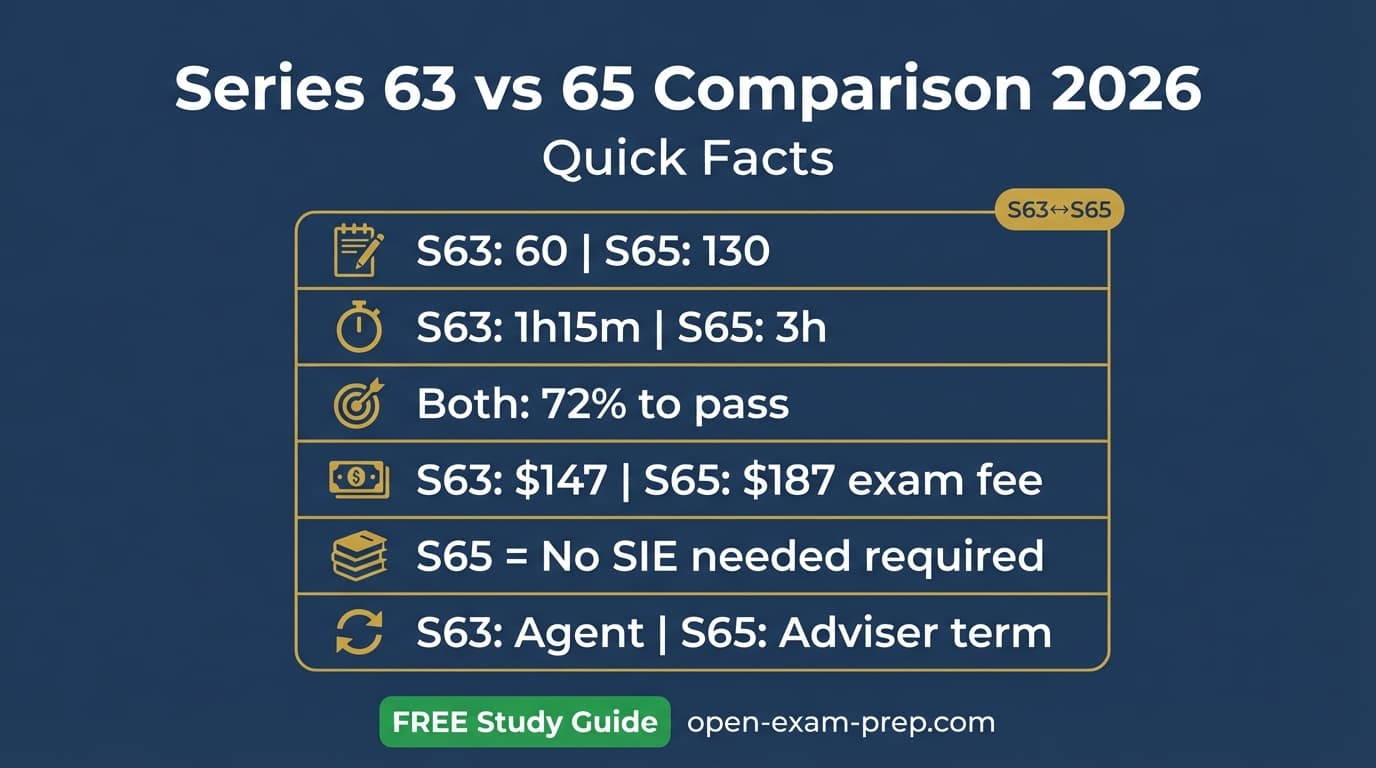
Watch: Series 63 vs Series 65 Explained
Side-by-Side Comparison
| Feature | Series 63 | Series 65 |
|---|---|---|
| Full Name | Uniform Securities Agent State Law Examination | Uniform Investment Adviser Law Examination |
| Exam Cost | $147 | $187 |
| Passing Score | 72% (43 of 60 scored questions) | 72% (94 of 130 scored questions) |
| Questions | 60 (55 scored + 5 unscored pretest) | 130 (120 scored + 10 unscored pretest) |
| Time Limit | 1 hour 15 minutes | 3 hours |
| Study Time | 20 - 30 hours over 1 - 2 weeks | 60 - 80 hours over 4 - 6 weeks |
| Difficulty | Moderate | Challenging |
| Prerequisites | No formal prerequisite, but almost always taken alongside a FINRA representative exam (SIE + Series 6 or SIE + Series 7). Must be sponsored by a FINRA-member broker-dealer. | None — no SIE, no Series 7, no firm sponsorship required. Anyone can register and take the Series 65 independently. |
| Exam Body | NASAA (North American Securities Administrators Association) | NASAA (North American Securities Administrators Association) |
Key Differences
- 1The Series 63 authorizes you to sell securities as an agent at a broker-dealer; the Series 65 authorizes you to provide investment advice for fees as an IAR at an RIA. Selling vs. advising is the core distinction.
- 2The Series 65 requires NO prerequisites — no SIE, no Series 7, no firm sponsorship. The Series 63 is practically useless without a FINRA representative license (Series 6 or Series 7) because it only grants state agent registration.
- 3Series 65 holders at RIAs operate under a fiduciary standard (must act in client's best interest); Series 63 holders at broker-dealers operate under a suitability standard (must recommend "suitable" products, but not necessarily the best).
- 4The Series 65 is significantly harder: 130 questions in 3 hours with a ~66% pass rate vs. the Series 63's 60 questions in 75 minutes with an ~82% pass rate. The Series 65 requires 2-3x more study time.
- 5The Series 65 covers economics, investment strategies, and portfolio management — content areas absent from the Series 63, which focuses exclusively on state securities law (the Uniform Securities Act).
- 6The Series 65 is a standalone career path: you can become a financial planner or wealth manager at an RIA without ever touching a FINRA exam. The Series 63 is always a supplement to a FINRA license.
- 7The Series 66 (Uniform Combined State Law) effectively combines the Series 63 and Series 65 into a single exam — but the Series 66 REQUIRES the Series 7 as a prerequisite, unlike the standalone Series 65.
- 8The fee-only RIA model (Series 65 pathway) is the fastest-growing segment of wealth management, while traditional commission-based brokerage (Series 63 pathway) is declining as a percentage of industry revenue.
What Each Exam Allows You To Do
Series 63
- Register as a securities agent in any state that requires the Series 63 (most states)
- Sell securities within state borders when combined with a FINRA representative license (Series 6 or Series 7)
- Ensure compliance with state-level blue sky laws and Uniform Securities Act provisions
- Operate legally as a registered representative at a broker-dealer with full state registration
Series 65
- Register as an Investment Adviser Representative (IAR) at a state-registered or SEC-registered RIA firm
- Charge fees for investment advice — hourly fees, flat fees, or assets under management (AUM) fees
- Provide fiduciary investment guidance to clients as a fee-based or fee-only adviser
- Operate as a financial planner, wealth manager, or portfolio manager at an RIA without any FINRA licenses
- Combine with a CFP, CFA, or CPA credential to offer comprehensive financial planning services for fees
Who Should Take Each Exam?
Take the Series 63 if you...
- →Broker-dealer agents who need state registration to sell securities alongside a Series 6 or Series 7
- →Wirehouse trainees completing their licensing requirements (SIE + Series 7 + Series 63 or 66)
- →Registered representatives selling securities in multiple states who need multi-state registration
- →Anyone following the traditional broker-dealer career path with commission-based compensation
Take the Series 65 if you...
- →Career changers who want the fastest path into financial advice without the SIE or Series 7
- →CFP certificants, CPAs, and attorneys who want to charge for investment advice at an RIA
- →Aspiring fee-only or fee-based financial planners and wealth managers
- →Anyone who wants to work at a Registered Investment Adviser (RIA) firm under a fiduciary standard
- →Professionals pursuing the growing fee-only advisory model instead of commission-based sales
Which Should You Take First?
The answer depends entirely on your career path. If you are following the traditional broker-dealer route (you have or plan to get a Series 6 or Series 7), the Series 63 is typically taken first as part of your firm's licensing package — most wirehouse and broker-dealer training programs require SIE + Series 7 + Series 63 (or Series 66) within 120 days of hire. In this scenario, the Series 63 comes before the Series 65. However, if you are a career changer, CFP holder, CPA, or anyone who wants to enter financial advice without going through the FINRA exam gauntlet, the Series 65 is your first and potentially only exam. The Series 65 has no prerequisites — you can take it tomorrow without the SIE, without the Series 7, and without firm sponsorship. This makes the Series 65 the single fastest path from zero to licensed financial adviser. For career changers, the Series 65 eliminates months of additional study and thousands of dollars in exam fees. If you eventually want BOTH the ability to sell securities AND advise for fees, consider the Series 66, which combines Series 63 and Series 65 content into one exam — but requires the Series 7 as a prerequisite. The optimal path for most full-service advisors is SIE → Series 7 → Series 66, which gives you everything the Series 63 and Series 65 would separately.
At a Glance: Series 63 vs Series 65
Exam Cost
$147
Series 63
$187
Series 65
Pass Rate
~82%
Series 63
~66%
Series 65
Study Time
20-30 hrs
Series 63
60-80 hrs
Series 65
Prerequisites
SIE + S6/S7
Series 63
None
Series 65
Series 63
Broker-dealer agents who need state registration to sell securities — typically paired with a Series 6 or Series 7 license
Series 65
Aspiring investment adviser representatives (IARs) at RIAs, career changers entering financial advice, and anyone wanting to charge fees for investment guidance without needing a FINRA license
Start preparing today:
Key Facts: Series 63 vs Series 65
- 1The Series 63 exam costs $147 and covers state securities law (Uniform Securities Act) with 60 questions in 75 minutes, while the Series 65 costs $187 and covers investment adviser law with 130 questions in 3 hours.
- 2The Series 65 requires NO prerequisites — no SIE, no Series 7, no firm sponsorship — making it the fastest standalone path into the financial advisory profession for career changers.
- 3The Series 63 has an approximately 82% first-time pass rate compared to the Series 65's approximately 66% first-time pass rate, according to NASAA 2023-2024 data.
- 4Series 65 holders at RIAs operate under a fiduciary standard (legally required to act in the client's best interest), while Series 63 holders at broker-dealers follow the suitability standard.
- 5Investment Adviser Representatives (IARs) at RIA firms earn an average of $151,203 per year according to the InvestmentNews 2024 Compensation Study, with firm owners and partners earning $250,000-$500,000+.
- 6The Series 66 (Uniform Combined State Law Exam) combines the content of both the Series 63 and Series 65 into a single exam but requires the Series 7 as a prerequisite.
- 7Fee-based revenue now accounts for over 75% of total financial advisor compensation at leading firms according to Cerulli Associates, driving rapid growth in the RIA channel favored by Series 65 holders.
- 8The BLS projects 13% growth for personal financial advisors (Series 65 pathway) through 2034, compared to just 3% growth for securities sales agents (Series 63 pathway).
- 9The total cost to become a licensed IAR through the Series 65 standalone path is $337-$787, compared to $700-$925+ for the traditional Series 63 + Series 7 + SIE broker-dealer path.
- 10An estimated 30-40% of financial advisors are expected to retire by 2030, creating unprecedented career opportunities in both the broker-dealer and RIA channels.
Why This Comparison Matters
Fiduciary Standard
Series 65 = Fiduciary Duty
Series 65 holders at RIAs operate under a fiduciary standard — legally required to act in the client's best interest. Series 63 holders at broker-dealers follow the suitability standard. This distinction is reshaping the entire advisory industry.
No SIE Required
Series 65 Standalone Path
The Series 65 requires NO FINRA prerequisite exams — no SIE, no Series 7. This makes it the fastest path into financial advice for career changers, CFP holders, and CPAs who want to charge for investment guidance.
$151,203 Avg
RIA Advisor Compensation
Investment adviser representatives at RIAs earn an average of $151,203 per year (InvestmentNews Compensation Study). The fee-only RIA model is the fastest-growing segment of wealth management.
The Series 63 vs Series 65 comparison represents the most important fork in the road for anyone entering financial services: do you want to sell securities (broker-dealer agent model) or advise on investments for fees (RIA adviser model)? This distinction, which once seemed like a regulatory technicality, has become the defining strategic decision in wealth management careers.
The industry is undergoing a seismic shift. According to Cerulli Associates, fee-based revenue now accounts for over 75% of total financial advisor compensation at leading firms, up from roughly 50% a decade ago. The fee-only RIA model — where advisors charge a percentage of assets under management (AUM) or flat fees and have no commission income whatsoever — is growing at over 12% annually, making it the fastest-growing segment of the advisory industry. This trend massively favors Series 65 holders, who can operate as Investment Adviser Representatives at RIAs without any FINRA licenses.
Perhaps the most underappreciated fact in the industry: the Series 65 requires no FINRA prerequisites. While broker-dealer agents must navigate the SIE → Series 7 → Series 63/66 licensing gauntlet (costing $472-$509 in exam fees alone and requiring 120-180 hours of study), the Series 65 is a single $187 exam that you can take without sponsorship. For career changers, CFP certificants, CPAs, and attorneys, this makes the Series 65 the most efficient entry point into the advisory profession — a fact that is reshaping who becomes a financial adviser and how they serve clients.
What Each Exam Covers
Series 63 Exam Topics
Pass Rate: ~82% first-time pass rate (NASAA data, 2023-2024)
Series 65 Exam Topics
Pass Rate: ~66% first-time pass rate (NASAA data, 2023-2024)
Salary & Income Comparison
Securities Agent (Series 63 + Series 6 or 7)
$78,140
Median Annual Salary
Range: $47,080 - $215,210+
BLS Occupational Employment Statistics, May 2024 (SOC 41-3031). Series 63 salary depends entirely on the underlying FINRA license (Series 6 or Series 7).
The Series 63 itself does not determine earnings — it is a state registration exam paired with a FINRA license. Series 63 + Series 7 holders at wirehouses earn grid-based compensation (35-51% of revenue). Series 63 + Series 6 holders selling mutual funds and variable annuities typically earn $50,000-$90,000 in their first few years.
Investment Adviser Representative (IAR)
$78,695
Median Annual Salary
Range: $48,000 - $151,203+ (RIA firm advisors)
ZipRecruiter IAR salary data, 2024; InvestmentNews RIA Compensation Study, 2024
Compensation varies significantly by firm model. At fee-only RIAs, advisors managing $50M+ in client assets typically earn $120,000-$200,000 in salary plus bonus. Lead advisors and partners at established RIAs earn $200,000-$400,000+. Solo RIA owners with $100M+ AUM commonly earn $250,000-$500,000 after expenses. The InvestmentNews 2024 Compensation Study reports an average RIA advisor salary of $151,203.
Series 63 compensation is entirely dependent on the underlying FINRA license it accompanies. Series 63 + Series 7 holders at broker-dealers earn a median of $78,140 according to BLS May 2024 data (SOC 41-3031), with top earners at wirehouses generating $200,000-$500,000+ through grid-based compensation (35-51% of revenue). Series 63 + Series 6 holders selling packaged products typically earn $50,000-$90,000 in their early years. In all cases, the Series 63 alone contributes nothing to compensation — it is purely a state registration requirement.
Series 65 holders working as Investment Adviser Representatives (IARs) at RIAs earn a median of $78,695 per year according to ZipRecruiter 2024 data, but this median significantly understates compensation at established RIA firms. The InvestmentNews 2024 Compensation Study reports an average RIA advisor salary of $151,203, with lead advisors and partners earning $200,000-$400,000+. Solo RIA owners who build practices with $100M+ in AUM commonly earn $250,000-$500,000 after overhead expenses. The RIA compensation model is fundamentally different from brokerage: instead of one-time commissions, advisors earn recurring AUM fees (typically 0.75%-1.25% of assets), creating predictable, growing revenue streams. An advisor managing $75M in client assets at a 1% AUM fee generates $750,000 in annual revenue — even after firm overhead, take-home pay is substantial. The recurring nature of AUM fees also makes RIA practices highly valuable for acquisition: RIA firms typically sell for 2.0-2.5x annual revenue, meaning a practice generating $500,000 in annual fees is worth $1M-$1.25M.
Total Cost to Get Licensed
| Expense | Series 63 | Series 65 |
|---|---|---|
| Pre-Licensing Education | $100 - $350 (Series 63 prep course: Kaplan $279, STC $199, Achievable $99, ExamFX $149) | $150 - $400 (Series 65 prep course: Kaplan $349, STC $299, Achievable $149, ExamFX $199) |
| Exam Fee | $147 (NASAA). Note: Series 63 is taken alongside a FINRA exam (SIE $80 + Series 7 $245 = $325 additional) | $187 (NASAA) |
| License Fee | $0 - $100 (state registration fees vary by state; paid by employing broker-dealer in most cases) | $0 - $150 (state IAR registration fees vary by state; some states charge $50-$150 for IAR registration) |
| Background Check | $50 - $100 (fingerprinting and background check via Form U4, typically firm-paid) | $0 - $50 (some RIA firms require background checks; not universally required like Form U4) |
| Total Investment | $147 - $925 (Series 63 alone: $247-$497; full licensing with SIE + Series 7 + Series 63: $700-$925+) | $337 - $787 (Series 65 standalone path — no SIE, no Series 7 required) |
A Day in the Life
Series 63 Professional
A Series 63 + Series 7 licensed registered representative at a regional broker-dealer starts his day at 8:00 AM reviewing the firm's recommended product list and checking overnight market activity. At 9:30 AM when markets open, he processes several client trade orders — a buy for 500 shares of an S&P 500 ETF and a sell of a municipal bond position. At 10:30 AM, he cold-calls prospects from a lead list, trying to set appointments for portfolio reviews. Over lunch, he attends a wholesaler presentation on a new variable annuity product his firm just approved. In the afternoon, he meets with an existing client couple to review their portfolio performance and recommends reallocating from growth stocks to more conservative income-producing investments as they approach retirement. He documents the suitability rationale for each recommendation. By 4:30 PM, he submits his trade blotters and reviews his commission report for the month: $12,400 in gross production, with his 40% grid payout yielding about $4,960.
Series 65 Professional
A Series 65 licensed Investment Adviser Representative at a fee-only RIA firm begins her day at 8:30 AM reviewing client financial plans flagged for quarterly updates. At 9:30 AM, she conducts a comprehensive financial planning meeting via Zoom with a new client — a 38-year-old physician with $400,000 in student loans, a $350,000 income, and no investment strategy. She builds a holistic plan covering debt payoff optimization, retirement projections, tax-loss harvesting, disability insurance review, and a Backdoor Roth IRA strategy. At 11:00 AM, she runs portfolio rebalancing across 15 client accounts using the firm's model portfolios in their portfolio management software. After lunch, she prepares a retirement income analysis for a couple in their late 50s — projecting Social Security optimization strategies, Roth conversion ladders, and sustainable withdrawal rates. At 3:00 PM, she meets with her firm's Chief Compliance Officer to review updated ADV Part 2 disclosures. She ends the day drafting a quarterly client newsletter on tax planning strategies for year-end. Her compensation: a $95,000 base salary plus a performance bonus tied to client retention and new assets gathered — no commissions, no product sales.
Career Paths & Progression
Series 63 Career Path
0-2 years
Registered Rep Trainee (Series 63 + S7)
$50K-$80K base
2-5 years
Financial Advisor / Broker (Broker-Dealer)
$80K-$150K
5-10 years
Senior Financial Advisor (Wirehouse)
$150K-$350K
10+ years
Branch Manager / Managing Director
$250K-$600K+
Series 65 Career Path
0-2 years
Associate Advisor / Paraplanner (RIA)
$50K-$70K
2-5 years
Financial Planner / IAR (RIA)
$75K-$130K
5-10 years
Lead Advisor / Partner (RIA)
$150K-$300K
10+ years
RIA Firm Owner / Managing Partner
$250K-$500K+
The Series 63 career path runs through the traditional broker-dealer channel. After obtaining a FINRA representative license (Series 6 or 7) plus the Series 63 for state registration, agents work at wirehouses (Morgan Stanley, Merrill Lynch, UBS, Wells Fargo), regional broker-dealers, or independent broker-dealers. Compensation is primarily commission-based or grid-based, rewarding transaction volume and product sales. The career ceiling is high — top wirehouse advisors managing $200M+ in client assets earn $300,000-$600,000+ — but the path requires building a client book through cold calling, referrals, and networking.
The Series 65 career path runs through the RIA channel, which operates under fundamentally different economics. IARs at fee-only RIAs earn compensation through recurring AUM fees (0.75%-1.25% of assets managed), hourly fees ($150-$400/hr), or flat retainer fees ($2,000-$10,000/year). This model produces predictable, recurring revenue that grows with markets and new client acquisition. The InvestmentNews 2024 Compensation Study shows the average RIA advisor earns $151,203, with partners and firm owners earning significantly more. The RIA path is particularly attractive for CFP certificants and CPAs who want to deliver comprehensive financial planning under a fiduciary standard. Unlike broker-dealer agents, RIA advisors are legally required to act in the client's best interest — a distinction that is increasingly valued by consumers and regulators alike.
Start preparing today:
Should You Get Both the Series 63 and Series 65?
Benefits
- +Having both the Series 63 and Series 65 (or the combined Series 66) with a Series 7 gives you the maximum career flexibility: you can sell securities on commission AND advise for fees at a dual-registered firm
- +The Series 66 combines the Series 63 and Series 65 into a single exam — if you already have or plan to get the Series 7, the Series 66 is more efficient than taking the 63 and 65 separately
- +Dual registration (broker-dealer agent + IAR) allows you to serve clients through both brokerage and advisory accounts, matching the service model to each client's needs
- +Most wirehouse and large broker-dealer training programs now require Series 7 + Series 66 (equivalent to 63 + 65), reflecting the industry's shift toward fee-based advice
- +Having both registrations future-proofs your career: if you later transition from a broker-dealer to an RIA (or vice versa), you already hold the necessary qualifications
Considerations
- !The Series 66 requires the Series 7 as a prerequisite — if you do not have or want the Series 7, you cannot take the Series 66 and must take the Series 63 and Series 65 separately
- !If you only plan to work at an RIA and never sell securities on commission, the Series 65 alone is sufficient — the Series 63 adds no value in a fee-only RIA model
- !Studying for both exams separately requires 80-110 total hours (20-30 for Series 63 + 60-80 for Series 65), compared to 50-70 hours for the combined Series 66
- !State registration requirements vary: some states have specific rules about which exams qualify for IAR registration, so verify with your state securities regulator
The Verdict: If you are pursuing the traditional broker-dealer path with a Series 7, take the Series 66 instead of the Series 63 and 65 separately — it is more efficient and gives you both state agent and IAR registration in one exam. If you are a career changer or professional (CFP, CPA, attorney) who wants to advise for fees at an RIA without the FINRA exam gauntlet, the Series 65 alone is the optimal choice — skip the Series 63 entirely. The only scenario where taking BOTH the 63 and 65 separately makes sense is if you already hold the Series 63 from prior broker-dealer work and now want to add advisory capabilities without retaking an exam you have already passed.
Job Outlook & Industry Trends
3% (2024-2034, BLS — securities sales agents)
Series 63 Job Growth (2024-2034)
13% (2024-2034, BLS — personal financial advisors)
Series 65 Job Growth (2024-2034)
The job outlook strongly favors the Series 65 pathway. The BLS projects 13% growth for personal financial advisors (SOC 13-2052) through 2034 — more than four times the rate for securities sales agents (3%). This divergence reflects the industry's accelerating shift from commission-based brokerage to fee-based advisory services. According to Cerulli Associates, fee-based revenue now exceeds 75% of total advisor compensation at leading firms, and independent RIAs are capturing an increasing share of new client assets. The retirement of baby boomer advisors — an estimated 30-40% of financial advisors will exit the industry by 2030 — creates massive opportunities in both channels, but particularly in the RIA space where succession planning and firm acquisitions are driving consolidation. The BLS projects approximately 27,200 annual openings for personal financial advisors, driven by retirements, career transitions, and growing consumer demand for fiduciary advice.
Study Strategy & Tips
Series 63 Preparation
State securities law and the Uniform Securities Act
- Complete a Series 63 prep course (Kaplan, STC, Achievable, or similar)
- Study the Uniform Securities Act: definitions of securities, agents, broker-dealers, and investment advisers under state law
- Master registration requirements: registration by coordination, qualification, and notice filing; exemptions from registration
- Learn the Administrator's powers: denial, suspension, revocation; grounds for action; due process protections
- Take 2-3 full-length practice exams, scoring 80%+ consistently before scheduling
Pass Series 63
Final review and exam
- Review anti-fraud provisions and unethical business practices — these are heavily tested
- Drill on exemption categories (exempt securities vs. exempt transactions) until they are second nature
- Schedule and pass the Series 63 exam
- Begin transitioning to Series 65 prep material
Series 65 Deep Study
Investment theory, economics, regulations, and ethics
- Complete a Series 65 prep course — focus on the two 30% sections: Client Recommendations and Laws/Regulations
- Study Investment Vehicle Characteristics (25%): equities, bonds, options, mutual funds, ETFs, REITs, alternatives, and their risk/return profiles
- Master economics and business information (15%): monetary/fiscal policy, business cycles, GDP, inflation, yield curves, financial statement analysis
- Understand the fiduciary standard, Investment Advisers Act of 1940, brochure rule, custody rules, and conflict-of-interest disclosure requirements
Series 65 Practice & Pass
Practice exams and final preparation
- Take 4-5 full-length timed practice exams (3 hours each)
- Score 78%+ consistently before scheduling (the ~66% pass rate means extra preparation margin is critical)
- Focus on weak areas — most candidates struggle with economics, portfolio theory (Modern Portfolio Theory, CAPM, alpha/beta), and detailed regulatory provisions
- Schedule and pass the Series 65 exam
Total Duration: 6-8 weeks (if studying for both exams sequentially)
Series 63 Study Tips
- 1Focus on the Uniform Securities Act (USA) — the entire exam is about state-level securities regulation. Understand how the USA defines securities, agents, broker-dealers, and investment advisers differently from federal law.
- 2Memorize registration requirements: who must register, who is exempt, and what triggers registration in a state. Know the difference between registration by coordination, qualification, and notice filing.
- 3Understand the Administrator's powers: the ability to deny, suspend, or revoke registrations; issue cease and desist orders; and impose penalties. Know the grounds for each action and the due process requirements.
- 4Learn the anti-fraud provisions cold — unethical business practices, prohibited activities for agents and broker-dealers, and the specific rules around churning, unauthorized trading, and material misrepresentation.
- 5Take at least 2-3 full-length practice exams. The Series 63 is short (55 scored questions, 75 minutes) and heavily conceptual — the questions test your understanding of state regulatory principles, not calculations.
Series 65 Study Tips
- 1Allocate the most time to Client Investment Recommendations and Strategies (30%) and Laws/Regulations (30%) — together they account for 60% of the exam. These sections test your ability to apply investment concepts to real client scenarios and understand fiduciary obligations.
- 2Master Investment Vehicle Characteristics (25%): understand the risk/return profiles, tax treatment, and suitability of equities, fixed income, options, mutual funds, ETFs, REITs, hedge funds, private equity, and alternative investments. This section overlaps significantly with Series 7 content.
- 3Study economics and business information (15%): monetary policy, fiscal policy, business cycles, GDP, inflation, interest rates, yield curves, and balance sheet analysis. This section is unique to the Series 65 — the Series 63 does not cover economics.
- 4Understand the fiduciary standard thoroughly — how it differs from the suitability standard, what constitutes a breach of fiduciary duty, and how conflicts of interest must be disclosed and managed under the Investment Advisers Act of 1940.
- 5The Series 65 has a lower pass rate (~66%) than the Series 63 (~82%) because of its breadth and depth. Take at least 4-5 full-length practice exams under timed conditions (3 hours). Many candidates underestimate this exam because it has no prerequisites.
Ready to Start Studying?
Free practice questions, study guides, and AI tutoring for the matching exam resources.
Frequently Asked Questions
QCan I take the Series 65 without the SIE or Series 7?
Yes — this is one of the most important and underappreciated facts in financial services licensing. The Series 65 has absolutely no prerequisites. You do not need the SIE, the Series 7, or any other FINRA exam. You do not need firm sponsorship. Anyone can register with NASAA, pay $187, and take the Series 65 at a Prometric testing center. This makes the Series 65 the fastest path from zero to licensed financial adviser, which is why it is so popular among career changers, CFP certificants, CPAs, and attorneys who want to provide investment advice for fees at an RIA without navigating the FINRA licensing gauntlet.
QWhat is the difference between the Series 63 and the Series 65?
The Series 63 (Uniform Securities Agent State Law) authorizes you to register as a state securities agent who SELLS securities at a broker-dealer — it must be paired with a FINRA license (Series 6 or 7) to be useful. The Series 65 (Uniform Investment Adviser Law) authorizes you to register as an Investment Adviser Representative (IAR) who ADVISES clients for fees at an RIA firm — it works as a standalone license. The Series 63 covers only state securities law (the Uniform Securities Act), while the Series 65 covers economics, investment strategies, portfolio management, and investment adviser regulations. The fiduciary vs. suitability distinction is paramount: Series 65 holders at RIAs must act in the client's best interest, while Series 63 holders at broker-dealers need only ensure recommendations are suitable.
QShould I take the Series 66 instead of the Series 63 and 65 separately?
If you already have or plan to get the Series 7, the Series 66 is almost always the better choice. The Series 66 combines the content of both the Series 63 and Series 65 into a single exam (100 questions, 2.5 hours, $177) and gives you both state agent registration and IAR qualification. It requires 50-70 study hours vs. a combined 80-110 hours for the 63 and 65 separately. However, the Series 66 requires the Series 7 as a prerequisite. If you do not have the Series 7 and want to enter financial advice quickly, the Series 65 alone is your best option. The only reason to take the 63 and 65 separately is if you already passed one exam previously and need to add the other.
QIs the Series 65 harder than the Series 63?
Yes, significantly. The Series 65 has a first-time pass rate of approximately 66% compared to the Series 63's approximately 82%. The Series 65 has more than twice as many questions (130 vs. 60), double the time limit (3 hours vs. 75 minutes), and covers far broader content including economics, investment theory, portfolio management concepts like Modern Portfolio Theory and CAPM, and detailed investment adviser regulations. The Series 63 focuses exclusively on state securities law. Most candidates need 60-80 hours of study time for the Series 65 compared to just 20-30 hours for the Series 63. Many people underestimate the Series 65 because it has no prerequisites, but its breadth and depth make it a legitimately challenging exam.
QHow much do Series 65 holders (Investment Adviser Representatives) earn?
Compensation for Series 65 holders varies widely by role and firm size. According to ZipRecruiter 2024 data, the median IAR salary is approximately $78,695. However, the InvestmentNews 2024 Compensation Study reports an average RIA advisor salary of $151,203, reflecting the higher compensation at established fee-only and fee-based firms. Lead advisors and partners at RIAs typically earn $200,000-$400,000+. Solo RIA owners managing $100M or more in client assets commonly earn $250,000-$500,000 after expenses. The RIA compensation model is built on recurring AUM fees (typically 0.75%-1.25% of assets managed), which creates predictable, growing income as markets appreciate and new clients are added.
QWhat is the fiduciary standard and why does it matter for the Series 63 vs 65 decision?
The fiduciary standard requires investment advisers to act in the client's best interest at all times, disclose all conflicts of interest, and put client needs ahead of their own compensation. Series 65 holders working as IARs at RIA firms are bound by this standard under the Investment Advisers Act of 1940. By contrast, Series 63 holders working as broker-dealer agents operate under the suitability standard (and more recently the SEC's Regulation Best Interest), which requires that recommendations be "suitable" for the client but does not mandate the best possible advice. This distinction matters because consumer awareness of fiduciary duty is rising rapidly, and the fee-only fiduciary model is becoming a major competitive advantage in attracting clients. For advisors who want to market themselves as always acting in the client's best interest, the Series 65 and the RIA model provide the clearest regulatory framework.

Your AI study companion · 10 free interactions a day
Free exam resources
Start Studying the Exact Exam
Use the comparison to choose a path, then move into the matching practice questions, study guide, and flashcards.
 Buy on Amazon
 Flashcards on Mometrix
 Prep course on Achievable
 Practice exams on ExamEdge
Related Exam Comparisons
Stay Updated
Get free exam tips and study guides delivered to your inbox.