SIE vs Series 7
The SIE is the entry-level prerequisite exam that anyone 18+ can take without firm sponsorship — it proves foundational securities knowledge. The Series 7 is the comprehensive license exam that requires both the SIE and firm sponsorship, authorizing you to sell virtually all types of securities. You must pass the SIE before taking the Series 7, making the path SIE → firm sponsorship → Series 7.
Watch: SIE vs Series 7 Explained
Side-by-Side Comparison
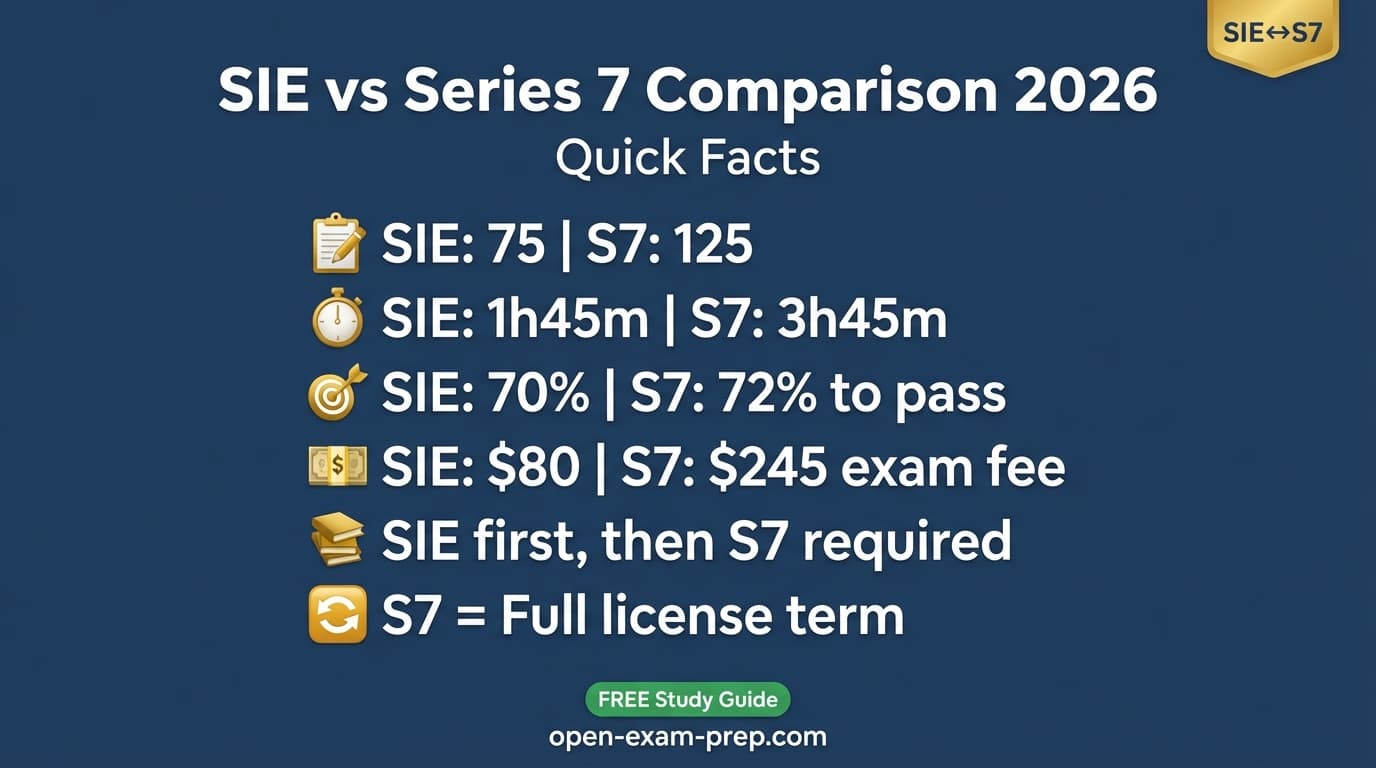
| Feature | SIE | Series 7 |
|---|---|---|
| Full Name | Securities Industry Essentials Exam | General Securities Representative Exam |
| Exam Cost | $80 | $245 |
| Passing Score | 70% (56 of 80 scored questions) | 72% (83 of 115 scored questions) |
| Questions | 85 (75 scored + 10 unscored) | 135 (125 scored + 10 unscored) |
| Time Limit | 1 hour 45 minutes | 3 hours 45 minutes |
| Study Time | 40 - 60 hours over 2 - 4 weeks | 80 - 120 hours over 4 - 8 weeks |
| Difficulty | Entry-level | Challenging |
| Prerequisites | None — anyone 18+ can take it without firm sponsorship | SIE exam passed + firm sponsorship (Form U4 filing) required |
| Exam Body | FINRA | FINRA |
Key Differences
- 1The SIE is a prerequisite exam; the Series 7 is the actual license. Passing the SIE alone does not authorize you to conduct securities business.
- 2The SIE can be taken without firm sponsorship by anyone 18+; the Series 7 requires an employing broker-dealer to file Form U4 on your behalf.
- 3The SIE tests knowledge recognition (what IS a municipal bond?); the Series 7 tests application and calculation (which municipal bond is most suitable for this client, and what is the tax-equivalent yield?).
- 4The SIE costs $80 and has 75 scored questions in 1 hour 45 minutes; the Series 7 costs $245 and has 125 scored questions in 3 hours 45 minutes.
- 5The SIE result is valid for 4 years without association; the Series 7 license requires ongoing continuing education (CE) and lapses after 2 years of non-association with a firm.
- 6Study time is roughly 40-60 hours for the SIE vs 80-120 hours for the Series 7 — the Series 7 requires twice the preparation.
- 7The SIE has a 70% passing score; the Series 7 has a 72% passing score with significantly harder questions involving calculations and multi-step analysis.
- 8About 40-50% of SIE content overlaps with Series 7 material, giving SIE passers a head start on their Series 7 preparation.
What Each Exam Allows You To Do
SIE
- Demonstrate foundational knowledge of the securities industry
- Satisfy the prerequisite for all FINRA representative-level exams (Series 6, 7, 57, 79, etc.)
- Show prospective employers you are serious about a career in finance
- Begin job hunting at broker-dealers with a credential on your resume
Series 7
- Sell all types of securities: stocks, bonds, options, mutual funds, ETFs, variable annuities, and direct participation programs
- Recommend investment strategies and execute trades for retail and institutional clients
- Work as a registered representative (stockbroker) at any FINRA-member broker-dealer
- Act as a financial advisor at wirehouses like Morgan Stanley, Merrill Lynch, UBS, and Wells Fargo
- Earn commissions on securities transactions or manage fee-based accounts (with Series 66 or 65)
Who Should Take Each Exam?
Take the SIE if you...
- →Career changers exploring financial services
- →College students or recent graduates getting a head start
- →Job seekers who want to prove securities knowledge before landing a firm
- →Anyone preparing for the Series 6, Series 7, or another FINRA representative exam
Take the Series 7 if you...
- →Aspiring stockbrokers and registered representatives
- →Financial advisors at full-service broker-dealers and wirehouses
- →Anyone wanting the broadest securities license available
- →Career changers targeting high-income financial services roles
Which Should You Take First?
You MUST take the SIE first — it is a mandatory prerequisite for the Series 7 (and all other FINRA representative-level exams). The optimal strategy for most people is: (1) Study for and pass the SIE while job hunting — since it requires no sponsorship, you can take it on your own timeline. (2) Use your SIE credential to strengthen your resume and interviews at broker-dealers. (3) Once hired, your firm will sponsor you for the Series 7 via Form U4. (4) Study for and pass the Series 7 within your firm's training window (typically 120 days). Many successful candidates study for both exams in sequence, starting Series 7 prep immediately after passing the SIE while the foundational material is still fresh. The 40-50% content overlap between the exams makes this approach highly efficient.
At a Glance: SIE vs Series 7
Exam Cost
$80
SIE
$245
Series 7
Pass Rate
~74%
SIE
~74%
Series 7
Study Time
40-60 hrs
SIE
80-120 hrs
Series 7
Median Salary
N/A (prerequisite)
SIE
$78,140
Series 7
SIE
Career changers exploring finance, college students, and anyone wanting to prove securities knowledge without firm sponsorship
Series 7
Aspiring stockbrokers, financial advisors at broker-dealers, and anyone wanting the full general securities license
Start preparing today:
Key Facts: SIE vs Series 7
- 1The SIE exam costs $80 and can be taken by anyone 18+ without firm sponsorship, while the Series 7 costs $245 and requires both the SIE and sponsorship by a FINRA-member broker-dealer.
- 2Both the SIE and Series 7 have approximately a 74% first-time pass rate according to FINRA data from 2023-2024, but the Series 7 requires twice the study time (80-120 hours vs 40-60 hours).
- 3The SIE result is valid for 4 years without firm association, giving candidates time to secure employment before taking the Series 7.
- 4Securities, commodities, and financial services sales agents (Series 7 holders) earn a median salary of $78,140 per year, with the top 10% earning over $215,210 according to BLS May 2024 data.
- 5Wirehouse financial advisors at firms like Morgan Stanley and Merrill Lynch earn 35-51% of revenue generated through a grid-based compensation system, meaning an advisor producing $1M in annual revenue earns $350,000-$510,000.
- 6The Series 7 exam is 73% focused on providing investment recommendations and information — making suitability analysis and product knowledge the most critical study areas.
- 7Approximately 40-50% of SIE content overlaps with the Series 7, giving SIE passers a meaningful head start on Series 7 preparation.
- 8The standard licensing sequence for full-service financial advisors is SIE → Series 7 → Series 66 (or Series 63), typically completed within 120 days of hire at a broker-dealer.
- 9The BLS projects 38,100 annual job openings for securities sales agents through 2034, with an estimated 30-40% of current financial advisors expected to retire by 2030.
- 10The total cost to become a fully licensed registered representative (SIE + Series 7 + state exam + prep courses + background check) ranges from $550 to $1,100.
Why This Comparison Matters
4-Year Window
SIE Validity Period
Pass the SIE without firm sponsorship and your result stays valid for 4 years — giving you time to land a job before taking the Series 7.
$78,140
Median Salary (BLS)
Securities sales agents (Series 7 holders) earn a median of $78,140/year per BLS, with the top 10% exceeding $215,000.
38,100
Annual Job Openings
The BLS projects 38,100 annual openings for securities sales agents through 2034, driven by retirements and financial market growth.
The SIE and Series 7 are the two most important exams in the FINRA licensing framework, and understanding their relationship is essential for anyone entering the securities industry. Since FINRA restructured its exam system in October 2018, the SIE has served as the universal gateway — a foundational test that proves you understand the basics before you specialize.
The key strategic insight most candidates miss: the SIE is your ticket to job interviews, not just a test to pass. Because you can take the SIE without firm sponsorship, it serves as a powerful signaling device. Listing "SIE Passed" on your resume tells hiring managers you are serious, prepared, and ready to move straight to the Series 7. In competitive hiring cycles, this can be the difference between getting an interview and being overlooked.
The Series 7 is where careers are made. It is the broadest FINRA license available, authorizing you to sell virtually every type of security to retail and institutional clients. Combined with a state registration exam (Series 63 or Series 66), the Series 7 is the foundation for careers at wirehouses, independent broker-dealers, and hybrid RIA firms. The BLS reports a median salary of $78,140 for securities sales agents, with the top 10% earning over $215,000 — and those figures do not capture the full compensation of top wirehouse advisors who routinely earn $300,000-$500,000+.
What Each Exam Covers
SIE Exam Topics
Pass Rate: ~74% first-time pass rate (FINRA data, 2023-2024)
Series 7 Exam Topics
Pass Rate: ~74% first-time pass rate (FINRA data, 2023-2024)
Salary & Income Comparison
SIE Credential Holder (Pre-License)
N/A — SIE alone is not a license
Median Annual Salary
Range: $40,000 - $55,000 (entry-level trainee positions)
ZipRecruiter, 2025; reflects trainee/associate roles that value SIE completion
The SIE is a prerequisite, not a standalone license. By itself it does not authorize you to conduct securities business. However, listing SIE on your resume signals readiness and may help you secure a trainee position at a broker-dealer where you will then take the Series 7.
Registered Representative / Securities Sales Agent
$78,140
Median Annual Salary
Range: $47,080 - $215,210+
BLS Occupational Employment Statistics, May 2024 (SOC 41-3031)
Top-performing registered representatives at wirehouses can earn $200,000-$450,000+ through grid-based compensation (35-51% of revenue generated). An advisor managing $100M in client assets producing $1M in annual revenue earns $350,000-$510,000 from the grid alone. Wirehouse trainees start with a full salary and transition to commission/bonus-based pay over 18-24 months.
| Commission Detail | Series 7 |
|---|---|
| First-Year Commission | Trainee salary ($50,000-$80,000 base) transitioning to grid-based payout |
| Renewal Commission | 35-51% of revenue at wirehouses; 80-95% at independent broker-dealers |
| Income Model | Wirehouse compensation follows a "grid" system: you earn 35-51% of the revenue you generate from client trading commissions, advisory fees, and product sales. A new advisor generating $300,000 in annual revenue would take home approximately $105,000-$153,000. Independent broker-dealer (IBD) reps keep 80-95% of revenue but pay their own overhead (office, compliance, technology). The economics heavily favor experienced advisors with large client books — the same grid percentage on $1M in revenue produces $350,000-$510,000 in take-home pay. |
The SIE alone does not unlock earning potential — it is a prerequisite, not a license. The Series 7 is where compensation begins. According to BLS May 2024 data (SOC 41-3031), securities sales agents earn a median of $78,140, with the 10th percentile at $47,080 and the 90th percentile at $215,210.
However, BLS data dramatically understates what top Series 7 holders actually earn. Wirehouse financial advisors at firms like Morgan Stanley, Merrill Lynch, and UBS operate on grid-based compensation, earning 35-51% of the revenue they generate. An advisor producing $500,000 in annual revenue earns $175,000-$255,000. At $1M in revenue, the take-home reaches $350,000-$510,000. Independent broker-dealer reps keep 80-95% of revenue but cover their own expenses.
Entry-level trainee positions at wirehouses typically start with a $50,000-$80,000 base salary during the 18-24 month training program, transitioning gradually to commission-based compensation. By year 3-5, competent advisors typically earn $100,000-$200,000. The profession rewards client acquisition and retention — your income is directly proportional to the size of your client book.
Total Cost to Get Licensed
| Expense | SIE | Series 7 |
|---|---|---|
| Pre-Licensing Education | $0 (no pre-licensing course required, though $150-$400 for optional prep course recommended) | $150 - $500 (prep course: Kaplan $349, Achievable $149, ExamFX $199-$349, Knopman $350+) |
| Exam Fee | $80 (FINRA) | $245 (FINRA) + $80 SIE if not already passed = $245-$325 |
| License Fee | N/A (SIE is not a license) | $147-$187 (Series 63 at $147 or Series 66 at $177 typically required for state registration) |
| Background Check | N/A (no Form U4 filing for SIE alone) | $50 - $100 (fingerprinting and background check via Form U4) |
| Total Investment | $80 - $480 (exam fee + optional prep course) | $550 - $1,100 (SIE + Series 7 + state exam + prep courses + Form U4 processing) |
A Day in the Life
SIE Professional
A college senior who recently passed the SIE spends her morning at a campus career fair, confidently telling recruiters at Morgan Stanley and Raymond James that she already has her SIE credential. Over lunch, she reviews her Series 7 prep book — she knows the 40-50% content overlap gives her a head start once she lands a sponsoring firm. In the afternoon, she has a phone interview with a regional broker-dealer whose hiring manager is impressed she took the initiative to pass the SIE on her own. By evening, she receives an offer for a financial advisor trainee program that will sponsor her for the Series 7 and Series 66.
Series 7 Professional
A Series 7-licensed financial advisor at a wirehouse starts the day at 7:30 AM reviewing overnight market movements and pre-market earnings reports. At 9:00 AM, she reviews client portfolios flagged for rebalancing, executing several trades before the morning team meeting. At 10:30, she meets with a new prospect — a couple in their 40s with $800,000 in investable assets — and conducts a needs analysis covering risk tolerance, retirement goals, and tax situation. After lunch, she calls five existing clients to discuss quarterly performance reviews. At 3:00 PM, she presents a financial plan to a business owner considering a 401(k) for his 15 employees. She ends the day reviewing her pipeline: 3 proposals outstanding, 2 account transfers in progress, and a referral dinner scheduled for Thursday.
Career Paths & Progression
SIE Career Path
0 years
SIE Credential Holder (Job Seeker)
$0 (credential only)
0-1 years
Trainee at Broker-Dealer (studying for Series 7)
$45K-$55K
Series 7 Career Path
0-2 years
Registered Representative (Wirehouse Trainee)
$50K-$80K base
3-5 years
Financial Advisor / Wealth Manager
$100K-$200K
5-10 years
Senior Financial Advisor / Team Lead
$200K-$400K
10+ years
Managing Director / Branch Manager
$300K-$600K+
The SIE is a stepping stone, not a destination. After passing, the career path branches depending on which representative exam you pursue: Series 7 (general securities), Series 6 (packaged products only), or Series 57 (proprietary trading). The Series 7 path is the broadest and highest-ceiling option.
Series 7 holders typically follow one of three career tracks: (1) Wirehouse advisor — building a client book at Morgan Stanley, Merrill Lynch, UBS, or Wells Fargo, earning grid-based compensation of 35-51% of revenue; (2) Independent broker-dealer rep — affiliating with an IBD like LPL, Raymond James, or Cetera, keeping 80-95% of revenue but managing your own practice; (3) Hybrid advisor — combining brokerage and advisory services at a dual-registered firm, earning both commissions and advisory fees. All three paths reward client acquisition and can produce six-figure incomes within 3-5 years.
Start preparing today:
What Else Do You Need After the Series 7?
Benefits
- +The Series 7 + Series 66 combination is the industry standard for full-service financial advisors — it enables both securities sales (brokerage) and investment advice for fees (advisory)
- +Adding the Series 66 (or Series 63 + Series 65 separately) gives you state registration as both a securities agent AND an investment adviser representative
- +Series 7 + Series 66 holders can work at dual-registered firms (broker-dealer + RIA), the fastest-growing segment of the advisory industry
- +Most wirehouse training programs require SIE + Series 7 + Series 66 within 120 days of hire — having the SIE done before arrival gives you a significant head start
- +The Series 63 alone (paired with Series 7) is sufficient if you only plan to sell securities and never charge advisory fees, but the trend is overwhelmingly toward fee-based advice
Considerations
- !The Series 66 requires the Series 7 as a prerequisite, so you must pass the Series 7 first
- !Studying for Series 7 + Series 66 back-to-back requires 130-190 total hours of preparation — firms typically allow 120 days for all exams
- !Some states do not accept the Series 66 (Series 63 + Series 65 separately may be required) — verify with your state securities regulator
The Verdict: The standard career path is SIE → Series 7 → Series 66 (or Series 63), all completed within your firm's training window. This combination gives you the broadest possible authority to both sell securities and provide advisory services. If your firm only requires the Series 63, you can always add the Series 65 later to expand into fee-based advice. The key takeaway: the SIE is just step one of a multi-exam licensing sequence, and planning the full sequence upfront helps you study more efficiently.
Job Outlook & Industry Trends
N/A (prerequisite exam)
SIE Job Growth (2024-2034)
3% (2024-2034, BLS)
Series 7 Job Growth (2024-2034)
The BLS projects 3% growth for securities, commodities, and financial services sales agents through 2034, with approximately 38,100 annual openings driven primarily by the need to replace workers who transfer to other occupations or retire. The real opportunity lies in the ongoing shift from commission-based brokerage to fee-based advisory, which creates demand for advisors who can both sell securities (Series 7) and provide fiduciary advice (Series 65/66). Additionally, the retirement of baby boomer advisors — an estimated 30-40% of financial advisors will retire by 2030 — creates unprecedented book-of-business acquisition opportunities for young professionals entering the industry.
Study Strategy & Tips
SIE Preparation
Foundational securities knowledge
- Complete an SIE prep course (Kaplan, Achievable, ExamFX, or similar)
- Study Products and Their Risks (44% of exam) first — equities, bonds, options basics, mutual funds, ETFs
- Review Trading, Accounts, and Prohibited Activities (31%) — order types, account types, insider trading rules
- Take 3+ full-length practice exams, scoring 80%+ consistently before scheduling
Pass SIE + Begin Job Search
Pass SIE and secure firm sponsorship
- Schedule and pass the SIE exam
- Update resume with SIE credential
- Apply to broker-dealer trainee programs (wirehouses, regional firms, IBDs)
- Begin reviewing Series 7 overlap material while interviewing
Series 7 Deep Study
Intensive Series 7 preparation (typically within firm training program)
- Complete a Series 7 prep course — focus on the 73% "Recommendations" section
- Master options: 4 basic positions, breakeven calculations, max gain/loss, spreads, straddles, combinations
- Study bonds: pricing, yields, duration, suitability, tax treatment
- Learn suitability rules, customer account types, margin requirements, and regulatory compliance
Series 7 Practice & Pass
Practice exams and pass
- Take 5-8 full-length timed practice exams (3 hours 45 minutes each)
- Score 80%+ consistently before scheduling the real exam
- Focus weak areas — most candidates need extra work on options and bonds
- Schedule and pass the Series 7 exam
Total Duration: 10-14 weeks for SIE + Series 7 (sequential study)
SIE Study Tips
- 1Focus 44% of your study time on Products and Their Risks — this is nearly half the exam. Know the characteristics, risks, and suitability of equities, debt securities, packaged products (mutual funds, ETFs), options, and alternative investments.
- 2Understand the difference between primary and secondary markets, the role of market makers, and how securities are issued (IPOs, secondary offerings). Capital Markets questions are straightforward if you understand the flow of money.
- 3Memorize key regulatory bodies and their jurisdictions: FINRA regulates broker-dealers, SEC oversees markets, MSRB governs municipal securities, and state regulators enforce blue sky laws.
- 4Take at least 3 full-length practice exams under timed conditions. The SIE tests breadth over depth — you need to recognize concepts quickly across a wide range of topics.
- 5Do NOT over-study. The SIE is designed as an entry-level exam. If you find yourself studying options strategies or complex bond calculations, you have gone too deep — save that for the Series 7.
Series 7 Study Tips
- 1Spend at least 30-40% of your study time on options. Options questions comprise a significant portion of the exam and are the #1 reason people fail. Master the four basic positions (long call, short call, long put, short put), breakeven calculations, max gain, max loss, and multi-leg strategies (spreads, straddles, combinations).
- 2Understand bond pricing inside and out: the inverse relationship between price and yield, current yield calculations, yield to maturity, discount vs. premium bonds, and duration/convexity concepts. Bond questions appear throughout the exam.
- 3Master suitability and know-your-customer rules. The exam will present client scenarios and ask which investment is most suitable. Consider the client's age, risk tolerance, time horizon, liquidity needs, tax situation, and investment objectives in every question.
- 4Learn the tax implications of securities transactions: capital gains (short-term vs. long-term), wash sale rules, cost basis methods (FIFO, specific identification), and the taxation of dividends, interest, and municipal bond income.
- 5Take at least 5-8 full-length practice exams. The Series 7 is a marathon (3 hours 45 minutes), and you need to build both content mastery and testing stamina. Review every wrong answer thoroughly — the exam tests the same concepts from different angles.
Ready to Start Studying?
Free practice questions, study guides, and AI tutoring for the matching exam resources.
Frequently Asked Questions
QCan I take the Series 7 without the SIE?
No. Since FINRA restructured its exam system in October 2018, the SIE is a mandatory prerequisite for all representative-level exams including the Series 7. The only exception is if you passed certain legacy exams (like the old Series 7 before 2018) that grandfathered your registration. For all new candidates, the path is SIE first, then Series 7 with firm sponsorship.
QHow long after passing the SIE can I take the Series 7?
Your SIE result is valid for 4 years from the date you pass. You can take the Series 7 anytime within that window, but you will need a FINRA-member broker-dealer to sponsor you by filing Form U4. Many candidates pass the SIE while job hunting, then take the Series 7 within their firm's 120-day training window after being hired. If your SIE expires before you take the Series 7, you must retake and pass the SIE again.
QIs the Series 7 harder than the SIE?
Yes, significantly. While both have similar pass rates (~74%), the Series 7 is longer (125 vs 75 scored questions), has a higher passing score (72% vs 70%), and tests much deeper content. The SIE tests recognition ("what is a municipal bond?") while the Series 7 tests application ("which municipal bond is most suitable for this client in the 35% tax bracket, and what is the tax-equivalent yield?"). The Series 7 requires mastery of options calculations, bond pricing, suitability analysis, and margin requirements. Most candidates need 80-120 hours of study vs 40-60 for the SIE.
QHow much does a Series 7 holder make?
According to BLS May 2024 data, securities sales agents earn a median of $78,140/year, with the bottom 10% at $47,080 and the top 10% at $215,210. However, BLS data understates top earner compensation. Wirehouse financial advisors earn 35-51% of revenue via grid payout — an advisor generating $500K in revenue earns $175,000-$255,000, while one generating $1M earns $350,000-$510,000. Independent broker-dealer reps keep 80-95% of revenue. Entry-level trainees typically start with a $50,000-$80,000 base salary.
QShould I study for the SIE and Series 7 at the same time?
It depends on your situation. If you already have firm sponsorship, studying for both sequentially (SIE first, then immediately Series 7) is efficient because 40-50% of content overlaps. If you don't have sponsorship yet, study for and pass the SIE alone — there's no point studying Series 7 material you may forget before securing a firm. The most common and effective approach is: pass SIE → land a job → use the content overlap momentum to start Series 7 prep immediately.
QWhat is the total cost to become a licensed registered representative?
The full cost for SIE + Series 7 + a state registration exam (Series 63 or 66) typically ranges from $550 to $1,100. This includes: SIE exam fee ($80), Series 7 exam fee ($245), state exam fee ($147-$177), prep course(s) ($150-$500), and Form U4 background check ($50-$100). Many broker-dealers cover all exam fees and provide proprietary study materials as part of their training program, reducing your out-of-pocket cost to $0. Always ask about exam fee reimbursement during the interview process.

Your AI study companion · 10 free interactions a day
Free exam resources
Start Studying the Exact Exam
Use the comparison to choose a path, then move into the matching practice questions, study guide, and flashcards.
 Flashcards on Mometrix
Third-party resources · We may earn a commission from purchases.

Series 7 Study Guide 2025-2026: Complete Prep Book for the FINRA General Securities Representative Certification with 10 Full Length Practice Tests and 1500+ Questions & Detailed Answers.
By Solway, Marin K.
$29.99 · 
 Practice exams on ExamEdge
 Take courses on Udemy
 Prep course on Achievable
Related Exam Comparisons
Stay Updated
Get free exam tips and study guides delivered to your inbox.