Patient Care
45%of exam
Compliance, Safety & Professional Responsibility
20%of exam
Infection Control
11%of exam
Phlebotomy
14%of exam
EKG
10%of exam
Quick Facts
- Exam
- CPCT/A
- Items
- 120 (100 scored + 20 pretest)
- Time
- 2 hours
- Pass
- 390/500 scaled
- Fee
- $165 application
- Retest
- 30-day wait
- Cert
- 2 yrs / 10 CE
- Provider
- PSI or live remote
Stroke Recognition
Face -> Arm -> Speech -> Time
PROM vs AROM
PROM
- Caregiver moves the joint
- Patient cannot move it
- Passive range of motion
AROM
- Patient moves independently
- Patient is able
- Active range of motion
Who is doing the moving
Critical Value Escalation
- SpO2 below 90%→Report to nurse now
- Systolic BP <90 or >180→Report immediately(critical value)
- Heart rate <50 or >120→Report immediately
- Glucose <70 or >400→Report immediately
- New confusion or sudden SOB→Report right away(never baseline)
Normal Vital Sign Ranges
- Temperature
- 97.0-99.0°F oral
- Pulse
- 60-100 bpm
- Respirations
- 12-20 breaths/min
- Blood pressure
- under 120/80 mmHg
- SpO2
- 95-100%
- Apical pulse
- infants, irregular rhythms
Critical Values: Report Now
- SpO2
- below 90%
- New fever
- above 100.4°F
- Systolic BP
- below 90 or above 180
- Heart rate
- below 50 or above 120
- Resp rate
- below 10 or above 24
- Glucose
- below 70 or above 400
Basic Body Positions
- Semi-Fowler's
- HOB 30-45 degrees
- High Fowler's
- eases COPD breathing
- Sims'
- semi-prone, left side
- Trendelenburg
- head lower, order only
- Supine
- standard EKG position
Pressure Injury Staging
- Stage 1
- non-blanchable redness, intact
- Stage 4
- full-thickness, exposed bone
- Unstageable
- obscured by slough/eschar
- Deep tissue injury
- purple, intact or open
- Reposition
- at least every 2 hrs
I&O + Elimination Red Flags
- Urine output
- at least 30 mL/hr
- Healthy stoma
- red/pink, moist
- Report stoma
- pale, dusky, purple, bleeding
- Ostomy irrigation
- outside PCT scope
- I&O units
- always measured in mL
- Abnormal stool
- black/tarry or bright red
Feeding, O2 & Suction
- HOB during feeding
- at least 30-45 degrees
- Post-feeding upright
- 30 to 60 minutes
- Thickened liquids
- for dysphagia patients
- Nasal cannula
- 1-6 L/min
- Non-rebreather mask
- 10-15 L/min
- Yankauer suction
- only while withdrawing
Fire Response
Rescue -> Alarm -> Confine -> Extinguish
Before Applying a Restraint
- Patient safety at risk→Try alternatives first(alarms, sitter, reorient)
- Alternatives failed→Get a physician order(type + time limit)
- Restraint is necessary→Choose least restrictive type(mitts before vest)
- Restraint applied→Check at least q2h
- Behavior resolves→Discontinue the restraint(never for convenience)
Five Rights of Delegation
- Right task
- legally, safely delegable?
- Right circumstance
- patient stable now?
- Right person
- PCT trained, competent?
- Right direction
- clear instructions given?
- Right supervision
- nurse evaluates outcome?
Extinguisher Use
Pull -> Aim -> Squeeze -> Sweep
HIPAA & Charting Rules
- Privacy Rule
- governs PHI use
- Security Rule
- governs ePHI safeguards
- Minimum necessary
- only PHI needed
- Charting error fix
- single line, sign, date
- Do-Not-Use list
- e.g. 'U' for unit
Patient ID & Safety Goals
- Identifiers required
- 2: name + DOB
- Never accept
- room or bed number
- Time-out
- before invasive procedures
- Critical results
- read-back confirmation
- Hand hygiene
- before and after contact
Abuse Reporting & Ethics
- Mandated reporter
- report suspicion, not proof
- Physical abuse sign
- multi-stage-healing bruising
- Financial exploitation
- missing money, will changes
- Autonomy
- patient's right to choose
- Beneficence
- act for patient benefit
- Nonmaleficence
- do no harm
- Justice
- fair, equal treatment
Fire Codes & Restraints
- Code Blue
- cardiac/respiratory arrest
- Code Red
- fire
- Restraint order
- physician-ordered, time-limited
- Restraint checks
- at least every 2 hrs
- Restraints
- always the last resort
PPE Donning Order
Gown -> Mask -> Goggles -> Gloves
Medical vs Surgical Asepsis
Medical Asepsis
- Reduces organism numbers
- Clean technique
- Most PCT tasks
Surgical Asepsis
- Eliminates all organisms
- Sterile technique
- Includes bacterial spores
Clean vs completely sterile
Which Precaution Type?
- MRSA, C. diff, or VRE→Contact precautions(gown + gloves)
- Flu, pertussis, or meningitis→Droplet precautions(surgical mask)
- TB, measles, or varicella→Airborne precautions(N95 + neg-pressure room)
- Any patient, any time→Standard precautions(baseline, always on)
Chain of Infection (6 Links)
- Infectious agent
- the pathogen itself
- Reservoir
- where agent lives
- Portal of exit
- leaves the reservoir
- Mode of transmission
- travels to new host
- Portal of entry
- enters the new host
- Susceptible host
- cannot resist the agent
Droplet vs Airborne
Droplet
- Large respiratory particles
- Short travel distance
- Surgical mask only
Airborne
- Small droplet nuclei
- Travels farther, stays suspended
- N95 + neg-pressure room
Mask type is the tell
Transmission-Based Precaution Types
- Contact
- MRSA, C. diff, VRE
- Droplet
- flu, pertussis, meningitis
- Airborne
- TB, measles, varicella
- Contact PPE
- gown + gloves
- Droplet PPE
- surgical mask
- Airborne PPE
- fit-tested N95, neg-pressure room
Standard vs Transmission-Based
Standard Precautions
- Every patient, every time
- Baseline hand hygiene + gloves
- Applies regardless of diagnosis
Transmission-Based
- Added for known pathogen
- Contact, droplet, or airborne
- Stacked on top of standard
Baseline vs added-on
PPE Don/Doff Sequence
- Don 1st
- gown
- Don 2nd
- mask or respirator
- Don 3rd
- goggles or face shield
- Don 4th
- gloves
- Doff 1st
- gloves (most contaminated)
- Doff last
- mask or respirator
Asepsis & Disinfection Levels
- Medical asepsis
- reduces microorganisms
- Surgical asepsis
- eliminates all, incl. spores
- Sterile field border
- outer 1 inch contaminated
- C. diff hand hygiene
- soap and water only
- C. diff disinfectant
- 1:10 bleach dilution
- Disinfectant contact time
- must reach full dwell time
Biohazard & Sharps Safety
- Sharps container
- replace at 3/4 full
- Needle recapping
- never recap by hand
- Needlestick response
- wash site immediately
- Exposure reporting
- report right away
- Exposure Control Plan
- reviewed at least annually
Order of Draw
Stop, Light, Red, Green, Light-Purple, Gray
Arterial vs Venous Blood
Arterial
- Bright red color
- Pulsating flow
- Stop, do not draw
Venous
- Dark red color
- Steady, non-pulsing flow
- Routine draw target
Pulsing bright red means stop
Order of Draw Decision
- Blood culture ordered→Draw yellow tube first
- Coagulation panel (PT/PTT)→Draw light blue second
- First tube is coag→Fill a discard tube(prevents underfill)
- Chemistry or serology→Draw red/gold third
- CBC ordered→Draw lavender EDTA fifth
- Glucose or lactate→Draw gray tube last
CLSI Order of Draw
- 1st
- Yellow, blood culture (SPS)
- 2nd
- Light blue, citrate
- 3rd
- Red/gold, SST clot activator
- 4th
- Green, heparin
- 5th
- Lavender/pink, EDTA
- 6th (last)
- Gray, fluoride
Implied vs Informed Consent
Implied Consent
- Routine venipuncture
- Extending the arm implies
- No signature required
Informed Consent
- Invasive procedures
- Explicit signed agreement
- Risks explained first
Routine vs invasive procedure
Tube Inversion Counts
- Citrate (blue)
- 3-4 inversions
- SST (gold)
- 5 inversions
- Heparin/EDTA/fluoride
- 8-10 inversions
- Plain red top
- no inversion
- Rule
- invert gently, never shake
Vein Selection & Site Prep
- First-choice vein
- median cubital
- Last-choice vein
- basilic
- Tourniquet placement
- 3-4 inches above site
- Tourniquet release
- within 1 minute
- Needle angle
- 15-30 degrees
- Antiseptic
- 70% isopropyl alcohol
Capillary Puncture Rules
- Capillary order 1st
- EDTA lavender
- Finger site
- distal, lateral 3rd/4th finger
- First drop
- wipe away, discard
- Heel site
- medial or lateral plantar
- Heel depth limit
- under 2.0 mm
- Avoid
- posterior heel curvature
Complications & Specimen Handling
- Adverse reaction
- stop, release, remove, support
- Hemolysis causes
- hematoma, shaking, small needle
- Labeling rule
- at bedside, in presence
- Attempt limit
- 2 tries, then escalate
- Light-sensitive analyte
- e.g. bilirubin, protect
- Sites to avoid
- mastectomy side, active IV
VT vs VF
V-Tach (VT)
- Wide, regular QRS
- 100-250 bpm
- May still have pulse
V-Fib (VF)
- Chaotic, no QRS
- No cardiac output
- Always pulseless
Check the pulse to tell
Dangerous Rhythm Response
- Wide, regular, fast rhythm→Check pulse immediately(VT vs VF risk)
- No pulse, chaotic QRS→Start CPR + AED(VF = cardiac arrest)
- Flatline noted→Confirm in 2 leads(rule out lead-off)
- Any lethal rhythm seen→Call the code team(don't wait for order)
Conduction System Rates
- SA node
- 60-100 bpm, primary pacemaker
- AV node
- 40-60 bpm, delays impulse
- Purkinje fibers
- 20-40 bpm, last resort
- SA node role
- produces the P wave
- AV node role
- allows ventricular filling
12-Lead Placement Landmarks
- RA/LA/RL/LL
- the 4 limb leads
- V1
- 4th ICS, right sternal border
- V2
- 4th ICS, left sternal border
- V4
- 5th ICS, midclavicular line
- V3
- midpoint between V2 and V4
- V5/V6
- level with V4, lateral
EKG Machine Settings
- Paper speed
- 25 mm/second standard
- 1 small box
- 0.04 second
- 1 large box
- 0.20 second
- Sensitivity
- 10 mm/mV standard
- Calibration pulse
- 10 mm tall square wave
- Skin prep order
- clean, dry, shave, abrade
Waveforms & Intervals
- P wave
- atrial depolarization
- QRS complex
- ventricular depolarization
- T wave
- ventricular repolarization
- PR interval
- 0.12-0.20 second
- QRS duration
- under 0.12 second
Life-Threatening Rhythms
- VT
- wide, regular, 100-250 bpm
- VF
- chaotic, no pulse, no output
- Asystole
- flatline, confirm in 2 leads
- VF / pulseless VT
- CPR + defibrillation now
- PCT response
- start BLS, don't wait
Common Traps
Room Number vs Patient Identifier
Room number is invalid ≠ Name + DOB required
Standard vs Transmission Precautions
Standard applies to everyone ≠ Transmission-based is added on
Hand Sanitizer vs C. diff
Sanitizer misses spores ≠ Soap and water works
PROM vs AROM
PROM: caregiver moves it ≠ AROM: patient moves alone
VT vs VF Pulse
VT: may have pulse ≠ VF: always pulseless
Droplet vs Airborne Mask
Droplet needs surgical mask ≠ Airborne needs fit-tested N95
EDTA Before Citrate Error
EDTA first corrupts coag ≠ Citrate always drawn second
Tourniquet Timing
Applied 3-4 inches above ≠ Released within one minute
Capillary First Drop
First drop gets discarded ≠ Diluted with tissue fluid
Restraint Without an Order
Never a PCT's choice ≠ Always needs physician order
Last Minute
- 1.120 items: 100 scored, 20 pretest
- 2.2-hour limit; passing score 390/500
- 3.Patient Care = 45%, largest domain
- 4.Donning order: gown, mask, goggles, gloves
- 5.Doffing order: gloves, goggles, gown, mask
- 6.Blood cultures are always drawn first
- 7.Gray fluoride tube is always last
- 8.Tourniquet: release within 1 minute
- 9.CPR ratio is 30:2 compressions
- 10.Compressions: 100-120/min, 2-2.4 inches deep
- 11.Two identifiers required: name and birthdate
- 12.SpO2 below 90% needs immediate report
- 13.V1-V2 sit at the 4th ICS
- 14.V4 sits at the 5th ICS
- 15.Restraints always need an MD order
- 16.Restraint checks: at least every 2h
 Free CE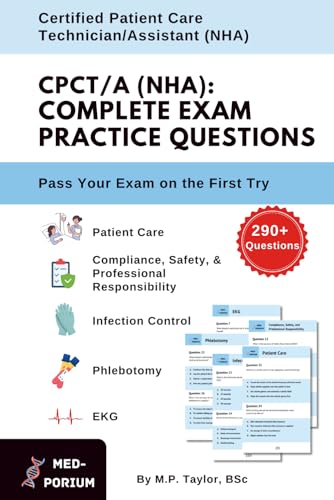
 Buy on Amazon
 Take courses on Udemy
 Practice exams on ExamEdge
 Flashcards on Mometrix
Explore More NHA Certifications
Continue into nearby exams from the same family. Each card keeps practice questions, study guides, flashcards, videos, and articles in one place.
 Course Playlist
More From This Family
Videos and articles for deeper review.