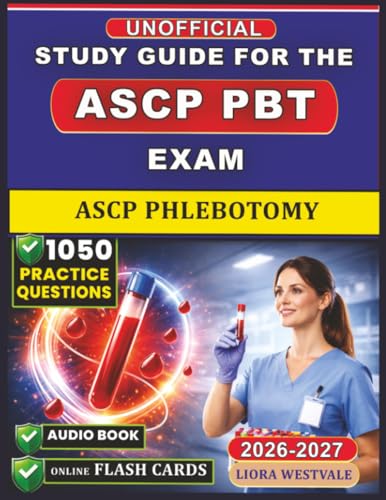
Phlebotomy Certification in 2026: Everything You Need to Know
Becoming a certified phlebotomist is one of the fastest ways to enter healthcare. Training takes 4–8 months, jobs are in high demand, and it's an excellent stepping stone to higher-paying medical careers.
But here's what most guides don't tell you: there are multiple certification exams from different organizations, and choosing the wrong one for your situation can waste time and money.
This guide breaks down every certification option, covers the brand-new 2026 NHA CPT exam released January 7, 2026, and gives you a clear path from certification to career.
Start Your FREE Phlebotomy Prep Today
Our comprehensive course covers all major phlebotomy certification content areas—100% FREE.
The 4 Major Phlebotomy Certifications Compared
| Feature | NHA CPT | ASCP PBT | AMT RPT | NPA CPT |
|---|---|---|---|---|
| Full Name | Certified Phlebotomy Technician | Phlebotomy Technician | Registered Phlebotomy Technician | Certified Phlebotomy Technician |
| Organization | National Healthcareer Assoc. | American Society for Clinical Pathology | American Medical Technologists | National Phlebotomy Association |
| Questions | 120 (100 scored + 20 pretest) | 80 (computer-adaptive) | 200 | 200 |
| Time Limit | 2 hours | 2 hours | 2.5 hours | 3 hours |
| Cost | ~$117 | ~$155 | ~$125 | ~$200 |
| Passing Score | 390/500 scaled | 400 (scaled) | Varies | Varies |
| Employer Recognition | Very High | Highest | High | Moderate |
| New 2026 Format | Yes (Jan 7, 2026) | No changes | No changes | No changes |
| Renewal | Every 2 years | Every 3 years | Every 3 years (annual fee) | Annual |
Fees verified June 2026 from each agency; always confirm the current price on the official site before you apply. ASCP raised certification fees roughly $10 effective January 2026.
The 6 Recognized Certifying Agencies
Beyond the four big exams above, US employers also recognize NCCT (NCPT), ASPT, and the ACA (CPT). The six bodies most often named in job postings are NHA, ASCP, AMT, NCCT, ASPT, and ACA. NHA, ASCP, AMT, and NCCT are accepted nationally; ASPT and ACA are legitimate but have narrower employer recognition, so verify acceptance locally before choosing them. For a side-by-side agency breakdown, see our phlebotomy certification agencies compared guide.
Which Certification Should You Get?
Choose NHA CPT if:
- Your training program recommends it (most common)
- You want the exam most employers recognize
- You want the lowest exam fee (~$117)
Choose ASCP PBT if:
- You want the gold standard certification for hospital lab settings
- You plan to advance to MLT or MLS
- Your state specifically requires ASCP
Choose AMT RPT if:
- Your program is AMT-affiliated or accredited (NAACLS/ABHES)
- You prefer a slightly longer but less time-pressured exam
- You're focused on outpatient/clinical settings
The New 2026 NHA CPT Exam Format
On January 7, 2026, the NHA launched a completely updated CPT exam. Here's what changed:
Updated Content Domains
| Domain | 2026 Weight | Key Topics |
|---|---|---|
| Patient Preparation | 22% | Patient identification, consent, allergy verification, positioning |
| Specimen Collection | 36% | Venipuncture, capillary puncture, order of draw, equipment selection |
| Specimen Processing & Handling | 18% | Labeling, processing, transport, rejection criteria |
| Safety & Compliance | 14% | Infection control, OSHA, bloodborne pathogens, PPE |
| Professional Practice | 10% | Communication, ethics, scope of practice, documentation |
What's New vs. Old Format
- More emphasis on specimen processing (increased from 14% to 18%)
- Expanded safety section (now includes updated OSHA and infection control protocols)
- New question styles with case-based scenarios where you follow a patient through the entire collection process
- Updated study materials required—older NHA prep books are outdated
State Licensure: Do You Legally Need a License?
Most US states do not require a state-issued phlebotomy license — employers simply prefer or require a national certification (NHA, ASCP, AMT, etc.). But four states regulate phlebotomy directly:
- California — requires a state license. The Certified Phlebotomy Technician I (CPT-1) is issued by the California Department of Public Health (CDPH) Laboratory Field Services after you complete an approved program (40 hours classroom + 40 hours practical with at least 50 venipunctures and 10 skin punctures) and pass a CDPH-approved national exam (NHA, ASCP, AMT, NCCT, ASPT, or ACA).
- Louisiana — phlebotomists must be licensed/registered through the state.
- Nevada — requires a state certificate to draw blood.
- Washington — requires a Medical Assistant-Phlebotomist credential through the Department of Health.
Even where the state does not mandate it, a national certification is effectively required to get hired, so it is rarely optional in practice.
Eligibility: Training Hours and Clinical Sticks
Most certifications expect you to finish an accredited program and document live blood draws:
- NHA CPT — high school diploma/GED plus a training program completed in the last 5 years with at least 30 venipunctures and 10 capillary/finger sticks on live individuals (or 1-2 years of supervised work experience).
- ASCP PBT — multiple routes; the common one is a NAACLS-approved program, or a structured program with 40 classroom hours + 100 clinical hours, completed within 5 years.
- AMT RPT — an accredited program with at least 120 didactic hours, or 1,040 hours of work experience, or 50 venipunctures + 10 capillary punctures.
- ASPT — accredited program plus roughly 75 venipunctures and 5 fingersticks, or 6-12 months of work experience.
Recertification and Continuing Education
Certification is not permanent — you must renew it:
- NHA CPT — renew every 2 years with 10 continuing education (CE) credits.
- ASCP PBT — renew every 3 years through the Credential Maintenance Program (CMP); PBT requires 9 CMP points.
- AMT RPT — a 3-year continuing competency cycle (about 24 points) with an annual renewal fee.
Budget for these ongoing costs when you choose an agency.
Core Content: What Every Phlebotomy Exam Tests
Regardless of which certification you pursue, you need to master these topics:
1. Venipuncture Procedure (The Most Important Skill)
The step-by-step process tested on every exam:
- Verify order and identify patient (two identifiers: name + DOB)
- Assemble equipment (tube selection, needle gauge, tourniquet, antiseptic)
- Apply tourniquet (3–4 inches above site, no more than 1 minute)
- Select vein (palpate median cubital → cephalic → basilic)
- Cleanse site (70% isopropyl alcohol, 30-second dry time)
- Perform venipuncture (15–30 degree angle, bevel up)
- Fill tubes in correct order of draw
- Release tourniquet BEFORE removing needle
- Apply pressure and bandage (3–5 minutes pressure)
- Label tubes at bedside (NEVER pre-label)
2. Order of Draw (Memorize This!)
The order of draw prevents cross-contamination of additives between tubes:
| Order | Tube Color | Additive | Purpose |
|---|---|---|---|
| 1 | Yellow (SPS) | Sodium polyanethol sulfonate | Blood cultures |
| 2 | Light Blue | Sodium citrate | Coagulation (PT/PTT) |
| 3 | Red | None (or clot activator) | Serum chemistry |
| 4 | Gold/Tiger-top (SST) | Clot activator + gel | Serum chemistry |
| 5 | Green | Lithium/sodium heparin | Plasma chemistry |
| 6 | Lavender/Purple | EDTA | Hematology (CBC) |
| 7 | Gray | Potassium oxalate/sodium fluoride | Glucose, alcohol |
| 8 | Pink | EDTA | Blood bank/type & screen |
Memory aid: "Stop Light, Remember Good Grades Last Greatly Please" (SPS, Light blue, Red, Gold, Green, Lavender, Gray, Pink)
3. Capillary (Dermal) Puncture
Used for infants, difficult veins, and point-of-care testing:
- Site: Lateral or medial plantar surface of heel (infants), fingertip middle or ring finger (adults)
- Depth: No deeper than 2.0 mm (infants), 2.4 mm (adults)
- Order: Blood gas → EDTA slides → other tubes
- Wipe away first drop (contaminated with tissue fluid)
4. Safety & Infection Control
- Standard Precautions: Treat all blood as potentially infectious
- Sharps disposal: Immediately into puncture-resistant container, never recap
- Needlestick protocol: Wash immediately, report to supervisor, seek medical evaluation
- PPE requirements: Gloves always; gown/mask/eye protection for splash risk
- Hand hygiene: Before and after every patient, even with glove use
5. Specimen Rejection Criteria
Labs reject specimens for these common reasons:
- Wrong tube type for the test ordered
- Hemolyzed specimen (red cell destruction)
- Clotted specimen in an anticoagulant tube
- Insufficient volume (QNS — Quantity Not Sufficient)
- Unlabeled or mislabeled specimen
- Expired tube
- Improper temperature during transport
Free Phlebotomy Practice Questions
Our question bank covers all certification exam content areas, including order of draw, venipuncture technique, specimen handling, and safety protocols.
8-Week Phlebotomy Exam Study Plan
| Week | Focus Area | Activities |
|---|---|---|
| 1 | Patient Prep & Identification | Study patient ID protocols, consent, positioning, review anatomy of arm veins |
| 2 | Venipuncture Procedure | Master the 10-step venipuncture process, equipment selection, needle gauges |
| 3 | Order of Draw & Tube Selection | Memorize order of draw, learn all tube additives and their purposes |
| 4 | Capillary Puncture & Special Collections | Dermal puncture sites, infant heel sticks, blood cultures, glucose tolerance |
| 5 | Specimen Processing & Handling | Centrifugation, aliquoting, transport requirements, rejection criteria |
| 6 | Safety & Compliance | OSHA regulations, bloodborne pathogens, sharps disposal, PPE protocols |
| 7 | Professional Practice & Communication | Patient communication, ethics, scope of practice, difficult draw scenarios |
| 8 | Full Practice Exams & Review | Timed practice tests, review weak areas, exam logistics |
Total study time: 40–60 hours over 8 weeks
Exam Day: What to Expect
NHA CPT (Most Popular)
- Location: PSI testing centers or online proctored (remote option with webcam monitoring)
- ID required: Government-issued photo ID
- Duration: 2 hours for 120 questions (100 scored + 20 pretest)
- Passing score: 390 out of 500 (scaled)
- Results: Preliminary pass/fail immediately after completing
- Eligibility: High school diploma/GED + completion of phlebotomy program with 30 venipunctures and 10 capillary sticks on live individuals
ASCP PBT
- Location: Pearson VUE testing centers only
- ID required: Two forms of ID
- Duration: 2 hours for 80 questions (computer-adaptive)
- Passing score: 400 out of 999 (scaled)
- Results: Within 5–7 business days
- Eligibility: Completion of accredited phlebotomy program or 1 year of full-time experience with 100+ venipunctures
Test-Taking Tips
- Order of draw questions are guaranteed — know it cold
- Read patient scenarios completely before answering
- When in doubt, prioritize patient safety (ID the patient, infection control)
- Time management: NHA CPT is 120 questions in 2 hours = 1 minute per question; ASCP PBT is 80 adaptive questions in 2 hours = 1.5 minutes per question
- Don't change answers unless you're certain — first instinct is usually right
Phlebotomy Career Path & Salary (2026)
| Position | Education | Median Salary | Growth |
|---|---|---|---|
| Phlebotomist | Certificate (4–8 months) | $43,660 | 6% |
| Medical Assistant | Certificate/Associate | $42,000 | 14% |
| Medical Lab Technician (MLT) | Associate degree | $57,380 | 7% |
| Medical Lab Scientist (MLS) | Bachelor's degree | $60,780 | 7% |
| Registered Nurse (RN) | ADN or BSN | $86,070 | 6% |
| Pathologists' Assistant | Master's degree | $95,000+ | 10% |
The Phlebotomy Career Ladder
Phlebotomy certification opens doors to advancement:
- Phlebotomist → Gain 1–2 years experience in hospital/lab
- Lead Phlebotomist → Supervise team, train new hires ($45K–$55K)
- MLT Bridge → Many programs accept phlebotomy experience for admission
- Specialized Roles → Donor phlebotomy (blood bank), pediatric phlebotomy, mobile/travel phlebotomy
The Bureau of Labor Statistics reports a median wage of $43,660 (May 2024) and projects about 18,400 job openings annually for phlebotomists with a 6% growth rate from 2024 to 2034 — faster than the average for all occupations.
Pass Your Phlebotomy Certification — Start FREE
Join thousands of phlebotomy candidates using our comprehensive, 100% FREE study materials:
- All content domains covered (venipuncture, order of draw, safety, processing)
- Updated for 2026 including new NHA CPT exam format
- AI-powered explanations for instant help on any topic
- Practice questions matching all major certification exams
No credit card required. Your healthcare career starts here.
Official Resources
- NHA (National Healthcareer Association) — CPT exam registration
- ASCP (American Society for Clinical Pathology) — PBT exam registration
- AMT (American Medical Technologists) — RPT exam registration
- OSHA Bloodborne Pathogens Standard — Safety regulations
- BLS Phlebotomist Career Outlook — Salary and job data


 Buy on Amazon
 Take courses on Udemy
 Practice exams on ExamEdge
 Flashcards on Mometrix