PMP vs CMA
PMP and CMA certify expertise in two different corporate functions that often work together. PMP certifies project management excellence - delivering projects on time and budget. CMA certifies management accounting expertise - financial analysis, budgeting, and strategic decision support. In practice, CMAs often work with PMs by providing financial analysis for project business cases, tracking project budgets, and measuring project ROI. Both are valuable corporate credentials, but serve different roles.
Side-by-Side Comparison
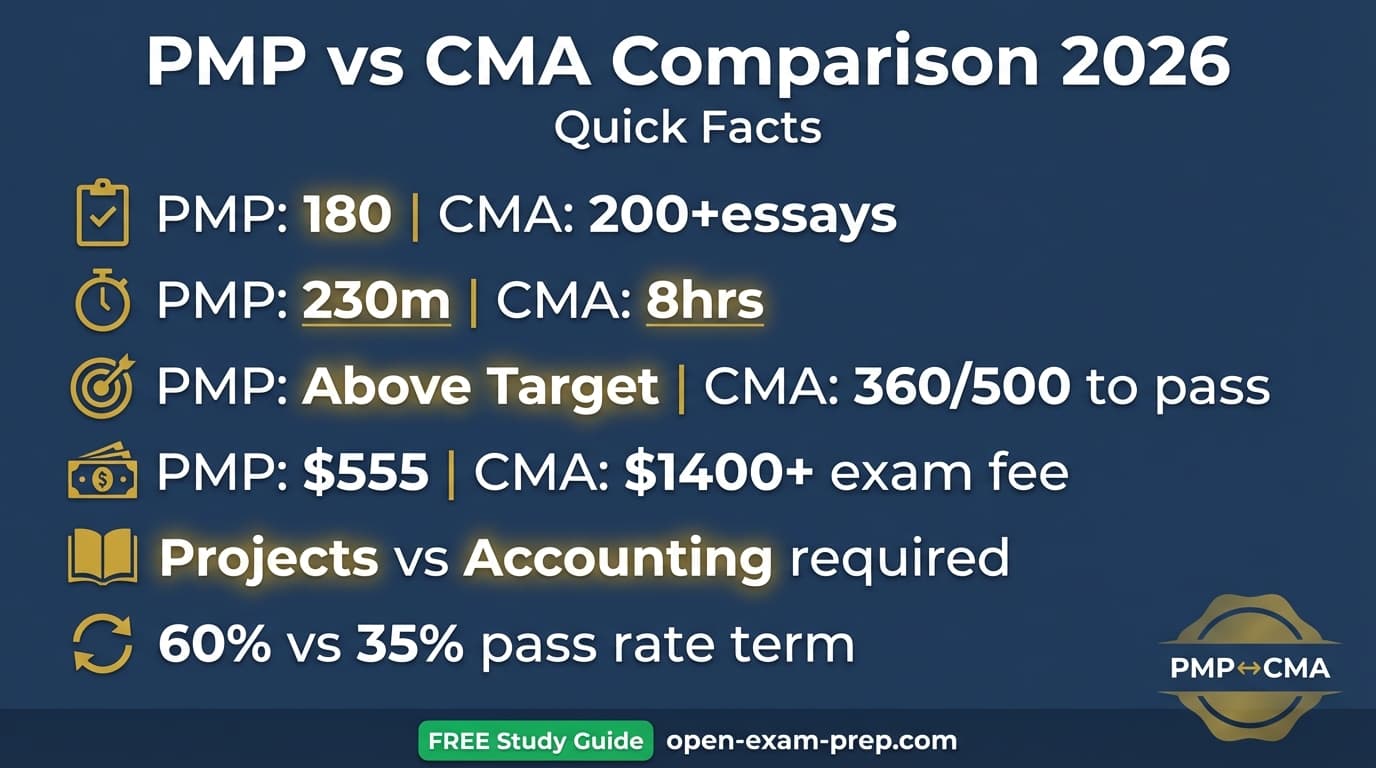
| Feature | PMP | CMA |
|---|---|---|
| Full Name | Project Management Professional | Certified Management Accountant |
| Exam Cost | $555 (members) / $575 (non-members) | $545/part ($1,090 total) + membership |
| Passing Score | Above Target on 3 domains | 360/500 (scaled) |
| Questions | 180 questions | 100 MCQ + 2 essays per part |
| Time Limit | 230 minutes | 4 hours per part (8 hours total) |
| Study Time | 100-150 hours | 300-400 hours |
| Difficulty | Challenging | Very Challenging |
| Prerequisites | 35 hours PM education + 36 months experience (bachelor's) or 60 months | Bachelor's degree + 2 years management accounting experience |
| Exam Body | PMI (Project Management Institute) | IMA (Institute of Management Accountants) |
Key Differences
- 1PMP is for project delivery; CMA is for financial analysis
- 2PMP exam is 180 questions in 230 minutes; CMA is 2 parts, 100 MCQ + essays each, 8 hours total
- 3PMP costs ~$555-575; CMA costs ~$1,400-1,700 total with membership
- 4PMP requires PM experience; CMA requires accounting experience
- 5PMPs lead projects; CMAs analyze financial performance
- 6PMP pass rate ~60%; CMA pass rate ~35-45%
What Each Exam Allows You To Do
PMP
- Lead complex projects across industries
- Manage project budgets and timelines
- Apply agile and predictive methodologies
- Advance to program/portfolio management
CMA
- Lead financial planning and analysis
- Perform cost management and budgeting
- Support strategic business decisions
- Advance to Controller or CFO roles
Who Should Take Each Exam?
Take the PMP if you...
- →Project managers in any industry
- →IT project leads
- →Construction and engineering PMs
- →Those pursuing management track
Take the CMA if you...
- →Corporate accountants and analysts
- →FP&A professionals
- →Those pursuing CFO track
- →Management accountants in industry
Which Should You Take First?
Choose based on your career function. If you're in project management, operations, or IT leadership, PMP validates your project delivery skills. If you're in finance, accounting, or FP&A, CMA validates your management accounting expertise. Some professionals get both - for example, a finance manager who also leads system implementations might benefit from both credentials. But generally, focus on the certification that matches your primary role.
Frequently Asked Questions
QHow do PMP and CMA work together in organizations?
PMPs and CMAs often collaborate in corporate settings. When a company launches a major project, the PMP manages the delivery (timeline, resources, milestones) while the CMA provides financial analysis (business case, ROI calculations, budget tracking, variance analysis). The CMA might build the financial model that justifies the project, and the PMP executes it. Both report to leadership on project success from their respective angles.
QWhich certification is harder - PMP or CMA?
CMA is significantly harder. The CMA has a ~35-45% pass rate versus ~60% for PMP. CMA requires 300-400 hours of study across two parts, each with a 4-hour exam including essay questions. The content requires deep financial and accounting knowledge. PMP requires 100-150 hours of study for a single 230-minute exam. Both are challenging, but CMA's depth and pass rate make it the harder credential.
QWhich pays more - PMP or CMA?
Salaries are comparable but depend on role and seniority. PMP holders average $115,000-$140,000, with senior program directors earning $150,000+. CMA holders average $90,000-$120,000 in typical roles, but CMAs in senior positions like Controller or VP of Finance earn $150,000-$250,000+. The CMA career path often has higher ceiling (CFO track), while PMP paths level at program/portfolio management unless moving to executive roles.
QShould a project manager in finance get both PMP and CMA?
It depends on your specific role. If you manage finance transformation projects (ERP implementations, process improvements), PMP certification validates your PM skills while understanding finance is valuable context. A finance professional who occasionally manages projects might find PMP useful for career flexibility. However, both certifications require significant investment - choose the one most relevant to your primary responsibilities first.
10 free AI interactions per day
Free exam resources
Start Studying the Exact Exam
Use the comparison to choose a path, then move into the matching practice questions, study guide, and flashcards.
 Buy on Amazon
 Flashcards on Mometrix
 Take courses on Udemy
 Prep course on Brain Sensei
Related Exam Comparisons
Stay Updated
Get free exam tips and study guides delivered to your inbox.