CFP vs PMP
CFP and PMP are both prestigious professional certifications, but in completely different fields. CFP certifies expertise in personal financial planning - helping individuals manage wealth, plan for retirement, minimize taxes, and protect assets. PMP certifies expertise in project management - leading teams, managing budgets, delivering projects on time across any industry. There's virtually no overlap in content or career application. The only connection is that both are rigorous certifications valued by employers in their respective fields.
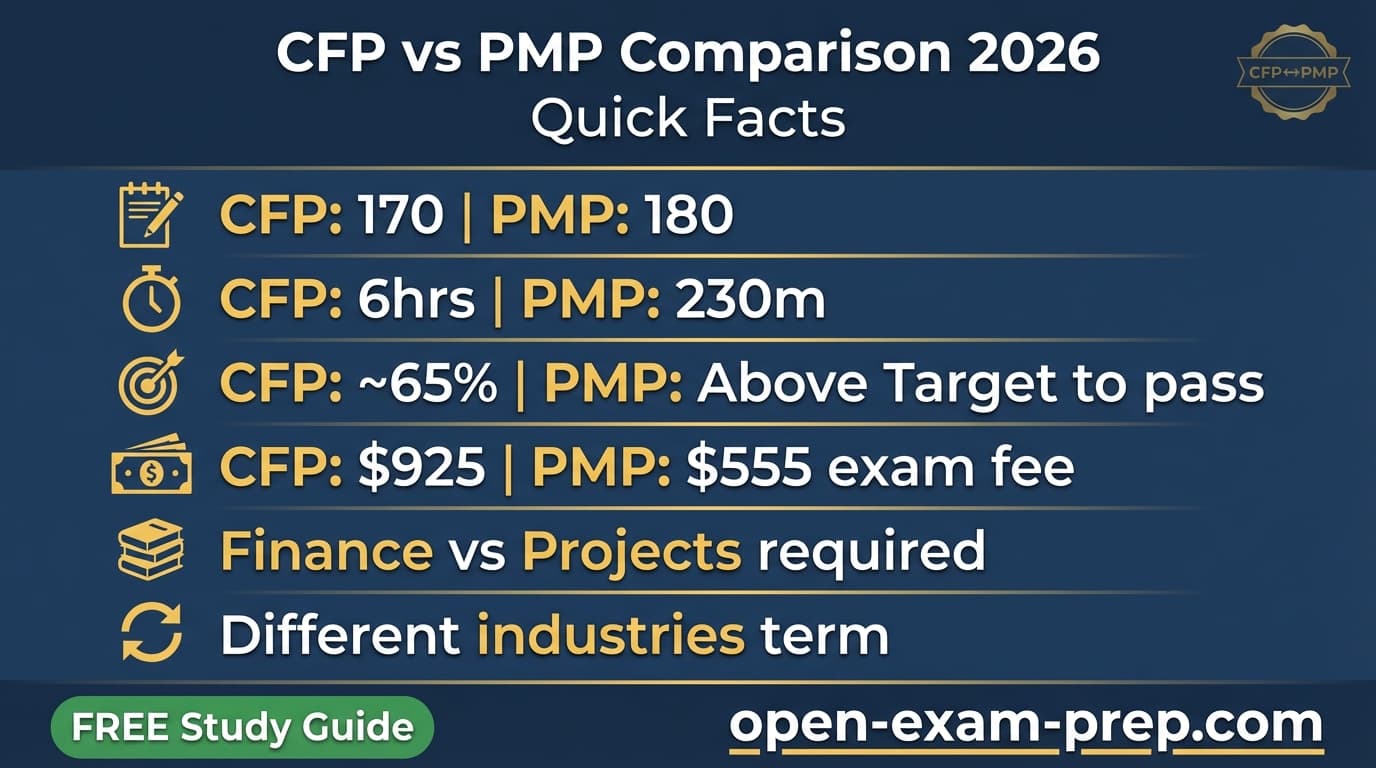
Side-by-Side Comparison
| Feature | CFP | PMP |
|---|---|---|
| Full Name | Certified Financial Planner | Project Management Professional |
| Exam Cost | $925 | $555 (members) / $575 (non-members) |
| Passing Score | ~65% (scaled) | Above Target on 3 domains |
| Questions | 170 multiple-choice | 180 questions |
| Time Limit | 6 hours (two 3-hour sessions) | 230 minutes |
| Study Time | 250-300 hours | 100-150 hours |
| Difficulty | Very Challenging | Challenging |
| Prerequisites | Bachelor's degree + CFP education + 6,000 hours experience | 35 hours PM education + 36 months experience (bachelor's) or 60 months (high school) |
| Exam Body | CFP Board | PMI (Project Management Institute) |
Key Differences
- 1CFP is for financial planning; PMP is for project management
- 2CFP requires bachelor's degree + 6,000 hours experience; PMP requires 36-60 months PM experience
- 3CFP exam is 6 hours; PMP exam is 230 minutes
- 4CFP costs $925; PMP costs $555-575
- 5CFP leads to financial advisor careers; PMP leads to project manager careers
- 6CFP has fiduciary obligation; PMP has project delivery obligation
What Each Exam Allows You To Do
CFP
- Create comprehensive financial plans
- Advise on investments, taxes, retirement
- Act as fiduciary for clients
- Use CFP® marks professionally
PMP
- Lead complex projects
- Manage project teams and budgets
- Apply agile and predictive methodologies
- Qualify for senior PM roles globally
Who Should Take Each Exam?
Take the CFP if you...
- →Financial planners and advisors
- →Wealth managers
- →Those wanting holistic planning careers
- →Professionals at RIAs or broker-dealers
Take the PMP if you...
- →Project managers in any industry
- →IT professionals
- →Construction and engineering PMs
- →Those seeking management advancement
Which Should You Take First?
Choose based on your career path - these certifications don't complement each other. If you want to help individuals with financial planning, wealth management, or retirement planning, pursue CFP. If you want to manage projects, lead teams, and oversee complex initiatives in IT, construction, healthcare, or any industry, pursue PMP. The only scenario where both might apply is if you're managing projects within a financial services firm, but even then you'd prioritize one based on your actual role.
Frequently Asked Questions
QCan having both CFP and PMP help my career?
These certifications serve entirely different career paths with minimal overlap. A CFP in a financial planning role wouldn't benefit from PMP, and a project manager wouldn't benefit from CFP. The exception might be: 1) A financial services executive overseeing major technology implementations, or 2) Someone transitioning between careers. Generally, focus your time and investment on the certification that matches your career goals.
QWhich certification is harder - CFP or PMP?
CFP is generally considered harder due to its breadth and prerequisites. CFP requires a bachelor's degree, CFP Board-registered education (6+ courses), 6,000 hours of experience, and passing a 6-hour exam covering 8 principal knowledge areas. CFP has a 60-67% pass rate. PMP requires 35 hours of education, 36-60 months of experience, and a 230-minute exam. PMP's pass rate varies but is typically higher than CFP's.
QHow do salaries compare between CFP and PMP holders?
Both certifications command premium salaries in their fields. CFP holders in financial planning average $90,000-$150,000+, with experienced advisors managing significant assets earning $200,000+. PMP holders average $115,000-$140,000, with senior project managers and program directors earning $150,000+. Both certifications typically result in 20-25% salary premiums over non-certified peers in their respective fields.
QWhich is more valuable - CFP or PMP?
Value depends entirely on your career. In financial services, CFP is considered the gold standard - it's often required for financial planner positions and signals comprehensive expertise. In project management, PMP is the globally recognized standard - it's often required for senior PM roles and recognized across industries worldwide. Both are highly valuable within their domains; neither has cross-domain value.
10 free AI interactions per day
Free exam resources
Start Studying the Exact Exam
Use the comparison to choose a path, then move into the matching practice questions, study guide, and flashcards.
Third-party resources · We may earn a commission from purchases.

Secrets of the CFP Exam Study Guide: CFP® Test Review for the Certified Financial Planner Exam (Mometrix Secrets Study Guides)
By CFP® Exam Secrets Test Prep Team
$54.99 · 
 Take courses on Udemy
 Exam information on Achievable
 Flashcards on Mometrix
 Prep course on Brain Sensei
Related Exam Comparisons
Stay Updated
Get free exam tips and study guides delivered to your inbox.