EA vs Series 65
EA and Series 65 are complementary credentials for comprehensive financial services. The EA credential authorizes you to represent taxpayers before the IRS and specialize in tax planning, preparation, and resolution. The Series 65 authorizes you to provide investment advice for fees as an Investment Adviser Representative. Together, they allow a professional to offer both tax and investment advisory services - a powerful combination for serving clients holistically. Many CPAs and financial planners pursue both to expand their service offerings.
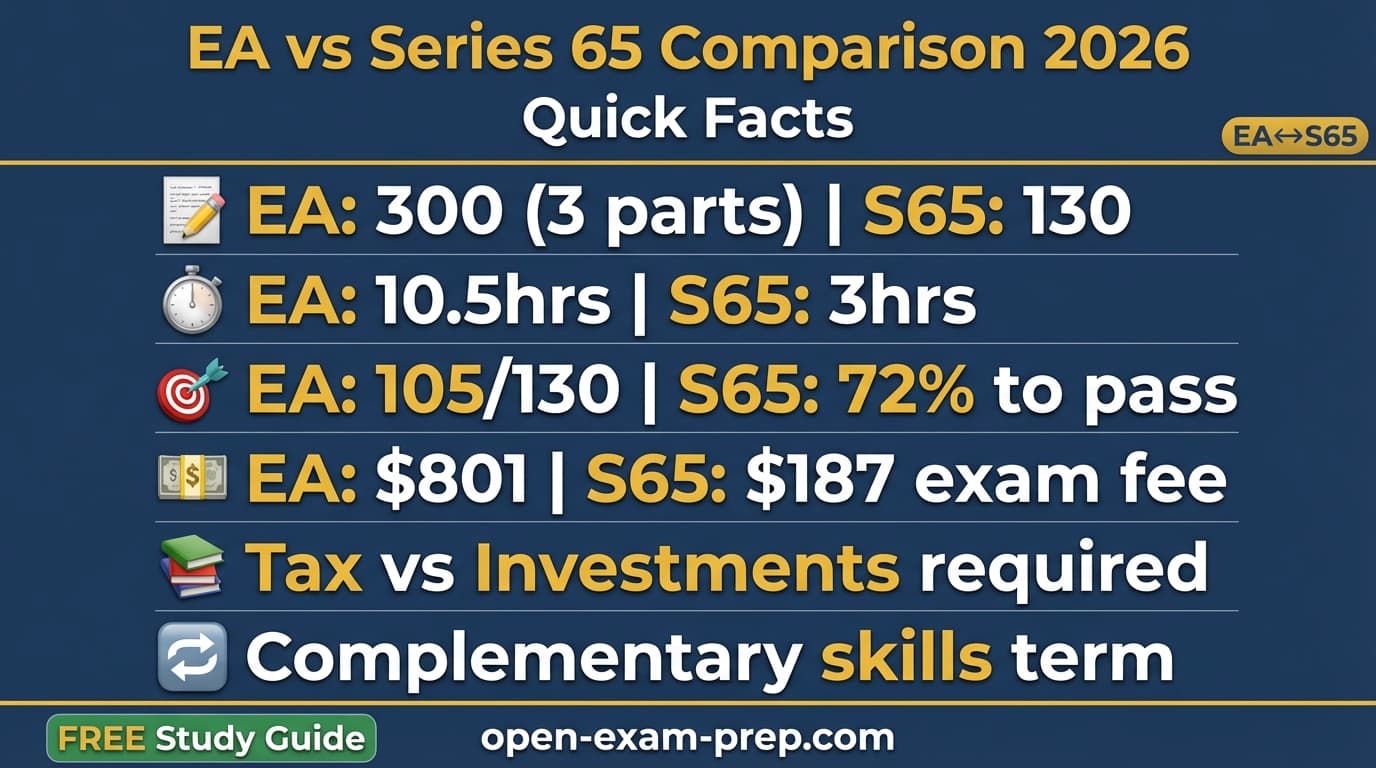
Side-by-Side Comparison
| Feature | EA | Series 65 |
|---|---|---|
| Full Name | Enrolled Agent (IRS Special Enrollment Examination) | Uniform Investment Adviser Law Examination |
| Exam Cost | $267/part ($801 total for all 3 parts) | $187 |
| Passing Score | 105/130 scaled score per part | 72% (94 of 130) |
| Questions | 100 questions per part (300 total) | 130 (120 scored + 10 unscored) |
| Time Limit | 3.5 hours per part | 180 minutes |
| Study Time | 200-300 hours total | 40-60 hours |
| Difficulty | Challenging | Moderate to Challenging |
| Prerequisites | None (PTIN required to practice) | None (standalone exam) |
| Exam Body | IRS (administered by Prometric) | NASAA (administered by FINRA) |
Key Differences
- 1EA is for tax representation and preparation; Series 65 is for investment advice
- 2EA is issued by the IRS; Series 65 is a state securities license via NASAA
- 3EA requires 3 exams totaling $801; Series 65 is one exam for $187
- 4EA study time is 200-300 hours; Series 65 is 40-60 hours
- 5EA has unlimited practice rights nationwide; Series 65 requires state-by-state registration
- 6EA focuses on tax code; Series 65 focuses on investments and regulations
What Each Exam Allows You To Do
EA
- Represent taxpayers before IRS
- Prepare tax returns professionally
- Handle audits and appeals
- Practice tax in all 50 states
Series 65
- Provide investment advice for fees
- Work as Investment Adviser Representative
- Act as fiduciary for clients
- Start or join an RIA firm
Who Should Take Each Exam?
Take the EA if you...
- →Tax preparers seeking credentials
- →Accountants specializing in tax
- →Those wanting IRS representation rights
- →Professionals building tax practices
Take the Series 65 if you...
- →Fee-based financial advisors
- →RIA firm employees
- →Financial planners adding investments
- →Those seeking advisory careers
Which Should You Take First?
Choose based on your primary service offering. If you're building a tax practice or work primarily in tax preparation, start with EA - it gives you IRS representation rights that create immediate value. If you want to manage investments or charge advisory fees, Series 65 is the faster path. Many comprehensive financial planners eventually get both, often starting with whichever aligns with their current role, then adding the other to expand services.
Frequently Asked Questions
QCan I offer both tax and investment services with EA and Series 65?
Yes, and this combination is increasingly valuable. With EA credentials, you can prepare taxes, represent clients in audits, and provide tax planning. With Series 65, you can manage investments and charge advisory fees. Together, you can offer comprehensive financial planning that includes tax-optimized investment strategies, retirement planning with tax considerations, and coordinated wealth management. Many successful independent advisors hold both credentials.
QWhich is harder to obtain - EA or Series 65?
EA is significantly harder. The EA requires passing 3 separate exams (Individuals, Businesses, Representation) totaling 300 questions over approximately 10.5 hours of testing. Study time is typically 200-300 hours. The pass rate is around 60-70% per part, but many candidates need multiple attempts for all three parts. Series 65 is a single 130-question, 3-hour exam with 40-60 hours of study time and a ~70% pass rate.
QDo financial planners need both EA and Series 65?
Need depends on services offered. Series 65 alone is sufficient if you only provide investment advice and don't prepare taxes or represent clients before the IRS. Many CFPs have Series 65 but refer tax work to CPAs or EAs. However, having both credentials eliminates referral dependence and captures more revenue per client. The trend toward holistic planning makes the EA increasingly valuable for comprehensive advisors.
QWhat's the career path difference between EA and Series 65?
EA leads to careers as tax preparer, tax specialist, IRS enrolled agent at accounting firms, or independent tax practice owner. Income is often seasonal (heavy during tax season) unless you specialize in business clients or IRS representation year-round. Series 65 leads to careers as Investment Adviser Representative at RIAs, fee-only financial planner, or independent advisory practice owner. Income is typically more consistent throughout the year, often based on assets under management.
10 free AI interactions per day
Free exam resources
Start Studying the Exact Exam
Use the comparison to choose a path, then move into the matching practice questions, study guide, and flashcards.

 Buy on Amazon
 Take courses on Udemy
 Study resources on Achievable
 Flashcards on Mometrix
 Practice exams on ExamEdge
Related Exam Comparisons
Stay Updated
Get free exam tips and study guides delivered to your inbox.