CFP vs NMLS MLO
CFP and NMLS MLO serve different but potentially complementary roles in client financial lives. CFPs provide comprehensive financial planning across investments, retirement, taxes, insurance, and estate planning - holistic advice for clients' entire financial pictures. MLOs specialize exclusively in residential mortgage financing - helping clients get home loans. Some CFPs add MLO licenses to help clients with home financing directly rather than referring to mortgage brokers. However, most CFPs focus on wealth management while most MLOs focus solely on mortgage production.
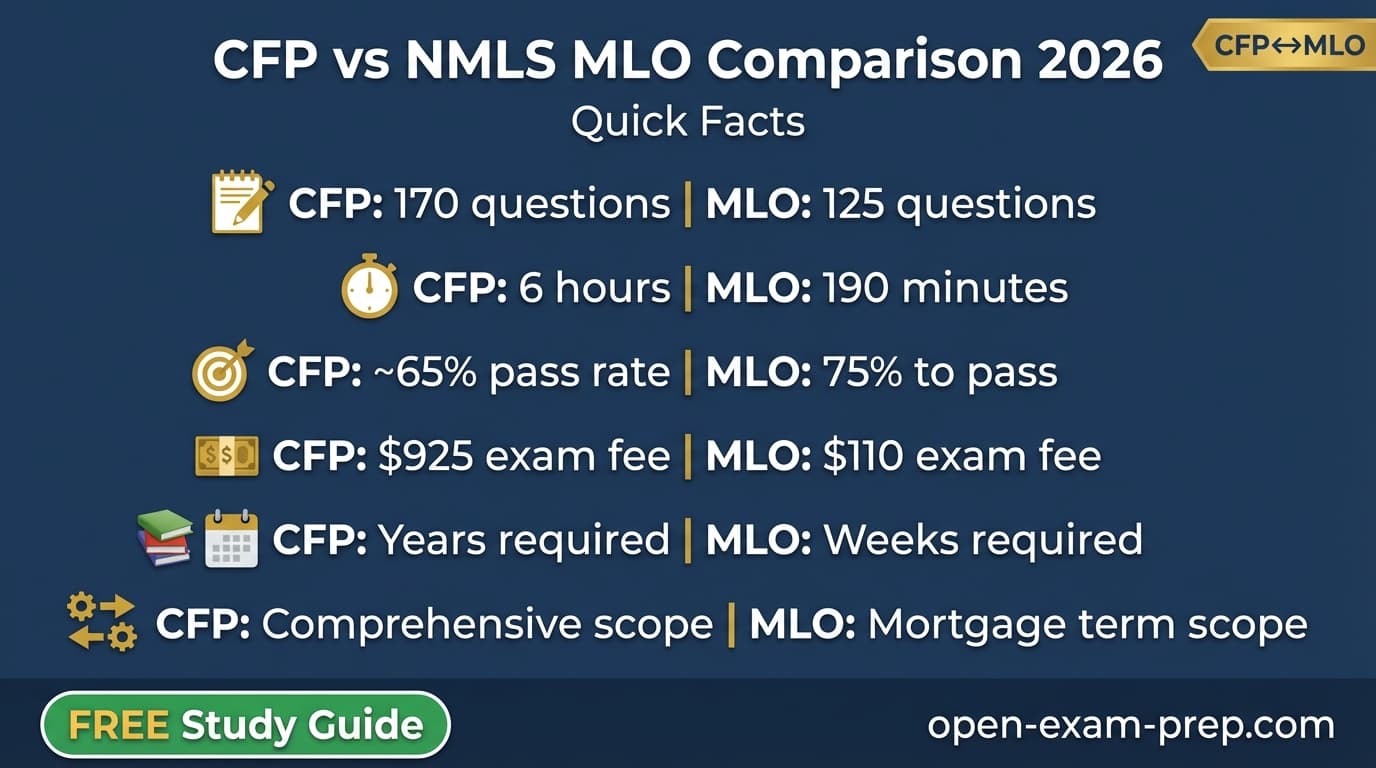
Side-by-Side Comparison
| Feature | CFP | NMLS MLO |
|---|---|---|
| Full Name | Certified Financial Planner | SAFE Mortgage Loan Originator Test |
| Exam Cost | $925 | $110 |
| Passing Score | ~65% (scaled) | 75% (86 of 115) |
| Questions | 170 multiple-choice | 125 (115 scored + 10 unscored) |
| Time Limit | 6 hours (two 3-hour sessions) | 190 minutes |
| Study Time | 250-300 hours | 40-80 hours |
| Difficulty | Very Challenging | Moderate |
| Prerequisites | Bachelor's degree + CFP education + 6,000 hours experience | 20 hours NMLS-approved pre-licensing education |
| Exam Body | CFP Board | NMLS (administered by Prometric) |
Key Differences
- 1CFP is comprehensive financial planning; MLO is mortgage lending only
- 2CFP requires 6,000 hours experience + degree; MLO requires 20 hours education
- 3CFP exam is 6 hours; MLO exam is 190 minutes
- 4CFP costs $925; MLO costs $110
- 5CFP acts as fiduciary; MLO facilitates transactions
- 6CFP study time is 250-300 hours; MLO is 40-80 hours
What Each Exam Allows You To Do
CFP
- Create comprehensive financial plans
- Advise on investments, taxes, retirement, estate
- Act as fiduciary for clients
- Use CFP® marks professionally
NMLS MLO
- Originate residential mortgage loans
- Help homebuyers secure financing
- Work at banks, mortgage companies, credit unions
- Earn commission on loan production
Who Should Take Each Exam?
Take the CFP if you...
- →Financial planners and advisors
- →Wealth managers
- →Holistic planning professionals
- →Those building advisory practices
Take the NMLS MLO if you...
- →Mortgage lending careers
- →Real estate-adjacent professionals
- →Commission-based sales careers
- →Those serving homebuyers
Which Should You Take First?
These credentials serve different career purposes. Pursue CFP if you want to be a comprehensive financial planner helping clients with their entire financial lives - investments, retirement, taxes, estate planning. Pursue NMLS MLO if you want to specialize in mortgage lending and home financing. Some established CFPs add MLO to serve clients more completely, but this is less common since mortgage origination requires ongoing loan volume to maintain licensing. Most professionals choose one path based on their primary career focus.
Frequently Asked Questions
QShould CFPs get MLO licenses to help clients with mortgages?
It's possible but uncommon for good reasons. CFPs focus on wealth accumulation and planning, while mortgage origination requires ongoing transaction volume to maintain proficiency and licensing requirements. Most CFPs refer clients to trusted mortgage brokers rather than originating loans themselves. However, if you serve clients who frequently buy real estate (investors, business owners), having MLO capability could add value. Consider the time investment vs. referral alternatives.
QWhich credential is harder to obtain?
CFP is dramatically harder. CFP requires a bachelor's degree, completing CFP Board-registered education courses, accumulating 6,000 hours of professional experience, and passing a 6-hour exam with 250-300 hours of study (60-67% pass rate). NMLS MLO requires 20 hours of pre-licensing education and passing a 190-minute exam with 40-80 hours of study (58% pass rate). CFP is a multi-year journey; MLO can be obtained in weeks.
QHow do compensation models differ?
CFPs typically earn fees - hourly rates ($150-$400/hour), flat fees, or percentage of assets under management (0.5%-1.5% annually). Income is relatively stable and scales with client base. MLOs earn commission on loan volume - typically around 1% of loan amount (so $4,000-$5,000 on a $400,000 loan). MLO income is transaction-based and varies with housing market conditions. CFP offers more predictable income; MLO offers higher potential in strong housing markets.
QCan mortgage professionals benefit from CFP education?
Yes, CFP knowledge can help MLOs serve clients better by understanding how mortgages fit into overall financial planning. However, the full CFP credential requires significant investment that may not pay off for someone focused on mortgage production. Some MLOs complete CFP education courses for knowledge without pursuing the full credential, or they partner with CFPs for referrals. Consider whether you want to pivot to comprehensive planning or stay in mortgage lending.
10 free AI interactions per day
Free exam resources
Start Studying the Exact Exam
Use the comparison to choose a path, then move into the matching practice questions, study guide, and flashcards.
Third-party resources · We may earn a commission from purchases.

CFP Study Guide 2025–2026: 10 Full-Length Practice Tests, 1650+ High-Yield Questions, and Detailed Answer Explanations to Help You Pass the Certified Financial Planner Certification on Your First Try
By Bean, Charles K.
$30.88 · 
 Online course on Mometrix
 Take courses on Udemy
 Exam information on Achievable
Third-party resources · We may earn a commission from purchases.

NMLS SAFE MLO Study Cards 2026-2027: NMLS Exam Prep and Practice Test Questions for Mortgage Loan Originators [Color-Coded]
By Test Prep Books
$37.99 ·
Take courses on UdemyStudy guide on Mometrix MLO pre-licensing on Aceable Mortgage
Related Exam Comparisons
Stay Updated
Get free exam tips and study guides delivered to your inbox.