Clinical Medical Procedures
57.6%of exam
Law and Ethics
16%of exam
Pharmacology and Medical Knowledge
14.4%of exam
Medical Administrative Duties
12%of exam
Quick Facts
- Credential
- NCCT NCMA
- Items
- 150 total
- Scored
- 125 items
- Pretest
- 25 unscored
- Time
- 3 hours
- Format
- 92% standard, 8% alternative
- Pass
- 575 scaled
- Scale
- 200–720
- NCCT Fee
- $119
- Site Fee
- May apply separately
- Delivery
- Computer-based
- Results
- Immediately after exam
- Renewal
- Annual recertification
- First Retake
- Wait 30 days
Order of Draw
Cultures, blue, serum, green, lavender, gray.
Disinfection vs Sterilization
Disinfection
- Inanimate surfaces
- Not all spores
Sterilization
- Critical instruments
- All microbial life
Surface control vs complete destruction
Safety Response Picker
- Patient becomes unresponsive→Activate emergency response
- Patient begins fainting→Stop and protect patient
- Medication reaction suspected→Stop and notify provider
- Needlestick occurs→Wash and report immediately
- Chemical exposure occurs→Follow SDS guidance
- Fire is discovered→Begin RACE protocol
- Isolation type unclear→Confirm before entry
- Scope is unclear→Stop and escalate
Official Blueprint
- Clinical
- 72 scored items
- Law and ethics
- 20 scored items
- Pharmacology
- 18 scored items
- Administration
- 15 scored items
- Infection control
- 15 clinical items
- Patient care
- 32 clinical items
- Phlebotomy
- 15 clinical items
- ECG
- 10 clinical items
- Pretest items
- 25 unscored items
- Alternative items
- Drag, select, hotspot
Fire RACE
Rescue, alarm, contain, extinguish or evacuate.
Subjective vs Objective
Subjective
- Patient reports
- Pain or nausea
Objective
- Measured findings
- Vitals or tests
Stated vs measured
Specimen Response Picker
- Identity cannot be confirmed→Do not collect
- Label is incorrect→Recollect per policy
- Hematoma develops→Stop and apply pressure
- Blood flow stops→Assess needle position
- Citrate tube underfilled→Recollect per policy
- Specimen is rejected→Correct and recollect
- Patient begins fainting→Stop and protect patient
- Sterile site contaminated→Prepare site again
Infection and Safety
- Standard precautions
- Use for every patient
- Contact precautions
- Prevent contact transmission
- Droplet precautions
- Mask per protocol
- Airborne precautions
- Respirator and special room
- Visibly soiled hands
- Wash with soap and water
- Clean hands
- Before and after care
- Disinfection
- Treats inanimate surfaces
- Sterilization
- Destroys all microbial life
- After needle use
- Activate safety; discard without recapping
- Sharps container
- Puncture resistant
- Needlestick
- Wash and report immediately
- Chemical exposure
- Follow SDS directions
ECG Troubleshooting
- Baseline wanders→Check electrode adhesion
- Tracing looks shaky→Reduce patient movement
- Regular interference appears→Remove electrical sources
- Lead is missing→Check cable connection
- Skin is oily→Clean and dry skin
- Hair prevents contact→Clip per policy
- Patient cannot lie flat→Adjust and document position
- Abnormal tracing appears→Notify appropriate clinician
Patient Intake and Care
- Patient identity
- Use two identifiers
- Chief complaint
- Use patient words
- Medication list
- Review and reconcile per protocol
- Allergy check
- Verify before treatment
- Pain
- Patient-reported data
- Blood pressure
- Use correct cuff
- Pulse
- Rate, rhythm, strength
- Respirations
- Rate, rhythm, effort
- BMI
- Screening measure
- Abnormal finding
- Report promptly
- Snellen chart
- Distance visual acuity
- Teach-back
- Patient explains instructions
Procedures and POCT
- Supine
- Face up
- Prone
- Face down
- Fowler position
- Head elevated
- Sims position
- Left side, knee flexed
- Lithotomy
- Pelvic examination
- Sterile field
- Protect from contamination
- Wound drainage
- Document amount and character
- Suture removal
- Requires authorized order
- CLIA-waived test
- Simple low-risk testing
- Quality control
- Validate testing system
- Invalid control
- Stop patient testing
- Specimen label
- Apply in patient's presence
Phlebotomy
- Median cubital
- Common first choice
- Cephalic vein
- Common alternate site
- Basilic vein
- Use added caution
- Site antisepsis
- Let site dry
- Needle bevel
- Faces upward
- Tourniquet
- Release before needle removal
- No blood flow
- Assess needle position
- Hematoma
- Stop and apply pressure
- Syncope
- Stop and protect patient
- Tube mixing
- Invert gently
- Blood cultures
- Collect first
- Light blue
- Coagulation tests
- Serum tube
- Before green tube
- Green tube
- Heparin additive
- Lavender tube
- EDTA additive
- Gray tube
- Glycolysis inhibitor
- Adult capillary
- Middle or ring finger
- Infant capillary
- Medial or lateral heel
ECG Setup and Artifacts
- Twelve-lead ECG
- Uses ten electrodes
- V1
- Fourth interspace, right sternal
- V2
- Fourth interspace, left sternal
- V3
- Between V2 and V4
- V4
- Fifth interspace, midclavicular
- V5
- Anterior axillary, level V4
- V6
- Midaxillary, level with V4
- Wandering baseline
- Check electrode adhesion
- Somatic artifact
- Reduce patient movement
- AC artifact
- Remove electrical interference
- Before recording
- Explain and position patient
- After recording
- Label and route tracing
Informed vs Implied Consent
Informed
- Material information explained
- Voluntary patient decision
Implied
- Conduct shows agreement
- Routine action context
Explained choice vs conduct
Law and Ethics
- HIPAA
- Protects health information
- HITECH
- Strengthens electronic privacy enforcement
- OSHA
- Protects worker safety
- CLIA
- Regulates laboratory testing
- DEA
- Enforces controlled-substance law
- Scope
- State law plus authorization
- Informed consent
- Provider explains material information
- Implied consent
- Conduct indicates agreement
- Battery
- Unauthorized intentional touching
- Negligence
- Breach of reasonable care
- Record correction
- Preserve original entry
- Incident report
- Follow facility policy
- Patient refusal
- Respect, document, report
- Mandatory report
- Follow applicable law
HIPAA vs OSHA
HIPAA
- Patient information
- Privacy and security
OSHA
- Worker protection
- Workplace hazards
Privacy vs workplace safety
Eligibility and Exam Rules
- Current student route
- Enrolled authorized program
- Graduate route
- Authorized graduate within five years
- Experience route
- 2080 qualifying hours
- Military route
- Equivalent military training
- High school route
- Authorized program, five-year window
- Instructor route
- Teaching plus practice experience
- Eligibility window
- Generally five years
- First failure
- Wait 30 days
- Second failure
- Wait 30 days
- Third failure
- Wait 90 days
- Fourth or later failure
- 180 days, appeal, remediation evidence
- Scaled score
- Not raw percentage
- Test-day ID
- Valid nonmilitary government photo ID
- High-school ID exception
- Current school ID permitted
Scored vs Pretest Items
Scored
- 125 items
- Affects scaled score
Pretest
- 25 items
- Does not affect score
Answer every item
Core Medication Rights
Patient, drug, dose, route, time, documentation.
Generic vs Trade
Generic
- Nonproprietary name
- Lowercase convention
Trade
- Brand name
- Manufacturer selected
Drug name vs brand
Medication Basics
- Right patient
- Verify two identifiers
- Right drug
- Match authorized order
- Right dose
- Calculate and verify
- Right route
- Match order and formulation
- Right time
- Follow ordered schedule
- Right documentation
- Record after administration
- Oral
- Swallowed through GI tract
- Sublingual
- Under tongue
- Topical
- Applied to surface
- Intradermal
- Into dermis
- Subcutaneous
- Into fatty tissue
- Intramuscular
- Into muscle
- Dose formula
- Desired over available times quantity
- Drug reference
- Verify unfamiliar medication
Allergy vs Side Effect
Allergy
- Immune response
- May become severe
Side effect
- Known secondary effect
- Not necessarily immune
Immune vs expected secondary
Medical Knowledge
- Generic name
- Nonbrand drug name
- Trade name
- Manufacturer brand
- Indication
- Reason for use
- Contraindication
- Reason to avoid
- Adverse effect
- Harmful unintended response
- Allergic reaction
- Immune-mediated response
- Anterior
- Toward front
- Posterior
- Toward back
- Medial
- Toward midline
- Lateral
- Away from midline
- Proximal
- Nearer attachment
- Distal
- Farther from attachment
SOAP Note
Subjective, objective, assessment, plan.
CPT vs ICD-10-CM
CPT
- Procedures and services
- What was performed
ICD-10-CM
- Diagnoses and conditions
- Why care occurred
What vs why
Administration and Coding
- CPT
- Procedures and services
- HCPCS
- Products, supplies, services
- ICD-10-CM
- Diagnoses and conditions
- Modifier
- Adds service context
- Prior authorization
- Payer approval before service
- Eligibility check
- Verify active coverage
- Telephone call
- Document facts and disposition
- Urgent symptom
- Follow triage protocol
- Referral
- Coordinate specialty care
- Copayment
- Patient cost share
- EOB
- Not a bill
- EHR access
- Use role-authorized job access
Common Traps
Credential Mix-Up
NCCT owns NCMA ≠ Not NHA CCMA
Clinical Weight
72 of 125 scored ≠ Not 72 of 150 delivered
Pretest Items
Unscored pretest status ≠ Never safe to skip
Scaled Passing Score
575 is not percent ≠ Raw cutoff unpublished
Scope Boundaries
State rules vary ≠ Do not diagnose
Glove Misconception
Gloves never replace hygiene ≠ Clean hands after removal
Record Corrections
Never erase originals ≠ Use approved correction method
Patient Refusal
Do not force care ≠ Document and notify
Eligibility Evidence
Passing score alone ≠ Does not replace eligibility documents
Last Minute
- 1.150 total, 125 scored
- 2.Clinical equals 72 scored
- 3.Pass point is 575
- 4.Use two patient identifiers
- 5.Report abnormal findings promptly
- 6.Avoid recapping used needles
- 7.Label specimens beside patient
- 8.Blue precedes serum tubes
- 9.Check ECG electrode contact
- 10.CPT means procedures
- 11.ICD-10-CM means diagnoses
- 12.No penalty for guessing
- 13.Arrive fifteen minutes early
- 14.Respect and document refusal
- 15.Protect original chart entries
- 16.Scope unclear: stop, escalate
Third-party resources · We may earn a commission from purchases.
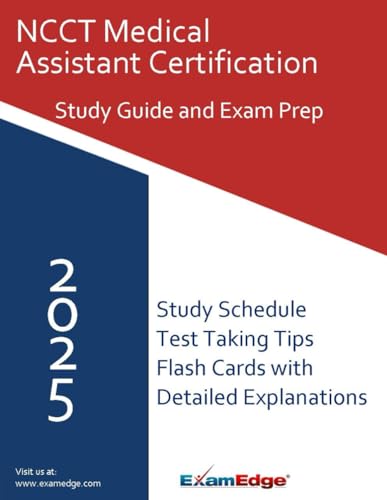
NCCT Medical Assistant Certification Exam Prep 2025: Comprehensive Study Guide with Practice Questions, Key Terms, and Proven Strategies for Passing the NCMA Exam on the First Attempt
By Edge, Exam
$34.28 · 
 Study guide on Mometrix
Explore More NCCT Certifications
Continue into nearby exams from the same family. Each card keeps practice questions, study guides, flashcards, videos, and articles in one place.
More From This Family
Videos and articles for deeper review.