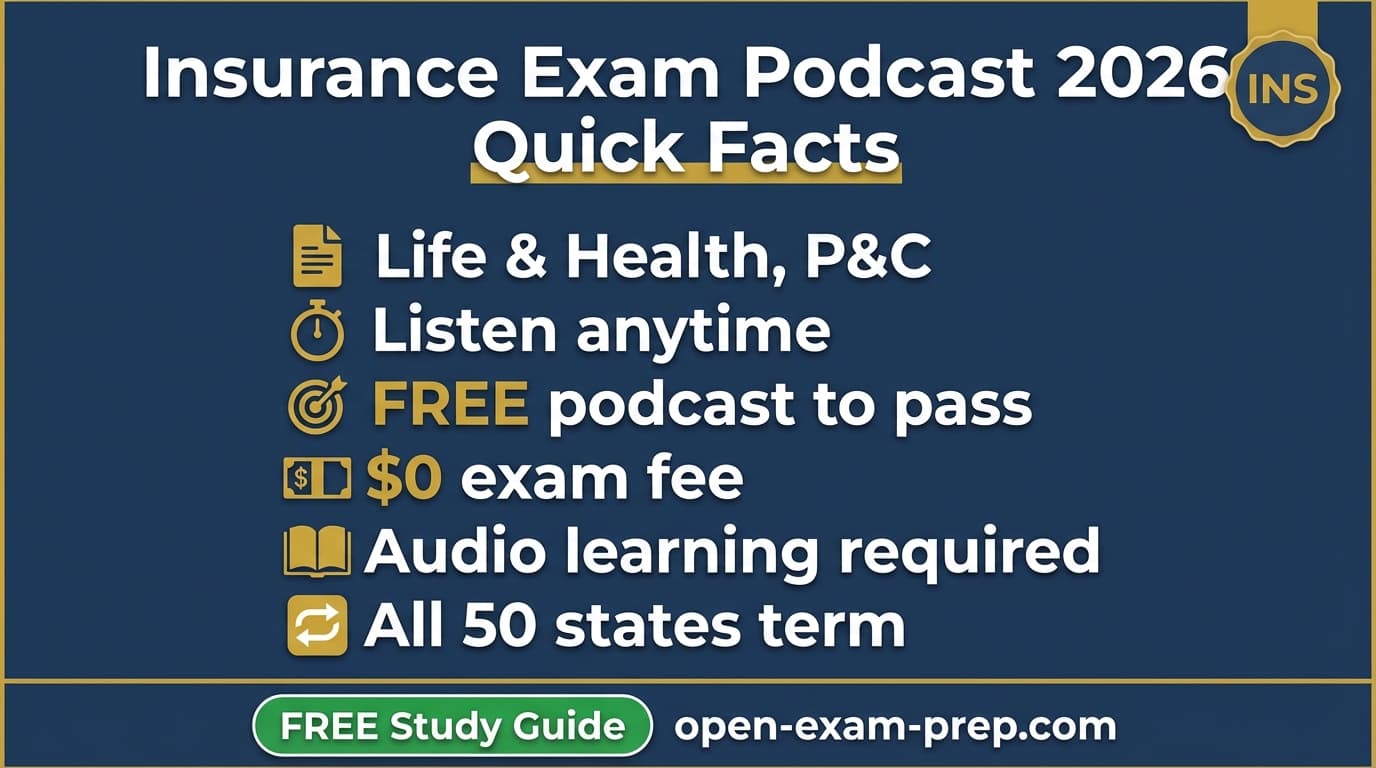
Turn Your Commute into Insurance Exam Study Time
Preparing for your Life & Health or Property & Casualty insurance license? The free Open Exam Prep Insurance Podcast lets you study while commuting, exercising, or doing chores.
Why Podcast Study Works for Insurance Exams
Insurance Exams Are Concept-Heavy
Unlike math-heavy exams, insurance licensing tests your understanding of:
- Policy types and their features
- Coverage provisions and exclusions
- Regulatory requirements
- Ethics and producer responsibilities
These concepts are perfect for audio learning—you can absorb definitions and explanations while doing other activities.
Maximize Hidden Study Time
| Activity | Weekly Study Time |
|---|---|
| Commuting | 5-10 hours |
| Gym/Walking | 3-5 hours |
| Chores/Errands | 2-3 hours |
| Total | 10-18 hours/week |
That's 40-70+ hours of study over a month—just from listening.
What the Podcast Actually Covers
Confirmed Episode Topics (Licensing & Regulation)
The insurance episodes focus on the regulatory rules that appear on every state exam, regardless of which line of authority you're pursuing:
- State insurance commissioner and department authority
- NAIC model laws and how they become state regulation
- Types of insurance organizations (stock, mutual, fraternal, HMOs)
- Producer licensing requirements and lines of authority
- Continuing education requirements
- Unfair trade practices and unfair claims settlement practices
- Policy replacement regulations and free look period provisions
- Insurance guaranty associations and insurance fraud
These rules are tested almost identically across all 50 states, which is exactly why they translate so well to audio—you don't need state-specific detail to absorb them on a commute.
Product Knowledge to Pair With Practice Questions
Product-specific details (policy forms, coverage limits, exact numbers) are better drilled with written practice than audio alone. Use the tables below as your study checklist, then use the practice links further down for each topic.
Life & Health Topics
| Topic | Key Concepts |
|---|---|
| Life Insurance | Term vs. permanent, whole life, universal life, variable life |
| Annuities | Fixed, variable, indexed, immediate vs. deferred |
| Health Insurance | Major medical, ACA provisions, Medicare, Medicaid |
| Disability | Short-term, long-term, own occupation vs. any occupation |
| Long-Term Care | Benefit triggers, elimination periods, inflation protection |
Property & Casualty Topics
| Topic | Key Concepts |
|---|---|
| Homeowners | HO-1 through HO-8, coverage A-F, endorsements |
| Auto Insurance | Liability, collision, comprehensive, uninsured motorist |
| Commercial | BOP, commercial property, general liability, workers comp |
| Liability | Personal liability, professional liability, umbrella policies |
| Bonds | Surety bonds, fidelity bonds, bail bonds |
Free vs. Paid Insurance Exam Podcasts
Most insurance exam podcasts hold their full course behind a paywall and give away only a handful of sample episodes—typical bundles run $80+ for around 20-25 hours of paid audio, with just a few free samples unlocked by an email signup. The Open Exam Prep Insurance Podcast works differently: every episode is free on Spotify, Apple Podcasts, and YouTube, with no email gate, no trial period, and no upsell to a paid tier. Pair it with our free state-specific practice questions and AI tutor and you have a complete prep stack without spending a dollar.
Study Strategy: Podcast + Practice Questions
The 3-Step Method
Step 1: Listen During Downtime
Use commutes and exercise time to absorb the regulatory concepts above passively. The podcast introduces topics and explains key distinctions.
Step 2: Practice with Questions
After listening to a topic, immediately practice with our free questions:
Step 3: Review Mistakes with AI
When you miss a question, ask our AI tutor to explain the concept. This fills knowledge gaps quickly.
Sample Study Week
| Day | Focus Topic | Practice Focus |
|---|---|---|
| Mon | Life Insurance Types | Term vs. Whole Life questions |
| Tue | Annuities | Fixed vs. Variable Annuity questions |
| Wed | Health Insurance | ACA and Major Medical questions |
| Thu | Homeowners Policies | HO Forms and Coverage questions |
| Fri | Auto Insurance | Liability and Coverage questions |
| Sat | Review weak areas | Mixed practice exam |
Free Practice Questions by State
Insurance exams are state-specific. We offer free practice for all 50 states:
Life & Health Practice
| Popular States | Practice Link |
|---|---|
| California | CA Life & Health → |
| Texas | TX Life & Health → |
| Florida | FL Life & Health → |
| New York | NY Life & Health → |
| National | Life & Health (All States) → |
Property & Casualty Practice
| Popular States | Practice Link |
|---|---|
| California | CA P&C → |
| Texas | TX P&C → |
| Florida | FL P&C → |
| New York | NY P&C → |
| National | P&C (All States) → |
Where to Listen
Subscribe on your preferred platform:
- Spotify - Listen on Spotify
- Apple Podcasts - Listen on Apple Podcasts
- YouTube - Watch on YouTube
Common Insurance Exam Questions Answered
"What's the difference between Life & Health and Property & Casualty?"
Life & Health covers products that protect people:
- Life insurance (death benefits)
- Health insurance (medical expenses)
- Disability insurance (income replacement)
- Long-term care (nursing care costs)
Property & Casualty covers products that protect things and liability:
- Homeowners/renters insurance
- Auto insurance
- Commercial property insurance
- Liability insurance
Many agents pursue both licenses to offer complete coverage to clients.
"How many questions are on an insurance licensing exam?"
It varies widely by state. Across our own state-by-state data, Life & Health exams run from about 95 to 221 questions and Property & Casualty exams run from about 110 to 220 questions, with 150 questions as the most common length. Most states require 70% correct to pass; California is a notable exception at 60%.
"How hard are insurance exams?"
Insurance exam pass rates run roughly 50-65% on the first attempt nationally—for example, Texas reported a 57% first-time pass rate for Life & Health in 2024, and Florida's Property & Casualty first-time pass rate runs about 55-60%. Most failures come from:
- Underestimating the amount of content
- Not practicing with realistic questions
- Rushing through without understanding concepts
The podcast + practice question combination addresses all three issues.
Need Help? Ask the AI Tutor
Confused about a concept from the podcast? Our AI tutor can explain anything in depth:
Try asking:
- "What's the difference between whole life and universal life insurance?"
- "Explain the HO-3 homeowners policy"
- "How does coinsurance work in property insurance?"
Free for 10 questions per day.
Start Your Insurance Exam Prep Today
- Subscribe to the podcast on Spotify
- Practice with Life & Health or P&C questions
- Ask the AI when you need concepts explained
All free. No credit card required.
Turn Listening Into Exam Points
A podcast episode only raises your score if you convert it into rules, exceptions, and scenarios. After each episode, ask what an exam writer could test: Is there a required disclosure? A prohibited sales practice? A timing window? A licensing step? A difference between state and federal authority? Those are the details most likely to become questions.
Make it active, not passive: pause after an episode and write five questions it should have answered, then answer them without looking at notes. If you can't, replay only that segment and turn it into a flashcard or a tagged practice question. A good rule is two listens per topic, then switch to written practice—licensing exams grade whether you can apply a rule in unfamiliar wording, not whether a phrase sounds familiar.
Keep official sources close for anything that affects licensing or consumer rights. The NAIC state insurance department directory routes you to your current regulator, and NIPR state requirements helps verify application workflows. Use OpenExamPrep for practice and explanations; use official sources for current legal, fee, and filing details.
Practice Routing by Exam Type
For Life and Health, route your practice toward policy provisions, replacement, annuities, Medicare-related products, health renewability, unfair trade practices, and producer duties. For Property and Casualty, route toward policy structure, covered causes of loss, liability triggers, auto requirements, workers' compensation, commercial exposures, cancellation, nonrenewal, and claims practices.
When you miss a practice question, don't stop at the right answer. Write one sentence on why the correct answer wins and one sentence on why your chosen answer was tempting. That second sentence is where the trap lives: a familiar term, a true statement that didn't answer the question, or a state rule confused with a national concept.
Exam-Day Reading Strategy
Insurance exams reward precise reading. Before choosing an answer, identify the product, the parties, the state-law clue, and the action being tested. If a question asks what a producer must do, don't answer what an insurer may do. If it asks about a policyholder right, don't answer with a carrier's underwriting preference. If it asks for the best next step, look for the compliant action that preserves documentation and doesn't mislead the consumer.

 Buy on Amazon
 Flashcards on Mometrix
 Take courses on Udemy
 Prep course on Achievable