1.2 Eligibility, Application & Preparation Strategy
Key Takeaways
For the ordinary 2026 Deputy Director route, applicants had to have reached Assistant Director I in or before 2022 and stayed at post except for approved leave.
For out-of-turn consideration based on a Master's or PhD, the 2026 advert requires a GES-approved programme and a certificate obtained by 2023 and no earlier than the previous promotion.
The 2026 application required a passport-sized photograph, the latest applicable promotion, appointment or upgrading letter and the highest academic certificate used for the application.
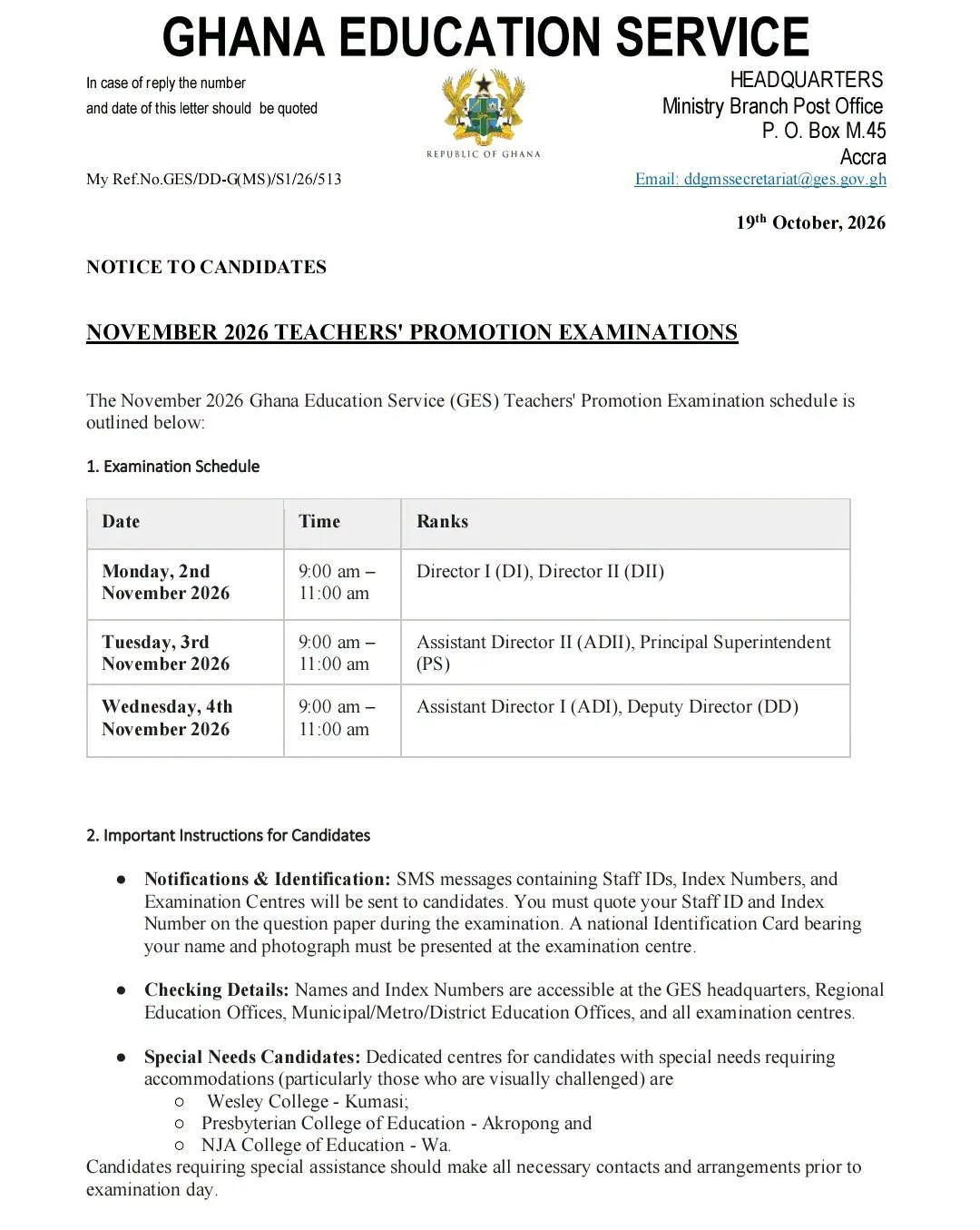
The October 2026 notice required candidates to write both Staff ID and index number on the question paper and to present a national identification card bearing their name and photograph.
The 120-minute paper averages 96 seconds per item. One practice split is 75 minutes for 60 objective items, 30 minutes for 15 fill-ins and 15 minutes to review.
Eligibility for the 2026 Deputy Director Exercise
In the 2026 General Promotion advertisement, Deputy Director is one of four advertised ranks. The ordinary route uses the applicant's Assistant Director I promotion date and service continuity. A separate part of the advertisement addresses requests to use a Master's or doctorate for out-of-turn consideration.
| Check | 2026 condition |
|---|---|
| Ordinary qualifying rank | Promoted to Assistant Director I in or before 2022. |
| Ordinary service continuity | At post continuously since that promotion, with an exception for periods of approved leave. |
| Out-of-turn programme | The postgraduate programme must be on the GES-approved course of study. |
| Out-of-turn certificate date | For Deputy Director, the certificate must be obtained in or before 2023. It must not predate the previous promotion. |
Compare both dates on a worked example. An applicant whose last promotion was in 2021 and who obtained a GES-approved Master's certificate in 2023 meets the programme and certificate-date checks for out-of-turn consideration. An applicant with a certificate from 2020 and a last promotion in 2021 fails the sequence check. Meeting the postgraduate checks alone does not establish selection for promotion.
When checking ordinary eligibility, use the promotion date and verify any uncertainty about the date or leave record through GES. If an Assistant Director I reached that rank in 2022 and took approved leave in 2024, the leave falls within the advert's exception. An otherwise similar colleague promoted in 2023 falls outside the ordinary date rule.
Application and Examination-Day Documents
The 2026 advertisement lists an online application window of 17 August to 28 September 2026. Prepare a legible passport-sized photograph in JPEG, JPG or PNG format. Upload the latest applicable promotion, appointment or upgrading letter and the highest academic certificate used for the application in PDF. Keep the advertisement for the cycle you are applying under.
Check Your Personal Sitting Instructions
- The 19 October GES notice says candidates receive their Staff ID, index number and examination centre by SMS. A candidate can also check names and index numbers at the GES offices and examination centres named in the notice.
- Write both identifiers on the question paper and present the national identification card bearing your name and photograph at the examination centre.
- Arrange examination accommodations in advance through the offices identified by GES. Follow current instructions for permitted materials and assigned centres.
- If you missed a sitting or need another attempt, check for an applicable GES notice. The General Promotion advertisement does not set a fixed retake interval.
Pacing & Format Strategy for the 75-Item Sitting
The 2026 Deputy Director test packs 75 items into 120 minutes, giving an average pace of:
However, treating all 75 questions as requiring equal time is a costly mistake. The 60 multiple-choice / true-false items provide answer choices you can evaluate rapidly, whereas the 15 fill-in items demand exact recall of statutory terms, numbers, or calculated values with zero multiple-choice cues.
| Sitting Phase | Target Items | Recommended Time | Pace per Item | Primary Focus |
|---|---|---|---|---|
| Pass 1: Objective Core | 60 MCQ / True-False items | 75 minutes | ~1.25 min | Answer high-confidence items quickly; flag complex statutory or calculation scenarios |
| Pass 2: Precision Fill-In | 15 Fill-In items | 30 minutes | ~2.00 min | Write exact statutory titles, ratios, percentages, and units without guessing blindly |
| Pass 3: Audit & Flagged Review | All flagged + fill-in answers | 15 minutes | Review buffer | Verify units (%, GH¢, ratio), spelling of acronyms, and double-check flagged items |
How to Tackle Each Question Format
For multiple-choice questions, identify the setting first. If a school has received textbooks and the question asks who should verify delivery, determine the applicable procurement arrangement and whether the question concerns receiving, approval or payment. For a true/false item, check the exact condition that makes the statement true.
For fill-ins, practise writing exact terms and units independently. After reading the chapter on indicators, close the guide and write the numerator and denominator for gross enrolment ratio. Then calculate a result using a clearly specified age group and enrolment total. Repeat with a different example so recall depends on the definition.
An 80-Hour Study Plan
A study plan can run for 6 to 8 weeks. The example below totals 80 hours, or 10 hours per week over eight weeks. If you have less time, preserve coverage of each syllabus area and shorten drills on topics you already handle confidently.
- Phase 1 — Legal & Policy Frameworks (20 hours): Master Act 1049 (MoE, GES Council, Regional/District Directorates, DEOCs, SMCs), Act 1023 (NTC, NaSIA, NaCCA, GTEC, CTVET), Free SHS rules, and Ghana's 2015 Inclusive Education Policy.
- Phase 2 — Administrative, Financial & Procurement Mastery (25 hours): Study Act 921, Act 1136, L.I. 2378, Act 663 / Act 914 / L.I. 2516 procurement thresholds and methods, GRA withholding tax rules, Capitation/GALOP grant controls, stores vouchers, and PRAAD (Act 535) records management—working through tax and variance calculations by hand.
- Phase 3 — Strategic Leadership, Supervision & Pedagogy (20 hours): Consolidate leadership styles, SWOT/PESTEL, School Improvement Plans (SIP), clinical supervision steps, staff appraisal, GES Code of Conduct, Constitution Article 284, Standards-Based Curriculum (SBC), CCP, Bloom's Taxonomy, and School-Based Assessment (SBA).
- Phase 4 — Contemporary Issues, EMIS Statistics & Timed Mocks (15 hours): Practise GER, NER, GPI, gross intake, completion, PTR, and PTTR calculations manually, review current MoE/GES initiatives (GALOP, ESP 2018–2030, SDG 4), and complete full 75-item timed simulations.
Key Takeaways
- Check Assistant Director I by 2022 and continuous service for the ordinary route. Check the programme, the previous promotion date and the 2023 cut-off if seeking out-of-turn consideration.
- Upload all three mandatory documents on
promotion.gedplatform.com, confirm your Staff ID, index number, and centre, and bring a national identification card bearing your name and photograph. - Train for both recognition (60 MCQ/T-F) and exact recall (15 fill-in) under a 75 / 30 / 15-minute pacing plan and check current GES instructions for permitted materials.
An officer obtained Assistant Director I rank in 2021, remained continuously at post except for officially approved maternity leave, and plans to apply under the ordinary 2026 route. Another colleague obtained AD I in 2024 and holds an unapproved Master's degree completed before their 2024 promotion. Which statement is accurate?
Both officers qualify automatically because any Master's degree waives the 2022 rank cut-off
Only the officer who obtained Assistant Director I in 2021 with approved leave satisfies the ordinary 2026 route conditions
Neither officer qualifies because maternity leave breaks continuous service under GES promotion rules
Only the officer with the Master's degree qualifies because postgraduate degrees override the previous-promotion rule
Which combination of documents and credentials is required across the 2026 online application and examination-day verification process?
Only a Staff ID number online, followed by a school head's introductory letter at the examination centre
A birth certificate and bank statement online, plus a personal calculator at the examination centre
Online uploads of a photograph, last promotion/appointment/upgrading letter, and highest relevant academic certificate, followed by presenting the specified national ID card matching your registered name and photograph at your assigned centre
A letter from the District Chief Executive online, followed by automatic centre transfer on examination morning
Why is a 75 / 30 / 15-minute pacing split recommended for the 120-minute Deputy Director examination rather than spending an identical 1.6 minutes on every item?
The 15 fill-in items require exact recall and manual checking without multiple-choice options, so allocating roughly 2 minutes per fill-in item and saving a 15-minute review buffer protects accuracy
The 60 multiple-choice items are worth zero marks unless all 15 fill-in items are answered first
GES rules prohibit candidates from revisiting multiple-choice answers after the first 60 minutes
Fill-in items require writing full 500-word essays that cannot be completed in under 2 minutes
Sections you finish are checked off in the contents.