Algebra (Equations)
48-61%of exam
Functions
24-32%of exam
Number + Statistics
11-25%of exam
Exam Skills
10-15%of exam
Quick Facts
- Exam
- Regents Algebra I
- Standards
- Next Generation Math
- Questions
- 35 in 4 parts
- Time
- 3 hours
- Pass
- Scale score 65
- Calculator
- Graphing allowed
- Reference sheet
- Provided
- Max credits
- 82 raw
Order of Operations
PEMDAS: Please Excuse My Dear Aunt Sally
Factoring vs Formula
Factoring
- Nice integers
- Zero product
- Fast
Quadratic formula
- Any quadratic
- Uses discriminant
- Always works
Easy vs universal
Solve Quadratic How?
- Factors easily→Factor + zero product(Fastest)
- a = 1, b even→Complete the square(Clean)
- Will not factor→Quadratic formula(Always works)
- Need only roots→Graph x-intercepts(Calculator)
- x^2 = number→Square root both sides(Two roots)
- Need vertex→Vertex form / -b/2a(Min or max)
Quadratic Core
- Standard form
- y = ax^2 + bx + c
- Quadratic formula
- x = (-b +/- root) / 2aReference
- Discriminant
- b^2 - 4ac
- Axis of symmetry
- x = -b / 2a
- Vertex x
- -b / 2a
- Vertex form
- a(x-h)^2 + k
- Vertex point
- (h, k)
- Zeros
- Where y = 0
Quadratic Formula
x = (-b +/- root b^2 - 4ac) / 2a
Solve System How?
- One variable alone→Substitution(Plug in)
- Opposite coefficients→Elimination(Add equations)
- Answer choices given→Graph intersection(Calculator)
- Variables cancel false→No solution(Parallel)
- Variables cancel true→Infinite solutions(Same line)
Discriminant Rules
- b^2 - 4ac > 0
- Two real roots
- b^2 - 4ac = 0
- One real root
- b^2 - 4ac < 0
- No real roots
- Perfect square
- Two rational roots
- Not a square
- Two irrational roots
- Sum of roots
- -b / a
- Product of roots
- c / a
Factoring Patterns
- GCF first
- Pull common factor
- Diff of squares
- a^2 - b^2 = (a-b)(a+b)
- Perfect trinomial
- a^2 + 2ab + b^2
- x^2 + bx + c
- Multiply c, add b
- ax^2 + bx + c
- AC method / split
- Zero product
- Each factor = 0
- Complete square
- Add (b/2)^2
Linear Forms
- Slope
- (y2 - y1)/(x2 - x1)
- Slope-intercept
- y = mx + b
- Point-slope
- y-y1 = m(x-x1)
- Standard form
- Ax + By = C
- y-intercept
- b, where x = 0
- Parallel
- Same slope m
- Perpendicular
- Negative reciprocal slope
- Horizontal
- Slope = 0
Systems + Inequalities
- Substitution
- Plug one into other
- Elimination
- Add to cancel variable
- Graphing
- Solution is intersection
- No solution
- Parallel, no cross
- Infinite solutions
- Same line
- Flip sign
- Divide by negative
- Dashed line
- Strict < or >
- Solid line
- <= or >=
Line Equation
y = mx + b: slope m, intercept b
Linear vs Exponential
Linear
- Add constant
- Constant rate
- Straight line
Exponential
- Multiply constant
- Constant ratio
- Curved growth
Add vs multiply
Which Function Type?
- Equal y differences→Linear(Constant rate)
- Constant y ratio→Exponential(Multiply)
- Equal 2nd differences→Quadratic(Parabola)
- Add same each step→Arithmetic / linear(Common d)
- Multiply each step→Geometric / exponential(Common r)
- U-shaped graph→Quadratic(Vertex)
Function Basics
- f(x) notation
- Output for input x
- Domain
- Allowed x inputs
- Range
- Possible y outputs
- Function test
- One y per x
- Vertical line test
- Graph crosses once
- Avg rate of change
- (f(b)-f(a))/(b-a)
- x-intercept
- Root, where y = 0
- Discrete
- Separate plotted points
Slope
Slope = rise over run
Domain vs Range
Domain
- Inputs x
- Read left-right
- Allowed values
Range
- Outputs y
- Read bottom-up
- Resulting values
x in vs y out
Exponential Models
- General form
- y = a * b^x
- a value
- Initial amount
- b > 1
- Growth factor
- 0 < b < 1
- Decay factor
- Growth rate r
- b = 1 + r
- Decay rate r
- b = 1 - r
- Constant ratio
- Equal y multiples
Exponential
y = a times b to the x
Discrete vs Continuous
Discrete
- Separate points
- Countable items
- No connecting
Continuous
- Solid curve
- Any value
- Connected graph
Dots vs line
Sequences
- Arithmetic
- Add common difference d
- Arithmetic nth
- a_n = a_1 + (n-1)d
- Geometric
- Multiply common ratio r
- Geometric nth
- a_n = a_1 * r^(n-1)
- Recursive
- Uses previous term
- Linear pattern
- Arithmetic sequence
- Exponential pattern
- Geometric sequence
Transformations
- f(x) + k
- Shift up k
- f(x) - k
- Shift down k
- f(x - h)
- Shift right h
- f(x + h)
- Shift left h
- -f(x)
- Reflect over x-axis
- a * f(x)
- Vertical stretch a
- f(-x)
- Reflect over y-axis
Correlation vs Causation
Correlation
- Move together
- Measured by r
- Pattern only
Causation
- One causes other
- Needs experiment
- Not from r
Linked vs causes
Statistics
- Mean
- Sum / count
- Median
- Middle of ordered data
- Correlation r
- Range -1 to 1
- r near 1
- Strong positive linear
- r near 0
- Weak / no linear
- Residual
- Actual minus predicted
- Good fit
- Random residual scatter
- Two-way table
- Counts by categories
Mean vs Median
Mean
- Average value
- Sum / count
- Shifted by outliers
Median
- Middle value
- Order first
- Resists outliers
Average vs middle
Number + Quantity
- Rational
- Fraction of integers
- Irrational
- Non-repeating decimal
- Rational +/- rational
- Stays rational
- Rational + irrational
- Becomes irrational
- Closure
- Stays in same set
- Units / accuracy
- Match real context
Common Traps
Zero vs no solution
x = 0 is a value ≠ No solution means none
Slope vs intercept
m is the slope ≠ b is the y-intercept
Domain vs range
Domain is x inputs ≠ Range is y outputs
Add vs multiply exponents
Same base multiply: add ≠ Power of power: multiply
Vertex vs zeros
Vertex is turning point ≠ Zeros are x-intercepts
Correlation vs causation
r shows a pattern ≠ Pattern is not cause
Scale score vs percent
65 is scale score ≠ Not raw percent correct
Last Minute
- 1.Passing = scale score 65, not percent
- 2.35 questions, Parts I-IV, 3 hours
- 3.Graphing calculator and straightedge allowed
- 4.Reference sheet given at back
- 5.Quadratic: (-b +/- root b^2-4ac)/2a
- 6.Axis and vertex: x = -b/2a
- 7.Discriminant b^2-4ac: + two, 0 one
- 8.Slope m = (y2-y1)/(x2-x1)
- 9.Linear adds; exponential multiplies y = a*b^x
- 10.Define variable, write equation first
- 11.Show all work on constructed-response
- 12.Interpret slope, zeros, vertex in context
Third-party resources · We may earn a commission from purchases.
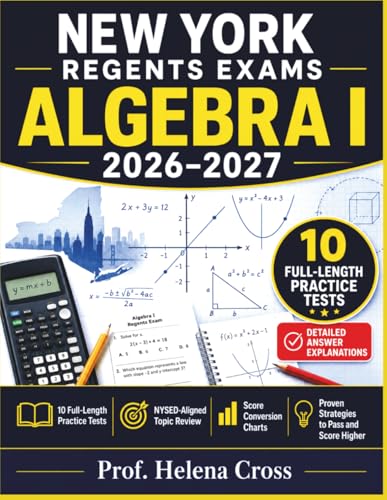
New York Regents Exams Algebra I 2026–2027: Complete Study Guide With 10 Full-Length Practice Tests, Detailed Answer Explanations, NYSED-Aligned Topic ... Proven Strategies to Pass and Score Higher
By Cross, Prof Helena
$17.99 · 
 Flashcards on Mometrix
Explore More New York Regents Exams
Continue into nearby exams from the same family. Each card keeps practice questions, study guides, flashcards, videos, and articles in one place.
More From This Family
Videos and articles for deeper review.