Structure + Function
9-20%of exam
Matter + Energy
9-16%of exam
Ecosystem Relationships
14-27%of exam
Inheritance + Variation
14-27%of exam
Natural Selection
14-24%of exam
Earth Systems
2-9%of exam
Investigations + Engineering
2-11%of exam
Quick Facts
- Exam
- Life Science Biology
- Legacy
- Living Environment
- Time
- 3 h
- Pass
- 65 scale
- Items
- 45-55
- Clusters
- 9-11
- Split
- 60% MC / 40% CR
- Calculator
- Four-function/scientific
- Labs
- Investigations required
Biology Concept Picker
- Internal balance→Homeostasis(Feedback)
- Body interaction→Systems(Structure-function)
- Sugar made→Photosynthesis(Chloroplast)
- ATP released→Respiration(Mitochondria)
- Trait inherited→Genetics(DNA)
- Population shifts→Evolution(Selection)
- Organisms interact→Ecology(Relationships)
- Solution judged→Engineering(Criteria)
Cell Structures
- Membrane
- Selective boundary
- Nucleus
- DNA storage
- Ribosome
- Protein assembly
- Mitochondrion
- ATP release
- Chloroplast
- Sugar production
- Vacuole
- Storage
- Enzyme
- Reaction catalyst
- Receptor
- Signal binding
- Stem cell
- Unspecialized cell
Homeostasis
- Stimulus
- Detected change
- Receptor
- Detects stimulus
- Control center
- Compares setpoint
- Effector
- Makes response
- Feedback
- Response loop
- Negative feedback
- Restores balance
- Insulin
- Lowers glucose
- Guard cell
- Controls stomata
- Thermoregulation
- Temperature balance
Human Systems
- Circulatory
- Transport system
- Respiratory
- Gas exchange
- Digestive
- Breaks food
- Excretory
- Removes wastes
- Nervous
- Fast signals
- Endocrine
- Hormone signals
- Immune
- Defense system
- Reproductive
- Makes offspring
Energy + Matter
Energy flows; matter cycles
Photosynthesis vs Respiration
Photosynthesis
- Stores energy
- Uses CO2
- Makes glucose
Respiration
- Releases energy
- Uses glucose
- Makes ATP
Store vs release
Matter + Energy
- Photosynthesis
- CO2 -> glucose
- Respiration
- Glucose -> ATP
- Glucose
- Stored chemical energy
- ATP
- Cell energy currency
- Chlorophyll
- Captures light
- Autotroph
- Makes food
- Heterotroph
- Consumes food
- Decomposer
- Recycles matter
- Biomass
- Living matter
Matter vs Energy
Matter
- Cycles
- Atoms reused
- Carbon moves
Energy
- Flows
- Heat lost
- Needs input
Recycle vs flow
Ecology Core
- Population
- Same species
- Community
- Many populations
- Ecosystem
- Living + nonliving
- Niche
- Organism role
- Carrying capacity
- Maximum support
- Limiting factor
- Growth restriction
- Biodiversity
- Variety of life
- Succession
- Community change
- Symbiosis
- Close interaction
- Invasive species
- Disruptive newcomer
Central Dogma
DNA -> RNA -> Protein -> Trait
Mitosis vs Meiosis
Mitosis
- Body cells
- Same DNA
- Growth/repair
Meiosis
- Gametes
- Half DNA
- Variation
Copy vs vary
Genetics Core
- DNA
- Genetic code
- Gene
- Trait instruction
- Allele
- Gene version
- Chromosome
- DNA package
- Codon
- Three-base code
- Protein
- Folded product
- Mutation
- DNA change
- Mitosis
- Body-cell division
- Meiosis
- Gamete formation
- Zygote
- Fertilized cell
Genotype vs Phenotype
Genotype
- Alleles
- DNA basis
- Can be hidden
Phenotype
- Observable trait
- Environment affected
- Expressed result
Code vs trait
Inheritance Patterns
- Genotype
- Allele combination
- Phenotype
- Observed trait
- Homozygous
- Same alleles
- Heterozygous
- Different alleles
- Dominant
- Expressed allele
- Recessive
- Masked allele
- Carrier
- Hidden allele
- Pedigree
- Family inheritance
- Punnett square
- Offspring probability
Selection
Variation plus pressure changes populations
Individual vs Population
Individual
- Does not evolve
- Has traits
Population
- Evolves
- Allele frequencies shift
Organisms survive; populations evolve
Evolution Core
- Variation
- Trait differences
- Adaptation
- Inherited advantage
- Fitness
- Reproductive success
- Selection pressure
- Environment filter
- Common ancestry
- Shared origins
- Fossil
- Past-life evidence
- Homologous
- Shared structure
- Speciation
- New species
- Bottleneck
- Reduced variation
Adaptation vs Acclimation
Adaptation
- Inherited
- Population-level
- Selected
Acclimation
- Individual response
- Within lifetime
- Not inherited
Inherited vs temporary
Earth + Engineering
- Carbon cycle
- Carbon movement
- Fossil fuels
- Stored carbon
- Climate
- Long-term patterns
- Atmosphere
- Gas layer
- Criteria
- Solution goals
- Constraints
- Solution limits
- Trade-off
- Benefit lost
- Prototype
- Test model
CER
Claim, evidence, reasoning
Control vs Constant
Control
- Comparison group
- Baseline
Constant
- Kept same
- Fair test
Compare vs hold
Evidence Picker
- Graph included→Trend(Axes first)
- Table included→Compare values
- Experiment described→Variables
- Family chart→Pedigree
- Trait ratio→Punnett square
- Fossil series→Common ancestry
- Food web→Energy flow
- Design problem→Trade-offs
Lab Design
- Independent variable
- Changed factor
- Dependent variable
- Measured outcome
- Control group
- Comparison baseline
- Constants
- Kept same
- Sample size
- Number tested
- Trend
- Data pattern
- Claim
- Answer statement
- Evidence
- Data support
- Reasoning
- Biology link
Lab Response Picker
- Changed factor→Independent variable
- Measured result→Dependent variable
- Fair comparison→Control group
- Same conditions→Constants
- More confidence→Larger sample
- Answer prompt→Claim
- Use data→Evidence
- Connect biology→Reasoning
Data Skills
- Graph
- Visual data
- Table
- Organized values
- Model
- Simplified system
- Validity
- Tests intended claim
- Reliability
- Repeatable results
- Outlier
- Unusual data
- Error
- Measurement uncertainty
- Inference
- Evidence conclusion
Regents Vocabulary
- Explain
- Use mechanism
- Identify
- Name from evidence
- Describe
- State pattern
- Compare
- Find similarities
- Contrast
- Find differences
- Support
- Use evidence
- Evaluate
- Judge trade-offs
- Predict
- Apply trend
Common Traps
Organisms vs populations
Organisms adapt physiologically ≠ Populations evolve genetically
Energy vs matter
Energy flows ≠ Matter cycles
Mitosis vs meiosis
Mitosis copies ≠ Meiosis halves
Trait vs adaptation
Trait may vary ≠ Adaptation improves fitness
Control vs constant
Control compares ≠ Constant stays same
Data vs opinion
Data supports ≠ Opinion distracts
Food web arrows
Arrow shows energy ≠ Not eating direction
Last Minute
- 1.Scale 65 passes
- 2.Read stimulus before choices
- 3.Axes before trends
- 4.CER for written responses
- 5.Energy flows; matter cycles
- 6.Individuals do not evolve
- 7.Mitosis copies; meiosis varies
- 8.DNA codes proteins
- 9.Controls compare; constants match
- 10.Use evidence, not recall
Third-party resources · We may earn a commission from purchases.
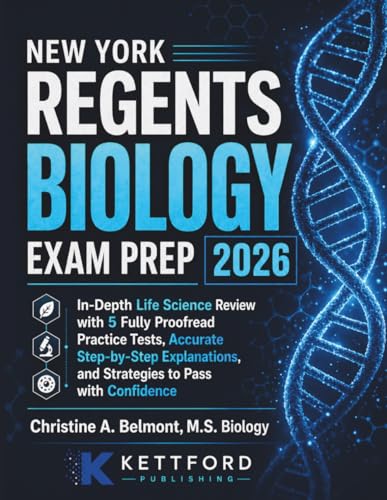
New York Regents Biology Exam Prep 2026: In-Depth Life Science Review with 5 Fully Proofread Practice Tests, Accurate Step-by-Step Explanations, and Strategies to Pass with Confidence
By Publishing, Kettford, Belmont M.S. Biology, Christine A.
$23.97 · 
 Flashcards on Mometrix
Explore More New York Regents Exams
Continue into nearby exams from the same family. Each card keeps practice questions, study guides, flashcards, videos, and articles in one place.
More From This Family
Videos and articles for deeper review.