Exam and Element 1
Not publishedof exam
Element 3 Foundations
Not publishedof exam
Element 3 Radio Systems
Not publishedof exam
Element 3 Applications
Not publishedof exam
Quick Facts
- License
- GROL code PG
- Required
- Written Elements 1 + 3
- Element 1
- 24 multiple-choice questions
- Element 1 pass
- 18 correct
- Element 3
- 100 multiple-choice questions
- Element 3 pass
- 75 correct
- Pool date
- June 25, 2009
- Session timing
- COLEM determines
- License term
- Lifetime
- Technical scope
- Adjust, maintain, internally repair
- Eligibility
- Eligible for U.S. employment
- Language
- Send and receive spoken English
- Application
- FCC Form 605
- PPC window
- 365 days
- Included authority
- MP + RR
- Ship radar
- Element 8 separate
Traffic Priority
Distress, urgency, safety, routine
Element 1 vs Element 3
Element 1
- Radio law and practice
- 24 questions
- 18 correct passes
Element 3
- Technical radio knowledge
- 100 questions
- 75 correct passes
Pass both for GROL
License Path Picker
- Want base GROL→Pass Elements 1 + 3(Written elements)
- Already hold valid MROP→Claim Element 1 credit(Verify license credit)
- Need MROP only→Pass Element 1(Marine operator permit)
- Need ship radar work→Add Element 8(Separate endorsement)
- Need GMDSS operation→Pass Elements 1 + 7(Different license)
- Need GMDSS maintenance→Pass Elements 1 + 3 + 9(Different license)
- Elements are passed→Obtain COLEM PPC(Proof of passing)
- Ready to apply→File FCC Form 605(Within 365 days)
GROL vs Radar Endorsement
Base GROL
- Elements 1 + 3
- Radiotelephone scope
- Code PG
Ship radar endorsement
- Element 8
- Ship radar service
- Added endorsement
Element 3 radar is not endorsement
License Path
- GROL
- Elements 1 + 3PG
- MROP
- Element 1 onlyMP
- Ship radar
- Add Element 8
- GMDSS operator
- Elements 1 + 7
- GMDSS maintainer
- Elements 1 + 3 + 9
- Exam manager
- FCC-authorized COLEM
- PPC
- Proof of passing
- License term
- Holder's lifetime
Element 1 Map
- 1-A Rules
- 6 exam questions
- 1-B Procedures
- 6 exam questions
- 1-C Equipment
- 6 exam questions
- 1-D Other gear
- 6 exam questions
- Element 1 pool
- 144 published questions
- Element 1 exam
- 24 selected questions
- Passing mark
- 18 of 24
- Subject
- Maritime law and practice
Distress Priority
- MAYDAY
- Distress traffic
- PAN-PAN
- Urgency traffic
- SECURITE
- Safety traffic
- VHF Channel 16
- 156.8 MHz voice
- VHF Channel 70
- DSC only
- MMSI
- Nine-digit DSC identity
- False distress
- Cancel; broadcast correction
- Minimum power
- Effective communications only
VIRP Core
V equals IR; P equals VI
Voltage vs Current
Voltage
- Electrical potential
- Measure in parallel
- Unit volts
Current
- Charge flow
- Measure in series
- Unit amperes
Potential across; flow through
Element 3 Map
- 3-A Principles
- 8 exam questions
- 3-B Electrical Math
- 10 exam questions
- 3-C Components
- 10 exam questions
- 3-D Circuits
- 4 exam questions
- 3-E Digital Logic
- 8 exam questions
- 3-F Receivers
- 10 exam questions
- 3-G Transmitters
- 6 exam questions
- 3-H Modulation
- 3 exam questions
- 3-I Power Sources
- 3 exam questions
- 3-J Antennas
- 5 exam questions
- 3-K Aircraft
- 6 exam questions
- 3-L Installation
- 8 exam questions
- 3-M Communications
- 3 exam questions
- 3-N Marine
- 5 exam questions
- 3-O RADAR
- 5 exam questions
- 3-P Satellite
- 4 exam questions
- 3-Q Safety
- 2 exam questions
ELI the ICE Man
E leads I inductive; I leads E capacitive
Inductor vs Capacitor
Inductor
- Magnetic field
- XL rises with frequency
- Current lags voltage
Capacitor
- Electric field
- XC falls with frequency
- Current leads voltage
ELI the ICE man
Formula Deck
- Ohm's law
- V = IR
- DC power
- P = VI
- Inductive reactance
- XL = 2pi fL
- Capacitive reactance
- XC = 1/(2pi fC)
- Resonance
- XL equals XC
- Wavelength meters
- 300 divided by MHz
- Power dB
- 10 log power ratio
- Equal-Z voltage dB
- 20 log voltage ratio
- RMS sine
- 0.707 times peak
- Transformer voltage
- Follows turns ratio
Components and Logic
- Capacitor
- Stores electric-field energy
- Inductor
- Stores magnetic-field energy
- Diode
- One-way conduction
- Zener diode
- Voltage regulation
- BJT
- Base current controls collector
- FET
- Gate voltage controls channel
- Transformer
- Changes impedance and voltage
- Oscillator
- Generates periodic signal
- Flip-flop
- Stores one binary bit
- XOR
- High when inputs differ
Superhet Order
RF, mixer, IF, detector, audio
Mixer vs Detector
Mixer
- Changes frequency
- Uses local oscillator
- Creates sum and difference
Detector
- Demodulates received signal
- Recovers intelligence
- Feeds audio stages
Convert first; recover later
Receiver Chain
- RF amplifier
- Raises incoming signal
- Local oscillator
- Supplies mixer frequency
- Mixer
- Creates sum and difference
- IF amplifier
- Provides fixed-frequency gain
- Detector
- Recovers intelligence
- AGC
- Stabilizes receiver output
- Squelch
- Mutes weak-signal noise
- Image frequency
- Unwanted mixer response
AM vs FM
AM
- Carrier amplitude varies
- Amplitude noise matters
- Sidebands carry intelligence
FM
- Carrier frequency varies
- Limiter removes amplitude noise
- Capture effect applies
Amplitude changes vs frequency changes
Transmitter Chain
- Carrier oscillator
- Creates stable carrier
- Buffer
- Prevents oscillator loading
- Frequency multiplier
- Raises carrier frequency
- Modulator
- Adds intelligence
- Driver
- Feeds final amplifier
- Power amplifier
- Supplies RF output
- Low-pass filter
- Suppresses harmonics
- ALC
- Limits transmitter drive
Signals and Modulation
- A3E
- AM voice; full carrier
- J3E
- SSB voice; suppressed carrier
- F3E
- FM voice
- F1B
- Frequency-shift telegraphy
- Deviation
- FM carrier shift
- PEP
- Modulation-envelope peak power
- FM limiter
- Rejects amplitude noise
- Capture effect
- Stronger FM signal wins
Antennas and Feed Lines
- Half-wave dipole
- Balanced resonant antenna
- Quarter-wave monopole
- Needs ground plane
- Yagi
- Directional parasitic array
- Isotropic
- Zero-dBi reference
- Characteristic impedance
- Feed-line voltage-current ratio
- Velocity factor
- Wave speed ratio
- SWR 1:1
- Ideal impedance match
- Dummy load
- Nonradiating RF termination
ILS Axes
Localizer left-right; glideslope up-down
Channel 70 vs Channel 16
Channel 70
- Digital DSC
- No voice traffic
- Calls and alerts
Channel 16
- Radiotelephone voice
- Distress and calling
- 156.8 MHz
Digital alert then voice
Measurement Picker
- Need voltage→Voltmeter(Connect parallel)
- Need current→Ammeter(Connect series)
- Need resistance→Ohmmeter(Power removed)
- Need waveform→Oscilloscope(Amplitude versus time)
- Need exact frequency→Frequency counter(Stable input required)
- Need RF output→Wattmeter + dummy load(Avoid radiation)
- Need antenna match→SWR meter(Forward versus reflected)
- Need failed stage→Signal tracing(Follow signal path)
Aircraft and Marine
- VOR
- Magnetic bearing guidance
- DME
- Slant-range distance
- ILS localizer
- Lateral runway guidance
- ILS glideslope
- Vertical approach guidance
- Transponder
- Replies to interrogation
- ELT
- Aircraft distress beacon
- EPIRB
- 406-MHz maritime alert
- SART
- Radar search response
- NAVTEX
- Maritime safety broadcasts
- DSC
- Digital selective calling
Test and Repair
- Voltmeter
- Connect in parallel
- Ammeter
- Connect in series
- Ohmmeter
- Deenergized circuit only
- Oscilloscope
- Displays waveform
- Frequency counter
- Measures signal frequency
- Wattmeter
- Measures RF power
- SWR meter
- Reveals mismatch
- Signal tracing
- Locates failed stage
Radar Satellite Safety
- Radar range
- Pulse round-trip time
- Radar bearing
- Antenna direction
- Shorter pulse
- Improves range resolution
- Magnetron
- Microwave oscillator
- GEO satellite
- Fixed equatorial sky position
- Transponder
- Receives then retransmits
- Footprint
- Satellite coverage area
- Stored charge
- Discharge before servicing
- RF exposure
- Observe applicable MPE limits
- Protective ground
- Fault-current path
Common Traps
GROL versus radar
Base uses Elements 1 + 3 ≠ Radar endorsement needs Element 8
Commercial versus amateur
GROL is commercial Part 13 ≠ Ham licensing is Part 97
Timing versus thresholds
COLEM chooses session timing ≠ FCC publishes passing counts
Channel 70 versus voice
Channel 70 carries DSC ≠ Channel 16 carries voice
Meter connection
Voltmeter goes parallel ≠ Ammeter goes series
Ohmmeter safety
Remove circuit power ≠ Never measure energized resistance
SWR versus impedance
SWR reveals mismatch ≠ Impedance causes mismatch
Lifetime versus static rules
License normally lasts lifetime ≠ Operating rules still change
Last Minute
- 1.Base GROL = Elements 1 + 3
- 2.Element 1: 18 of 24
- 3.Element 3: 75 of 100
- 4.Element 8 = separate radar endorsement
- 5.COLEM determines session timing
- 6.File PPC within 365 days
- 7.Use FCC Form 605
- 8.GROL includes MP and RR authority
- 9.V = IR; P = VI
- 10.XL rises; XC falls
- 11.Mixer converts; detector recovers
- 12.Channel 70 DSC; 16 voice
- 13.Voltmeter parallel; ammeter series
- 14.Ohmmeter requires power removed
- 15.SWR 1:1 means ideal match
- 16.Element 3 exam has 100 questions
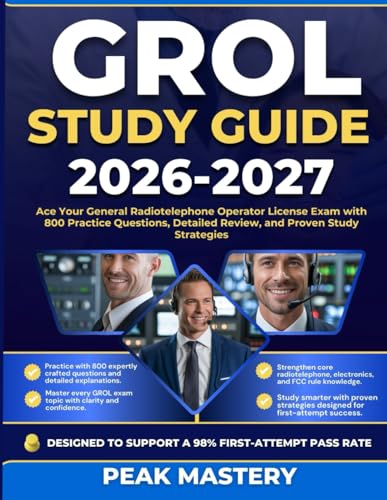
 Buy on Amazon
Explore More FCC Radio Operator Licenses
Continue into nearby exams from the same family. Each card keeps practice questions, study guides, flashcards, videos, and articles in one place.
More From This Family
Videos and articles for deeper review.