Why Referrals Are Your Best Growth Strategy
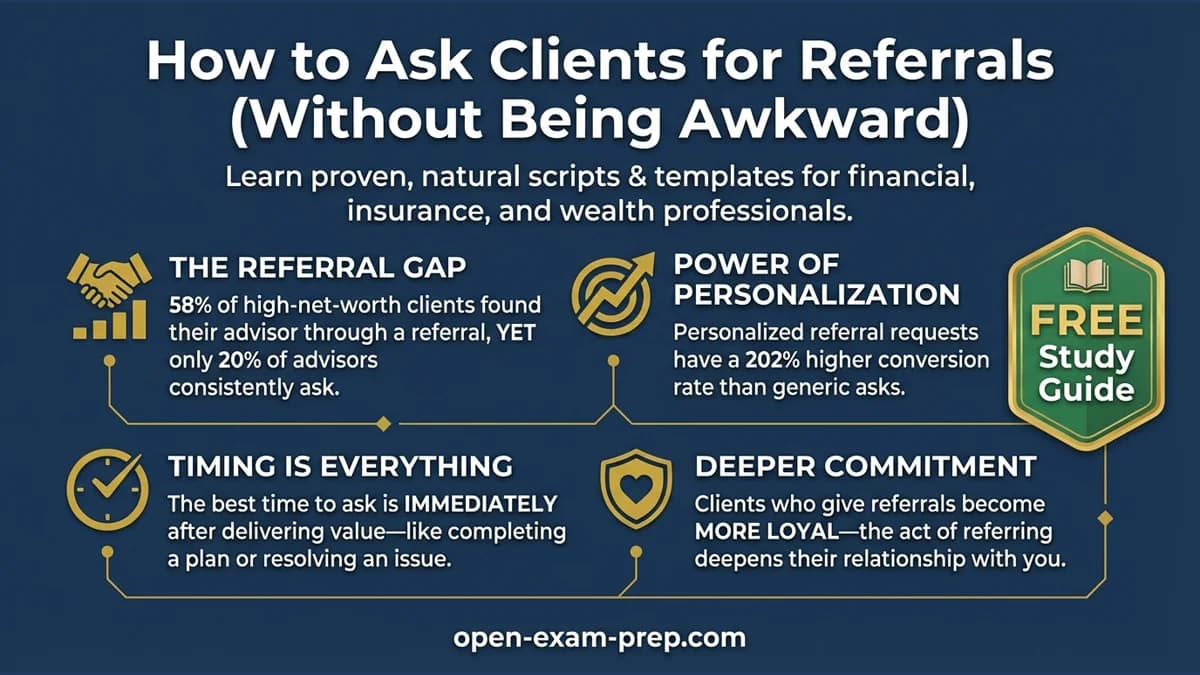
Here's a surprising statistic: 58% of high-net-worth clients found their financial advisor through a referral. Yet only 20% of advisors consistently ask for referrals.
That gap represents an enormous missed opportunity.
Referral-based clients:
- Trust you faster (they're pre-sold by someone they trust)
- Stay longer (16% higher lifetime value)
- Refer more (they understand referral culture)
The problem? Most advisors don't ask because they're afraid of being awkward, pushy, or damaging the relationship.
This guide gives you word-for-word scripts that feel natural, not salesy.
The Psychology of Referrals
Why Clients Don't Refer (Even When They're Happy)
It's not that clients don't want to help. They don't refer because:
- They don't think of it - Their life is busy
- They don't know who needs you - Too vague a request
- They're not sure how to introduce you - Needs a bridge
- They worry about the friend's reaction - Risk to their relationship
Your job is to solve all four of these problems.
The Referral Mindset Shift
❌ Old mindset: "I need clients. Can you send me people?"
✅ New mindset: "I help people like you. Who else can I help?"
This shift changes everything. You're not asking for a favor—you're offering to extend your value to their network.
When to Ask for Referrals (Timing Is Everything)
The Best Moments to Ask
| Moment | Why It Works |
|---|---|
| After completing their financial plan | They see your value clearly |
| After resolving a problem | You just proved yourself |
| When they say "thank you" or give a compliment | They're already in appreciation mode |
| After a positive annual review | They see the results |
| After a life event (new baby, home purchase) | They're talking to friends about it |
When NOT to Ask
- During market downturns when they're anxious
- When delivering bad news
- When they have unresolved complaints
- During your first few meetings
- When they seem distracted or rushed
7 Proven Referral Scripts
Script 1: The Direct Ask (After Positive Feedback)
Trigger: Client says "Thank you for everything" or "You've been so helpful"
You: "I really appreciate you saying that. It means a lot to me.
Can I ask you something? My practice grows almost entirely through referrals from clients like you. Is there anyone in your life—maybe a colleague, family member, or friend—who might be in a similar situation to when you first came to me? I'd love to help them the way I've helped you."
Why it works: You've anchored to their positive experience and made a specific, easy-to-answer request.
Script 2: The "Second Opinion" Approach
Trigger: During an annual review meeting
You: "I'm glad we had this time to review your progress. Before we wrap up, I wanted to mention something.
Recently, a few of my clients have introduced me to friends who wanted a second opinion on their financial situation. No pressure, no commitment—just a fresh perspective.
Do you know anyone who might appreciate that kind of conversation?"
Why it works: "Second opinion" is low commitment and positions you as helpful, not pushy.
Script 3: The Specific Situation Ask
Trigger: Any meeting with a satisfied client
You: "I've been thinking about who I can best help next. My ideal clients are [specific description—e.g., "tech executives navigating equity compensation" or "couples within 5 years of retirement"].
Does anyone come to mind when I describe that?"
Why it works: Specific criteria help clients actually think of someone, rather than drawing a blank.
Script 4: The Casual Introduction
Trigger: Client mentions a friend in passing
You: "It sounds like your friend Sarah is going through something similar to what you experienced a few years ago.
Would it make sense for the three of us to grab coffee? No agenda—I'd just enjoy meeting her and hearing about her situation. If I can help, great. If not, no problem."
Why it works: You're creating a social connection, not a sales pitch. Low pressure, high warmth.
Script 5: The Advisory Request
Trigger: With your best, most engaged clients
You: "Can I get your advice on something?
You've been a client for [X years] and you really understand what I do. If you were me, trying to connect with more people like yourself—people who [care about X, are in Y situation, value Z]—what would you do?
How would you go about it?"
Why it works: Asking for advice flatters people and often naturally leads them to offer introductions.
Script 6: The Email Follow-Up
Trigger: After a positive meeting, as a follow-up
Subject: Quick thought from our meeting
Email body:
Hi [Name],
I enjoyed our conversation yesterday. It's always great to see the progress you're making toward [specific goal].
I had a thought: if you know anyone—a friend, colleague, or family member—who's dealing with [specific situation], I'd be happy to offer them a complimentary consultation. No obligation, just a chance to help.
Feel free to share my contact info, or if you'd prefer, just reply with their name and email and I'll reach out directly.
Either way, thank you for being such a great client.
Best, [Your name]
Why it works: Written requests are lower pressure and give clients time to think of someone.
Script 7: The Event-Based Ask
Trigger: You're hosting an educational event or webinar
You: "I'm hosting a workshop on [topic] next month. It's designed for people who [specific audience description].
I'd love to invite two or three people you think might find it valuable. Who comes to mind?"
Why it works: You're offering value (education) and making it easy to take action (bring someone to an event).
📘 Want to practice these scripts? Our free Client Conversations Mastery course includes AI-powered roleplay so you can practice asking for referrals before real client meetings.
The Referral Follow-Up System
Getting a referral is just the beginning. Here's how to maximize every introduction:
Step 1: Thank the Referrer Immediately
Send a handwritten note or personal text within 24 hours:
"Thank you so much for connecting me with [name]. I really appreciate your confidence in me. I'll take great care of them."
Step 2: Reach Out to the Referral Promptly
Contact the referred person within 48 hours while the connection is fresh:
"Hi [Name], [Referrer] suggested I reach out. They thought we might have some common ground, and I'd love to learn more about your situation. Would you be open to a brief call?"
Step 3: Keep the Referrer Updated
Close the loop with your original client:
"I met with Sarah last week—thank you again for the introduction. We had a great conversation and I think I'll be able to help her. She's in good hands, and I'll keep you posted."
Step 4: Recognize Consistently
For clients who refer regularly, show consistent appreciation:
- Handwritten thank-you notes
- Holiday gifts (compliant ones)
- Priority scheduling
- Special recognition
Common Mistakes to Avoid
Mistake 1: Being Too Generic
❌ "Do you know anyone who could use my services?"
✅ "Do you know anyone who's recently gone through a divorce and needs help reorganizing their finances?"
Mistake 2: Asking Too Early
Build the relationship first. Earn the right to ask by delivering exceptional value.
Mistake 3: Only Asking Once
Referrals should be a regular part of your client conversations, not a one-time request.
Mistake 4: Not Making It Easy
Give clients specific language and a clear path:
"You can just forward my email to them" or "I can send you a calendar link to share"
Mistake 5: Forgetting to Say Thank You
Always, always thank people for referrals—whether or not they become clients.
Tracking Your Referral Success
Metrics to Monitor
| Metric | Target |
|---|---|
| Referral requests made per month | 10-20 |
| Referral conversion rate | 50%+ |
| Referred clients as % of new clients | 40-60% |
| Thank you notes sent | 100% of referrals |
Simple Tracking System
Create a simple spreadsheet:
| Client Name | Date Asked | Referral Name | Contacted? | Status | Thank You Sent? |
|---|---|---|---|---|---|
| John Smith | 12/15 | Mary Johnson | ✅ | Meeting scheduled | ✅ |
Practice These Scripts
Reading scripts isn't enough—you need to practice until they feel natural.
Practice Exercise 1: Mirror Practice
Say each script out loud in front of a mirror. Watch your facial expressions and body language.
Practice Exercise 2: Roleplay with a Colleague
Take turns being the advisor and client. Practice handling different responses.
Practice Exercise 3: Record Yourself
Listen to how you sound. Are you too rushed? Too formal? Adjust accordingly.
Master Client Conversations
Asking for referrals is just one skill in the client relationship toolkit. Our Client Conversations Mastery course covers the full client lifecycle:
- Getting the meeting - Cold calling and prospecting scripts
- Discovery conversations - Questions that uncover real needs
- Handling objections - Scripts for every common pushback
- Closing the business - Moving from conversation to commitment
- Referrals & follow-up - Building a sustainable referral engine
Each module includes AI-powered roleplay practice so you can build confidence before real client conversations.
Your 30-Day Referral Challenge
Week 1: Prepare
- Choose 2-3 scripts that feel natural to you
- Practice them until they're conversational
- Identify 10 clients who might refer
Week 2-3: Ask
- Ask at least 5 clients for referrals
- Note what works and what doesn't
- Adjust your approach based on feedback
Week 4: Systematize
- Set up tracking system
- Create thank-you note templates
- Schedule referral asks in your meeting prep
The Bottom Line
Referrals aren't about being salesy—they're about extending the value you provide to more people. Your satisfied clients want to help their friends and family, but they need you to make it easy for them.
Start with one script. Practice it. Use it in your next client meeting.
The advisors who grow fastest aren't necessarily the best at their craft—they're the ones who consistently ask for referrals in a way that feels natural and helpful.
Your challenge: Ask for one referral this week. Just one. See how it feels.
You might be surprised how easy it is.


 Buy on Amazon
 Prep course on Achievable
 Online course on Mometrix
 Take courses on Udemy

 Practice exams on ExamEdge