Study for Your Nursing Exam Between Shifts
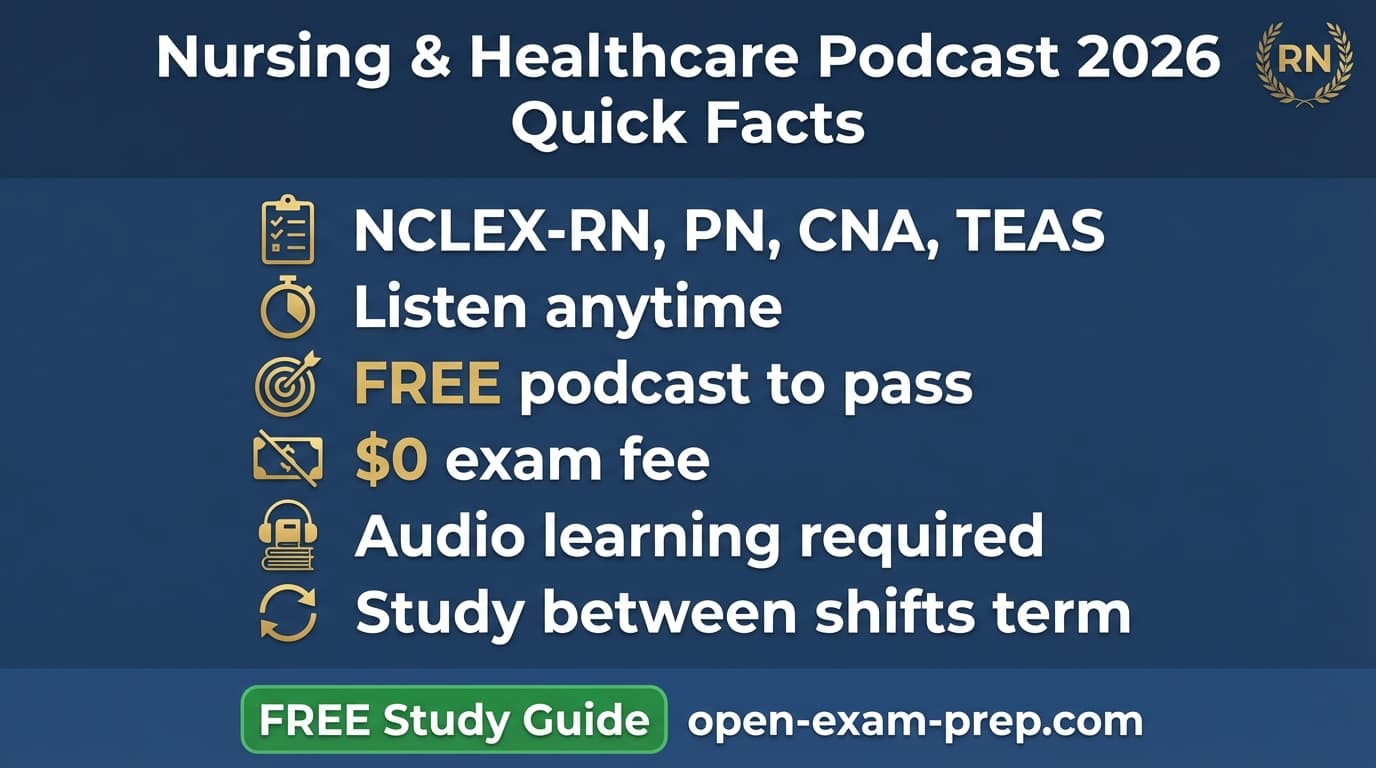
Nursing students and aspiring nurses are busy. Between clinicals, classes, work, and life—finding study time is hard. The free Open Exam Prep Nursing & Healthcare Podcast lets you study during commutes, while meal prepping, or during any downtime.
Why Audio Learning Works for Nursing Exams
You're Already Exhausted
After a 12-hour clinical shift or a full day of classes, the last thing you want to do is sit down with a textbook. Audio learning lets you:
- Study during your commute home
- Review concepts while making dinner
- Reinforce learning during your morning routine
- Learn passively when you're too tired to read
Nursing Exams Test Understanding, Not Memorization
The NCLEX isn't about memorizing facts—it's about applying nursing judgment. The podcast helps you:
- Understand WHY things work the way they do
- Connect concepts across body systems
- Think through clinical scenarios
- Develop the reasoning skills NCLEX tests
What the Podcast Covers
NCLEX-RN & NCLEX-PN Topics
| Category | Topics Covered |
|---|---|
| Safe & Effective Care | Management, safety, infection control |
| Health Promotion | Growth/development, prevention, wellness |
| Psychosocial | Coping, mental health, therapeutic communication |
| Physiological | Body systems, pharmacology, nutrition |
TEAS Exam Topics
| Section | Topics Covered |
|---|---|
| Reading | Comprehension, inference, text structure |
| Math | Arithmetic, algebra, measurement, data |
| Science | A&P, biology, chemistry, scientific reasoning |
| English | Grammar, vocabulary, sentence structure |
CNA Exam Topics
| Area | Topics Covered |
|---|---|
| Basic Care | ADLs, hygiene, mobility, nutrition |
| Safety | Infection control, fall prevention, emergency response |
| Communication | Patient rights, documentation, reporting |
| Clinical Skills | Vital signs, positioning, transfers |
Study Strategies by Exam
For NCLEX-RN/PN
The NCLEX uses Computer Adaptive Testing (CAT)—questions get harder as you answer correctly. Here's how to prepare:
Week 1-2: Content Review
Listen to podcast episodes covering your weak areas. If you struggled with pharmacology in school, focus there first.
Week 3-4: Application Practice
Take NCLEX-style practice questions after each podcast episode:
Week 5-6: Test Strategies
Listen to episodes on prioritization, delegation, and NCLEX-specific strategies. These test-taking skills are critical.
For TEAS
| Study Phase | Podcast Focus | Practice Focus |
|---|---|---|
| Week 1 | Science (A&P) | TEAS Science Practice → |
| Week 2 | Math concepts | TEAS Math Practice → |
| Week 3 | Reading & English | TEAS Practice → |
| Week 4 | Full review | Full TEAS Practice → |
For CNA
CNA exams have written and skills components. The podcast helps with written exam concepts. Use our practice questions for skills scenarios:
Free Practice Questions
Pair the podcast with free practice questions on your target exam:
| Exam | Pass Rate | Free Practice |
|---|---|---|
| NCLEX-RN | 87% (first-time, US) | Start NCLEX-RN Practice → |
| NCLEX-PN | 84% (first-time, US) | Start NCLEX-PN Practice → |
| CNA | Varies by state | Start CNA Practice → |
| TEAS | ~60% achieve "Proficient" | Start TEAS Practice → |
Pharmacology: The #1 Weak Area
Pharmacology is consistently the most challenging area for nursing students. The podcast covers:
Drug Categories You Must Know
- Cardiac drugs: Beta blockers, ACE inhibitors, antiarrhythmics
- Antibiotics: Penicillins, cephalosporins, fluoroquinolones
- Pain management: Opioids, NSAIDs, adjuvants
- Psych meds: SSRIs, antipsychotics, mood stabilizers
- Endocrine: Insulin types, thyroid medications
Memory Tips from the Podcast
- Drug names ending in "-olol" = beta blockers
- Drug names ending in "-pril" = ACE inhibitors
- Drug names ending in "-statin" = cholesterol medications
- Drug names ending in "-pam" or "-lam" = benzodiazepines
For a deep dive, check out our pharmacology guide: NCLEX Pharmacology Guide →
Where to Listen
The Nursing & Healthcare Exam Prep Podcast is available on all platforms:
- Spotify - Listen on Spotify
- Apple Podcasts - Listen on Apple Podcasts
- YouTube - Watch on YouTube
Download episodes for offline listening during clinicals or in hospital dead zones with no cell service.
When to Study: A Realistic Schedule
Nursing students don't have 8-hour study days. Here's a realistic approach:
| Time Slot | Activity | Study Method |
|---|---|---|
| Morning commute | 20-30 min | Podcast (new content) |
| Lunch break | 15 min | Practice 10 questions |
| Evening commute | 20-30 min | Podcast (review) |
| Before bed | 15 min | Review missed questions |
| Daily total | 70-90 min | Distributed learning |
This adds up to 8-10+ hours per week without blocking off "study time."
Need Help? Ask the AI Tutor
Confused about a concept from the podcast? Our free AI tutor can explain any nursing topic:
Try asking:
- "Explain the difference between Type 1 and Type 2 diabetes"
- "What are the signs of digoxin toxicity?"
- "How do I prioritize using the ABCs?"
- "Explain the nursing process steps"
Free for 10 questions per day.
Start Your Nursing Exam Prep Today
- Subscribe to the podcast on Spotify
- Practice with free questions for your exam:
- Ask the AI when you need concepts explained
All free. You've already invested so much in nursing school—exam prep shouldn't break the bank.
Add This Clinical Review Layer Before Test Day
Use the final stretch for decision quality, not just more exposure to facts. Start each study block for Free Nursing & Healthcare Exam Podcast (2026): NCLEX-RN, NCLEX-PN, CNA, TEAS Audio Study Guide by naming the task the question is really testing: recognition, prioritization, safety, communication, documentation, or workflow. Healthcare exams often hide the correct answer behind a familiar detail, so the safest habit is to pause before reading the options and predict what a competent entry-level professional would do next. That prediction keeps you from chasing the option that sounds medically interesting but does not answer the actual patient-care problem.
Build a small error log with four columns: missed topic, missed cue, correct rule, and next drill. A missed cue is more useful than a broad content label. For example, do not only write cardiovascular, infection control, medication safety, specimen handling, imaging, or professional practice. Write the actual cue you ignored: unstable finding, contraindication, timing before a procedure, patient identification, scope boundary, chain of custody, isolation wording, or documentation sequence. Review that log every two or three days and convert repeated misses into short practice sets.
Official-Source Check
Before relying on any third-party outline, compare your plan with the official exam owner site. Official pages and candidate handbooks are the place to confirm current eligibility language, testing vendor instructions, identification rules, rescheduling policies, accommodations steps, and any content outline changes. You do not need to memorize administrative details for every practice question, but you do need to avoid preparing from an outdated blueprint or an old retake policy. If a handbook uses different domain names than your notes, rename your notes to match the handbook so your remediation stays aligned with the exam owner.
Scenario Strategy for Clinical and Administrative Questions
Read healthcare scenarios in this order: setting, role, patient or client status, time pressure, and requested action. The role matters because many distractors are clinically reasonable but outside the expected scope for the candidate. A nursing, allied health, pharmacy, laboratory, imaging, respiratory, compliance, or management exam may ask what should be done first, what should be reported, what should be documented, or what should be delegated. Those verbs change the answer. Highlight them in practice even if the real test interface does not let you mark text the same way.
When two options both look correct, choose the one that best protects the patient, preserves specimen or data integrity, follows policy, or escalates an unsafe condition. Avoid answers that skip assessment, skip identification, skip hand hygiene or privacy safeguards, give education before immediate safety is addressed, or perform a task that belongs to another licensed professional. For management and compliance exams, translate clinical safety into system safety: risk identification, incident response, documentation, auditing, corrective action, and communication with the right stakeholder.
Practice Routing After Each Score Report
Do not retake full-length practice exams until you know what the previous one taught you. After each set, sort misses into three groups. Knowledge misses need a short content review and then ten targeted questions. Reasoning misses need rationales: write why the correct answer is safer or more aligned with the role than your answer. Speed misses need shorter timed sets, not another full review chapter.
In the last week, keep practice mixed. Real exam questions rarely announce the domain, and mixed sets force you to choose between similar procedures, symptoms, lab clues, safety steps, and communication tasks. End each day with a brief review of high-yield normal findings, urgent findings, infection prevention, medication or equipment safety, and professional boundaries that appear in your own missed-question history. The goal is not to feel as if every topic is finished. The goal is to enter the exam with a repeatable method for unfamiliar cases: identify the role, find the safety issue, rule out unsafe shortcuts, and choose the action that a careful professional could defend.

 Buy on Amazon
 Practice exams on ExamEdge
 Take courses on Udemy
 Flashcards on Mometrix