Study for Your Real Estate License Anywhere
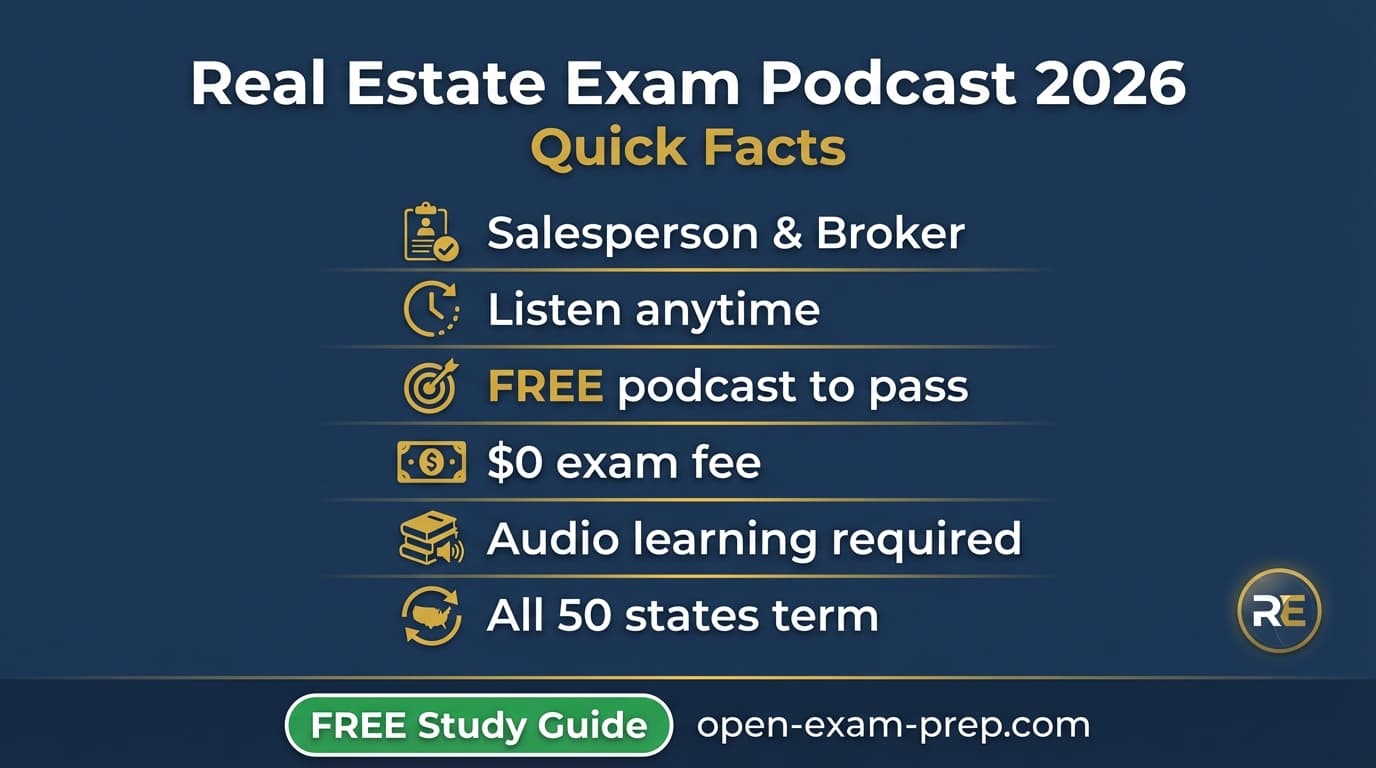
Getting your real estate license? The free Open Exam Prep Real Estate Podcast lets you turn drive time, open house downtime, and daily commutes into productive study sessions.
Why Audio Learning is Perfect for Real Estate
You're Already Mobile
Real estate is a mobile profession. Even before you're licensed, you're likely:
- Driving to pre-licensing classes
- Attending open houses to learn
- Meeting with potential brokerages
- Running errands between activities
The podcast turns all this time into study time.
Real Estate Exams Are Concept-Heavy
Unlike math exams, real estate tests focus on:
- Legal concepts and definitions
- Contract provisions and requirements
- Fair housing rules and protected classes
- Agency relationships and duties
These topics are ideal for audio learning—you can absorb and review them without needing to write anything down.
What the Podcast Covers
Property Ownership & Transfer
| Topic | Key Concepts |
|---|---|
| Ownership Types | Fee simple, life estate, joint tenancy, tenancy in common |
| Legal Descriptions | Metes and bounds, lot and block, government survey |
| Transfer Methods | Deeds, wills, adverse possession, eminent domain |
| Title Issues | Encumbrances, liens, easements, restrictions |
Contracts & Agency
| Topic | Key Concepts |
|---|---|
| Contract Elements | Offer, acceptance, consideration, legal purpose |
| Agency Types | Seller's agent, buyer's agent, dual agency, transaction broker |
| Duties | Loyalty, disclosure, confidentiality, obedience, accounting |
| Listing Agreements | Exclusive right to sell, exclusive agency, open listing |
Financing & Fair Housing
| Topic | Key Concepts |
|---|---|
| Mortgage Types | Conventional, FHA, VA, USDA |
| Loan Terms | LTV, DTI, points, APR, amortization |
| Fair Housing | Protected classes, exemptions, violations, penalties |
| Closing | TRID disclosures, prorations, settlement statements |
Study Strategy: Podcast + Practice Questions
The Driving Study Method
Real estate agents spend a lot of time driving. Here's how to maximize it:
Morning Drive (Going to showings)
Listen to new podcast episodes on topics you haven't studied yet. Focus on understanding concepts.
Evening Drive (Heading home)
Re-listen to episodes from earlier in the week. Repetition builds retention.
At Open Houses (Slow periods)
Take practice questions on the topics you've been listening to:
Sample Study Week
| Day | Podcast Topic | Practice Focus |
|---|---|---|
| Mon | Property Ownership | Ownership types, estates |
| Tue | Contracts | Elements, breach, remedies |
| Wed | Agency Relationships | Duties, disclosures |
| Thu | Financing | Mortgages, qualifying |
| Fri | Fair Housing | Protected classes, violations |
| Sat | Full practice exam | Take Practice Exam → |
Free Practice Questions by State
Real estate exams have state-specific sections. We offer free practice for all 50 states:
Most Popular States
| State | Practice Link | Exam Provider |
|---|---|---|
| California | CA Real Estate → | DRE |
| Texas | TX Real Estate → | TREC/Pearson VUE |
| Florida | FL Real Estate → | Pearson VUE |
| New York | NY Real Estate → | DOS |
| National | All States → | PSI/Pearson VUE |
Also Available
Georgia, Arizona, North Carolina, Illinois, Ohio, Michigan, Pennsylvania, Virginia, and all other states.
Where to Listen
The Real Estate Exam Prep Podcast is available everywhere:
- Spotify - Listen on Spotify
- Apple Podcasts - Listen on Apple Podcasts
- YouTube - Watch on YouTube
Download episodes for offline listening during showings or in areas with poor cell service.
Real Estate Math: The One Area Where Podcast Isn't Enough
Real estate exams include math questions on:
- Commission calculations
- Prorations (taxes, rent, interest)
- Loan qualifying (LTV, DTI)
- Property valuation (GRM, cap rate)
For math, you need to practice on paper. The podcast explains concepts, but you must work through calculations. Use our blog:
Common Questions About Real Estate Licensing
"How hard is the real estate exam?"
Pass rates average 50-60% on the first attempt. It's not extremely difficult, but it covers a lot of material. Most failures result from:
- Not taking it seriously (it's not "just a license")
- Relying only on pre-licensing class materials
- Not practicing with realistic questions
The podcast + practice question combination addresses all three.
"How long should I study?"
Most successful candidates study 40-80 hours over 2-4 weeks after completing their pre-licensing course. Using the podcast during daily activities can add 10-15 hours weekly without dedicated desk time.
"Should I get my salesperson or broker license first?"
In most states, you must work as a salesperson for 1-3 years before qualifying for a broker license. Start with the salesperson exam—that's what this podcast primarily covers.
Need Help? Ask the AI Tutor
Confused about a topic from the podcast? Our free AI tutor can explain any real estate concept:
Try asking:
- "What's the difference between joint tenancy and tenancy in common?"
- "Explain the duties a listing agent owes to the seller"
- "How do I calculate a buyer's maximum loan amount?"
Free for 10 questions per day.
Start Your Real Estate Exam Prep Today
- Subscribe to the podcast on Spotify
- Practice with free real estate questions
- Ask the AI when you need concepts explained
All free. No credit card. Get licensed faster.
How to Apply This Real Estate Exam Podcast (2026): Salesperson & Broker License Audio Study Guide Guide to Your Own State Exam
Use this guide as a practice framework, then connect it to the candidate bulletin for the state where you are getting licensed. Real estate exams share a national foundation, but states differ in licensing agency procedure, application timing, broker sponsorship, education hours, retake rules, allowed calculators, and state-law emphasis. The safest study plan is to learn the national concept here, then ask how your state tests that same concept.
For every topic, create three lines in your notes. The first line is the general rule. The second line is a short example from a transaction. The third line is the state-specific variation you need to verify. For example, a contracts topic might start with offer, acceptance, consideration, capacity, and legality; the transaction example might involve a buyer missing a contingency deadline; the state line might note a required disclosure form, agency notice, or licensing rule. This three-line method prevents shallow memorization and makes practice questions easier to review.
Practice Routing for Better Scores
Do not treat all missed questions equally. A missed definition needs flashcards. A missed scenario needs rule application. A missed math item needs setup practice. A missed state-law question needs official-source verification. A missed reading question needs slower annotation of the stem. If you put every miss into one pile, your study plan becomes vague and your score stalls.
After each practice set, write the rule that would let you answer the question next time without seeing the choices. Then write why the best wrong answer was wrong. Real estate exams often use answer choices that are partly true but incomplete, true in another context, or true for the wrong party. Learning to reject those choices is as important as memorizing the correct rule.
How to Use Audio Review Without Letting It Replace Practice
A real estate exam podcast is best used for repetition, vocabulary, and issue spotting. It is not a substitute for timed questions because the exam tests recognition and application under pressure. Use audio when you are commuting, walking, or doing light review, then convert what you heard into active practice later the same day. If an episode explains agency duties, take a ten-question agency set afterward. If it reviews math, work problems with a calculator. If it covers contracts, write down the elements and then answer scenario questions.
Keep an audio mistake log. When an episode mentions a term you cannot define quickly, pause and write it down. Later, add the term to your flashcards or study notes with one example. Good audio review should make your weak topics visible. If you only listen passively, familiar phrases may create false confidence without improving your score.
For state-specific exams, pair podcast review with your state candidate bulletin and study guide. National audio can help with ownership, agency, contracts, finance, valuation, transfer, land use, and math, but it will not replace state rules on licensing, supervision, disclosures, advertising, trust money, retakes, or renewal. Route those topics to the relevant OpenExamPrep state guide and practice sets before test day.

 Buy on Amazon
 Study guide on Mometrix
 Take courses on Udemy
 Pre-licensing on Colibri
 MLO pre-licensing on Aceable Mortgage