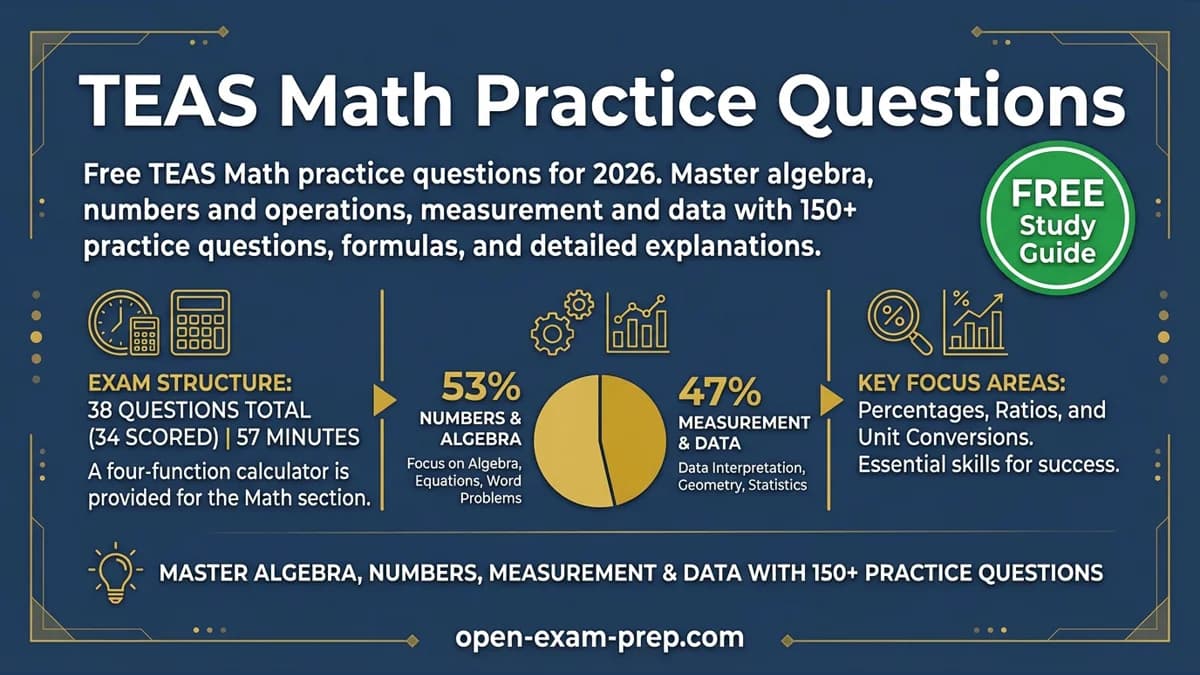
TEAS 7 Math Practice Questions 2026: Master the Math Section
The ATI TEAS 7 Math section is the part of the nursing-school entrance exam most candidates fear most -- not because the math is advanced, but because you have to set up real-world nursing problems quickly and accurately. This guide gives you free worked practice questions for every TEAS math topic, the exact section format straight from ATI, the formulas worth memorizing, and a study plan that actually moves your score. Every example below shows the full step-by-step solution.
Start the FREE TEAS Math practice test -> -- 100+ questions, instant explanations, no signup.
TEAS 7 Math Section Format (2026)
The Mathematics section is the second of the four TEAS 7 sections. Here is exactly how it is built, per the official ATI exam blueprint:
| Sub-content area | Scored questions | Share of scored math |
|---|---|---|
| Numbers and Algebra | 18 | ~53% |
| Measurement and Data | 16 | ~47% |
| Scored total | 34 | 100% |
| Unscored (pretest) | 4 | not counted |
| Questions on screen | 38 | -- |
- Total questions: 38 (34 scored + 4 unscored pretest items mixed in -- you cannot tell which are which)
- Time allowed: 57 minutes (about 1.5 minutes per question)
- Calculator: A basic four-function on-screen calculator IS provided (add, subtract, multiply, divide). You cannot bring your own.
- Format: Multiple choice, plus a few fill-in-the-blank (numeric entry) items
The two sub-areas are weighted roughly 53% / 47%, so spend slightly more prep time on Numbers and Algebra -- but do not neglect Measurement and Data, where unit conversions trip up the most candidates.
Numbers and Algebra (18 scored questions)
This sub-area covers arithmetic, fractions, decimals, percentages, ratios, proportions, and solving linear equations. Work each example before reading the solution.
Order of Operations
Q1. Solve: 3 + 4 x 2 - 8 / 4
Solution (PEMDAS):
- Multiply: 4 x 2 = 8
- Divide: 8 / 4 = 2
- Left to right: 3 + 8 - 2 = 9
Answer: 9 -- The trap is adding 3 + 4 first; multiplication and division always come before addition and subtraction.
Fractions
Q2. Add: 2/3 + 3/4
Solution:
- Least common denominator of 3 and 4 is 12
- Convert: 2/3 = 8/12 and 3/4 = 9/12
- Add numerators: 8/12 + 9/12 = 17/12
- Simplify to a mixed number: 17/12 = 1 5/12
Answer: 1 5/12 (or 17/12)
Percentages
Key formulas:
- Part = Whole x Percent (as a decimal)
- Percent = Part / Whole x 100
- Percent change = (New - Old) / Old x 100
Q3. A hospital unit had 250 patients. If 80% were discharged, how many were discharged?
Solution: 250 x 0.80 = 200
Answer: 200 patients
Q4 (percent change). A patient's weight dropped from 80 kg to 72 kg. What was the percent decrease?
Solution: (72 - 80) / 80 x 100 = -8 / 80 x 100 = -10%
Answer: a 10% decrease
Ratios and Proportions
Q5. A medication is mixed at a 1:4 ratio of drug to total solution. How many mL of drug are in 20 mL of solution?
Solution: A 1:4 ratio here means 1 part drug for every 4 parts total. Set up the proportion 1/4 = x/20, cross-multiply: 4x = 20, so x = 5 mL.
Answer: 5 mL -- Read ratio wording carefully: "1 part to 4 parts total" differs from "1 part to 4 parts of something else." On the TEAS, the stated total is your denominator.
Solving Equations
Q6. Solve for x: 3x + 7 = 22
Solution:
- Subtract 7 from both sides: 3x = 15
- Divide both sides by 3: x = 5
Answer: x = 5
Word Problems
Q7. A nurse works 36 hours per week at $28/hour. What is her weekly gross pay?
Solution: 36 x $28 = $1,008
Answer: $1,008
Measurement and Data (16 scored questions)
This sub-area covers unit conversions, measurement, geometry basics, and interpreting data (tables, graphs, mean/median/mode). Conversions are the single highest-yield skill here.
Unit Conversions
Metric conversions:
| Conversion | Value |
|---|---|
| 1 kg | 1,000 g |
| 1 L | 1,000 mL |
| 1 m | 100 cm |
| 1 cm | 10 mm |
US / household / metric conversions:
| Conversion | Value |
|---|---|
| 1 inch | 2.54 cm |
| 1 kg | 2.2 lb |
| 1 oz | 30 mL |
| 1 tsp | 5 mL |
| 1 tbsp | 15 mL |
| 1 cup | 240 mL |
Q8. Convert 150 pounds to kilograms (1 kg = 2.2 lb).
Solution: Divide by 2.2 because kilograms are the larger unit: 150 / 2.2 = 68.2 kg
Answer: 68.2 kg -- Decide direction first: going from a smaller unit (lb) to a larger unit (kg) means the number gets smaller, so you divide.
Time Calculations
Q9. A medication is due every 8 hours. If the first dose was at 6:00 AM, when are the next two doses?
Solution:
- Dose 1: 6:00 AM
- Dose 2: 6:00 AM + 8 h = 2:00 PM
- Dose 3: 2:00 PM + 8 h = 10:00 PM
Answer: 2:00 PM and 10:00 PM
Data Interpretation
Know the difference: mean = average, median = middle value when ordered, mode = most frequent value.
Q10 (mean). Find the mean of: 72, 85, 90, 78, 85.
Solution: (72 + 85 + 90 + 78 + 85) / 5 = 410 / 5 = 82
Answer: 82
Q11 (median and mode). For the same data set 72, 78, 85, 85, 90, find the median and the mode.
Solution: Ordered, the middle value is 85 (median). The value that appears most often is 85 (mode).
Answer: median = 85, mode = 85
Geometry Basics
Area formulas:
- Rectangle: A = length x width
- Triangle: A = 1/2 x base x height
- Circle: A = pi x r squared
Q12. Find the area of a rectangle with length 8 cm and width 5 cm.
Solution: A = 8 x 5 = 40
Answer: 40 square cm
Harder TEAS Math Questions (the ones most people miss)
These mirror the trickiest items on the real exam -- multi-step conversions and dosage-style reasoning. Try them before checking the worked solutions.
Q13 (multi-step ratio). A solution is mixed at a 1:250 ratio of drug to solution. How much drug is in 1,000 mL?
Solution: 1/250 = x/1000 -> 250x = 1000 -> x = 4 mL.
Answer: 4 mL
Q14 (concentration / dosage). A drug is supplied at 250 mg per 5 mL. How many mL deliver a 400 mg dose?
Solution: Use Desired / Have x Quantity: 400 / 250 x 5 = 1.6 x 5 = 8 mL.
Answer: 8 mL
Q15 (IV rate / time). An IV runs at 125 mL/hour. How long to infuse 1,000 mL?
Solution: Time = Volume / Rate = 1000 / 125 = 8 hours.
Answer: 8 hours
Q16 (temperature conversion). Convert 98.6 degrees F to Celsius using C = (F - 32) x 5/9.
Solution: (98.6 - 32) x 5/9 = 66.6 x 5/9 = 333 / 9 = 37.
Answer: 37 degrees C
Essential TEAS Math Formulas
Must-know formulas
| Formula | Use |
|---|---|
| Distance = Rate x Time | Rate word problems |
| Percent = Part / Whole x 100 | Percent questions |
| Percent change = (New - Old) / Old x 100 | Increase/decrease |
| Mean = Sum / Count | Statistics |
| Perimeter = 2L + 2W | Rectangle |
| Area = L x W | Rectangle |
| Area = 1/2 x b x h | Triangle |
| Circumference = 2 x pi x r | Circle |
| Area = pi x r squared | Circle |
| C = (F - 32) x 5/9 | Fahrenheit to Celsius |
Nursing-style calculations
| Calculation | Formula |
|---|---|
| Dosage | Desired / Have x Quantity |
| IV rate (time) | Volume / Rate |
| BMI | Weight (kg) / Height squared (m) |
Calculator Strategy for the TEAS
A basic four-function on-screen calculator is provided on the Math section -- add, subtract, multiply, divide only. There is no exponent, square-root, or fraction key, so plan around its limits.
Use the calculator for:
- Multi-digit multiplication and division
- Decimal arithmetic (e.g., 150 / 2.2)
- Verifying a result before you commit
Do it in your head for:
- Simple arithmetic and times tables (faster than typing)
- Recognizing benchmark fractions (1/4 = 25%, 1/2 = 50%)
- Estimating to rule out wrong answer choices first
Calculator gotchas: convert mixed numbers to improper fractions or decimals before entering them, and key in the full order of operations yourself -- the four-function calculator does not apply PEMDAS for you.
Common TEAS Math Mistakes to Avoid
- Order of operations -- multiply and divide before you add and subtract; go left to right within the same level.
- Conversion direction -- decide whether the number should get bigger or smaller before you multiply or divide.
- Decimal placement -- line up decimals for addition/subtraction; count total decimal places for multiplication.
- Ratio wording -- "1 part to 4 parts total" is not the same as "1:4 of drug to water." Match your denominator to the stated total.
- Answering the wrong thing -- the question may ask for the leftover, the percent, or the unit you did not solve for. Re-read the final sentence.
How to Study for TEAS Math (4-Step Plan)
1. Diagnose first. Take a timed free TEAS Math practice test to find your weakest of the six topic clusters: percents, ratios, conversions, algebra, geometry, data.
2. Fix one cluster at a time. Review the rule, then do 10-15 targeted questions on just that topic until you are consistently right -- not just "I get it when I see the answer."
3. Build a miss log. For every wrong answer write the topic, the exact cue you missed, the correct rule, and one drill to repeat. Patterns appear fast.
4. Go timed and mixed. In the final week, do mixed 38-question sets in 57 minutes so you practice switching topics and pacing -- the real test never tells you which topic is coming.
For the full blueprint across all four sections, see our TEAS 7 study guide and the structured TEAS study guide hub.
Quick Reference: Number Properties
Prime numbers (under 50): 2, 3, 5, 7, 11, 13, 17, 19, 23, 29, 31, 37, 41, 43, 47
Perfect squares: 1, 4, 9, 16, 25, 36, 49, 64, 81, 100
Fraction / decimal / percent equivalents:
| Fraction | Decimal | Percent |
|---|---|---|
| 1/2 | 0.5 | 50% |
| 1/3 | 0.333 | 33.3% |
| 1/4 | 0.25 | 25% |
| 1/5 | 0.2 | 20% |
| 1/10 | 0.1 | 10% |
Frequently Asked Questions
How many math questions are on the TEAS 7?
The Math section has 38 questions total: 34 scored and 4 unscored pretest items. You get 57 minutes, which is about 1.5 minutes per question.
Is a calculator allowed on TEAS Math?
Yes. A basic four-function on-screen calculator (add, subtract, multiply, divide) is provided during the Mathematics section. You cannot bring your own.
What math is on the TEAS?
Two sub-areas: Numbers and Algebra (18 scored) -- arithmetic, fractions, percents, ratios, basic algebra; and Measurement and Data (16 scored) -- unit conversions, geometry, and statistics.
Is TEAS Math hard?
No advanced math is tested -- no trigonometry or calculus. The challenge is speed and setting up word problems correctly, which targeted practice fixes quickly.
How can I improve my TEAS Math score fast?
Drill percentages, ratios, and unit conversions first -- they appear most often. Take timed mixed practice sets and keep a miss log so you stop repeating the same errors.
Start Your TEAS Math Practice Today
Your free OpenExamPrep toolkit includes:
- 100+ TEAS Math practice questions with step-by-step solutions
- An AI tutor that explains any problem (10 free questions a day)
- Formula reference and progress tracking
- Full-section TEAS practice across all four areas
Master TEAS Math one topic at a time, then prove it on a timed set.
Add This Clinical Review Layer Before Test Day
Use the final stretch for decision quality, not just more exposure to facts. Start each study block for 150+ FREE TEAS Math Practice Questions 2026 by naming the task the question is really testing: recognition, prioritization, safety, communication, documentation, or workflow. Healthcare exams often hide the correct answer behind a familiar detail, so the safest habit is to pause before reading the options and predict what a competent entry-level professional would do next. That prediction keeps you from chasing the option that sounds medically interesting but does not answer the actual patient-care problem.
Build a small error log with four columns: missed topic, missed cue, correct rule, and next drill. A missed cue is more useful than a broad content label. For example, do not only write cardiovascular, infection control, medication safety, specimen handling, imaging, or professional practice. Write the actual cue you ignored: unstable finding, contraindication, timing before a procedure, patient identification, scope boundary, chain of custody, isolation wording, or documentation sequence. Review that log every two or three days and convert repeated misses into short practice sets.
Official-Source Check
Before relying on any third-party outline, compare your plan with ATI TEAS page. Official pages and candidate handbooks are the place to confirm current eligibility language, testing vendor instructions, identification rules, rescheduling policies, accommodations steps, and any content outline changes. You do not need to memorize administrative details for every practice question, but you do need to avoid preparing from an outdated blueprint or an old retake policy. If a handbook uses different domain names than your notes, rename your notes to match the handbook so your remediation stays aligned with the exam owner.
Scenario Strategy for Clinical and Administrative Questions
Read healthcare scenarios in this order: setting, role, patient or client status, time pressure, and requested action. The role matters because many distractors are clinically reasonable but outside the expected scope for the candidate. A nursing, allied health, pharmacy, laboratory, imaging, respiratory, compliance, or management exam may ask what should be done first, what should be reported, what should be documented, or what should be delegated. Those verbs change the answer. Highlight them in practice even if the real test interface does not let you mark text the same way.
When two options both look correct, choose the one that best protects the patient, preserves specimen or data integrity, follows policy, or escalates an unsafe condition. Avoid answers that skip assessment, skip identification, skip hand hygiene or privacy safeguards, give education before immediate safety is addressed, or perform a task that belongs to another licensed professional. For management and compliance exams, translate clinical safety into system safety: risk identification, incident response, documentation, auditing, corrective action, and communication with the right stakeholder.
Practice Routing After Each Score Report
Do not retake full-length practice exams until you know what the previous one taught you. After each set, sort misses into three groups. Knowledge misses need a short content review and then ten targeted questions. Reasoning misses need rationales: write why the correct answer is safer or more aligned with the role than your answer. Speed misses need shorter timed sets, not another full review chapter.
In the last week, keep practice mixed. Real exam questions rarely announce the domain, and mixed sets force you to choose between similar procedures, symptoms, lab clues, safety steps, and communication tasks. End each day with a brief review of high-yield normal findings, urgent findings, infection prevention, medication or equipment safety, and professional boundaries that appear in your own missed-question history. The goal is not to feel as if every topic is finished. The goal is to enter the exam with a repeatable method for unfamiliar cases: identify the role, find the safety issue, rule out unsafe shortcuts, and choose the action that a careful professional could defend.


 Buy on Amazon
 Practice exams on ExamEdge
 Take courses on Udemy
 Study guide on Mometrix