Free TEAS Practice Test 2026: Your Complete ATI TEAS 7 Resource
Looking for a free TEAS practice test that matches the real exam? This page gives you accurate, up-to-date practice for the ATI TEAS 7 (the version in use since June 2022) plus realistic sample questions with full explanations for all four sections. Everything here is 100% free -- no credit card, no trial.
Whether you are applying to ADN, BSN, or accelerated nursing programs, you can practice every section, learn the exact format, and understand how scoring really works before test day.
ATI TEAS 7 Exam Format (Verified 2026)
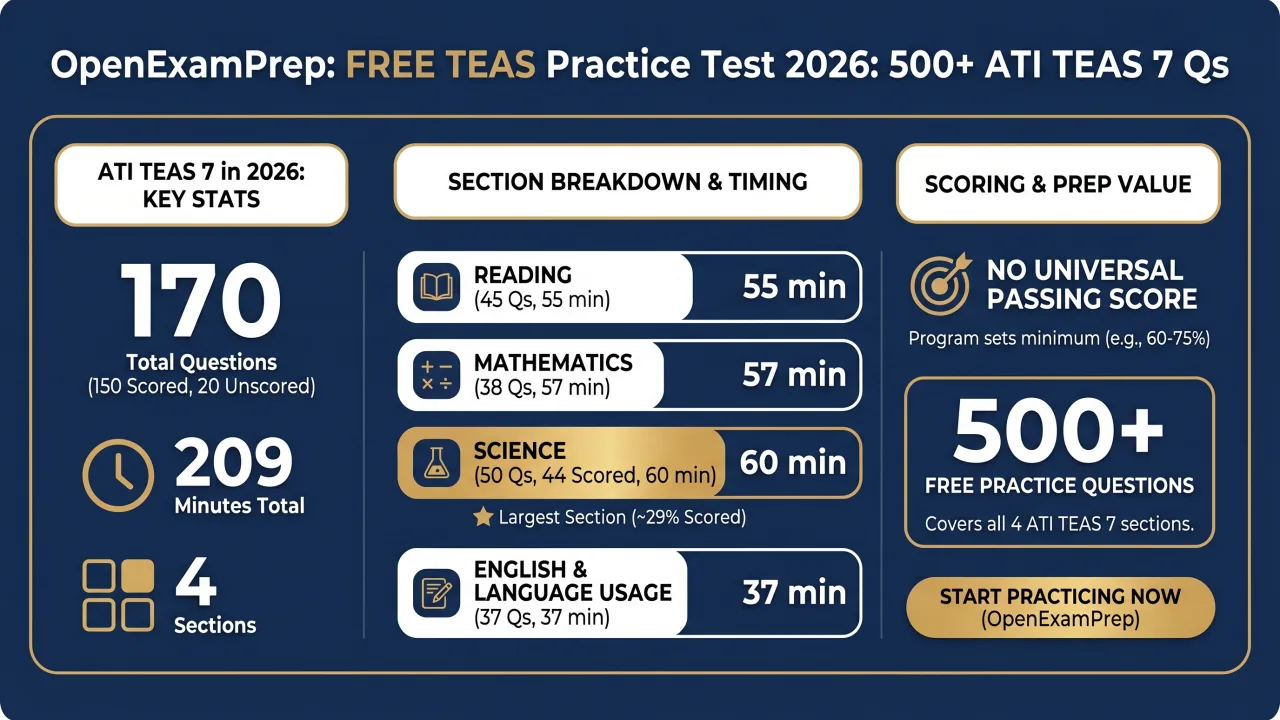
The ATI TEAS 7 has 170 total questions: 150 are scored and 20 are unscored pretest items that do not affect your result. You get 209 minutes of working time across four sections, taken back to back in this fixed order:
| Section | Total Q | Scored Q | Time | Per question |
|---|---|---|---|---|
| Reading | 45 | 39 | 55 min | ~1.2 min |
| Mathematics | 38 | 34 | 57 min | ~1.5 min |
| Science | 50 | 44 | 60 min | ~1.2 min |
| English & Language Usage | 37 | 33 | 37 min | ~1.0 min |
| Total | 170 | 150 | 209 min | -- |
Science is the largest scored section (44 questions, about 29% of your scored result), with Human Anatomy & Physiology as the single biggest topic. A basic on-screen four-function calculator is provided only during the Mathematics section -- you cannot bring your own.
TEAS 7 is not all standard multiple choice. Expect five question types: multiple choice, multiple select (select all that apply), supply answer (fill in the blank), ordered response, and hot spot. Practicing only four-option questions can leave you unprepared for the rest.
How TEAS Scoring Really Works (No Universal Passing Score)
This is where most candidates get bad information. There is no universal TEAS passing score. ATI does not set a pass/fail line. Instead, each nursing or allied-health program sets its own required minimum, so the "score you need" depends entirely on where you apply.
Your score report shows a Total Score, four content-area scores (one per section), and an ATI proficiency level (Below Basic, Basic, Proficient, Advanced, or Exemplary). Programs publish their own cutoffs, and competitive applicants usually aim well above the minimum.
| Program type | Typical required minimum | Competitive target |
|---|---|---|
| ADN (Associate) | ~58-65% | 70%+ |
| BSN (Bachelor's) | ~65-75% | 80%+ |
| Accelerated / Direct-entry | ~70-80% | 85%+ |
These ranges are typical, not rules. Always confirm the exact cutoff on your target program's admissions page -- some accept 58.7%, others want 80%+, and a few weight specific sections (often Science or Math) more heavily.
Free TEAS Practice Questions With Explanations
Below is one realistic sample from each section, written in the TEAS 7 style, with the correct answer and reasoning. For the full bank of 500+ questions with instant scoring and an AI tutor, use the free TEAS practice page.
Reading (Sample)
Passage: "Hand hygiene remains the single most effective measure for preventing healthcare-associated infections. Despite this, observational studies repeatedly show compliance below 50% on many units. The gap is rarely about knowledge; staff understand the rule. It reflects workflow pressure, glove overuse, and the simple fact that sinks are not always within reach."
Q: Which statement best captures the author's main point?
- A. Healthcare staff lack knowledge about hand hygiene.
- B. Hand hygiene compliance is poor mainly because of practical and workflow barriers, not ignorance.
- C. Gloves are a better infection-control measure than handwashing.
- D. Sinks should be installed in every patient room.
Correct: B. The passage explicitly says the gap "is rarely about knowledge" and lists workflow pressure, glove overuse, and sink access. A is contradicted by the text; C is never claimed; D is a possible inference but far narrower than the main point. Reading questions reward the choice the passage actually supports, not the one that merely sounds reasonable.
Mathematics (Sample)
Q: A provider orders 250 mg of a medication. The medication is supplied as 100 mg/mL. How many milliliters should be administered?
- A. 1.5 mL
- B. 2 mL
- C. 2.5 mL
- D. 4 mL
Correct: C. Use desired over have: 250 mg / 100 mg/mL = 2.5 mL. TEAS Math leans heavily on dosage, ratios, proportions, and unit conversion because they map to real nursing tasks. The on-screen four-function calculator handles the arithmetic -- your job is setting up the equation correctly and keeping units aligned.
Science (Sample)
Q: Which body system is primarily responsible for gas exchange between the blood and the external environment?
- A. Cardiovascular system
- B. Respiratory system
- C. Digestive system
- D. Lymphatic system
Correct: B. Gas exchange (oxygen in, carbon dioxide out) occurs across the alveoli of the respiratory system. The cardiovascular system transports those gases but does not exchange them with the outside air. Because Anatomy & Physiology is the highest-yield Science topic, drill organ-system functions and the structures that perform them.
English & Language Usage (Sample)
Q: Which sentence is written in standard English with correct punctuation?
- A. The patient, who was admitted yesterday is resting comfortably.
- B. The patient who was admitted yesterday, is resting comfortably.
- C. The patient, who was admitted yesterday, is resting comfortably.
- D. The patient who was admitted yesterday is resting comfortably?
Correct: C. "who was admitted yesterday" is a nonrestrictive clause and needs commas on both sides. A and B place only one comma; D adds an incorrect question mark to a statement. English questions focus on conventions of standard English, knowledge of language, and vocabulary -- punctuation rules like paired commas show up often.
How to Use Free TEAS Practice Tests Effectively
- Take a timed diagnostic first. A full-length, timed attempt tells you your real starting point and which sections drag your total down.
- Fix weak sections, not random topics. If Science is low, drill Anatomy & Physiology before anything else -- it carries the most weight.
- Review every miss with a reason. For each wrong answer, write why the correct option wins. This converts practice into actual score gains.
- Rehearse the question types. Deliberately practice multiple-select and ordered-response items so they are not a surprise.
- Simulate full length late. In your final two weeks, take at least one or two complete 209-minute sessions to build stamina and pacing.
Your 4-Week Free TEAS Study Plan
- Week 1 -- Diagnose: Take a full timed practice test. Record your four section scores. Read all explanations.
- Week 2 -- Science & Math: Focus on the two highest-leverage sections. Drill A&P, then biology and chemistry; for Math, master ratios, proportions, percentages, and dosage calculations.
- Week 3 -- Reading & English: Practice main-idea, inference, and structure questions; review standard-English conventions and vocabulary in context.
- Week 4 -- Simulate & refine: Take one or two full-length tests under real timing. Re-drill only the cues you keep missing. Confirm your target program's required score and section weights.
Build a free AI study plan -> -- ask the AI tutor for 10 questions on any weak topic, then have it explain each miss.
Why This Free TEAS Practice Test Beats Paid Prep
| Paid TEAS courses | OpenExamPrep (free) |
|---|---|
| $100-300 for a course | 100% free, all sections |
| Capped free questions | 500+ practice questions |
| Static PDFs | Instant scoring + explanations |
| No tutor | AI tutor for any concept |
Every practice question includes the correct answer, why the other options are wrong, and the concept to review next -- the same depth paid courses charge for, with no paywall.
Confirm Details on the Official Source
Format and policies here are verified against the ATI TEAS exam details page. Before test day, use ATI and your testing site (school, PSI, or ATI online proctoring) to confirm current fees -- typically about $70 to $140 depending on location and whether you test online -- plus ID requirements, rescheduling rules, and retake policy. Most importantly, confirm your specific program's required TEAS score, since that, not any universal cutoff, is what determines whether your result is good enough.
Start practicing free now -> No signup. All four sections. Updated for 2026.


 Buy on Amazon
 Practice exams on ExamEdge
 Take courses on Udemy
 Study guide on Mometrix