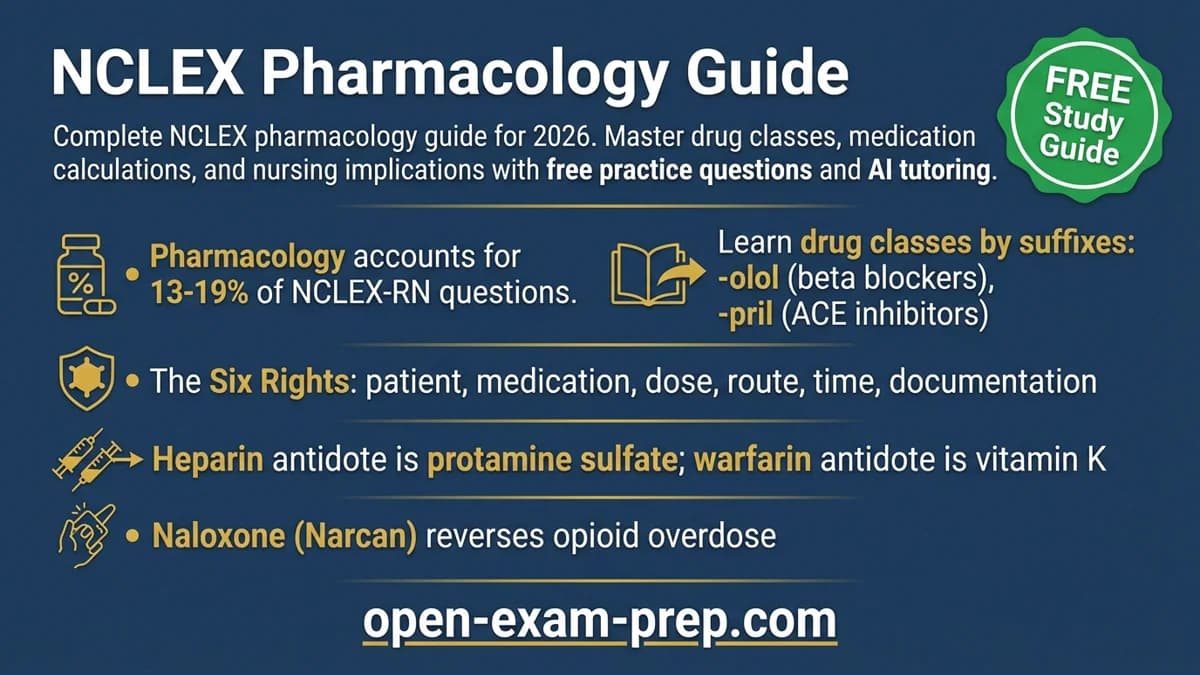
NCLEX Pharmacology Guide 2026: Master Medications for the NCLEX
Pharmacology and Parenteral Therapies make up 13-19% of the NCLEX-RN according to the 2026 NCLEX-RN Test Plan (effective April 2026) and is the second-highest-weighted content category after Management of Care (15-21%). The NCSBN (National Council of State Boards of Nursing) emphasizes safe medication administration as a core nursing competency, and medication questions are woven into clinical-judgment case studies as well as standalone items. This guide covers essential drug knowledge, calculations, antidotes, and test strategies for the 2026 exam.
Pharmacology on the NCLEX
| Aspect | Details |
|---|---|
| Percentage | 13-19% of NCLEX-RN items (second-highest category) |
| Question Types | Multiple choice, SATA, drag-and-drop, matrix, cloze, calculations |
| Focus Areas | Drug classes, side effects, nursing implications, antidotes |
| Key Skills | Safe administration, patient teaching, calculations, escalation |
The NCLEX-RN is a computer-adaptive test (CAT) that delivers between 85 and 150 scored and unscored items over up to 5 hours, including 3 Next Generation case studies (18 scored items) that measure the six steps of the NCSBN Clinical Judgment Measurement Model. For a full breakdown of the format and scoring algorithm, see our 2026 NCLEX test plan changes guide and how NCLEX-RN CAT/NGN scoring works.
Start Your Free NCLEX Pharmacology Practice
Our free practice includes questions on all major drug classes with detailed rationales.
Essential Drug Classes for NCLEX
Cardiovascular Medications
Beta Blockers (-olol)
Examples: metoprolol, atenolol, propranolol
- Action: Decrease heart rate and blood pressure
- Uses: Hypertension, heart failure, angina
- Side Effects: Bradycardia, hypotension, fatigue
- Nursing: Check HR before giving (hold if <60), don't stop abruptly
ACE Inhibitors (-pril)
Examples: lisinopril, enalapril, captopril
- Action: Block angiotensin-converting enzyme
- Uses: Hypertension, heart failure, diabetic nephropathy
- Side Effects: Dry cough, hyperkalemia, angioedema
- Nursing: Monitor potassium, watch for cough, first-dose hypotension
Calcium Channel Blockers
Dihydropyridines (-dipine): amlodipine, nifedipine
- Action: Vasodilation with minimal effect on heart rate
- Side Effects: Peripheral edema, headache, flushing
- Nursing: Monitor BP, check for edema, avoid grapefruit juice (raises drug levels)
Non-dihydropyridines: diltiazem, verapamil
- Action: Slow AV node conduction and heart rate in addition to vasodilation
- Side Effects: Bradycardia, constipation (especially verapamil)
- Nursing: Check HR/rhythm before giving; don't combine with beta blockers without provider guidance
Cardiac Glycosides
Example: digoxin (Lanoxin)
- Action: Increases contractility, slows heart rate
- Uses: Heart failure, atrial fibrillation
- Therapeutic range: 0.8-2.0 ng/mL; toxicity risk rises sharply above 2.0 ng/mL
- Toxicity signs: Nausea/anorexia (early), visual disturbances (yellow-green halos), bradycardia, arrhythmias
- Nursing: Hold and notify provider if apical pulse <60 bpm; monitor potassium closely (hypokalemia increases toxicity); antidote is digoxin immune Fab (DigiFab)
Diuretics
| Type | Examples | Key Point |
|---|---|---|
| Loop | furosemide, bumetanide | Potassium wasting |
| Thiazide | HCTZ, chlorthalidone | Potassium wasting |
| Potassium-sparing | spironolactone | Retain potassium |
Anticoagulants and Antiplatelets
Heparin
- Route: IV or SubQ
- Monitoring: aPTT (1.5-2.5x normal)
- Antidote: Protamine sulfate
- Nursing: No IM injections, watch for bleeding
Warfarin (Coumadin)
- Route: Oral
- Monitoring: PT/INR (goal usually 2-3; higher for mechanical heart valves)
- Antidote: Vitamin K (phytonadione); prothrombin complex concentrate for severe bleeding
- Nursing: Consistent vitamin K intake, many drug interactions
DOACs (Direct Oral Anticoagulants)
Examples: rivaroxaban, apixaban, dabigatran
- Advantage: No routine coagulation monitoring
- Reversal agents: Idarucizumab (Praxbind) reverses dabigatran; andexanet alfa (Andexxa) reverses apixaban and rivaroxaban
- Nursing: Assess for bleeding, confirm renal function before initiation
Diabetes Medications
Insulin Types
| Type | Onset | Peak | Duration |
|---|---|---|---|
| Rapid (lispro, aspart) | 15 min | 1-2 hr | 3-5 hr |
| Short (regular) | 30-60 min | 2-4 hr | 5-8 hr |
| Intermediate (NPH) | 1-2 hr | 4-12 hr | 18-24 hr |
| Long (glargine, detemir) | 1-2 hr | No peak | 24 hr |
Key Nursing Points:
- Check blood glucose before giving
- Know signs of hypoglycemia
- Rotate injection sites
- Never shake insulin (roll NPH)
Oral and Injectable Antidiabetics
- Metformin - First-line, hold before/after iodinated contrast (lactic acidosis risk)
- Sulfonylureas (-ide, e.g., glipizide, glyburide) - Cause hypoglycemia
- SGLT2 inhibitors (-flozin, e.g., empagliflozin) - UTI and genital infection risk, euglycemic DKA risk
- GLP-1 receptor agonists (-tide, e.g., semaglutide, liraglutide, tirzepatide) - Increasingly tested in 2026; GI upset (nausea, vomiting), rare pancreatitis, contraindicated with personal/family history of medullary thyroid carcinoma or MEN 2
- DPP-4 inhibitors (-gliptin, e.g., sitagliptin) - Weight-neutral, low hypoglycemia risk alone
Pain Medications
Opioids
Examples: morphine, hydrocodone, oxycodone, fentanyl
- Side Effects: Respiratory depression, constipation, sedation
- Antidote: Naloxone (Narcan)
- Nursing: Assess pain and respiratory status, prevent constipation
NSAIDs
Examples: ibuprofen, naproxen, ketorolac
- Risks: GI bleeding, renal impairment
- Nursing: Take with food, avoid in renal disease
Antibiotics
| Class | Examples | Key Points |
|---|---|---|
| Penicillins | amoxicillin, ampicillin | Allergy risk, take on empty stomach |
| Cephalosporins | cephalexin, ceftriaxone | Cross-reactivity with PCN allergy |
| Fluoroquinolones | ciprofloxacin, levofloxacin | Tendon rupture risk, avoid antacids |
| Aminoglycosides | gentamicin, tobramycin | Nephrotoxic, ototoxic, monitor levels |
| Macrolides | azithromycin, erythromycin | GI upset, QT prolongation |
Psychiatric Medications
Antidepressants
- SSRIs (fluoxetine, sertraline) - 4-6 weeks for effect, serotonin syndrome risk
- SNRIs (venlafaxine, duloxetine) - Monitor BP
- TCAs (amitriptyline) - Anticholinergic effects, cardiac toxicity
Antipsychotics
- Typical (haloperidol) - EPS, tardive dyskinesia
- Atypical (risperidone, quetiapine) - Weight gain, metabolic syndrome
Mood Stabilizers
- Lithium - Narrow therapeutic range, monitor levels, hydration critical
Other High-Alert and High-Yield NCLEX Medications
The ISMP (Institute for Safe Medication Practices) maintains the official list of high-alert medications — drugs with heightened risk of causing significant harm when used in error. Beyond insulin, opioids, and anticoagulants, know these high-yield agents:
| Medication | Why It's High-Yield |
|---|---|
| Potassium chloride (IV) | Never given IV push — always diluted and infused via pump; concentrated KCl vials are an ISMP high-alert item |
| Magnesium sulfate | Used for preeclampsia/eclampsia; monitor deep tendon reflexes, respiratory rate, and urine output; antidote is calcium gluconate |
| Phenytoin | Therapeutic range ~10-20 mcg/mL; causes gingival hyperplasia; give IV slowly to avoid "purple glove syndrome" |
| Corticosteroids (prednisone) | Never stop abruptly (adrenal suppression); monitor blood glucose and signs of infection |
Medication Calculations
Dosage Calculations
Formula: Desired/Have × Quantity = Amount to give
Example: Order: 500mg. Available: 250mg tablets
- 500mg/250mg × 1 tablet = 2 tablets
IV Flow Rates (Manual Tubing)
Formula: (Volume × Drop factor) / Time in minutes = gtts/min
Example: 1000mL over 8 hours, drop factor 15
- (1000 × 15) / 480 min = 31 gtts/min
IV Pump Rates
Formula: Volume (mL) / Time (hr) = mL/hr
Example: 1000mL over 8 hours
- 1000 / 8 = 125 mL/hr
Weight-Based Dosing
Formula: Weight (kg) × Dose per kg = Total dose
Example: Patient 70kg, order 2mg/kg
- 70 × 2 = 140mg
Six Rights of Medication Administration
| Right | Verification |
|---|---|
| Right Patient | Two identifiers (name, DOB) |
| Right Medication | Check label 3 times |
| Right Dose | Calculate and verify |
| Right Route | Appropriate for medication |
| Right Time | Per order and schedule |
| Right Documentation | After administration |
Common Antidotes Quick-Reference Table
| Drug/Toxin | Antidote/Reversal Agent |
|---|---|
| Heparin | Protamine sulfate |
| Warfarin (Coumadin) | Vitamin K (phytonadione) |
| Dabigatran | Idarucizumab (Praxbind) |
| Apixaban, rivaroxaban | Andexanet alfa (Andexxa) |
| Opioids | Naloxone (Narcan) |
| Benzodiazepines | Flumazenil |
| Acetaminophen overdose | N-acetylcysteine (Mucomyst) |
| Digoxin toxicity | Digoxin immune Fab (DigiFab) |
| Magnesium sulfate toxicity | Calcium gluconate |
| Beta-blocker overdose | Glucagon |
Look-Alike, Sound-Alike (LASA) Medications
The NCLEX tests safe-administration judgment partly by asking you to catch confusable drug names. These pairs are on the ISMP List of Confused Drug Names:
| Pair | Why It's Dangerous |
|---|---|
| hydrALAZINE vs. hydrOXYzine | Antihypertensive vs. antihistamine — mixing them up can deliver the wrong drug class entirely |
| clonazePAM vs. cloNIDine | Anti-seizure/anxiety drug vs. antihypertensive — name confusion is a classic medication-error scenario |
| HYDROmorphone vs. morphine | Hydromorphone is roughly 4-8x more potent — a mix-up can cause fatal respiratory depression |
| DOBUTamine vs. DOPamine | Both are cardiac infusions with very different hemodynamic effects — verify the order and pump label, not memory |
High-Yield NCLEX Pharmacology Topics
| Topic | Frequency | Priority |
|---|---|---|
| Anticoagulants | Very High | Essential |
| Insulin | Very High | Essential |
| Cardiac medications (including digoxin) | High | Important |
| Antibiotics | High | Important |
| Pain management | Medium | Review |
| Calculations | Medium | Must practice |
Common Medication Errors to Know
Types Tested on NCLEX
- Wrong dose - Always calculate and verify
- Wrong patient - Use two identifiers
- Wrong route - Check order carefully
- Missed allergies - Always assess first
- Drug interactions - Know major interactions
- Look-alike/sound-alike mix-ups - Use tall-man lettering and barcode scanning
Prevention Strategies
- Follow the 6 rights
- Use barcode scanning
- Independent double-check for high-alert meds
- Question unclear orders
Study Strategies for Pharmacology
1. Learn Drug Classes, Not Individual Drugs
Focus on:
- Common suffixes (-olol, -pril, -statin, -dipine, -tide)
- Class actions and side effects
- Nursing implications
2. Create Comparison Charts
Compare similar drugs:
- Heparin vs warfarin vs DOACs
- ACE inhibitors vs ARBs
- Different insulin types
- Dihydropyridine vs non-dihydropyridine calcium channel blockers
3. Focus on Safety
Know for each drug:
- When to hold
- What to monitor
- Patient teaching points
- Signs of toxicity and the antidote (if one exists)
4. Practice Calculations Daily
- Work through problems by hand
- Check your work
- Time yourself
Frequently Asked Questions
How much pharmacology is on the NCLEX-RN?
Pharmacology and Parenteral Therapies account for 13-19% of NCLEX-RN questions, the second-highest-weighted category after Management of Care. Medication questions are also embedded in the case studies that test clinical judgment.
Should I memorize all drug names?
Focus on drug classes and their common characteristics. Knowing suffixes (-olol, -pril, -dipine, -tide) helps identify drug classes quickly, even for brand-new medications you haven't memorized.
What calculations are on the NCLEX?
Basic dosage calculations, IV flow rates (gtts/min and mL/hr), and weight-based dosing. The NCLEX provides an on-screen calculator, but you must know how to set up the problem correctly.
What are high-alert medications?
Medications with high risk for harm if given incorrectly, per ISMP's official list: insulin, anticoagulants, opioids, concentrated electrolytes like potassium chloride, chemotherapy agents, and sedatives used for moderate sedation.
Is there a reversal agent for the newer blood thinners (DOACs)?
Yes. Idarucizumab (Praxbind) reverses dabigatran, and andexanet alfa (Andexxa) reverses apixaban and rivaroxaban in life-threatening bleeding. Coverage for other factor Xa inhibitors (edoxaban, betrixaban) is more limited.
What are the signs of digoxin toxicity?
Early signs are GI-related (nausea, vomiting, anorexia); later signs include visual disturbances (blurred or yellow-green vision with halos), bradycardia, and arrhythmias. Hypokalemia increases the risk, so potassium is monitored closely.
Start Your NCLEX Pharmacology Practice Today
Our free resources include:
- 100+ NCLEX-style pharmacology and medication questions
- Drug class coverage with detailed rationales
- Calculation practice (dosage, IV rates, weight-based dosing)
- An antidote and high-alert medication quick-reference
- AI study assistant for personalized review
Master pharmacology and boost your NCLEX score with our free practice questions.

 4 Job Wiki
 Buy on Amazon
 Take courses on Udemy
 Prep course on Achievable
 Study guide on Mometrix