TEAS Science Practice Questions 2026: Master the Largest Section
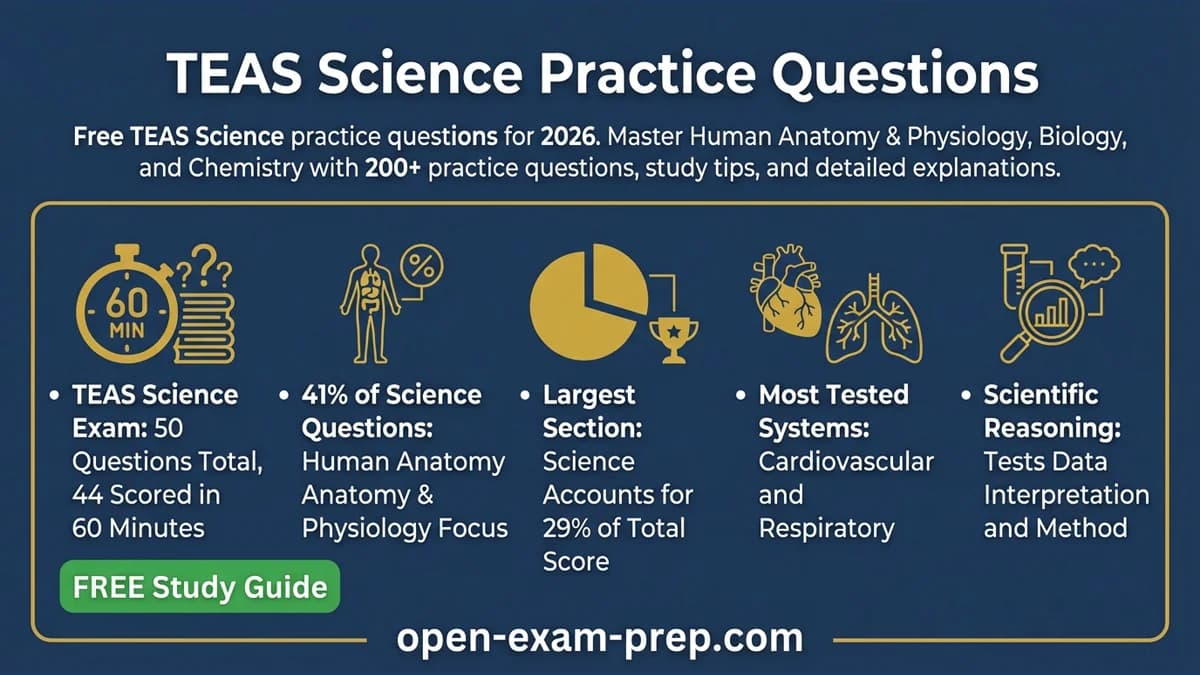
The TEAS Science section is the largest part of the ATI TEAS 7 exam, with 50 questions that account for about 29% of your total score. This guide provides free practice questions and strategies to help you succeed. All numbers below match the current ATI content outline.
Where Science Fits in the Full TEAS 7
The complete ATI TEAS Version 7 has 170 questions across four sections and a total testing time of 209 minutes (plus a 10-minute break after Math). Science is the single largest section by question count.
| Section | Questions | Time |
|---|---|---|
| Reading | 45 | 55 min |
| Math | 38 | 57 min |
| Science | 50 | 60 min |
| English & Language Usage | 37 | 37 min |
| Total | 170 | 209 min |
Important: There is no universal passing score for the TEAS. Each nursing program sets its own cutoff, and ATI reports proficiency levels (Basic, Proficient, Advanced, Exemplary) rather than a single pass/fail mark.
TEAS Science Section Overview
| Subsection | Scored Questions | Percentage |
|---|---|---|
| Human Anatomy & Physiology | 18 | 41% |
| Biology | 9 | 20% |
| Chemistry | 8 | 18% |
| Scientific Reasoning | 9 | 20% |
| Total | 44 scored (+ 6 unscored = 50) | 100% |
Time Allowed: 60 minutes for all 50 questions Time Per Question: about 1.2 minutes
The 6 unscored "pretest" questions are mixed in and look identical to scored items, so answer every question as if it counts. Human Anatomy & Physiology alone is nearly half the section, so it is the highest-yield place to spend your study time.
Start Your Free TEAS Science Practice
Our free practice includes 200+ Science questions covering all subsections with detailed explanations.
Human Anatomy & Physiology (18 Questions)
This is the highest-yield subsection. Master these body systems:
Cardiovascular System
Key Topics:
- Heart anatomy and blood flow pathway
- Cardiac cycle and electrical conduction
- Blood components and functions
- Blood pressure regulation
Practice Question: Which chamber of the heart receives deoxygenated blood from the body?
- A) Left atrium
- B) Right atrium ✓
- C) Left ventricle
- D) Right ventricle
Explanation: Deoxygenated blood returns to the heart via the superior and inferior vena cava, entering the right atrium. It then passes through the tricuspid valve to the right ventricle.
Respiratory System
Key Topics:
- Gas exchange in alveoli
- Mechanics of breathing
- Oxygen transport
- Regulation of respiration
Practice Question: Where does gas exchange occur in the lungs?
- A) Bronchi
- B) Bronchioles
- C) Alveoli ✓
- D) Trachea
Explanation: Gas exchange occurs in the alveoli, tiny air sacs surrounded by capillaries. Oxygen diffuses into the blood while carbon dioxide diffuses out.
Nervous System
Key Topics:
- Central vs peripheral nervous system
- Neuron structure and function
- Neurotransmitters
- Reflex arcs
Practice Question: Which part of a neuron receives incoming signals from other neurons?
- A) Axon
- B) Dendrites ✓
- C) Myelin sheath
- D) Axon terminal
Explanation: Dendrites are the branched extensions that receive incoming signals and carry them toward the cell body. The axon then conducts the impulse away from the cell body to the axon terminals.
Digestive System
Key Topics:
- Organs and their functions
- Enzyme actions
- Nutrient absorption
- Accessory organs (liver, pancreas)
Practice Question: Where does most nutrient absorption occur in the digestive tract?
- A) Stomach
- B) Large intestine
- C) Small intestine ✓
- D) Esophagus
Explanation: The small intestine is the primary site of nutrient absorption. Its villi and microvilli create a huge surface area, while the large intestine mainly absorbs water and electrolytes.
Urinary System
Key Topics:
- Kidney structure (nephron)
- Urine formation
- Fluid and electrolyte balance
- Acid-base regulation
Practice Question: What is the functional filtering unit of the kidney?
- A) Alveolus
- B) Nephron ✓
- C) Glomerulus only
- D) Ureter
Explanation: The nephron is the functional unit of the kidney where filtration, reabsorption, and secretion occur. The glomerulus is only one part of the nephron, where blood is initially filtered.
Musculoskeletal System
Key Topics:
- Muscle types and functions
- Bone structure and remodeling
- Joint types
- Muscle contraction mechanism
Practice Question: Which muscle type is involuntary and found in the walls of the heart?
- A) Skeletal muscle
- B) Smooth muscle
- C) Cardiac muscle ✓
- D) Voluntary muscle
Explanation: Cardiac muscle is striated but involuntary and found only in the heart. Skeletal muscle is voluntary, while smooth muscle is involuntary and lines hollow organs such as the intestines and blood vessels.
Biology (9 Questions)
Cellular Biology
Key Topics:
- Cell organelles and functions
- Cell membrane structure
- Mitosis vs meiosis
- ATP production
Practice Question: Which organelle is responsible for producing ATP?
- A) Nucleus
- B) Ribosome
- C) Mitochondria ✓
- D) Golgi apparatus
Explanation: Mitochondria are the "powerhouses" of the cell, producing ATP through cellular respiration.
Genetics
Key Topics:
- DNA structure and replication
- Protein synthesis
- Mendelian inheritance
- Punnett squares
Practice Question: If both parents are heterozygous (Aa) for a trait, what percentage of offspring will be homozygous recessive?
- A) 0%
- B) 25% ✓
- C) 50%
- D) 75%
Explanation: Using a Punnett square: AA (25%) + Aa (50%) + aa (25%). Homozygous recessive (aa) = 25%.
Biological Classification
Key Topics:
- Taxonomy levels
- Characteristics of kingdoms
- Prokaryotes vs eukaryotes
Chemistry (8 Questions)
Atomic Structure
Key Topics:
- Protons, neutrons, electrons
- Electron configuration
- Periodic table organization
- Isotopes
Practice Question: What determines the atomic number of an element?
- A) Number of neutrons
- B) Number of electrons
- C) Number of protons ✓
- D) Number of protons plus neutrons
Explanation: The atomic number equals the number of protons in the nucleus. This determines the element's identity.
Chemical Bonding
Key Topics:
- Ionic vs covalent bonds
- Electronegativity
- Polar vs nonpolar molecules
- Hydrogen bonding
Practice Question: Which type of bond forms when electrons are transferred from a metal to a nonmetal?
- A) Covalent bond
- B) Ionic bond ✓
- C) Hydrogen bond
- D) Nonpolar bond
Explanation: Ionic bonds form when one atom transfers electrons to another, creating oppositely charged ions (for example, Na+ and Cl- in table salt). Covalent bonds, by contrast, involve the sharing of electrons.
Chemical Reactions
Key Topics:
- Balancing equations
- Reaction types (synthesis, decomposition, etc.)
- Acids and bases
- pH scale
Practice Question: A solution with a pH of 3 is:
- A) Strongly acidic ✓
- B) Weakly acidic
- C) Neutral
- D) Basic
Explanation: pH below 7 is acidic, above 7 is basic. pH 3 is strongly acidic (low pH = high H⁺ concentration).
States of Matter
Key Topics:
- Phase changes
- Properties of solids, liquids, gases
- Solutions and concentrations
Scientific Reasoning (9 Questions)
Scientific Method
Key Topics:
- Hypothesis formation
- Variables (independent, dependent, controlled)
- Experimental design
- Drawing conclusions
Practice Question: In an experiment testing how fertilizer affects plant growth, what is the independent variable?
- A) Plant height
- B) Amount of fertilizer ✓
- C) Type of plant
- D) Amount of water
Explanation: The independent variable is what the researcher manipulates (fertilizer). Plant height is the dependent variable (what's measured).
Data Interpretation
Key Topics:
- Reading graphs and charts
- Calculating means and percentages
- Identifying trends
- Statistical significance
Practice Question: A study reports that a drug lowered blood pressure in 90 of 100 patients. What is the success rate?
- A) 9%
- B) 90% ✓
- C) 0.9%
- D) 19%
Explanation: A success rate is a percentage: 90 of 100 equals 90/100 = 0.90 = 90%. TEAS data-interpretation items frequently test converting counts to percentages and reading values off tables and graphs.
Critical Analysis
Key Topics:
- Evaluating experimental design
- Identifying bias
- Drawing valid conclusions
- Limitations of studies
High-Yield Study Topics
| Topic | Frequency | Priority |
|---|---|---|
| Cardiovascular system | Very High | Must know |
| Respiratory system | Very High | Must know |
| Nervous system | High | Important |
| Cell biology | High | Important |
| Chemical reactions | Medium | Review |
| Scientific method | Medium | Review |
Study Strategies for TEAS Science
1. Focus on A&P First
Human Anatomy & Physiology makes up 41% of the Science section. Prioritize:
- Body systems and their functions
- How systems work together
- Normal vs abnormal findings
2. Create System Summaries
For each body system, know:
- Major organs/structures
- Primary functions
- Key processes
- Common disorders
3. Use Visual Learning
- Anatomical diagrams
- Process flowcharts
- Cycle illustrations
- Comparison tables
4. Connect Concepts
Link related topics:
- Respiratory + cardiovascular (oxygen delivery)
- Digestive + urinary (waste elimination)
- Nervous + muscular (movement)
Common Mistakes to Avoid
- Skipping A&P - It's the largest subsection
- Memorizing without understanding - Know processes, not just facts
- Ignoring scientific reasoning - Easy points if prepared
- Running out of time - Practice pacing
TEAS Science Quick Reference
Key Values to Memorize
| Measurement | Normal Range |
|---|---|
| Body temperature | 97.8-99.1°F |
| Heart rate | 60-100 bpm |
| Blood pressure | 120/80 mmHg |
| Respiratory rate | 12-20/min |
| pH (blood) | 7.35-7.45 |
| pH (neutral) | 7.0 |
Essential Equations
- pH = -log[H⁺]
- Cardiac Output = Heart Rate × Stroke Volume
- BMI = weight (kg) / height² (m²)
Frequently Asked Questions
How many Science questions are on the TEAS?
The TEAS Science section has 50 questions total (44 scored + 6 unscored pretest items). You have 60 minutes.
What percentage of TEAS is Science?
Science accounts for approximately 29% of your total TEAS score (50 of the 170 questions), making it the largest section by question count.
Is there a passing score for TEAS Science?
No. ATI sets no universal passing score. Each nursing program decides its own required score, and ATI reports proficiency levels (Basic, Proficient, Advanced, Exemplary) instead of a single pass/fail result.
How long is the full TEAS 7 exam?
The complete ATI TEAS 7 has 170 questions across four sections (Reading, Math, Science, English & Language Usage) and 209 minutes of testing time, with a 10-minute break after Math.
Is TEAS Science hard?
TEAS Science requires solid knowledge of anatomy, biology, and chemistry. With focused study, especially on A&P, most test-takers can score well.
Should I memorize everything?
Focus on understanding processes and relationships rather than memorizing isolated facts. Understanding helps you reason through unfamiliar questions. Review the official exam details from ATI for specific content breakdowns.
Start Your TEAS Science Practice Today
Our free resources include:
- 200+ Science practice questions
- All subsections covered
- Detailed explanations
- AI study assistant
- Progress tracking
Master the largest TEAS section with our free practice questions and boost your nursing school application.
Add This Clinical Review Layer Before Test Day
Use the final stretch for decision quality, not just more exposure to facts. Start each study block for TEAS Science Practice Questions 2026: Free A&P, Biology & Chemistry Prep by naming the task the question is really testing: recognition, prioritization, safety, communication, documentation, or workflow. Healthcare exams often hide the correct answer behind a familiar detail, so the safest habit is to pause before reading the options and predict what a competent entry-level professional would do next. That prediction keeps you from chasing the option that sounds medically interesting but does not answer the actual patient-care problem.
Build a small error log with four columns: missed topic, missed cue, correct rule, and next drill. A missed cue is more useful than a broad content label. For example, do not only write cardiovascular, infection control, medication safety, specimen handling, imaging, or professional practice. Write the actual cue you ignored: unstable finding, contraindication, timing before a procedure, patient identification, scope boundary, chain of custody, isolation wording, or documentation sequence. Review that log every two or three days and convert repeated misses into short practice sets.
Official-Source Check
Before relying on any third-party outline, compare your plan with ATI TEAS page. Official pages and candidate handbooks are the place to confirm current eligibility language, testing vendor instructions, identification rules, rescheduling policies, accommodations steps, and any content outline changes. You do not need to memorize administrative details for every practice question, but you do need to avoid preparing from an outdated blueprint or an old retake policy. If a handbook uses different domain names than your notes, rename your notes to match the handbook so your remediation stays aligned with the exam owner.
Scenario Strategy for Clinical and Administrative Questions
Read healthcare scenarios in this order: setting, role, patient or client status, time pressure, and requested action. The role matters because many distractors are clinically reasonable but outside the expected scope for the candidate. A nursing, allied health, pharmacy, laboratory, imaging, respiratory, compliance, or management exam may ask what should be done first, what should be reported, what should be documented, or what should be delegated. Those verbs change the answer. Highlight them in practice even if the real test interface does not let you mark text the same way.
When two options both look correct, choose the one that best protects the patient, preserves specimen or data integrity, follows policy, or escalates an unsafe condition. Avoid answers that skip assessment, skip identification, skip hand hygiene or privacy safeguards, give education before immediate safety is addressed, or perform a task that belongs to another licensed professional. For management and compliance exams, translate clinical safety into system safety: risk identification, incident response, documentation, auditing, corrective action, and communication with the right stakeholder.
Practice Routing After Each Score Report
Do not retake full-length practice exams until you know what the previous one taught you. After each set, sort misses into three groups. Knowledge misses need a short content review and then ten targeted questions. Reasoning misses need rationales: write why the correct answer is safer or more aligned with the role than your answer. Speed misses need shorter timed sets, not another full review chapter.
In the last week, keep practice mixed. Real exam questions rarely announce the domain, and mixed sets force you to choose between similar procedures, symptoms, lab clues, safety steps, and communication tasks. End each day with a brief review of high-yield normal findings, urgent findings, infection prevention, medication or equipment safety, and professional boundaries that appear in your own missed-question history. The goal is not to feel as if every topic is finished. The goal is to enter the exam with a repeatable method for unfamiliar cases: identify the role, find the safety issue, rule out unsafe shortcuts, and choose the action that a careful professional could defend.


 Buy on Amazon
 Practice exams on ExamEdge
 Take courses on Udemy
 Study guide on Mometrix