Best Body Fat Calipers for Personal Trainers: Complete 2026 Buying Guide
Video
Which muscle fiber type is most resistant to fatigue and relies primarily on oxidative metabolism?
Cscs Exercise Science
Question · Easy
Week 1 vs week 12
Short
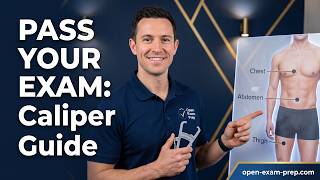
In-depth guide to the best skinfold body fat calipers for NASM-CPT, ACE-CPT, ACSM-CPT, and CSCS certification candidates. Covers Jackson-Pollock 3-site and 7-site protocols, caliper technique, Accu-Measure vs Sequoia TrimCal comparison, and why body composition assessment is tested on every major fitness certification exam in 2026.
Blog
Sliding Filament Theory
Exercise Science
Flashcard
According to the size principle of motor unit recruitment, which motor units are recruited first during a voluntary muscle contraction?
Rotational kinetic effect measured in newton-meters when a linear push acts at a perpendicular moment-arm distance from a joint axis.
Exercise science
Guess the Term
Introduction
About the CSCS
Study guide
Cheat sheet
During the sliding filament theory of muscle contraction, what role does calcium play?
Question · Medium
Read the clue and guess the term in 6 tries.
Game
CSCS Exam Pass Rate: Only 50% Pass (2026)
Motor Unit
Which of the following best describes Type IIa muscle fibers?
Best Body Measuring Tapes for Personal Trainers: Complete 2026 Buying Guide
In-depth guide to the best body measuring tapes for NASM-CPT, ACE-CPT, ACSM-CPT, and CSCS certification candidates. Covers circumference measurement protocols, waist-to-hip ratio calculation, proper technique for consistent readings, analog vs smart Bluetooth tape measures, and why body composition assessment is tested on personal trainer certification exams in 2026.
Time rate of performing mechanical work, calculated as the product of applied push and movement velocity in watts.
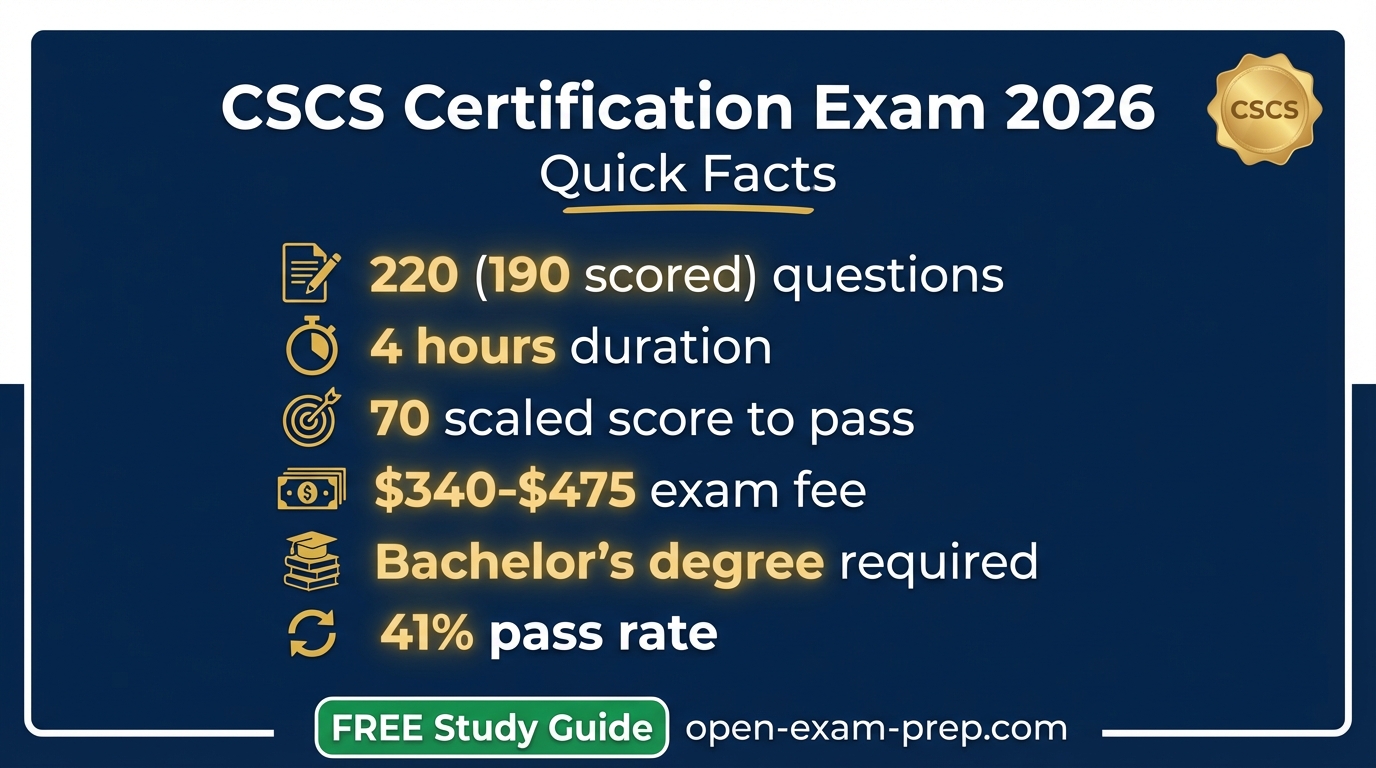
CSCS Pass Rate Is 41%: Retake Plan + Hardest Sections (2026)
What is the primary function of the Golgi tendon organ (GTO)?
Adult vitals: pick fast
NSCA 2025 data shows only 50% pass both CSCS exam sections. See which section fails most people, the hardest topics, and a free study plan to beat the odds.
Size Principle
Which of the following structures stores and releases calcium ions during muscle contraction?
Mechanical quantity in joules equal to the product of applied push and the displacement an object moves in that direction.
Exam Structure and Content Breakdown
What is the difference between muscle hypertrophy and hyperplasia?
Swap tiles to line up three of the same term.
Term Match
FREE CSCS Exam Guide 2026: Format, Domains & Pass Rate
EPOC (Excess Post-Exercise Oxygen Consumption)
Which type of muscle contraction occurs when the muscle produces force while lengthening?
Only 41% pass the CSCS exam. Hardest sections ranked, why each domain causes failures, and a structured 8-12 week retake plan to pass on your next attempt.
Kinetic vector quantity in newtons equal to mass multiplied by acceleration that alters a body's state of motion.
The muscle spindle is primarily responsible for detecting:
VO2max
A strength and conditioning specialist observes that an athlete can produce more force during an eccentric contraction than a concentric contraction of the same muscle. This is best explained by:
Question · Hard
Rigid anatomical bone shaft that rotates around a joint fulcrum when muscular effort opposes an external resistance.
Pass Rates and Scoring
Which of the following best describes the all-or-none principle of motor unit recruitment?
Flip two cards at a time to find matching terms.
Term Pairs
Lactate Threshold
An athlete performing heavy squats primarily relies on which mechanism to increase force production beyond initial motor unit recruitment?
Flat anatomical reference surface, classified as sagittal, frontal, or transverse, along which a segment translates or rotates.
Which of the following hormones has the greatest direct anabolic effect on skeletal muscle tissue?
Sarcomere
Anatomy
During a maximal isometric contraction, what happens to the length of the muscle fibers and the overall muscle-tendon unit?
Eponymous proprioceptive tendon organ at the musculotendinous junction that senses tension and inhibits the agonist muscle.
Loading more…