CSCS Exam Pass Rate 2026: The Hardest Fitness Certification Exam
The CSCS (Certified Strength and Conditioning Specialist) exam from the NSCA has one of the lowest pass rates of any major fitness certification. According to the NSCA's most recent 2025 Exam Report, only 50% of candidates pass both sections — meaning half of all test-takers fail.
If you're preparing for the CSCS exam in 2026, understanding exactly where candidates fail — and building a study plan that targets those weak spots — is the difference between joining the 50% who pass and the half who don't.
Start Your FREE CSCS Exam Prep Today
Our comprehensive CSCS study guide covers both exam sections with practice questions — 100% FREE.
Official CSCS Pass Rate Data (NSCA 2025)
The NSCA publishes pass rate data for each exam section in its annual Exam Report. Here are the most recent official numbers (2025):
| Metric | Pass Rate |
|---|---|
| Both sections combined | 50% |
| Scientific Foundations section only | 71% |
| Practical/Applied section only | 55% |
| Candidates tested in 2025 | 9,650 |
CSCS Pass Rate Trend (2024 vs 2025)
| Year | Scientific Foundations | Practical/Applied | Both Sections | Candidates |
|---|---|---|---|---|
| 2024 | 68% | 44% | 41% | ~6,200 |
| 2025 | 71% | 55% | 50% | 9,650 |
Note: Pass rates rose across the board in 2025 — the combined rate climbed from 41% to 50% — but the Practical/Applied section still fails nearly half of all candidates. The two-section format and applied, scenario-based questions keep the CSCS among the toughest fitness exams.
As of December 31, 2025, 45,669 professionals hold the CSCS credential — making it one of the most respected fitness certifications.
What This Data Tells You
- The Practical/Applied section is the killer. At a 55% pass rate, it still fails nearly half of all test-takers — far more than Scientific Foundations. This is where most people's CSCS attempts stall.
- Scientific Foundations is passable but not easy. 71% pass it, which means almost 3 in 10 still fail the "easier" section.
- The improvement is real but the bar is still high. Even after 2025's gains, the combined 50% rate means a coin-flip outcome for the average candidate who walks in underprepared.
- The combined 50% rate means BOTH sections must be passed. You can pass one section and retake only the failed section, but you must pass both within one year of your first exam date.
How CSCS Compares to Other Fitness Certifications
| Certification | First-Time Pass Rate | Difficulty Rank |
|---|---|---|
| CSCS | 50% (both sections) | Hardest |
| NSCA-CPT | 65–70% | Hard |
| ACSM-CEP | 55–60% | Hard |
| ACE-CPT | 65–73% | Moderate |
| NASM-CPT | 65–70% | Moderate |
| ISSA-CPT | 80–90% | Easier |
The CSCS is in a different league. It's designed for professionals working with athletes, not general fitness clients.
Eligibility today: You must hold at least a bachelor's degree (any field, from an accredited institution) and a current CPR/AED certification to sit for the exam.
Important 2030 change: Starting January 1, 2030, US candidates must hold a bachelor's degree from a CASCE-accredited program with a strength-and-conditioning concentration. International candidates have until January 2036. Anyone who earns the CSCS on or before December 31, 2029 is unaffected. If your degree is not from a CASCE-accredited program, sitting for the exam before 2030 protects your eligibility.
CSCS Exam Format and Structure (2026)
| Detail | Scientific Foundations | Practical/Applied |
|---|---|---|
| Questions | 80 scored + 15 unscored (95 total) | 110 scored + 15 unscored (125 total) |
| Time | 1.5 hours | 2.5 hours |
| Content | Exercise Science (60%), Sport Psychology (25%), Nutrition (15%) | Program Design (40%), Exercise Technique (25%), Program Implementation (20%), Organization & Administration (15%) |
| Passing score | Scaled score of 70 or higher | Scaled score of 70 or higher |
| Testing | Can take both sections same day or separately | Pearson VUE center or online proctored |
| Cost | $340 NSCA member / $475 non-member (both sections) | Retake one section: $250 member / $385 non-member |
Important: The Practical/Applied section includes 30-40 video and/or image items that show real lifting technique and coaching scenarios — you analyze what you see, not just recall definitions. You can take both sections on the same day (back-to-back with a break) or schedule them separately; most candidates take both in one sitting to avoid losing momentum.
The Hardest CSCS Topics (Ranked by Failure Data)
Based on NSCA score reports and candidate feedback, here are the topics that cause the most failures:
Practical/Applied Section — Where Most People Fail
#1: Program Design (The Single Hardest Topic)
This is the largest content area and the one candidates struggle with most:
- Periodization models: Linear, undulating, block — you must design programs, not just identify them
- Exercise prescription variables: Sets, reps, rest periods, intensity assignments for specific goals
- Needs analysis: Translating sport demands into training programs (biomechanical analysis, energy system demands, injury risk)
- Training age considerations: Modifying programs for novice vs. advanced athletes across different age groups
Why it's hard: The questions aren't "What is linear periodization?" They're "An NCAA Division I volleyball player has 12 weeks of off-season. Design the most appropriate training phase progression." You must apply, not recall.
#2: Exercise Technique
- Spotting techniques: Correct spotter positions for bench press, squat, overhead press — including single vs. double spotter
- Exercise execution errors: Identifying form breakdowns and their muscular/biomechanical causes
- Breathing patterns: Valsalva maneuver application, when to cue exhale vs. inhale
- Exercise selection: Choosing appropriate exercises based on athlete needs, equipment availability, and injury history
#3: Program Implementation (Testing, Monitoring and Data)
On the current NSCA outline, testing and evaluation live inside the Program Implementation domain (20% of the Practical/Applied section):
- Test selection: Choosing valid, reliable tests for specific performance attributes (Wingate for anaerobic power, 1RM for maximal strength, T-test for agility)
- Statistical interpretation: Understanding percentile rankings, standard error of measurement, coefficient of variation
- Test administration protocols: Exact procedures for the YMCA bike test, skinfold measurements, vertical jump, pro agility
Scientific Foundations Section — Still Challenging
#1: Exercise Physiology
- Energy systems: Phosphagen, glycolytic, oxidative — and the training adaptations specific to each
- Endocrine responses: Hormonal responses to resistance training (testosterone, GH, cortisol, IGF-1) and how they differ by training status
- Cardiovascular adaptations: Stroke volume, cardiac output, VO2max, arteriovenous oxygen difference
- Neuromuscular physiology: Motor unit recruitment (size principle), rate coding, muscle fiber types, stretch-shortening cycle
#2: Sport Nutrition
- Macronutrient calculations: Protein requirements for strength athletes (1.6–2.2 g/kg), carbohydrate loading protocols, fat intake minimums
- Hydration: Fluid replacement guidelines, sweat rate calculations, hyponatremia risk
- Supplementation evidence: Creatine loading protocols, caffeine timing, beta-alanine dosing, and what the evidence actually supports
#3: Biomechanics
- Force-velocity relationship: Understanding the inverse relationship and its application to power training
- Lever systems: First, second, third class levers in human movement — and mechanical advantage calculations
- Kinetic chain: Open vs. closed chain exercises and their joint force implications
Practice CSCS Questions for FREE
Our practice questions cover both Scientific Foundations and Practical/Applied with detailed explanations — completely free.
10-Week CSCS Study Plan
This plan assumes a background in exercise science and targets 10–12 study hours per week:
| Week | Focus Area | Section | Activities |
|---|---|---|---|
| 1 | Exercise Physiology (energy systems, cardiovascular) | Scientific | Read Essentials Ch. 1–4; practice metabolic calculations |
| 2 | Exercise Physiology (neuromuscular, endocrine) | Scientific | Motor unit recruitment, hormonal responses; practice questions |
| 3 | Biomechanics & Sport Psychology | Scientific | Lever systems, force-velocity, arousal theories; practice questions |
| 4 | Nutrition & Pharmacology | Scientific | Macronutrient calculations, supplementation evidence; practice exam #1 |
| 5 | Testing & Evaluation | Practical | Test protocols, statistical concepts, normative data tables |
| 6 | Exercise Technique & Spotting | Practical | Watch technique videos, study spotting positions, breathing patterns |
| 7 | Program Design — Resistance Training | Practical | Periodization models, set/rep schemes, exercise selection logic |
| 8 | Program Design — Aerobic, Speed, Plyometric | Practical | Interval training, sprint mechanics, plyometric progression; practice exam #2 |
| 9 | Organization & Administration | Practical | Facility design, legal liability, emergency procedures, scheduling |
| 10 | Full practice exams + weak area review | Both | Take 2 timed practice exams; review all missed questions; final review |
Study Time Allocation
Based on the section weights and difficulty data:
| Area | % of Total Study Time | Rationale |
|---|---|---|
| Program Design | 25% | Largest content area + hardest topic |
| Exercise Physiology | 20% | Foundation for understanding everything else |
| Exercise Technique | 15% | High failure rate; requires both knowledge and visual recognition |
| Program Implementation (testing/monitoring) | 15% | Statistical concepts trip up many candidates |
| Nutrition | 10% | Manageable volume but calculation-heavy |
| Biomechanics + Sport Psych | 10% | Conceptual — either you understand it or you don't |
| Organization & Administration | 5% | Smallest section; often common sense |
5 Strategies That Separate the 50% Who Pass
1. Study the Essentials Textbook, Not Summaries
The NSCA's Essentials of Strength Training and Conditioning (4th Edition) is the primary exam reference. Every question can be traced back to this textbook. Third-party study guides are helpful supplements, but the textbook is the source material the exam writers use.
2. Practice Program Design on Paper
Don't just read about periodization — actually design training programs:
- Pick a sport and create a 12-week off-season program
- Include periodization phases, exercise selection, and set/rep prescriptions
- Have a colleague or mentor review it
3. Memorize Test Protocols Exactly
The exam tests specific numbers and procedures:
- YMCA bike test: 150 bpm target, 25 watts/stage, 3-minute stages
- Skinfold sites: exact anatomical landmarks for 3-site and 7-site formulas
- 1RM testing: warm-up protocol, 2–5 minute rest, attempt progression
4. Take Both Sections on the Same Day
Unless you have a specific reason not to, take both sections back-to-back:
- Saves the cost and logistics of a second testing appointment
- Scientific Foundations knowledge is fresh when you start Practical/Applied
- Prevents procrastination on the harder section
5. Use the Full Time Allowed
Unlike most certification exams, the CSCS gives adequate time (1.5 hours for 95 questions, 2.5 hours for 125 questions). Don't rush. Read every question twice, especially program design scenarios where one word changes the correct answer.
CSCS Retake Policy and Costs
| Scenario | Policy |
|---|---|
| Failed one section | Retake only the failed section |
| Failed both sections | Must retake both |
| Retake window | 1 year from first exam date to pass both sections |
| Wait period | At least 30 days from your most recent exam date |
| Retake cost (one section) | $250 member / $385 non-member |
| Retake cost (both sections) | $340 member / $475 non-member |
| Max attempts | 3 within a 1-year period |
| After 3 failed attempts | Wait 1 year from your most recent exam date |
CSCS Career and Salary Outlook (2026)
Passing the CSCS opens doors to positions that general fitness certifications cannot:
| Position | Median Salary (2026) | Setting |
|---|---|---|
| Collegiate S&C Coach | $55,000–$75,000 | NCAA Division I, II, III |
| Professional Sports S&C | $80,000–$120,000+ | NFL, NBA, MLB, MLS |
| Head S&C Director | $70,000–$95,000 | University athletic departments |
| Private Sector S&C | $50,000–$70,000 | Private training facilities, athlete development |
| Military S&C Specialist | $60,000–$80,000 | DoD Tactical Strength programs |
| Sports Science/Performance | $65,000–$90,000 | Performance institutes, Olympic training centers |
The NSCA's 2025 salary survey reported average S&C professional salaries of $68,089–$98,564 with 6.7% annual growth since 2018.
Start Your CSCS Prep Now — 100% FREE
Our comprehensive CSCS study course includes:
- Both exam sections (Scientific Foundations + Practical/Applied) with detailed explanations
- Practice questions covering all content areas including program design scenarios
- AI-powered study help — get instant explanations for any topic
- Free forever — no credit card, no trial period
Only 50% pass both sections. Be one of them.
Official CSCS Resources
- NSCA Official CSCS Page — Exam registration, eligibility, fees
- NSCA CSCS Exam Description — Official content outline
- NSCA Essentials Textbook — Primary exam reference
- Pearson VUE — NSCA Testing — Schedule your exam
- NSCA Salary Survey Results — 2025 career and salary data

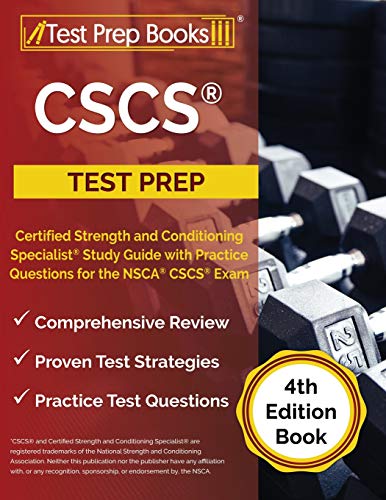
 Buy on Amazon
 Take courses on Udemy
 Prep course on Achievable
 Study guide on Mometrix