CSCS Exam 2026: Your Complete Certification Guide
The CSCS (Certified Strength and Conditioning Specialist) exam is a prestigious certification administered by the National Strength and Conditioning Association (NSCA). It's designed for professionals who train athletes to improve athletic performance, making it the gold standard certification for strength and conditioning coaches working with competitive athletes.
Whether you're working in collegiate athletics, professional sports, or private performance training, the CSCS credential demonstrates your expertise in designing and implementing safe, effective strength and conditioning programs.
Exam Format & Structure
| Component | Details |
|---|---|
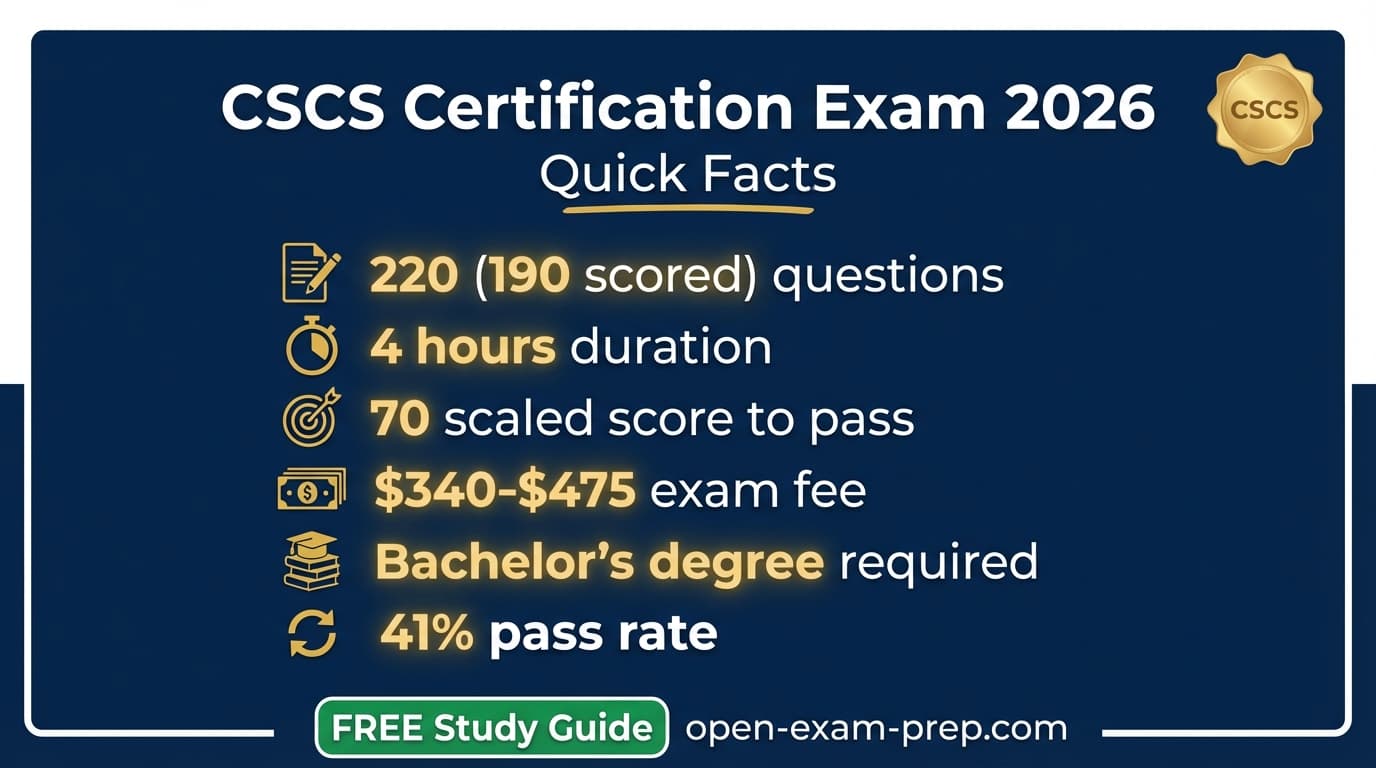
| Total Questions | 220 (190 scored + 30 nonscored) |
| Total Time | 4 hours (90 min + 150 min) |
| Section 1: Scientific Foundations | 95 questions (80 scored + 15 nonscored), 1.5 hours |
| Section 2: Practical/Applied | 125 questions (110 scored + 15 nonscored), 2.5 hours |
| Passing Score | Scaled score of 70 or higher on EACH section |
| 2025 Pass Rate | 50% combined (Scientific Foundations 71%, Practical/Applied 55%) |
| Cost | $340 (NSCA members) / $475 (non-members) |
| Testing Format | Computer-based at Pearson VUE centers |
The CSCS exam is divided into two separately scored sections:
- Scientific Foundations - 80 scored multiple-choice questions covering exercise science principles (90 minutes)
- Practical/Applied - 110 scored multiple-choice questions, including 30-40 video and image items, that test how you apply knowledge to real-world coaching scenarios (150 minutes)
You must earn a scaled score of 70 or higher on BOTH sections to earn the CSCS credential. If you pass one section but fail the other, you only need to retake the failed section at a reduced retake fee ($250 members / $385 non-members). As of December 31, 2025, 45,669 professionals held the CSCS credential (NSCA).
Start Your FREE CSCS Prep Today
Our comprehensive course covers all 7 content domains with detailed explanations and practice questions—100% FREE.
CSCS Eligibility Requirements
Before scheduling your exam, ensure you meet these requirements:
| Requirement | Details |
|---|---|
| Education (through Dec 31, 2029) | Bachelor's degree in any field from an accredited institution |
| CPR/AED | Current certification required before testing |
| Enrollment Option | Can sit for the exam as a college senior (last semester of a bachelor's program) |
Major 2030 Eligibility Change (verify before you apply)
NSCA is tightening the education requirement. Effective January 1, 2030, U.S. candidates must hold a bachelor's degree from a CASCE-accredited program (Council on Accreditation of Strength and Conditioning Education) to be eligible for the CSCS exam. This new requirement does not apply to non-U.S. candidates until January 2036.
What this means for you: If you test before January 1, 2030, the current rule still applies — a bachelor's in any field plus current CPR/AED. If you are early in your degree and plan to test in 2030 or later, confirm your program is CASCE-accredited (or on track to be). Always check the official NSCA page for the latest wording.
Note: Through 2029 you don't need a degree in exercise science - candidates from many backgrounds pass the CSCS exam. However, coursework in exercise physiology, biomechanics, and nutrition is highly beneficial.
CSCS Content Domain Breakdown
The CSCS exam tests knowledge across 7 content domains:
Section 1: Scientific Foundations (80 scored questions, 90 minutes)
Domain 1: Exercise Science (55% of section, ~44 questions)
- Muscle physiology and fiber types
- Energy systems (phosphagen, glycolytic, oxidative)
- Cardiovascular and respiratory physiology
- Biomechanics and movement analysis
- Bone and connective tissue physiology
- Neuroendocrine responses to exercise
Domain 2: Sport Psychology (24% of section, ~19 questions)
- Motivation techniques and goal setting
- Arousal and anxiety management
- Mental imagery and visualization
- Concentration and attention
- Self-confidence and self-efficacy
Domain 3: Nutrition (21% of section, ~17 questions)
- Macronutrient metabolism and energy balance
- Hydration strategies for athletes
- Pre/post-workout nutrition
- Supplements (evidence-based vs. prohibited)
- Body composition assessment and management
Section 2: Practical/Applied (110 scored questions, 150 minutes)
This section includes 30-40 video and image items that show exercises or coaching scenarios you must analyze.
Domain 4: Exercise Technique (36% of section, ~40 questions)
- Olympic lifts (clean, snatch, jerk variations)
- Powerlifts (squat, bench press, deadlift)
- Plyometric exercises and proper progression
- Speed and agility drills
- Flexibility exercises and stretching techniques
- Spotting techniques and safety protocols
Domain 5: Program Design (35% of section, ~38 questions)
- Needs analysis for specific sports
- Exercise selection and order
- Training load and volume calculations
- Periodization models (linear, undulating, block)
- Rest interval and training frequency
- Special populations (youth, female athletes)
Domain 6: Organization and Administration (11% of section, ~12 questions)
- Facility design and equipment placement
- Legal and safety considerations
- Scheduling and program organization
- Emergency action plans
Domain 7: Testing and Evaluation (18% of section, ~20 questions)
- Test selection for specific fitness components
- Test administration protocols
- Statistical analysis (validity, reliability, norms)
- Body composition testing methods
- Performance testing (1RM, power, speed, agility)
Free Practice Questions & Study Materials
Each chapter includes:
- Detailed content explanations
- NSCA-style practice questions
- Exercise technique breakdowns
- Key takeaways for quick review
Why the CSCS Has a Demanding Pass Rate
In 2025, the CSCS exam was administered to 9,650 candidates, and 50% passed both sections - up from 41% in 2024 but still one of the more demanding fitness certifications. Understanding the section split helps you prepare:
Section-Specific Pass Rates (NSCA, 2025)
| Section | 2025 Pass Rate | 2024 Pass Rate |
|---|---|---|
| Scientific Foundations | 71% | 68% |
| Practical/Applied | 55% | 44% |
| Combined (both sections) | 50% | 41% |
Because the two sections are scored separately and you must pass both, the combined rate is lower than either individual section. The Practical/Applied section remains the bigger hurdle.
Why the Practical Section is Harder
- Applied knowledge - Questions require you to apply concepts to specific scenarios
- Exercise technique - Must recognize correct form from descriptions/images
- Program design - Requires synthesizing multiple concepts
- Sport-specific knowledge - Questions cover many different sports
- Testing protocols - Must know exact procedures and normative data
Key Insight
Most candidates who fail struggle with the Practical/Applied section. Focus extra study time on exercise technique, program design, and testing protocols.
CSCS Study Timeline
| Timeline | Focus | Activities |
|---|---|---|
| Months 1-2 | Scientific Foundations | Exercise science, sport psychology, nutrition |
| Months 3-4 | Practical/Applied | Exercise technique, program design |
| Month 5 | Testing & Organization | Testing protocols, facility management |
| Month 6 | Final Review | Practice exams, weak area review |
Recommended: 300-500 hours total depending on background
Study Hours by Background
| Background | Recommended Hours |
|---|---|
| Exercise Science degree | 150-250 hours |
| Related degree (kinesiology, biology) | 250-350 hours |
| Unrelated degree | 400-500 hours |
Master CSCS Content with Our FREE Course
Our comprehensive course breaks down complex topics into easy-to-understand lessons with practice questions after each section.
Test-Taking Strategies
General Strategies
- Manage your time - Scientific section: ~1 min/question; Practical: ~1.3 min/question
- Flag difficult questions - Return to them if time permits
- Read questions carefully - Look for qualifying words (always, never, most, best)
- Eliminate wrong answers - Narrow down before selecting
For Scientific Foundations
- Know energy systems - Understand ATP-PC, glycolysis, and oxidative systems
- Memorize muscle actions - Origin, insertion, primary actions
- Understand adaptations - How the body responds to different training stimuli
- Learn biomechanical principles - Levers, force-velocity relationships
For Practical/Applied
- Study exercise technique - Know common errors and corrections
- Master periodization - Linear, undulating, block models
- Know the formulas - 1RM estimation, training load calculations
- Memorize testing protocols - Exact procedures for common tests
- Practice sport-specific scenarios - Apply knowledge to different athletes
Critical Formulas to Memorize
| Formula | Application |
|---|---|
| Load = Repetitions x Sets x Weight | Volume calculation |
| 1RM Estimation | Epley, Brzycki, Lombardi formulas |
| Training Load | Intensity x Volume |
| Max Heart Rate | 220 - age (estimate) |
| Work | Force x Distance |
| Power | Work / Time or Force x Velocity |
Common Topics to Master
Exercise Technique (High Priority)
| Exercise Category | Key Points |
|---|---|
| Olympic Lifts | Phases, common errors, progressions |
| Squat Variations | Depth, knee tracking, back position |
| Deadlift Variations | Conventional vs. sumo, hip hinge |
| Pressing Movements | Grip width, bar path, shoulder position |
| Plyometrics | Amortization phase, landing mechanics |
Program Design Considerations
For any athlete, consider:
- Needs analysis - What does the sport require?
- Training status - Beginner, intermediate, advanced?
- Competition schedule - When are important events?
- Available equipment - What resources exist?
- Individual factors - Injury history, strengths, weaknesses
Testing Protocols
Know exact procedures for:
- 1RM testing - Warm-up protocol, attempt progression
- Vertical jump - Countermovement vs. squat jump
- Pro agility - Setup, timing, starts
- 40-yard dash - Start position, timing methods
- Wingate test - Load calculation, protocol timing
Pass the CSCS Exam with Confidence
Join thousands of strength and conditioning professionals who passed their CSCS exam using our comprehensive, 100% FREE study materials. Our course includes:
- Complete content coverage of all 7 domains
- Exercise technique breakdowns with common errors
- Program design examples for various sports
- AI-powered study assistance for instant explanations
- Regularly updated for 2026 exam content
No credit card required. Start studying today.
Official Resources
- NSCA Official CSCS Information - Exam registration and requirements
- NSCA Certification Handbook - Complete policies and procedures
- Pearson VUE NSCA Testing - Schedule your exam
- NSCA CSCS Exam Content Description - Official content outline
- Essentials of Strength Training and Conditioning (4th Edition) - Official NSCA textbook
Official-Source Check Before You Schedule
Treat this article as a study map, not a substitute for the current CSCS exam candidate materials. Use the official candidate handbook, exam content outline, state agency page, or credential sponsor page as the source of truth for requirements that affect scheduling and eligibility. Requirements can change by testing window, jurisdiction, sponsor update, or delivery vendor, and those changes often affect small details candidates overlook: identification rules, retake timing, calculator policy, reference materials, continuing-education language, application approvals, and the exact way domains are named.
Before you pay for an exam date, make a one-page source checklist. Put the official exam page, candidate handbook, content outline or blueprint, fee page, accommodation instructions, and reschedule policy in one place. Then compare your prep materials against that checklist. If a prep book, course, or old post disagrees with the sponsor, follow the sponsor. This is especially important for candidates returning after a failed attempt because they may be studying from notes built around an older outline.
How To Read The Blueprint Without Overstudying
Do not read the CSCS exam outline like a table of contents. Read it like a risk map. Each domain tells you what the exam writer is allowed to test, but the action verbs tell you how the topic may appear. A verb such as identify usually points to recognition. A verb such as apply, analyze, evaluate, calculate, determine, or recommend means the question can require judgment, sequencing, or multi-step reasoning.
Use four passes through the outline. First, mark topics you already use at work. Second, mark topics you recognize but cannot explain without notes. Third, mark topics that have unfamiliar vocabulary. Fourth, mark topics that combine two skills, such as a rule plus a calculation or a policy plus a scenario. The fourth group deserves the most practice because it is where candidates often feel prepared while still missing points.
For CSCS exam, route your weekly study around these high-friction buckets:
- eligibility and scheduling rules
- scenario vocabulary
- domain-by-domain weak areas
- exam-day time control
The goal is not to give every line of the outline equal time. The goal is to convert weak, testable behaviors into repeatable decisions. If a topic is easy in isolation but difficult inside a mixed set, it belongs in your active rotation until it stays stable under time pressure.
Scenario Strategy For Hard Questions
Most candidates miss hard CSCS exam questions for one of three reasons: they answer the first familiar phrase, they ignore a limiting condition, or they spend too long trying to make every answer choice perfect. A better method is to treat each exam scenario as a short professional decision.
Start by naming the task in plain English. Ask: what is the exam actually asking me to decide? Then identify the controlling facts. Separate facts that change the answer from facts that merely describe the setting. Next, predict the principle before looking at the options. Even a rough prediction reduces the chance that an attractive distractor pulls you away from the rule, process, or judgment being tested.
When two answer choices remain, compare them against the exact role you are playing in the prompt. Are you acting as a supervisor, adviser, technician, manager, applicant, analyst, auditor, clinician, inspector, or public-facing professional? Exam writers often make the second-best option sound reasonable for the wrong role. If the question asks for the next action, prefer the answer that preserves safety, compliance, documentation, client interest, or process control before jumping to a final conclusion.
Practice Routing And Score Repair
Use practice questions as diagnostic data, not as a score-chasing game. After each timed block, tag every miss with one primary cause: content gap, vocabulary gap, careless reading, calculation setup, scenario judgment, or pacing. If you tag everything as content, your remediation will be too broad. If you tag every miss carefully, your next study block becomes obvious.
A strong remediation cycle has three steps. First, reread only the smallest source section that explains the miss. Second, write a one-sentence rule in your own words. Third, answer two or three nearby questions without notes. If you can only answer the original question after seeing the explanation, you have recognized the answer rather than repaired the skill.
Use mixed sets earlier than feels comfortable. Topic-by-topic drills build confidence, but the real exam rarely announces which rule is being tested. A mixed set forces you to identify the domain before solving. That recognition skill is part of readiness. Start with short mixed sets, then grow into longer timed blocks as your accuracy stabilizes.
Final Two-Week Readiness Plan
Two weeks before exam day, stop measuring progress by pages completed. Measure it by repeatable performance. Your target is not one lucky high score; it is several timed blocks where the same weak area no longer appears in the miss log.
During the first week, run alternating blocks: one targeted weak-area set, one mixed timed set, one review block, and one short recall session. The recall session should be closed-book. Write definitions, formulas, procedures, rule triggers, or decision steps from memory, then check them against the official outline and your notes.
During the final week, reduce new material. Keep daily contact with the hardest topics, but shift toward confidence, pacing, and clean execution. Rework missed questions from your log, especially the ones you missed twice. Review administrative requirements, testing location rules, remote-proctor rules if applicable, identification, permitted materials, and break policy. Those logistics are not content knowledge, but they can still disrupt performance if you handle them late.
Common Traps To Avoid
The first trap is passive rereading. Rereading feels productive because the material becomes familiar, but familiarity does not prove you can choose correctly under pressure. Convert reading into retrieval: close the source, explain the rule, then apply it.
The second trap is treating every miss as equal. A careless one-off miss needs a prevention habit. A repeated domain miss needs a study block. A pacing miss needs timed drills. A vocabulary miss needs flashcards or a glossary. Different misses require different repairs.
The third trap is delaying full-length or longer timed practice until the last few days. Longer practice exposes fatigue, sequencing problems, and weak time allocation. Find those problems while there is still time to fix them.
The fourth trap is ignoring why the right answer is right. For each reviewed item, write why the correct answer wins and why the best distractor fails. That second sentence is where durable learning happens.
When You Are Ready
You are ready for CSCS exam when you can explain the core domains without reading the outline, complete timed sets without rushing the final questions, and identify your miss patterns before checking the score report. You should also be able to say what you will do if the first ten questions feel harder than expected. The answer should be simple: slow down, return to the task, identify controlling facts, eliminate role-inconsistent options, and keep moving.
Passing is usually less about finding a secret resource and more about building a reliable loop: official source, focused study, timed practice, miss analysis, and targeted repair. Keep that loop tight, and every practice session has a job.

 Buy on Amazon
 Take courses on Udemy
 Prep course on Achievable
 Study guide on Mometrix