 View
ViewWhy Body Fat Calipers Are Essential for Fitness Certification Candidates
Every major personal trainer certification exam — NASM-CPT, ACE-CPT, ACSM-CPT, and CSCS — tests your knowledge of body composition assessment using skinfold calipers. This is not a minor topic. Body composition questions appear across multiple exam domains: fitness assessment, health screening, exercise programming, and special populations.
The reason is simple: skinfold measurement is the most practical, cost-effective, and widely used body composition method in the fitness industry. While DEXA scans cost $75-$200 per session and BIA devices range from $50 to $10,000, a quality skinfold caliper costs $10-$20 and delivers comparable accuracy when used with proper technique. Every personal trainer needs to own one, know how to use it, and understand the protocols behind it.
If you are preparing for your fitness certification, buying a caliper now and practicing the protocols on yourself and study partners will make exam questions significantly easier — because you will have hands-on experience to draw from, not just memorized theory. Study for your certification exam for free with our NASM-CPT study guide or ACE-CPT study guide.
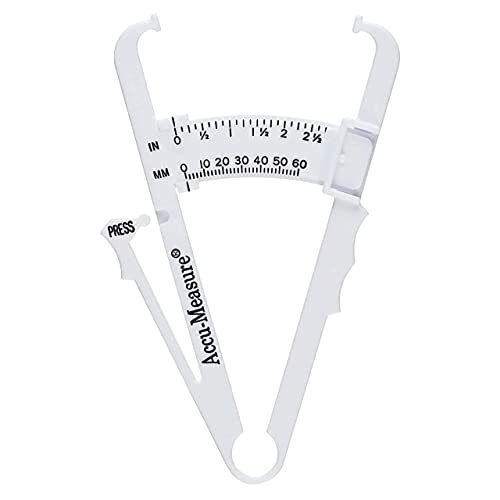
Accu-Measure Fitness 3000 Body Fat Caliper
by Accu-Measure
$9.99
- Spring-loaded mechanism delivers ACSM-standard consistent jaw pressure for repeatable measurements
- Most widely used personal caliper in NASM and ACE certification preparation
- Includes body fat percentage chart, measurement instructions, and tracking guide
The Jackson-Pollock Protocols: What Your Exam Will Test
The Jackson-Pollock skinfold protocols are the most frequently tested body composition methods on fitness certification exams. You need to know both the 3-site and 7-site versions, including which anatomical sites differ between males and females.
Jackson-Pollock 3-Site Protocol
The 3-site method is the most commonly used protocol in personal training settings because it is fast, practical, and accurate enough for client tracking. The sites differ by sex:
Males (3-site):
- Chest — diagonal fold, halfway between the anterior axillary line and the nipple
- Abdomen — vertical fold, 2 cm lateral to the umbilicus
- Thigh — vertical fold, midpoint between the inguinal crease and the proximal border of the patella
Females (3-site):
- Triceps — vertical fold, posterior midline of the upper arm, midway between the acromion and olecranon processes
- Suprailiac — diagonal fold, just above the iliac crest along the anterior axillary line
- Thigh — vertical fold, same landmark as males
The sum of the three skinfold measurements (in millimeters) is plugged into a sex-specific regression equation along with age to estimate body density. Body density is then converted to body fat percentage using the Siri equation: % Body Fat = (495 / Body Density) - 450.
For the exam: You must know which sites belong to which sex. A common exam trap is presenting male sites for a female client or vice versa. The thigh site is the same for both — that is the one consistent site across both protocols.
Jackson-Pollock 7-Site Protocol
The 7-site method is the gold standard for skinfold body composition assessment and is referenced extensively in ACSM and NSCA textbooks. It measures all seven sites regardless of sex:
- Chest — diagonal fold
- Midaxillary — vertical fold, at the level of the xiphoid process on the midaxillary line
- Triceps — vertical fold, posterior midline of the upper arm
- Subscapular — diagonal fold, 1-2 cm below the inferior angle of the scapula
- Abdomen — vertical fold, 2 cm lateral to the umbilicus
- Suprailiac — diagonal fold, above the iliac crest
- Thigh — vertical fold, midpoint of the anterior thigh
The 7-site protocol provides greater accuracy because it samples subcutaneous fat from more regions of the body, reducing the impact of individual site variation. The tradeoff is time — a full 7-site assessment with three measurements per site takes 15-20 minutes versus 5-10 minutes for the 3-site method.
For the exam: CSCS candidates should know that the 7-site method is preferred for athlete assessments where precision matters for performance programming. NASM-CPT and ACE-CPT exams tend to focus more on the 3-site method for general population clients. Practice these protocols with our free CSCS exam prep.
Proper Caliper Technique: The Details That Matter on Exam Day
Knowing the sites is only half the battle. Your certification exam will test whether you understand the correct measurement technique. Here is the step-by-step protocol that every major certification organization teaches.
Step-by-Step Skinfold Measurement Technique
-
Identify and mark the site. Use an erasable marker to mark the exact anatomical landmark. For the triceps, measure the distance from the acromion process to the olecranon process and mark the midpoint on the posterior midline.
-
Grasp the fold. Using the thumb and forefinger of your non-dominant hand, firmly pinch the skin and subcutaneous fat approximately 1 cm above the marked site. Lift the fold away from the underlying muscle — you should feel the muscle release beneath your fingers.
-
Place the caliper. Hold the caliper in your dominant hand and place the jaws perpendicular to the fold at the marked site (not at the pinch point above it). The jaws should be approximately 1 cm below your fingers.
-
Release and read. Fully release the caliper trigger so the full spring pressure is applied to the fold. Wait 2-3 seconds for the reading to stabilize — do not wait longer than 4 seconds or tissue compression will artificially reduce the measurement.
-
Record the measurement. Read to the nearest 0.5 mm and record immediately.
-
Rotate through sites. Take one measurement at each site, then cycle back through all sites for the second and third rounds. This rotation technique prevents tissue compression from repeated measurements at the same site.
-
Use the median. Of the three measurements at each site, use the median value (the middle number, not the average). If two measurements are identical, use that value.
Critical Technique Rules
- All measurements on the right side of the body — this is the ACSM convention and is consistent across all certification organizations
- Client should be standing with muscles relaxed during measurement
- Consistent caliper pressure is essential — ACSM-standard calipers apply approximately 10 g/mm² of jaw pressure; this is why spring-loaded calipers like the Accu-Measure Fitness 3000 are preferred over non-spring-loaded models
- Measurements should not vary by more than 1-2 mm between the three trials — if they do, technique needs improvement

Accu-Measure Body Fat Caliper
by Accu-Measure
$9.99
- Original Accu-Measure design — same price as the Fitness 3000 but without the spring-loaded upgrade
- Includes anatomical measurement guide and body fat chart
- We recommend the Fitness 3000 instead at the current identical price
The 5 Best Body Fat Calipers for Personal Trainers in 2026
Amazon prices verified July 2026. Amazon prices fluctuate daily; the prices below were confirmed at the time of writing but may differ slightly at purchase.
1. Accu-Measure Fitness 3000 — Best for Certification Students ($9.99)
Best for: NASM-CPT and ACE-CPT candidates who want the most widely used personal caliper in certification preparation.
The Fitness 3000 is the default recommendation for certification students. Its spring-loaded mechanism applies the ACSM-standard ~10 g/mm² jaw pressure regardless of how hard you squeeze the handles, which is critical because inconsistent jaw pressure is the number one source of measurement error in skinfold assessment. A trainee using a non-spring-loaded caliper can vary their readings by 5-10 mm between trials simply by applying different pressure — making the measurement useless.
The included body fat percentage chart is based on the suprailiac single-site method, which is the fastest body composition assessment in personal training. One pinch at the suprailiac site, cross-reference with the chart, and you have an estimated body fat percentage. This method is not as accurate as the 3-site or 7-site protocols, but it is practical for quick client check-ins and self-assessment.
With 4.1 stars and over 4,000 Amazon ratings, the Fitness 3000 has the largest user base of any personal caliper on the market. At $9.99, it is also the most affordable spring-loaded option on this list.
Pros:
- Spring-loaded mechanism for ACSM-standard consistent pressure
- Most widely used personal caliper in CPT certification preparation
- Includes body fat percentage chart (suprailiac single-site method), measurement instructions, and tracking guide
- Compact and easy to carry in a gym bag
- 4.1-star average from 4,000+ ratings
Cons:
- Narrower measurement range than the Sequoia TrimCal 4000
- Plastic construction — functional but not premium-feeling
- Single-site chart only — you need separate reference tables for 3-site and 7-site protocols
Accu-Measure Fitness 3000 Body Fat Caliper
by Accu-Measure
$9.99
- Spring-loaded mechanism delivers ACSM-standard consistent jaw pressure for repeatable measurements
- Most widely used personal caliper in NASM and ACE certification preparation
- Includes body fat percentage chart, measurement instructions, and tracking guide
2. Sequoia Fitness TrimCal 4000 — Best for Professional Use ($15.97)
Best for: Trainers who want a premium caliper for ongoing client assessments after certification.
The TrimCal 4000 offers a wider measurement range than the Accu-Measure models, making it more versatile for clients across all body fat levels. The dual-spring mechanism ensures balanced, consistent jaw pressure, and the build quality is noticeably more precise and durable. For trainers who plan to perform body composition assessments as a regular part of their client programming, the TrimCal 4000 is worth the $6 premium over the Fitness 3000.
With 4.3 stars and nearly 3,000 ratings, it has the highest rating of any standalone caliper on this list.
Pros:
- Wider measurement range accommodates more client body types
- Dual-spring mechanism for balanced, consistent pressure
- Premium build quality — more durable for daily professional use
- Professional-grade accuracy for multi-site Jackson-Pollock protocols
- Body fat chart included; 4.3-star average from ~3,000 ratings
Cons:
- $6 more than the Accu-Measure Fitness 3000
- Not as commonly seen in CPT study materials as the Accu-Measure (though functionally equivalent)
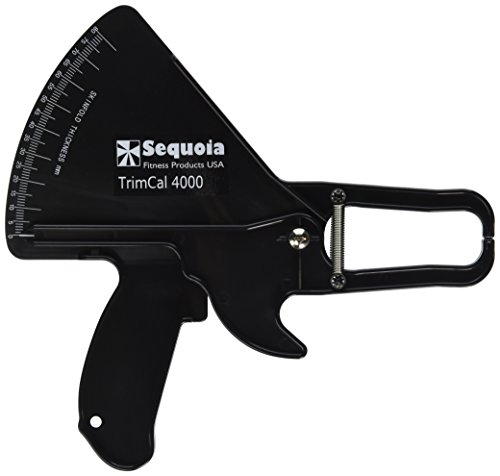
Sequoia Fitness TrimCal 4000 Body Fat Caliper
by Sequoia Fitness
$15.97
- Dual-spring mechanism for balanced, consistent jaw pressure across the wider measurement range
- Professional-grade accuracy suitable for Jackson-Pollock 3-site and 7-site protocols
- Body fat percentage chart included — ideal for ongoing client assessments
3. MEDca Body Fat Caliper and Measuring Tape Bundle — Best Caliper + Tape Combo Under $12 ($11.99)
Best for: Certification students who need both a caliper and measuring tape without paying for premium caliper quality.
The MEDca bundle gives you both tools for $11.99 — only $2 more than the Accu-Measure Fitness 3000 alone. The caliper is functional for learning technique, and the included measuring tape enables circumference measurements (waist, hip, arm, thigh), which are also tested on every major certification exam. The waist-to-hip ratio (WHR) is a key health risk indicator that requires a measuring tape — above 0.95 for males and 0.86 for females indicates increased cardiovascular disease risk per ACSM guidelines — and having both tools from day one lets you practice the complete fitness assessment battery.
With 4.0 stars and over 6,200 ratings, the MEDca bundle is the most-reviewed product on this list.
Pros:
- Caliper + measuring tape for $11.99 (only $2 more than a standalone Accu-Measure 3000)
- Measuring tape enables circumference assessments (WHR, body measurements) — also exam-tested
- Body fat chart included for quick reference
- 4.0-star average from 6,200+ ratings — largest review base of any product here
Cons:
- Caliper build quality is lower than Accu-Measure or Sequoia
- No spring-loaded mechanism — less consistent jaw pressure than the Fitness 3000
- Better suited as a student practice tool than for long-term professional use
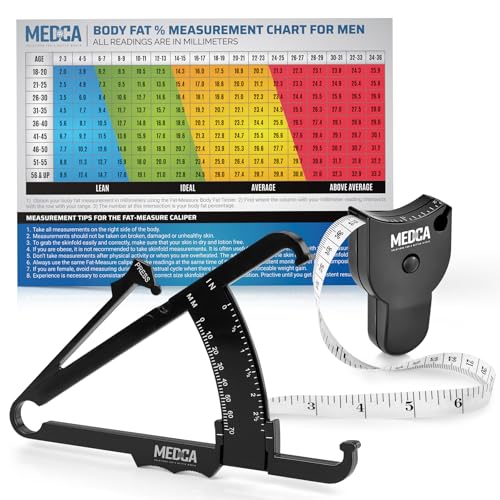
MEDca Body Fat Caliper and Measuring Tape Bundle
by MEDca
$11.99
- Caliper + measuring tape combo for $2 more than a standalone Accu-Measure Fitness 3000
- Measuring tape enables circumference assessments and waist-to-hip ratio — both exam-tested
- Body fat chart included; largest review base of any product on this list
4. Sequoia TrimCal 4000 with Tape Measure — Best Premium Bundle ($19.97)
Best for: Fitness professionals who want the best caliper and measuring tape combo for client assessments.
This is the premium bundle option. The Sequoia TrimCal 4000 caliper (reviewed above) paired with a retractable body measure tape gives you both assessment tools in professional-grade quality. The dual-sided precision design on the caliper provides accurate readings across the widest range of client body types, and the included tape measure is purpose-built for body circumference measurements.
At $19.97, it costs $8 more than the MEDca bundle but delivers meaningfully better caliper accuracy and durability. For trainers who are investing in tools they will use with paying clients after certification, the Sequoia bundle is the best long-term value.
Pros:
- Best overall build quality in a caliper + tape bundle
- Dual-sided precision design for professional accuracy
- Dual-spring caliper for consistent pressure
- Wide measurement range for diverse client body types
- 4.4-star average (highest-rated product on this list)
Cons:
- Most expensive option at $19.97 (still very affordable for a professional tool)
- Overkill for students who only need to practice technique for the exam

Sequoia TrimCal 4000 Body Fat Caliper with Tape Measure
by Sequoia Fitness
$19.97
- Dual-sided precision caliper paired with retractable body measure tape — best overall bundle
- Dual-spring mechanism for consistent pressure and wide measurement range
- Includes Fat% chart for men and women — purpose-built for fitness professionals
5. Accu-Measure Original Body Fat Caliper — Same Price as the Fitness 3000 ($9.99)
Best for: We recommend the Fitness 3000 instead. At the current $9.99 price — identical to the Fitness 3000 — there is no reason to choose the original over the spring-loaded upgrade.
The original Accu-Measure caliper is the predecessor to the Fitness 3000. It uses the same measurement principle but has simpler construction without the upgraded spring-loaded mechanism. At its previous lower price it was the budget pick; at the current $9.99, identical to the Fitness 3000, the Fitness 3000 is the better choice for the spring mechanism alone. We list it here for completeness, but our recommendation is to buy the Fitness 3000 instead.
Pros:
- Includes anatomical measurement guide and body fat chart
- Functional for learning pinch-and-read technique
Cons:
- Same price as the Fitness 3000 ($9.99) — no cost savings
- No spring-loaded mechanism — less consistent jaw pressure
- Simpler construction than the Fitness 3000
Accu-Measure Body Fat Caliper
by Accu-Measure
$9.99
- Original Accu-Measure design — same price as the Fitness 3000 but without the spring-loaded upgrade
- Includes anatomical measurement guide and body fat chart
- We recommend the Fitness 3000 instead at the current identical price
Quick Comparison: Which Caliper Should You Buy?
| Product | Price | Spring-Loaded | Measuring Tape | Build | Rating | Best For |
|---|---|---|---|---|---|---|
| Accu-Measure 3000 | $9.99 | Yes | No | Good | 4.1 stars (4,076) | Cert students |
| Accu-Measure Original | $9.99 | No | No | Basic | 4.0 stars (693) | Skip (buy 3000) |
| MEDca Bundle | $11.99 | No | Yes | Basic | 4.0 stars (6,282) | Budget bundle |
| Sequoia TrimCal 4000 | $15.97 | Yes (dual) | No | Premium | 4.3 stars (2,962) | Pro trainers |
| Sequoia TrimCal Bundle | $19.97 | Yes (dual) | Yes | Premium | 4.4 stars (160) | Pro bundle |
Decision framework:
- Studying for NASM-CPT or ACE-CPT? Get the Accu-Measure Fitness 3000 ($9.99). It is the most widely used personal caliper in certification preparation, features spring-loaded consistency, and includes everything you need for self-assessment and practice.
- Need both a caliper and a measuring tape on a budget? Get the MEDca Bundle ($11.99). For $2 more than a standalone Accu-Measure 3000, you get both tools — enough for the full fitness assessment battery including waist-to-hip ratio.
- Planning to use it with paying clients? Get the Sequoia TrimCal 4000 ($15.97) or the Sequoia Bundle ($19.97) for premium accuracy and durability.
- Skip the Accu-Measure Original — at $9.99 it is the same price as the spring-loaded Fitness 3000, so there is no reason to choose it.
Professional and Research-Grade Calipers
The five calipers above cover what most personal trainers need. If you work in a clinical, research, or high-performance athletic setting, you may encounter these research-grade instruments — and the CSCS exam references them as the tools used in validated body composition research:
- Slim Guide (~$30-$37) — A plastic caliper with a dual-spring mechanism delivering the ACSM-standard 10 +/- 1.0 g/mm² jaw pressure and a 0-80 mm measurement range. Widely used in exercise science research and ISAK anthropometry courses. The affordable research-grade option and the caliper most similar in design to the TrimCal 4000.
- Lange (~$218-$263) — A metal caliper manufactured by Beta Technology/NutriActiva with +/-1.0 mm precision and a 0-60 mm range. Favoured by exercise physiologists for durability and consistent pressure. Now manufactured by NutriActiva LLC, who acquired it from Seko USA in 2023.
- Harpenden (~$386) — The research gold standard, manufactured by Baty/Bowers Group in the UK. +/-0.2 mm precision with a 0-80 mm range. Used in the original Jackson-Pollock validation studies. The most precise skinfold caliper available.
These instruments cost 3-40x more than the personal calipers above and are overkill for certification students and most personal training work. They appear on CSCS exam content as the reference instruments for validated body composition research.
Body Composition on Your Certification Exam: What to Expect
Body composition assessment appears in multiple domains across every major fitness certification exam. Here is where you will encounter it and what to study.
NASM-CPT Exam
Body composition is covered in the Fitness Assessment domain. NASM uses the Optimum Performance Training (OPT) model, and body composition assessment falls under objective measurements in the initial client assessment phase. Key topics: skinfold protocols (Durnin-Womersley 4-site and Jackson-Pollock 3-site), circumference measurements, waist-to-hip ratio, and ACSM body fat classification ranges. NASM also tests your understanding of when to refer a client to a healthcare provider based on body composition results.
ACE-CPT Exam
Body composition appears in the Client Assessment domain. ACE emphasizes the practical application: knowing which assessment method to choose for different clients, understanding the limitations of each method, and being able to explain results to clients in motivating (not discouraging) terms. ACE also tests behavioral coaching around body composition goals — helping clients set realistic expectations and focus on health markers rather than a specific number.
ACSM-CPT Exam
ACSM provides the most detailed body composition content because ACSM publishes the clinical guidelines that other certifications reference. Expect questions on the full range of assessment methods (skinfold, BIA, hydrostatic weighing, DEXA), standard error of estimate for each method, and the ACSM body fat classification table. ACSM also tests your knowledge of body composition changes across the lifespan and special populations.
CSCS Exam
The CSCS exam tests body composition in the context of athlete assessment and performance programming. Key topics: using body composition data to guide weight class decisions, periodizing nutrition around training phases, and understanding the performance implications of body composition changes. The 7-site Jackson-Pollock protocol is preferred for athlete assessments because of its higher accuracy. Study for the CSCS exam for free at OpenExamPrep CSCS study guide.
Why Skinfold Measurement Still Matters in 2026
With smart scales, BIA devices, and wearable technology everywhere, you might wonder why certification exams still test manual skinfold measurement. The answer comes down to three factors that every personal trainer needs to understand.
1. Cost and Accessibility
A body fat caliper costs $10-$20. A quality BIA device costs $50-$200 for consumer-grade, $1,000-$10,000 for medical-grade. DEXA scans cost $75-$200 per session. Many personal trainers — especially those starting their careers — work in settings without access to expensive equipment. Skinfold calipers are the one body composition tool that every trainer can afford and carry in their gym bag.
2. Tracking Consistency
The most valuable use of body composition data is tracking changes over time, not the absolute number. A caliper used with consistent technique by the same technician at the same time of day produces highly reproducible measurements — even if the absolute body fat percentage has a 3.5% margin of error. What matters is whether the number is going up, down, or staying the same over weeks and months. Calipers excel at this because the variables are controlled by the technician, not by hydration status (BIA) or machine calibration (DEXA).
3. Practical Skill Development
Using skinfold calipers develops your understanding of where the body stores fat, how subcutaneous fat distribution differs between individuals, and how to communicate professionally about a sensitive topic. These are skills that no device can teach. When you manually measure a client's body composition, you build a tactile understanding of anatomy that makes you a better trainer overall.
Free Personal Trainer Certification Prep Resources
A quality body fat caliper is one piece of your certification toolkit. Build your knowledge with these free resources:
- Free NASM-CPT Study Guide — Complete coverage of the OPT model, fitness assessment, exercise science, program design, and client coaching
- Free ACE-CPT Study Guide — Client assessment, behavioral coaching, exercise programming, and professional responsibility
- Free ACSM-CPT Study Guide — ACSM guidelines, clinical exercise physiology, health screening, and body composition standards
- Free CSCS Exam Prep — Athlete assessment, performance programming, sport science, and strength training principles
- AI Tutor — 10 free questions per day — ask about body composition protocols, exercise science, anatomy, or any fitness certification topic
- Practice Questions — Test your knowledge with exam-style questions and detailed explanations for every answer
The AI tutor is particularly useful for body composition study. Ask it to walk you through the Jackson-Pollock 3-site protocol for a female client, or to quiz you on the ACSM body fat classification ranges, and get detailed, exam-level responses instantly.
Final Verdict
Buy the Accu-Measure Fitness 3000 ($9.99) if you are studying for your NASM-CPT or ACE-CPT certification. It is the most widely used personal caliper in certification preparation, features spring-loaded consistency, and includes everything you need for self-assessment and practice.
Buy the Sequoia TrimCal 4000 ($15.97) or the Sequoia TrimCal 4000 Bundle with Tape Measure ($19.97) if you want premium build quality for ongoing client assessments after certification. The wider measurement range and durability make it the better long-term investment for working trainers.
Buy the MEDca Bundle ($11.99) if you need both a caliper and measuring tape for $2 more than a standalone Accu-Measure 3000. It is the most practical way to get both skinfold and circumference assessment tools on a student budget.
Skip the Accu-Measure Original ($9.99) — at the same price as the spring-loaded Fitness 3000, there is no reason to choose it.
Whatever caliper you choose, pair it with serious exam preparation. Start studying today with our free NASM-CPT study guide and practice questions.
As an Amazon Associate, OpenExamPrep earns from qualifying purchases. All recommendations are based on editorial review.

 Free CE
 Practice exams on ExamEdge
 Flashcards on Mometrix
 Take courses on Udemy


 Prep course on Achievable