A 58-year-old man with type 2 diabetes has a clinic BP of 152/94 mmHg confirmed on two further readings and a urine albumin-to-creatinine ratio of 8 mg/mmol. Which antihypertensive class is the most appropriate first-line agent?
Chronic Diseases
Question · Medium
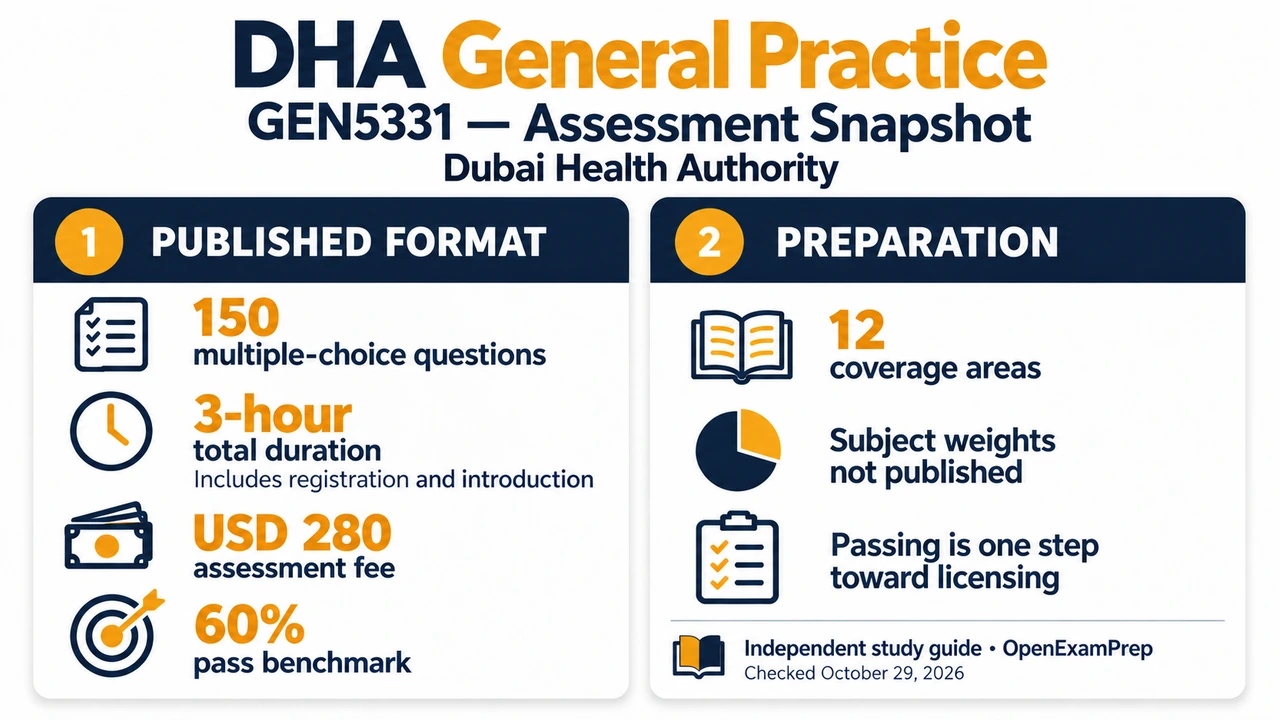
DHA GP Exam 2026: GEN5331 Format, Eligibility and Study Plan
Blog
A newly diagnosed type 2 diabetic has no contraindications. What HbA1c target and first medication should you set?
Flashcard
A 64-year-old woman with type 2 diabetes has an HbA1c of 8.4% (68 mmol/mol) despite maximal metformin, a BMI of 33, and established atherosclerotic cardiovascular disease. Which add-on agent best addresses both her glycaemic and cardiovascular needs?
To send a patient with a serious condition to a specialist for more intensive care.
General Scope
Guess the Term
Chapter 1: Chronic Cardiovascular & Endocrine Disorders
1.1 Hypertension Management in Primary Care
Study guide
Cheat sheet
A 45-year-old man with hypertension has an LDL-C of 4.2 mmol/L, no prior cardiovascular disease and a 10-year QRISK3 estimate of 18%. Under NICE guidance, what lipid-lowering treatment should be offered after discussing lifestyle changes, benefits and harms?
Question · Easy
Read the clue and guess the term in 6 tries.
Game
Your type 2 diabetic patient has established ASCVD. Which drug class should you add regardless of HbA1c control?
A 70-year-old man with COPD has had two moderate exacerbations in the past year despite regular use of a long-acting beta-agonist with good technique. He has no asthma and a blood eosinophil count of 60 cells/microlitre. What is the most appropriate inhaler step-up?
To keep accurate, adequate notes about a patient.
A 52-year-old woman with confirmed asthma has symptoms on most days and wakes with symptoms about once a week. She uses only a short-acting beta-agonist and is not acutely unwell. Under the preferred GINA treatment track, what regimen should she start?
A diabetic patient reports shakiness and sweating with capillary glucose 3.0 mmol/L. What is first-line treatment?
A 60-year-old man presents with central crushing chest pain for 40 minutes. ECG shows 2 mm ST-segment elevation in leads II, III and aVF. Which coronary artery is most likely occluded?
Acute Common Medical Problems
Relating to a physician's duties under medical liability law.
1.2 Type 2 Diabetes Mellitus Management
A 68-year-old woman with hypertension and diabetes has ECG-confirmed atrial fibrillation. She has no mechanical valve, moderate-to-severe mitral stenosis or other contraindication to anticoagulation. What is the most appropriate stroke-prevention therapy?
Swap tiles to line up three of the same term.
Term Match
What three findings confirm diabetic ketoacidosis (DKA)?
A 55-year-old man with stage 3b chronic kidney disease (eGFR 38 mL/min/1.73m2) and a serum potassium of 6.2 mmol/L has peaked T waves on ECG. What is the most immediate priority in management?
Emergency Problems
Question · Hard
A patient's own residence, which a GP may visit on request.
A 50-year-old woman with mild fatigue has a first TSH measurement of 9.8 mIU/L, normal free T4 and positive anti-TPO antibodies. She is not pregnant. What is the most appropriate next step?
What are the office blood pressure targets for a general adult versus a diabetic or CKD patient?
A 35-year-old woman presents with weight loss, palpitations, heat intolerance and a fine tremor. Examination shows a smooth diffuse goitre and bilateral exophthalmos. Which diagnosis is most likely?
The weight-for-height number used to guide nutrition and activity advice.
Adolescent Health
1.3 Dyslipidemia & Thyroid Disorders
A 63-year-old man with heart failure with reduced ejection fraction (EF 30%) remains breathless on an ACE inhibitor and a beta-blocker. He has no renal impairment and a normal potassium. Which agent is most appropriate to add to reduce mortality?
Flip two cards at a time to find matching terms.
Term Pairs
A diabetic patient has microalbuminuria and hypertension. What is the first-line antihypertensive?
A 48-year-old man with a 30-pack-year smoking history reports productive cough on most days for at least three months in each of the past two years. His post-bronchodilator FEV1/FVC ratio is 0.62. What is the most likely diagnosis?
A sudden loss of blood flow to the brain, a cardiovascular disease a GP must recognize.
Cardiology
A 55-year-old man with osteoarthritis of the knee has persistent pain limiting walking despite weight loss and topical NSAIDs. He has well-controlled hypertension and normal renal function. What is the most appropriate next pharmacological step?
A patient's blood pressure remains uncontrolled on three antihypertensives (ACEi/ARB + CCB + thiazide) at full dose. What do you add next?
A 40-year-old woman has symmetrical metacarpophalangeal synovitis and morning stiffness lasting over an hour for three months. Rheumatoid factor is negative. Which additional blood test is most useful for supporting the suspected diagnosis?
Chest pain from reduced blood flow to the heart.
Chapter 2: Chronic Respiratory, Renal & Musculoskeletal Disorders
2.1 Asthma & COPD Maintenance
A 67-year-old postmenopausal woman sustains a low-trauma wrist fracture. Her DXA scan shows a T-score of -2.7 at the femoral neck. Aside from calcium and vitamin D, which is the most appropriate first-line drug treatment?
Find five hidden terms in a grid of letters.
Term Search
What single prescribing rule must you never break when starting a LABA in asthma?
A 62-year-old man with type 2 diabetes attends for annual review. His feet show reduced sensation to a 10 g monofilament bilaterally but pulses are present and skin is intact. What is the most appropriate management of his feet?
An itchy skin inflammation a GP recognizes among major skin diseases.
Dermatology
A 38-year-old man with community-acquired right lower lobe pneumonia has a CURB-65 score of 1. He is clinically stable, has adequate oxygenation, can take oral medicines and has no penicillin allergy. What is the most appropriate treatment?
What defines CKD stage 3?
A 29-year-old nonpregnant woman with normal kidney function has dysuria, frequency, suprapubic discomfort and a dipstick positive for nitrites and leukocytes. She has no fever or flank pain. If treating now, which is the most appropriate empiric antibiotic?
Loading more…