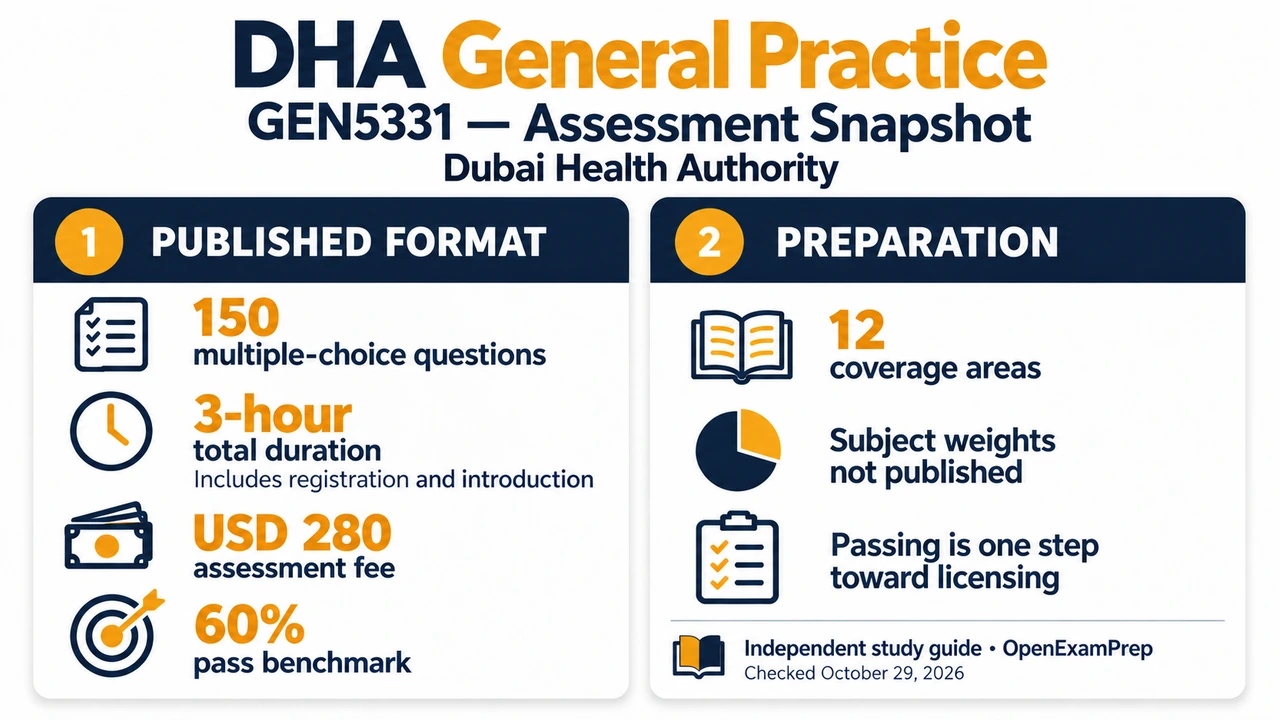
The DHA General Practice assessment, code GEN5331, is the Dubai Health Authority's computer-based assessment for the General Practitioner title. DHA's September 2026 CBT guideline lists 150 multiple-choice questions, three hours, a USD 280 assessment fee and a 60% pass score. Its introduction says the duration includes registration and the process introduction. The GP page lists 12 coverage areas without published subject percentages.
That distinction changes your preparation: cover the whole list, identify your own weak areas, and use the answering time actually displayed at your appointment. A commercial question bank's topic split does not establish the live exam's blueprint.
This guide, checked October 29, 2026, combines the current assessment documents with an application worksheet and an adaptable six-week revision plan. Start with our DHA GP practice questions, then use the study guide to investigate the reasoning behind each error. Our material is independently written practice, not official DHA questions.
Confirm GEN5331 before choosing a preparation course
DHA means Dubai Health Authority, the regulator. Dubai Health is a healthcare provider; it is not a replacement name for the licensing authority. The Dubai government explains their different roles. A specialist title also should not be assumed to use the GP assessment.
| Your booking check | Current published information | Preparation consequence |
|---|---|---|
| Assessment | General Practice, GEN5331 | Match the professional title and code on your application |
| Format | 150 MCQs | Practise making a defensible choice from clinical information |
| Listed duration | Three hours, including registration and introduction | Do not assume 180 minutes of answering time |
| Pass score | 60% | Avoid converting the benchmark into a guaranteed raw-answer count |
| Assessment fee | USD 280 | Budget separately for verification and licensing services |
| Coverage | Twelve areas; their percentages are not published | Use a coverage checklist rather than invented weights |
The current assessment manual, section 7.2, says result calculation uses correct answers and domain weighting. Therefore, “90 correct out of 150 guarantees a pass” goes beyond the published scoring information. The Prometric Learning Outcome letter identifies broad strengths and weaknesses; the official result comes through Sheryan as pass or fail, within two working days under that manual. Your numeric score is not shared.
The cited documents do not establish a separate 165-minute answering clock or a universal negative-marking rule. Follow the instructions supplied for your own assessment rather than treating commercial preparation claims as test-day policy.
Build an eligibility file before spending on the exam
The Unified Professional Qualification Requirements and DHA's licensing manual, version 1.4 effective September 30, 2026, govern qualifications and licensing. Read the GP row alongside the general physician rules and applicable amendments. The current licensing manual expressly refers to amendments after earlier versions of the PQR.
For the standard GP route, organise evidence of your recognised primary medical degree, internship, post-internship clinical experience, professional registration and good standing. The PQR requires at least five years of medical study excluding internship, a one-year internship and two years of clinical experience for this title. Its section 4.2 exempts UAE nationals, children of Emirati women and non-UAE graduates of UAE universities from GP experience requirements within three years of internship completion. Examine the applicable conditions rather than assuming a two-year exemption window. Experience and exam exemptions are separate provisions.
Create a simple evidence sheet before submitting documents:
| Evidence category | What to record | Error to catch before submission |
|---|---|---|
| Medical qualification | Award, institution, study dates and recognition | Selecting a title that your qualification does not support |
| Internship | Completion certificate, dates and rotations | Counting the same period again as post-internship experience |
| Clinical work | Employer, licensed role and exact dates | Adding observership time to qualifying clinical experience |
| Registration and good standing | Issuing regulator and current certificate | Using employer evidence where a regulator's certificate is required |
| Exemptions or practice gaps | Exact applicable provision and supporting documents | Assuming an exemption from another person's circumstances |
| Prior assessments | Authority, title, dates and outcomes | Treating a change of authority as a fresh attempt history |
Qualifying experience means licensed, hands-on work during salaried employment or a contractual period. Observerships, volunteer work and clinical attachments are excluded from that definition. For example, 14 months of qualifying clinical employment plus ten months observing does not establish 24 months of qualifying employment. The PQR requires good standing evidence no older than six months; a specified employer alternative exists where the country lacks a regulatory body. If an exemption or alternative might apply, identify it before concluding whether your file is complete.
Use the Sheryan self-assessment tool as an initial check. Version 1.4 makes clear that its result is preliminary: DHA still reviews the application and verifies supporting information. An agent's assurance or a successful practice mock does not resolve missing qualification evidence.
Keep the five administrative milestones separate
Plan your application as a sequence of different decisions, with a separate record for each. This helps when a document is returned for clarification: you can see whether the issue concerns credentials, booking or registration rather than restarting everything.
- Choose your title and complete self-assessment. Save the title, your DHA Unique ID and the application requirements. Read any request for additional evidence before paying for extra services.
- Arrange primary source verification. Submit the required credentials through the authorised verification process. Keep the verification reference and resolve discrepancies with the issuing institution or regulator.
- Generate the assessment Eligibility ID and book. Use the official Prometric DHA route, check GEN5331 and confirm that identity details match your valid passport. Keep the appointment confirmation.
- Complete the assessment and check Sheryan. Keep the Learning Outcome letter distinct from DHA's final pass/fail result. If a technical problem occurs, report it to centre staff during the assessment.
- Obtain registration and employer activation. Registration is valid for one year under section 10.12 of the current licensing manual. A hiring facility must activate the professional licence before you practise; passing the test alone is insufficient.
Make a budget from your actual service quotes
The published USD 280 is the GP assessment fee, not a complete licensing package. Build a budget with separate lines for eligibility review where required, primary source verification, assessment booking, registration and facility activation. Add translations or additional credential checks only if your case requires them.
For each line, record the charging organisation, currency, tax, included documents, refund terms and quote date. Compare like-for-like packages: a verification price covering fewer documents is not necessarily cheaper once extra checks are added. Ask who will pay the activation costs when discussing employment. This is more reliable than applying one approximate internet package price to every physician.
Cover the twelve areas without inventing a percentage split
The following checklist follows the published GP coverage list. The revision prompts are our study suggestions, not additional official subdomains or estimates of question frequency. Work through every row before allocating extra sessions to your weaker topics.
| Published coverage area | A useful question to practise |
|---|---|
| Chronic diseases | What finding changes investigation, treatment monitoring or follow-up? |
| Acute and/or common medical problems | Which common diagnosis fits, and what finding makes the presentation urgent? |
| Common pediatric problems | How do age, hydration and respiratory findings change the next step? |
| Women health | Which reproductive or pregnancy-related context changes the differential? |
| Emergency problems | What must happen first, and what makes an intervention unsafe now? |
| Common surgical problems | Which presentation needs urgent surgical assessment rather than routine follow-up? |
| Common psychiatric problems | What immediate risk and relevant physical causes need assessment? |
| Common eye and ENT problems | Which symptom threatens vision, airway or another critical function? |
| Common derma problems | What distinguishes the likely condition from its important mimics? |
| Basic epidemiology and EBM concepts | What population, outcome, denominator and follow-up period does a number describe? |
| Family medicine concepts | How will continuity, patient circumstances and shared decisions affect care? |
| Screening and periodic health examination | Is this screening an asymptomatic person, or investigating a symptom? |
Build an error log using these rows. After each practice set, record the decision you missed, the cue you overlooked and the source you used to correct it. “Read more cardiology” is difficult to act on; “recheck renal function after starting a renin–angiotensin system inhibitor” gives your next session a clear purpose. Use flashcards for a distinction you keep confusing, and the cheat sheet as a retrieval prompt after you understand the reasoning.
Practise decisions, not isolated cutoffs
Consider a patient whose creatinine changes from 1.30 to 1.55 mg/dL after starting an ACE inhibitor. The increase is (1.55 - 1.30) / 1.30 x 100, approximately 19.2%. That calculation alone should not be confused with a mandatory stop rule. KDIGO's 2024 CKD guideline discusses continuing ACE inhibitor or ARB treatment unless creatinine rises by more than 30% within four weeks, while separately considering symptomatic hypotension and uncontrolled hyperkalaemia. Practise reading the patient's symptoms, potassium and follow-up plan together.
Emergency algorithms also change. The 2024 international hyperglycaemic-crises consensus advises potassium replacement and delaying insulin when an adult with DKA has potassium below 3.5 mmol/L, until it rises above 3.5 mmol/L. An older memorised 3.3 threshold can therefore produce the wrong answer. Use this as a revision method: attach the guideline date and relevant clinical conditions to a treatment rule, then test whether a new vignette actually meets them.
For epidemiology, write units and the time horizon before calculating. If a hypothetical trial reduces a five-year event risk from 12% to 8%, the absolute reduction is four percentage points, or 0.04; the five-year number needed to treat is 1 / 0.04 = 25. It is not four patients, and the result should not be silently presented as a one-year benefit. Explaining why the other calculations fail helps you recognise a changed question rather than memorising its answer.
An adjustable six-week plan around clinical work
This is an editorial preparation plan, not a DHA requirement or a promise that everyone needs six weeks. Start with a mixed diagnostic set and check whether you can explain the answer without reading the explanation first. Extend the plan if your clinical experience is concentrated in one specialty or your baseline shows broad gaps.
Weeks one and two: rebuild breadth. Cover chronic and acute medicine, then visit every other coverage row at least once. Use manageable sets, such as 20 original practice questions followed by review. Spend time explaining the strongest alternative answer; if two options seem equally good, identify the missing discriminating fact. Keep unanswered questions separate from incorrect ones so slow reading does not look like a knowledge gap.
Week three: review urgent decisions and surgical presentations. Compare “most likely diagnosis,” “initial action” and “next investigation” questions about similar presentations. Your notes should explain why the order changes. Revisit a current guideline when a remembered algorithm conflicts with a source; do not resolve the disagreement by trusting whichever question bank gives a more confident explanation.
Week four: rotate through pediatrics and women's health. Change one feature of a case at a time, such as age, pregnancy status or clinical stability, and explain whether it changes the next step. Add brief sessions for eye/ENT, dermatology and psychiatry rather than postponing those areas until the final evening. The order here reflects a workable revision sequence, not an official weighting.
Week five: connect family medicine, screening and evidence appraisal. Separate investigation of symptoms from screening; distinguish relative and absolute effects; explain a patient's options in plain language. Review the coverage checklist and revisit the topics with repeated reasoning errors. Count how often you can solve an unfamiliar case, not just how many cards you have clicked through.
Week six: practise mixed decisions and appointment logistics. Use mixed sets whose answer order you have not memorised. Review all wrong answers and correct guesses before taking another set. For an endurance exercise, assemble 150 original practice items if available, but label your chosen answering time as a practice assumption. This does not establish the live exam's answering clock. Confirm your passport, booking location and instructions while there is still time to fix an administrative problem.
Pace from the clock you are actually given
At the appointment, read the tutorial and the displayed timing instructions. Do not build a plan that spends the entire published three-hour appointment answering questions while also promising time for registration and review.
For practice, choose an explicit answering budget T and a review reserve R. Your first-pass average is (T - R) / 150 minutes per item. For example, if you choose a 150-minute practice answering budget with 15 minutes reserved, the first pass has 135 minutes: 54 seconds per item. That is an arithmetic exercise, not a claim that DHA gives a 150-minute answering clock. Shorter practice sets can use the same method without requiring a full simulated appointment every day.
Track whether delays come from missing knowledge, extracting information or indecision between plausible options. Correct those causes separately. A faster first pass is useful only if you can still read the patient's qualifiers and choose safely.
Retakes and appointment changes: read the current clauses
Sections 7.4–7.6 of the September 2026 licensing manual describe three attempts, a two-year DHA reapplication block following a third failure, and permission-based fourth-attempt or later requalification provisions. Declare attempts across authorities; a fourth attempt is not an automatic entitlement. Section 7.10 imposes no fixed interval between reassessments, subject to availability. Check your own permitted attempts before booking again.
The May 2025 assessment manual says CBT cancellation or rescheduling should occur five calendar days before the exam, with applicable charges and non-refundable exam fees. It also specifies arriving 30 minutes before the appointment and bringing a valid passport whose details match the registration. Read your current confirmation as well, particularly if you need to change the centre or identity details.
Your next useful step is to check one administrative uncertainty, then take a small DHA GP practice set. Use its mistakes to select a study-guide section and update your coverage checklist. That gives you a concrete preparation decision without relying on invented weights or a claimed pass guarantee.
