The short answer: choose by what you produce, not by your job title
Anthropic runs four Claude certification exams, and every one of them uses the same 120-minute clock and the same 720 scaled cut score. What separates them is the artifact you are expected to be able to produce.
- You produce documents, analyses, and repeatable Claude workflows for a business team. Take CCAO-F.
- You produce shipping code against the Claude API, Claude Code, and Model Context Protocol servers. Take CCDV-F.
- You produce agentic system designs and configure Claude Code for other engineers. Take CCAR-F.
- You produce enterprise architecture decisions and defend them to security, legal, and executive stakeholders. Take CCAR-P.
Nothing gates you. The CCAO-F, CCDV-F, and CCAR-P exam guides, all Version 1.0 effective July 2026, each state that "There are no mandatory prerequisites or courses required to sit this exam" and that the credential is "awarded based on exam performance alone." The CCAR-F guide states no prerequisite rule of any kind; it describes a candidate who "typically has 6+ months of practical experience building with Claude APIs, Agent SDK, Claude Code, and MCP." Anthropic's certification FAQ separately confirms that Foundations does not convert to Professional. You can take them in any order, or take exactly one and stop.
The four Claude certifications side by side
| CCAO-F | CCDV-F | CCAR-F | CCAR-P | |
|---|---|---|---|---|
| Full name | Claude Certified Associate, Foundations | Claude Certified Developer, Foundations | Claude Certified Architect, Foundations | Claude Certified Architect, Professional |
| Fee (USD) | $99 | $125 | $125 | $175 |
| Scored items | 60 | 53 | 60 | 63 |
| Time limit | 120 min | 120 min | 120 min | 120 min |
| Minutes per item | 2.00 | 2.26 | 2.00 | 1.90 |
| Item structure | Standalone items | Standalone items | 4 scenarios drawn from a bank of 6 | Standalone items |
| Content domains | 7 | 8 | 5 | 7 |
| Passing score | 720 (scale 100 to 1,000) | 720 | 720 | 720 |
| Validity | 12 months | 12 months | 12 months | 12 months |
| Counts toward Claude Partner Network status | No | Yes | Yes | Yes |
Every exam uses multiple-choice and multiple-response items, and each item tells you how many responses to select. Delivery is proctored through Pearson VUE, online or at a test center.
Match the exam to your role
| Your role | Start here | Why | Skip |
|---|---|---|---|
| Project manager, operations lead, marketing, HR, communications | CCAO-F | The blueprint is written for people who translate business goals into Claude work, not for people who write code | CCDV-F entirely |
| Consultant or delivery lead who scopes Claude work but does not build it | CCAO-F, then CCAR-F | CCAO-F proves use-case judgment; CCAR-F is what your firm's partner tier actually counts | CCAR-P until you have shipped production systems |
| Software engineer with 1 to 5 years experience shipping Claude features | CCDV-F | About 61 percent of the blueprint is application integration, model selection, and prompt engineering | CCAO-F, which tests workplace judgment you already exercise |
| Engineer who configures Claude Code and designs agents for a team | CCAR-F | It is the only exam that tests Claude Code configuration at 20 percent | CCDV-F if your work is design rather than delivery |
| Solution architect with 3+ years in systems architecture | CCAR-P | Stakeholder Communication and Lifecycle Management is 14 percent and appears on no other exam; with governance it is 28 percent of the paper | CCAR-F, which is not a prerequisite |
| Individual with no Claude Partner Network affiliation | None yet | Registration requires a partner email on a recognized company domain, and personal addresses will not work | All four, until your organization joins |
What each exam actually tests
CCAO-F: Claude Certified Associate, Foundations
Seven domains, 60 items, $99. The blueprint is deliberately lopsided toward judgment rather than product trivia:
- Output Evaluation and Validation, 21 percent
- Workflow Integration and Solution Design, 16 percent
- Governance, Risk, and Responsible Use, 15 percent
- Prompting and Task Execution, 14 percent
- Product and Model Selection, 12 percent
- Configuration and Knowledge Management, 12 percent
- Troubleshooting and Optimization, 10 percent
Validation, governance, and workflow design together are 52 percent. Two of the three published sample questions in the official guide are decided on validation and data-sensitivity grounds, not on knowing a feature name. If you are choosing between CCAO-F and nothing at all, this is the exam that a non-engineer can prepare for with real workplace experience. Our full breakdown lives in the CCAO-F exam guide.
CCDV-F: Claude Certified Developer, Foundations
Eight domains, 53 items, $125. This is the most uneven blueprint of the four, and the imbalance should drive your study plan:
- Applications and Integration, 33.1 percent
- Model Selection and Optimization, 16.8 percent
- Agents and Workflows, 14.7 percent
- Prompt and Context Engineering, 11.0 percent
- Tools and MCPs, 10.6 percent
- Security and Safety, 8.1 percent
- Claude Code, 3.1 percent
- Eval, Testing, and Debugging, 2.6 percent
One domain carries a third of the exam. Claude Code and evaluation together carry under six percent, which is counterintuitive for engineers who assume the developer exam is the Claude Code exam. It is not. CCAR-F is the Claude Code exam. CCDV-F also gives you the most time per item of any of the four, because 53 items share the same 120 minutes.
CCAR-F: Claude Certified Architect, Foundations
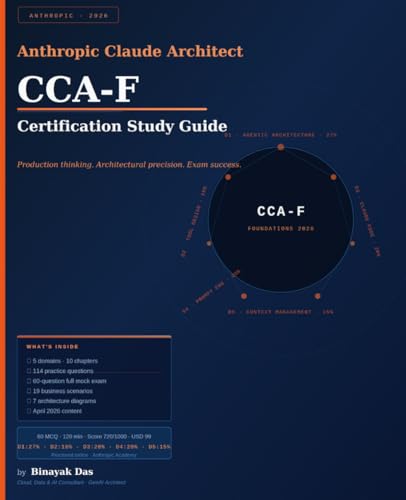
Five domains, 60 items, $125, and the only exam with a published scenario structure. You receive four scenarios drawn at random from a bank of six, and the questions hang off those scenarios rather than standing alone.
- Agentic Architecture and Orchestration, 27 percent
- Claude Code Configuration and Workflows, 20 percent
- Prompt Engineering and Structured Output, 20 percent
- Tool Design and MCP Integration, 18 percent
- Context Management and Reliability, 15 percent
The six published scenarios are a customer support resolution agent, code generation with Claude Code, a multi-agent research system, developer productivity tooling, Claude Code in a CI/CD pipeline, and structured data extraction. Because you only see four of the six, you cannot safely skip any of them. If your study material still calls this exam CCA-F, see our CCAR-F registration and naming guide, and the full CCAR-F exam guide.
CCAR-P: Claude Certified Architect, Professional
Seven domains, 63 items, $175, and the tightest clock at roughly 1.9 minutes per item.
- Integration, 19 percent
- Solution Design and Architecture, 17 percent
- Evaluation, Testing and Optimization, 16 percent
- Governance, Safety and Risk Management, 14 percent
- Stakeholder Communication and Lifecycle Management, 14 percent
- Claude Models, Prompting and Context Engineering, 13 percent
- Developer Productivity and Operational Enablement, 7 percent
The distinguishing block is Stakeholder Communication and Lifecycle Management, a full 14 percent that has no counterpart on any other exam. Combined with governance, more than a quarter of CCAR-P is about defending and operating a design rather than drawing one. The recommended experience is 3+ years in systems architecture or platform engineering plus 6+ months of production Claude work, but that is recommended, not required.
The rules that are identical on all four exams
- Scoring. Criterion-referenced, not curved. The 720 cut score was set through a formal standard-setting study with subject matter experts judging minimally qualified performance.
- Score report. Pass or fail plus a scaled score, and percent-correct by domain. Those domain percentages are diagnostic only and do not decide your result.
- Retakes. Wait 14 days after a first failure, 30 after a second, 90 after a third, with at most four attempts per exam in a rolling 12-month period. Limits are per exam, so failing CCAR-F does not block you from registering for CCDV-F. Every attempt costs the full fee.
- Renewal. Twelve months from the award date. On-time renewal is a free, non-proctored assessment on the Anthropic Partner Academy. Let it lapse and you retake the full exam at the full fee.
- Language. English only, for both the exam and the preparation content, per Anthropic's certification FAQ. The exam guides themselves do not mention language.
- Confidentiality. You accept a non-disclosure agreement before the exam starts. Decline it and the session ends with no refund.
Three facts that should change your decision
Only three of the four count toward partner status. Anthropic's certification FAQ states that Claude Certified Developer, Architect Foundations, and Architect Professional count toward Claude Partner Network eligibility. The Associate credential does not. Anthropic's June 3, 2026 partner announcement puts numbers on why that matters: Select tier requires at least 10 active certified individuals, Preferred at least 100, and Global Premier at least 1,000. If your employer is paying because it needs tier credit, CCAO-F is the wrong purchase order, however useful the credential is to you personally.
Your partner tier changes the price. Per the same certification FAQ, Registered-tier partners pay list price. Select, Preferred, and Global Premier partners receive 50 percent off, applied automatically at checkout. A promotional 100 percent discount for Global Premier partners ran through August 31, 2026 and has now closed, so check the price at checkout rather than assuming the figure you were quoted earlier still applies.
Only CCAR-F is scenario-based. This is the single largest format difference between the exams, and it changes how you prepare. Standalone items reward breadth. Scenario sets reward holding one production context in your head across several linked questions. If you have failed a scenario-driven exam before, budget extra practice time for CCAR-F specifically.
The recommended order, and when to skip a step
The natural ladder is CCAO-F, then CCDV-F, then CCAR-F, then CCAR-P. It is a reasonable default for someone entirely new to Claude who wants the cheapest exam first and a credential every quarter. It is the wrong plan for most people, for three reasons.
First, nothing stacks. Architect Foundations does not upgrade to Architect Professional automatically. They are separate certifications with separate exams and separate fees.
Second, the audiences barely overlap. The CCAO-F guide says explicitly that the credential is not intended for software developers who build against APIs or design agentic systems. A working engineer who takes CCAO-F first spends $99 and four weeks proving something the CCDV-F blueprint never asks about.
Third, the ladder costs $524 in fees for four credentials that all expire on their own 12-month clocks. Four renewals a year is real overhead for a benefit most people do not need.
Skip freely. A business analyst should take CCAO-F and stop. An engineer should go straight to CCDV-F or CCAR-F. A senior architect who has shipped Claude systems in production should go straight to CCAR-P and skip Foundations entirely, because it buys no exemption. The only sequence worth respecting is CCDV-F or CCAR-F before CCAR-P if you have never architected an LLM system end to end, and that is about readiness, not policy.
Two details worth checking before you book
The reschedule deadline is stated two different ways. All four Version 1.0 exam guides say you may cancel or reschedule up to 24 hours before your appointment. The Pearson VUE Anthropic program page says test center appointments can be rescheduled or cancelled up to 48 hours prior. Plan against the stricter 48-hour deadline and you are safe under either reading. Miss the window and you forfeit the fee.
There is no official practice exam. Anthropic's certification FAQ confirms the practice exam that existed on the previous platform was retired when certification moved to Pearson VUE on June 30, 2026. Digital badges now issue through Credly. That retirement is precisely the gap free practice banks fill, and it is why the exam guide's domain weights are the only reliable map you have for allocating study time.
What Anthropic does not publish
Be skeptical of any source that supplies these, because the official guides do not:
- Pass rates. No pass-rate data is published for any of the four exams.
- Raw-to-scaled conversion. You are told the cut score is 720 on a 100 to 1,000 scale. You are not told how many items that represents, and "answer 72 percent correctly" is not a claim the guides support.
- Required study hours. Every guide lists recommended experience only. The CCAO-F, CCDV-F, and CCAR-P guides each add that the credential is awarded on exam performance alone, and the CCAR-F guide sets no study or prerequisite requirement either.
Your next step
Pick one exam, download its official exam guide, and run a diagnostic against the real domain weights before you build a study plan. Free, no-signup practice banks for all four are here:
- CCAO-F practice questions
- CCDV-F practice questions
- CCAR-F practice questions
- CCAR-P practice questions
For CCAR-F specifically, our scenario drills and blueprint walkthrough mirror the four-of-six scenario format you will meet on exam day.

 Free CE
 Buy on Amazon
 Take courses on Udemy
 Course Playlist