Quick answer: book CCAR-F, whatever your study material calls it
If your study material says CCA-F, search and book CCAR-F. Both labels point at one credential, Claude Certified Architect - Foundations, and Anthropic's Exam Guide version 1.0, effective July 2026 lists its exam code as CCAR-F. Pearson VUE's Anthropic program page lists the same code alongside CCAO-F, CCDV-F, and CCAR-P.
CCA-F is what the exam was called before it moved to Pearson VUE, including in Anthropic's own early-access registration links, and it still fills community repositories, marketplace courses, and prep sites. No current Anthropic page or Pearson VUE listing uses it, and Anthropic's certification FAQ and exam guide never mention the older label; the July 2026 guide simply lists CCAR-F as the exam code. Nothing about the credential changed with the label: same name, same blueprint, same five domains, same scenario structure. Treat CCA-F as a search term, and treat CCAR-F as the string to verify on the guide, on your receipt, and on the Pearson VUE appointment.
Something real did change, and it is far more consequential than a label. On June 30, 2026 the certification moved to Pearson VUE for delivery and to Credly for badging, the fee rose from $99 to $125, the credential term went from 6 months to 12, and the official practice exam was retired. If your plan came from a page written before that date, its exam parameters are probably still right and its logistics are almost certainly wrong. The blueprint did not move, so a free CCAR-F practice bank built on the five official domains still applies.
One gate stops more candidates than any booking mistake, so it comes first: CCAR-F is not open to the general public. Read the next section before you budget a single study hour.
First gate: you need a partner company email address
Anthropic's certification FAQ is unambiguous. Certification is available to people at Claude Partner Network organizations, and registration requires a partner email address on a recognized company domain. Personal email addresses will not work. Pearson VUE states the same rule from the other side: certification is open to organizations in the Claude Partner Network and counts toward partner program standing.
Two consequences decide whether you can book at all:
- A rejected address is usually a domain-record problem, not a typo. If checkout returns "You aren't signed in with a partner company employee email," first confirm you used your company address rather than a personal one. If the address is correct, email partner-support@anthropic.com. Adding a domain is a record change on Anthropic's side and takes 7 to 10 days.
- Multi-domain employers have to pick the right one. Certify under a domain recognized on your organization's partner record. Certifications earned on an unrecognized domain, including subsidiary and regional domains, do not credit to the partner account, and getting extra domains rolled up takes the same 7 to 10 days.
Joining the network is not the expensive part. Anthropic's March 12, 2026 announcement, which introduced both the Claude Partner Network and this certification, says membership is free of charge. The domain record is the real lead time, so start it before you schedule study weeks around an exam date.
You must also be at least 18 years old. Age is verified at check-in against your government-issued photo identification, whether you test online or at a test center.
What actually changed on June 30, 2026
| Item | Before June 30, 2026 | Now |
|---|---|---|
| Exam delivery | Anthropic's Skilljar-hosted academy with ProctorFree online proctoring | Pearson VUE, online proctored or test center |
| Digital badge | Issued on the previous platform | Issued through Credly |
| Exam fee | $99 USD | $125 USD |
| Credential term | 6 months | 12 months |
| Official practice exam | Available on the previous platform | Retired, not replaced |
Three follow-on rules matter if you were already in the pipeline:
- A failed attempt from before the move is cleared. Anthropic's FAQ states that a candidate who attempted Architect - Foundations before June 30, 2026 and did not pass can register and retake on Pearson VUE with no waiting period.
- An earlier pass was extended. Certifications earned before June 30, 2026 under the previous 6-month validity were automatically extended to 12 months from their original earned date.
- Do not re-register if you already paid. If you registered before the migration and never received a Pearson VUE email, email certifications-support@anthropic.com. Registering again charges you a second time.
The registration path, step by step
Two systems share the job. Anthropic Partner Academy handles registration, payment, and policy. Pearson VUE handles the appointment, the proctoring, and the exam itself. That split is the single thing legacy CCA-F material describes badly, and it is why candidates think they are looking at two different exams.
Stage 1 - Anthropic Partner Academy
- Open the Claude Certified Architect - Foundations certification page and read the exam details.
- Download the exam guide, the Certification Terms and Conditions, and the Certification Exam Policy before you register. Save the guide version you used; if your employer reimburses certifications, this is the document to attach.
- Click "Register for the exam" and sign in with your company email address.
- Check the fee shown on the Register button. Any partner-tier discount is applied automatically at this step, so your total may differ from a colleague's at another firm.
- Confirm the order and click "Review and Pay". Payment is by credit card in Partner Academy, before you ever reach Pearson VUE.
- You land on a "Welcome and what to expect" confirmation page. Registration is complete, and this page carries your scheduling instructions.
Stage 2 - Pearson VUE
- Watch for two emails from PearsonVUEConfirmation@e.pearson.com: one titled "Web Account Created" with your username, and one titled "Notice of Automatic Web Account Creation" with a temporary password. Check your spam folder if they do not arrive shortly after registration.
- Sign in at the Pearson VUE Anthropic page with that username and temporary password.
- Review Pearson VUE's privacy policy and Candidate Agreement and check every box. You cannot schedule without accepting all terms.
- Set a new password of 12 or more characters, mixing upper and lower case, including numbers or symbols, and not containing your username.
- Choose three security questions and answer them in the Roman alphabet. Answers cannot contain your username or password.
- From your dashboard, choose "Schedule an exam", select Claude Certified Architect - Foundations from the catalog, and pick online proctoring or a Pearson VUE test center.
Two details save real money here. Your registration stays valid for five years, so paying does not start a clock that forces a rushed appointment. And the name on your Pearson VUE profile must match your government-issued photo identification exactly, because a mismatch discovered at check-in ends the session with the fee forfeited.
What it costs, and how a refund actually works
The list price is $125 USD. It rose from $99 effective June 30, 2026, which is why $99 still appears on prep sites, marketplace course listings, and older booking guides. Registrations completed before that date were charged the earlier price.
Discounts follow your organization's Claude Partner Network tier. Registered-tier partners pay list price, while Select, Preferred, and Global Premier partners receive 50 percent off applied automatically at checkout. Through December 31, 2026, Global Premier partners receive a 100 percent discount on all certification exams; after that date the standard 50 percent applies, so the number a colleague quoted may not be the number you see. If you are on a discounted tier and still see full price, your company domain is probably not linked to the partner record, which is the same 7-to-10-day fix. There is no voucher storefront or bulk purchasing yet.
The refund mechanic is the one most candidates get wrong:
- Cancelling in Pearson VUE does not issue a refund. It only releases your date and time so you can pick a new one. It does not end your registration and it does not return money.
- Refunds are requested from Anthropic. If you paid and no longer plan to test, email certifications-support@anthropic.com.
- Cancel at least 48 hours ahead or the fee is forfeited. The certification FAQ sets 48 hours (the exam guide still says 24). Cancel or reschedule inside that window, fail to appear, or arrive after Pearson's permitted late-arrival window, and you forfeit it and must re-register.
- Every attempt is a separate fee, and your partner-tier discount applies to retakes as well.
Retakes also carry waiting periods that Pearson VUE enforces when you pick a date: 14 days after a first failed attempt, 30 days after a second, and 90 days after a third, with a maximum of four attempts per exam in any rolling 12 months. To retake, register again in Partner Academy; the scheduling link then appears in Pearson VUE, which only offers dates after the waiting period ends. The limits apply per exam, so failing CCAR-F does not block you from registering for a different Claude certification.
The deadlines that cost money
| Action | Deadline | Where it is published |
|---|---|---|
| Cancel or reschedule any appointment | 48 hours before (the exam guide still says 24) | Certification FAQ |
| Cancel or reschedule a test center appointment | 48 hours before | Pearson VUE Anthropic page |
| Request a name correction | At least 24 hours before, and it takes 24 to 48 business hours | Certification FAQ |
| Request an accommodation | 10 or more days before, approved before you schedule | Certification FAQ and Exam Policy |
| Appeal a decision or a result | 14 calendar days | Anthropic Certification Exam Policy |
| Retake after a failed attempt | 14, 30, then 90 days of waiting; 4 attempts per rolling 12 months | Exam guide, certification FAQ, and Pearson VUE page |
The reschedule window is published two different ways, and the difference is not cosmetic. Anthropic's exam guide says 24 hours. Anthropic's certification FAQ now says at least 48 hours before any appointment, and Pearson VUE's Anthropic program page says test center appointments can be rescheduled or cancelled up to 48 hours prior through your Pearson account. Plan every booking against 48 hours and you are safe under every published rule; plan against 24 and a refusal costs you $125.
Name corrections deserve their own note because the failure mode is expensive. Email certifications-support@anthropic.com from the address your exam is registered under, use the subject line "Name Correction Request", give your first and last name exactly as they appear on your identification in Roman characters, and label which is which. If you arrive with an unreported mismatch, Pearson VUE will not let you test, the fee is forfeited, and a correction request filed afterwards cannot reverse that.
Online proctoring or a test center
The guide permits either, subject to program policy, and the choice should follow risk rather than convenience.
Choose online only if you can guarantee a quiet private room, a clean desk, reliable internet, and uninterrupted time. You must stay within view of the proctor and webcam for the entire session. Notes, books, phones, and secondary monitors must be out of the workspace; the Certification Exam Policy names more than one monitor as a prohibited item, so a second screen "just for documentation" is misconduct, not a workaround. Unscheduled breaks are prohibited unless requested and approved in advance. Run Pearson's system test well before exam day.
Choose a test center if your connectivity, privacy, or hardware is uncertain, and especially if you test on a managed corporate device. Pearson publishes the list of domains that must be reachable from your network for OnVUE delivery; hand it to your network administrator, and if the exam still will not launch, a test center removes the problem entirely.
Three rules apply either way. The exam is closed book: no notes, no documentation, no translation tools, and no AI assistants, with browser translation explicitly disallowed. The exam and its preparation content are available in English and Japanese. And you accept a confidentiality and non-disclosure agreement before the exam begins; declining it ends the session with no refund. Anthropic also reserves the right to exclude specific regions and countries from the program, and misrepresenting your country of residence or delivery is listed as prohibited conduct.
Confirm these exam facts on the guide before you pay
| Detail | Official value |
|---|---|
| Credential | Claude Certified Architect - Foundations |
| Exam code | CCAR-F |
| Items | 60 multiple-choice and multiple-response |
| Structure | 4 scenarios drawn at random from a bank of 6 |
| Time limit | 120 minutes, about 135 minutes of seat time |
| Passing score | Scaled 720 on a 100 to 1,000 range |
| Fee | $125 USD before partner-tier discount |
| Language | English or Japanese |
| Validity | 12 months from the award date |
Seat time is worth planning around: the 120-minute clock sits inside roughly 135 minutes that also covers check-in, instructions, and a short post-exam survey.
A scaled 720 is not a promise that 72 percent correct will pass. The exam is criterion-referenced, the cut score came from a formal standard-setting study, and scaled scoring exists to equate forms of slightly different difficulty. Anthropic publishes no raw-to-scaled conversion and no pass rate, so treat any source offering either as unreliable.
A booking checklist that tests readiness instead of confidence
CCAR-F is a scenario exam, so "I finished the courses" is a weak booking signal. The blueprint asks whether you can make and defend a production trade-off. Use this before choosing a date.
| Before scheduling, you can... | Why it matters on CCAR-F |
|---|---|
| Explain when deterministic enforcement belongs in a hook rather than a prompt instruction | The guide separates guaranteed controls from probabilistic prompt compliance. |
| Give a tool a precise boundary, input shape, output shape, and structured error response | Tool Design and MCP Integration is 18 percent, and ambiguous tools cause unreliable routing. |
| Configure a team Claude Code workflow with CLAUDE.md, path-scoped rules, skills, and an MCP server | Claude Code Configuration and Workflows is 20 percent. |
| Choose between a fixed workflow, adaptive delegation, and a multi-agent coordinator | Agentic Architecture and Orchestration is the largest domain at 27 percent. |
| Design structured extraction that separates schema validity from semantic validity | Prompt Engineering and Structured Output is 20 percent. |
| Preserve facts and source attribution across long sessions and subagent handoffs | Context Management and Reliability is the remaining 15 percent and crosses every scenario. |
The six published scenarios are a customer support resolution agent, code generation with Claude Code, a multi-agent research system, developer productivity tooling, Claude Code in a CI/CD pipeline, and structured data extraction. You will see four of the six, so none is safely skippable.
The guide also names what will not be tested, and several entries are exactly what an experienced engineer assumes an AI exam must cover: fine-tuning and model training, Claude's internal architecture, embedding models and vector databases, computer use and vision, streaming implementation, rate limits and pricing, authentication protocols, cloud provider configuration, and prompt caching internals beyond knowing the feature exists. Revising any of those buys nothing.
You do not need a large portfolio project. The guide sets four focused exercises: a multi-tool agent with escalation logic, a team Claude Code workflow, a structured-data extraction pipeline, and a multi-agent research pipeline. Build small versions, deliberately break them, and be able to explain why each repair is proportionate.
Because the official practice exam was retired, there is no sanctioned dry run left. Use the CCAR-F study guide for sequencing, domain-tagged practice questions to find the decisions you still miss, and flashcards or the cheat sheet for recall. Do not use recalled or "dump" questions: exam content is confidential under the non-disclosure agreement, and reproducing it can invalidate a result or revoke a credential.
After you pass, and the 12-month clock
Your score appears on screen at the end of the session, and test center candidates also receive a printed report. The report shows pass or fail, your scaled score, and percent-correct by domain; those domain percentages are diagnostic only and do not decide the result. A Credly email invites you to claim the badge, usually within minutes for online-proctored exams and a little longer for test center exams. Add a personal address to your Credly profile so the badge survives a job change.
The credential lasts 12 months. On-time renewal is a free, non-proctored assessment in Anthropic Partner Academy after you review what has changed. Let it lapse and you retake the full exam at the full fee; the Certification Exam Policy adds that an expired certification must be re-earned, including taking any required courses. Anthropic may also require a full retake instead of a renewal assessment if exam content changes significantly.
One organizational note: CCAR-F counts toward Claude Partner Network eligibility, as do the Developer and Architect Professional credentials. The Associate credential does not. If your employer is funding the attempt for tier credit, that distinction decides which exam belongs on the purchase order, and our four-exam comparison walks through the rest of the choice.
CCA-F vs CCAR-F FAQ
Is CCA-F the same exam as CCAR-F?
Yes. Both refer to Claude Certified Architect - Foundations. CCAR-F is the code in Anthropic's current exam guide and the Pearson VUE catalog. CCA-F is the older label, still common in third-party study material.
Can anyone register for the CCAR-F exam?
No. Certification is available only to people at Claude Partner Network organizations, and registration requires a partner email address on a recognized company domain. Personal email addresses are rejected at sign-in.
How much does CCAR-F cost in 2026?
The list price is $125 USD. It rose from $99 effective June 30, 2026. Select, Preferred, and Global Premier partners receive 50 percent off automatically at checkout (Global Premier 100 percent through December 31, 2026); Registered-tier partners pay full price.
Where do I register for CCAR-F, and where do I schedule it?
Register and pay on the Claude Certified Architect - Foundations page in Anthropic Partner Academy. Pearson VUE then emails your account details, and you schedule online proctoring or a test center from the Pearson VUE dashboard.
How far ahead can I reschedule a CCAR-F appointment?
Anthropic's exam guide says 24 hours, but the certification FAQ says at least 48 hours and Pearson VUE's Anthropic page says 48 hours for test center appointments. Plan against 48 hours. Changes inside the window forfeit the fee.
Does cancelling in Pearson VUE refund my CCAR-F exam fee?
No. Cancelling in Pearson VUE only releases the appointment. To request a refund you must email certifications-support@anthropic.com. Cancel at least 48 hours before the appointment, the deadline in the certification FAQ, or the fee is forfeited.
How long is a CCAR-F registration valid after I pay?
Five years. Anthropic's certification FAQ states that a registration stays valid for five years, so you can pay first and schedule the Pearson VUE appointment whenever you are ready within that window.
I failed the exam before June 30, 2026. Do I have to wait to retake CCAR-F?
No. Anthropic's FAQ states that attempts made before the June 30, 2026 move to Pearson VUE are cleared, so an earlier failure does not impose a waiting period on a new registration.
How soon can I retake CCAR-F if I fail?
Waiting periods are 14 days after a first failed attempt, 30 after a second, and 90 after a third, with at most four attempts per rolling 12 months. Each retake costs the full fee, less your partner-tier discount.
What score do I need to pass CCAR-F?
A scaled score of 720 on a 100 to 1,000 range. The exam is criterion-referenced and Anthropic publishes no raw-to-scaled conversion, so 720 does not mean 72 percent of items answered correctly.
The best next move
Use CCA-F to dig up legacy learning material, and use CCAR-F for every official check and the booking itself. In order: confirm your partner email domain is recognized, download the current exam guide and the policy documents, register through the official certification page, then schedule with Pearson VUE against the 48-hour test center deadline.
Because Anthropic retired its official practice exam, the domain weights in the guide are the only reliable map you have for allocating study time. Put the remaining hours into evidence: build the four exercises, break them on purpose, and test your judgment across the five domains with free CCAR-F practice questions and the full CCAR-F exam guide.

 Course Playlist
 Free CE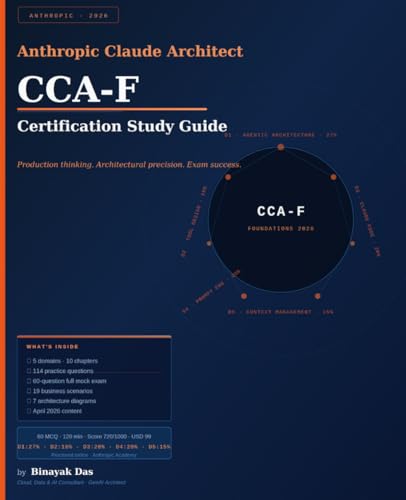
 Buy on Amazon
 Take courses on Udemy