What is the CCAR-F, and is it worth it?
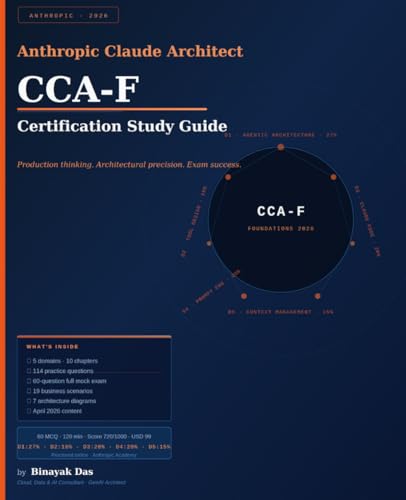
The Claude Certified Architect – Foundations credential uses the current exam code CCAR-F (formerly CCA-F) and is Anthropic's first official technical certification, launched March 12, 2026 through the Claude Partner Network. It validates that you can design, deploy, and maintain production-grade applications across the Claude ecosystem — the Claude API, the Claude Agent SDK, Claude Code, and the Model Context Protocol (MCP).
The one-line answer to "is it worth it": if you build real systems with Claude — agents, MCP integrations, structured-output pipelines, retrieval — CCAR-F is intended to assess architectural judgment rather than tutorial completion. It is a proctored, scenario-based exam aimed at solution architects, not casual chat users. Its value depends on whether the credential is relevant to the Claude systems you build and the roles you pursue.
Why Anthropic created the CCAR-F
Anthropic committed $100 million to the Claude Partner Network in 2026, with much of it directed at training and certification. The certification is designed to assess production architecture decisions across Claude APIs, agents, Claude Code, MCP, structured output, and reliability—not merely prompt vocabulary.
The CCAR-F is positioned as the entry point of a credential stack. Anthropic has stated that additional certifications for sellers, architects, and developers are planned later in 2026, with network partners getting priority access. Treat those future-program statements as roadmap context, not a guaranteed career outcome from this credential.
Who should take the CCAR-F?
This is an architecture-level exam. There are no hard prerequisites, but Anthropic recommends completing the Anthropic Academy 200-level courses and roughly 6 months of hands-on experience building production applications across the Claude API, Claude Agent SDK, Claude Code, and MCP servers. It is the right exam if you are a:
- Solution architect or AI engineer designing multi-agent systems and tool integrations on Claude.
- Technical consultant or partner-network engineer deploying Claude for enterprise clients.
- Backend/platform developer who already ships Claude features and wants to formalize the architecture skill set.
It is the wrong exam if you have only used claude.ai for chat. The questions assume you have wired up an MCP server, written a system prompt with structured output, configured Claude Code with a CLAUDE.md, and debugged a flaky agent loop in production.
CCAR-F exam format, scoring, cost, and eligibility
| Component | Detail |
|---|---|
| Questions | 60 multiple-choice and multiple-response (scenario-based) |
| Scenarios | 4 drawn from a published pool of 6; exact per-scenario counts are not published |
| Time limit | 120 minutes |
| Passing score | 720 on a 100–1000 scaled score |
| Cost | $125 USD per attempt; applicable partner-tier discounts appear at checkout |
| Delivery | Pearson VUE online-proctored or in person at a Pearson VUE test center |
| Administered by | Anthropic |
| Recommended prep | Anthropic Academy 200-level courses + ~6 months hands-on with Claude API, Agent SDK, Claude Code, and MCP |
| Launched | March 12, 2026 |
A few details worth internalizing. Scoring is scaled, not raw percentage — a 720/1000 does not mean exactly 72% of items correct, because harder items can be weighted. Anthropic does not publish a raw-score conversion, so use practice results to locate weak domains rather than to claim a guaranteed cutoff. The exam is scenario-driven: questions place you in the role of an architect at a company deploying Claude in production ("the chatbot is hallucinating confidently — what is the architectural fix?"), not a vocabulary quiz. Registration begins in Anthropic Partner Academy. After checkout, candidates continue to Pearson VUE to schedule either online-proctored delivery or a test-center appointment.
The six exam scenarios (and how questions hang off them)
CCAR-F questions are not free-floating. The exam draws four scenarios at random from a pool of six, but it does not publish a fixed question count for each scenario. Knowing the pool lets you rehearse the exact architectural decisions each one forces:
- Customer-support resolution agent — returns, billing, and account issues with high first-contact resolution. Tests tool design, escalation/guardrails, and structured output.
- Multi-agent research system — a coordinator delegating to specialized subagents. Tests orchestrator-worker design, the Agent SDK, and context handoff between agents.
- Code generation with Claude Code — team configuration,
CLAUDE.md, slash commands, and permissions. Tests the Claude Code workflow domain head-on. - Claude Code in CI/CD — headless automated reviews, test generation, and PR feedback. Tests permissions, hooks, and non-interactive runs.
- Developer-productivity tooling — helping engineers navigate codebases and automate tasks. Tests MCP server design and tool scoping.
- Structured data extraction — pulling fields from unstructured documents with validation. Tests tool-based JSON schemas, retries, and reliable parsing.
Notice every scenario spans multiple domains. That is by design: the exam rewards architects who can move between agent orchestration, prompting, tools, and reliability inside one business problem. Build a small version of at least three of these before exam day.
The five CCAR-F domains and weights, explained
The blueprint has five domains. The weights tell you exactly where to spend study hours.
1. Agentic Architecture & Orchestration — 27%
The single biggest domain and the most underestimated. You design agent and multi-agent systems with the Claude Agent SDK: agent loops, subagents, orchestrator-worker and evaluator-optimizer patterns, prompt chaining, routing, and parallelization. You also choose the right model for each role — Opus for hard reasoning, Sonnet for balanced throughput, Haiku for fast/cheap subtasks. Expect to defend trade-offs: when does routing beat a single mega-prompt? When does parallelization break state consistency?
2. Claude Code Configuration & Workflows — 20%
Configuring Claude Code for production teams: CLAUDE.md project memory, settings.json, permissions and modes, slash commands, hooks, subagents, headless/CI usage, and wiring MCP servers into developer workflows. Questions here are concrete — what a PostToolUse hook does, how the CLAUDE.md hierarchy resolves, how plan mode and CI/CD integration fit a team workflow.
3. Prompt Engineering & Structured Output — 20%
Production prompting, not casual prompting. System prompts with clear role/task framing, few-shot examples, extended thinking, tool-based JSON schemas for structured output, stop sequences, and reliable parsing of responses. The recurring theme is reliability: validation-retry loops, schema enforcement, and getting machine-parseable output every time, not most of the time.
4. Tool Design & MCP Integration — 18%
Designing tool-use schemas and integrating Model Context Protocol (MCP) servers. You must know the MCP primitives — tools, resources, and prompts — cold, plus stdio vs HTTP transports, the .mcp.json config, tool selection and error handling, and securing tool and data access. A favorite "gotcha" archetype: why would you NOT give Claude full access to your entire database? The right answer is an architectural one about least-privilege tool scoping.
5. Context Management & Reliability — 15%
The smallest domain by weight, but its ideas bleed into every other domain. Managing the context window, prompt caching, retries and timeouts, RAG/retrieval, evals and guardrails, and latency/cost optimization under failure. Because Claude has no persistent memory by default, you must know how to make apps feel stateful: conversation history management, summarization (/compact), and information provenance.
Quick math: domains 1, 3, and 4 alone are 67% of the exam. If you are short on time, weight your hours there — but skip nothing, because reliability concepts (domain 5) recur inside the other four.
How CCAR-F differs from "knowing how to use Claude"
This is the distinction that trips up experienced Claude users. The CCAR-F does not ask "what is a hallucination?" It asks "your customer's agent hallucinates confidently in production — what is the architectural fix?" The official guide warns that distractors are written to look reasonable to candidates with incomplete knowledge — every wrong answer sounds plausible. You cannot pattern-match your way through it.
Day-to-day Claude usage teaches you features. The CCAR-F tests trade-offs: when to use an orchestrator-worker pattern versus prompt chaining, when prompt caching pays off, what a user can override that an operator set (almost nothing, by default), and how to scope MCP tool access for least privilege. Internalizing Anthropic's design philosophy beats memorizing API parameters.
A domain-weighted preparation path
Map your study order to the weights and to how the platform actually layers. A realistic timeline is 4–12 weeks (≈40–100 hours) depending on prior experience.
Phase 1 — Claude API foundations (~12 hrs). Master the Messages API, system prompts, model selection (Opus/Sonnet/Haiku), streaming, token limits, and prompt caching. Everything above sits on this.
Phase 2 — Prompt engineering & structured output (~16 hrs). Practice tool-based JSON schemas, stop sequences, extended thinking, and validation-retry loops until you can reliably parse output in code. Covers domain 4 (20%).
Phase 3 — Tool design & MCP (~18 hrs). Actually build an MCP server. Wire it over both stdio and HTTP, configure it in .mcp.json, and deliberately trigger and handle tool errors. Reading about MCP is not enough — the exam tests design decisions you only understand by building. Covers domain 4-tools/2 (18%).
Phase 4 — Agentic architecture & Claude Code (~22 hrs). The heaviest phase for the heaviest domain (27%) plus Claude Code (20%). Build a multi-agent workflow with the Agent SDK using subagents and an orchestrator-worker design; configure Claude Code with CLAUDE.md, hooks, permissions, and slash commands.
Phase 5 — Context, reliability & timed mocks (~14 hrs). Context-window management, RAG, evals, guardrails, retries, and cost/latency tuning — then timed full-length practice to build exam stamina and pacing (you have ~2 minutes per question).
Common CCAR-F pitfalls
- Under-weighting domain 1. Agentic architecture is 27% and the section people most often underprepare. Know each pattern and its trade-offs, not just the names.
- Treating MCP as theory. You will be tested on transports, primitives, and error handling — build a server, do not just read about one.
- Casual prompting habits. The exam wants production-grade structured output and validation, not vibes-based prompting.
- Ignoring reliability because it is "only 15%." Context, caching, and evals appear inside other domains' scenarios too.
- Skipping timed practice. 60 scenario questions in 120 minutes punishes slow readers; rehearse pacing.
 Buy on Amazon
 Take courses on Udemy