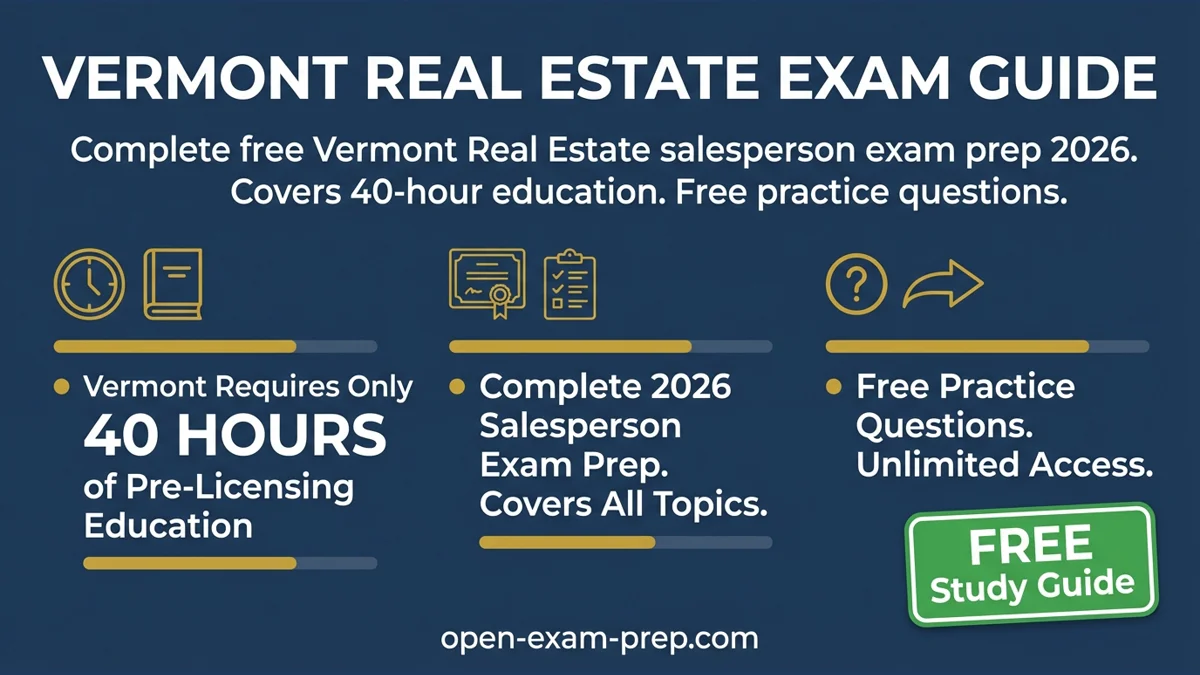
Vermont Real Estate License Overview
Vermont offers a unique real estate market characterized by historic properties, ski resort communities, and vacation homes. The Vermont Office of Professional Regulation (OPR), under the Secretary of State, oversees real estate licensing in the state.
With one of the lowest pre-license education requirements in the nation at just 40 hours, Vermont provides a more accessible path to real estate licensure while still maintaining professional standards.
Vermont Real Estate Exam Quick Facts
| Feature | Details |
|---|---|
| Exam Administrator | PSI Exams (National) / Vermont OPR (State) |
| Total Questions | 136 (100 national + 36 state) |
| Time Limit | ~4 hours total (2.5 hours national) |
| Passing Score | 70% on national, 75% on state |
| National Exam Fee | $110 |
| State Exam | Part of online application |
| Results | Immediate for national; state upon completion |
Requirements Before Taking the Exam
Pre-License Education Requirements
| Requirement | Details |
|---|---|
| Age | 18 years or older |
| Pre-License Course | 40 hours (one of the lowest nationally) |
| School Approval | Vermont OPR-approved provider |
| School Final Exam | Must pass before state exam |
| Background Check | Required for licensure |
Pre-License Course Content (40 Hours)
Vermont requires only 40 hours of pre-license education, making it one of the most accessible states for entry into real estate. The curriculum covers:
Core Topics:
- Real estate principles and practices
- Vermont real estate law
- Property ownership types
- Real estate contracts
- Agency relationships
- Real estate finance basics
- Property valuation
- Fair housing laws
- Ethics and professional conduct
Application Process
- Complete 40-hour pre-license course from OPR-approved school
- Pass school-administered final exam
- Register for and take the PSI national exam
- Pass the national exam with 70% or higher
- Complete online application with Vermont OPR
- Take and pass the state jurisprudence exam (36 questions)
- Complete background check
- Affiliate with a licensed broker
Vermont Exam Structure
Vermont has a unique two-part exam process - the national exam is administered separately by PSI, while the state exam is part of the online application through Vermont OPR.
National Exam (PSI)
| Feature | Details |
|---|---|
| Questions | 100 scored multiple-choice |
| Time Limit | 150 minutes (2.5 hours) |
| Passing Score | 70% (70 out of 100) |
| Format | Computer-based at testing center |
| Fee | $110 |
| Results | Immediate |
State Jurisprudence Exam (Vermont OPR)
| Feature | Details |
|---|---|
| Questions | 36 multiple-choice |
| Format | Online through Vermont OPR application |
| Passing Score | 75% |
| Topics | Vermont-specific laws and regulations |
| Retakes | Available if failed |
National Exam Content Breakdown
| Topic | Percentage | ~Questions |
|---|---|---|
| Property Ownership | 8% | 8 |
| Land Use Controls | 5% | 5 |
| Valuation & Market Analysis | 7% | 7 |
| Financing | 10% | 10 |
| Agency Principles | 13% | 13 |
| Property Disclosures | 6% | 6 |
| Contracts | 17% | 17 |
| Leasing & Property Management | 3% | 3 |
| Transfer of Title | 8% | 8 |
| Practice of Real Estate | 13% | 13 |
| Real Estate Calculations | 10% | 10 |
State Exam Content (36 Questions)
| Topic | Key Content |
|---|---|
| Vermont Real Estate Commission | Powers, duties, structure |
| Licensure Requirements | Initial, renewal, reciprocity |
| Regulations Governing Licensees | Conduct standards, ethics |
| Related Vermont Laws | Property, disclosure, environmental |
| Broker Topics | Supervision, trust accounts |
Vermont-Specific Topics to Know
Vermont Real Estate Commission
| Area | Key Points |
|---|---|
| Regulatory Body | Under Office of Professional Regulation |
| License Types | Salesperson, Broker |
| Oversight | Education providers, disciplinary actions |
| Commission Powers | Rule-making, license issuance/revocation |
Vermont Agency Disclosure
Vermont requires written disclosure of agency relationships:
- Seller's Agent - Represents seller exclusively
- Buyer's Agent - Represents buyer exclusively
- Disclosed Dual Agent - Represents both with written consent
- Transaction Facilitator - Neutral assistance without representation
Vermont Property Disclosure Requirements
Sellers must disclose:
- Known material defects
- Environmental hazards
- Water and septic system conditions
- Structural issues
- Lead-based paint (for pre-1978 homes)
- Flood zone status
Vermont Environmental Considerations
Important for exam:
- Act 250 (Environmental review for development)
- Wetlands protection regulations
- Shoreline protection
- Septic system requirements
- Well water testing requirements
Vermont Trust Account Requirements
| Requirement | Details |
|---|---|
| Deposit Timeline | Prompt deposit required |
| Account Type | Federally insured institution in Vermont |
| Record Keeping | Detailed transaction records |
| Commingling | Prohibited |
| Broker Supervision | Broker responsible for all trust funds |
Unique Vermont Market Factors
Vacation and Second Home Market:
- Ski resort properties (Stowe, Killington, Sugarbush)
- Lake Champlain waterfront
- Historic homes and villages
- Agricultural properties and land
Seasonal Considerations:
- "Mud season" (spring) affects showing access
- Ski season impact on resort areas
- Summer tourism in lake regions
- Fall foliage tourism
Vermont Exam Pass Rates
Pass Rate Statistics
| Portion | First-Time Pass Rate |
|---|---|
| National Exam | ~64% |
| State Exam | ~70-75% |
Why Vermont's Process is Manageable
| Factor | Impact |
|---|---|
| Low education hours | 40 hours is manageable |
| Separate exams | Can focus on one at a time |
| State exam online | Convenient, less stressful |
| Smaller state content | Less state-specific material |
Study Strategy
Recommended Study Timeline
| Approach | Study Hours | Timeline |
|---|---|---|
| Intensive | 30-40 | 2-3 weeks |
| Standard | 40-60 | 3-4 weeks |
| Part-time | 60-80 | 4-6 weeks |
After completing the 40-hour pre-license course.
Study Priority by Exam Section
National Exam Focus Areas:
-
Contracts (17 questions)
- Contract elements and types
- Offer and acceptance
- Contingencies and termination
-
Agency Principles (13 questions)
- Agency relationships and duties
- Fiduciary responsibilities
- Disclosure requirements
-
Practice of Real Estate (13 questions)
- Brokerage operations
- Client communication
- Transaction management
-
Financing (10 questions)
- Mortgage types
- Loan qualification
- Federal lending laws
-
Real Estate Calculations (10 questions)
- Commission calculations
- Prorations
- Area and measurement
State Exam Focus Areas:
-
Vermont Real Estate Commission Rules
- License requirements
- Continuing education
- Disciplinary procedures
-
Vermont Property Laws
- Disclosure requirements
- Environmental regulations
- Trust account rules
-
Vermont-Specific Practices
- Agency disclosure
- Contract requirements
- Broker supervision
Key Math Formulas
Commission Calculations:
Prorations (Vermont uses 365-day year):
Loan-to-Value:
Capitalization Rate:
Points Calculation:
Common Mistakes to Avoid
1. Treating Exams as One Test
Remember Vermont has two separate exams:
- Prepare for national exam first
- Then focus on state jurisprudence
- Different passing scores (70% vs 75%)
2. Underestimating the State Exam
The 36-question state exam requires 75% to pass:
- Study Vermont-specific laws
- Know OPR regulations
- Understand trust account requirements
3. Weak Contract Knowledge
Contracts are 17% of the national exam:
- Master contract elements
- Know contingency types
- Understand termination procedures
4. Insufficient Math Practice
Real estate calculations are 10% of national:
- Practice commission problems
- Master prorations
- Know area calculations
5. Ignoring Vermont Market Specifics
Know Vermont's unique market:
- Vacation home regulations
- Environmental laws (Act 250)
- Septic and well requirements
Exam Day Tips
For the National Exam (PSI)
Before the Exam:
- Get adequate rest the night before
- Eat a balanced meal
- Arrive 30 minutes early to testing center
- Bring two forms of ID (one government-issued with photo)
During the Exam:
- Read every question completely
- Watch for "EXCEPT" and "NOT" questions
- Use scratch paper for calculations
- Flag difficult questions and return later
- Pace yourself: ~1.5 minutes per question
- Use all available time to review
What to Bring:
- Two forms of valid ID (one government-issued with photo)
- Confirmation from PSI
- Nothing else - personal items stored in locker
For the State Exam (Online)
Before the Exam:
- Ensure stable internet connection
- Use a compatible browser
- Have quiet, distraction-free environment
- Review Vermont-specific laws one more time
During the Exam:
- Read questions carefully
- Focus on Vermont-specific content
- Take your time with 36 questions
After Passing Both Exams
Immediate Steps
- Receive national results at PSI testing center
- Complete Vermont OPR application online
- Pass state jurisprudence exam (part of application)
- Complete background check
- Pay license fee ($220)
- Affiliate with a broker (required to practice)
- Complete 8-hour post-license course within 90 days
Post-Licensure Education (Within 90 Days)
| Requirement | Details |
|---|---|
| Hours | 8 hours |
| Topics | Code of Ethics, New Agent Orientation |
| Deadline | 90 days from license issuance |
| Provider | VT Real Estate Commission approved |
Continuing Education Requirements
| License Type | Hours Required | Breakdown |
|---|---|---|
| Salesperson | 16 hours/2 years | 4 mandatory + 12 elective |
| Broker | 24 hours/2 years | 4 mandatory + 20 elective |
License Renewal Timeline
| License Type | Expiration Date |
|---|---|
| Salesperson | May 31 (even years) |
| Broker | March 31 (even years) |
| Deadline | Action |
|---|---|
| Before expiration | Complete CE, pay renewal fee ($220) |
| First renewal | Post-license + mandatory course + CE |
| Late renewal | Additional fees apply |
Vermont Real Estate Market Outlook
Hot Vermont Markets (2026)
| Market | Highlights |
|---|---|
| Burlington | Largest city, lakefront, tech growth |
| Stowe | Premier ski resort, luxury homes |
| Montpelier | State capital, historic homes |
| Manchester | Outlet shopping, second homes |
| Woodstock | Quintessential Vermont village |
| Lake Champlain | Waterfront properties |
Salary Expectations
| Experience | Annual Income |
|---|---|
| First year | $30,000-$50,000 |
| 2-5 years | $50,000-$75,000 |
| 5+ years | $75,000-$120,000+ |
| Luxury/Resort specialists | $150,000+ |
Vermont Market Characteristics
- Vacation home market - Significant portion of sales
- Ski properties - Premium prices, seasonal demand
- Historic homes - Require specialized knowledge
- Land sales - Agricultural and development parcels
- Affordability challenges - Housing shortage in desirable areas
Unique Opportunities
- Second home buyers - Wealthy out-of-state buyers
- Remote workers - Post-pandemic relocations
- Ski resort communities - Year-round transactions
- Agricultural properties - Farms and land
- Historic preservation - Specialized niche
Resources
- Vermont Office of Professional Regulation - Official licensing information
- PSI Exams - National exam scheduling
- Vermont Association of Realtors - Industry resources
- OpenExamPrep - Free study materials and practice tests

 Free CE
 Pre-licensing on Colibri
 Flashcards on Mometrix
 Buy on Amazon
 Pre-licensing on AceableAgent
 Take courses on Udemy