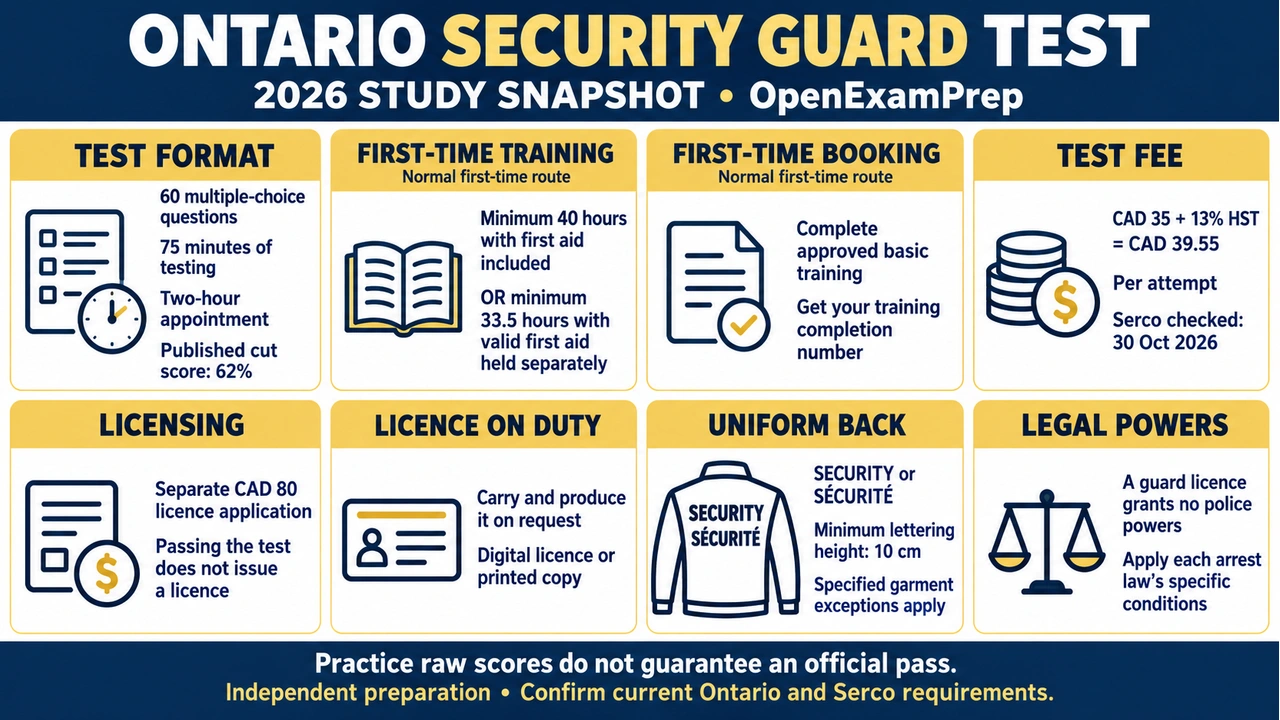
2026 Ontario Security Guard Licensing Test Overview
For a first-time Ontario applicant, the usual route is training → test → separate licence application. A passing test result alone does not authorize paid security work. Security work primarily involving guarding or patrolling people or property—including most patrol, loss-prevention, bodyguard and bouncer roles—requires the appropriate licence, subject to the Act’s specific exemptions. The governing law is the Private Security and Investigative Services Act, 2005 (PSISA). The licensing test is owned by the Ontario Ministry of the Solicitor General (Private Security and Investigative Services Branch, or PSISB) and delivered province-wide by Ontario Security Testing / Serco Canada Inc..
For the normal first-time route, complete a qualifying basic training course of at least 40 hours including emergency-level first aid, or at least 33.5 hours of security training when valid equivalent first-aid certification is held separately. Obtain the Training Completion Number (TCN) needed to book. Current Ontario licensees and applicants with qualifying Canadian out-of-province licences have different routes; do not assume everyone must repeat training. This article is independent exam preparation, not a substitute for mandatory training or employer procedures.
Verified 2026 Exam & Licensing Snapshot
| Parameter | Official Ontario Requirement & Verified Details |
|---|---|
| Governing Statute | Private Security and Investigative Services Act, 2005 (S.O. 2005, c. 34) & O. Reg. 26/10 |
| Exam Owner & Vendor | Ontario Ministry of the Solicitor General (PSISB); delivered by Serco (ontariosecuritytesting.com) |
| Prerequisite | Qualifying basic training and valid emergency-level first-aid certification; training TCN required for the normal first-time test route |
| Format & Time | 60 multiple-choice questions in 75 minutes of test time inside a 2-hour appointment |
| Passing Score | Ministry-published 62% cut score; rely on the official result, not an inferred raw-question guarantee |
| Test Fee (Serco) | $35.00 + 13% HST = $39.55 per attempt on the live Serco booking portal |
| Licence Fee (ServiceOntario) | $80.00 separate application fee paid to ServiceOntario after passing |
| Results & Validity | Serco says results are available within 2 business days; an issued first licence ends on the second birthday after issue, with two-year renewals |
Scoring example: On an equally weighted 60-question practice set, 37/60 is about 61.67% and 38/60 is about 63.33%. That arithmetic does not establish Serco’s unpublished raw-score handling or guarantee a live pass. Use the published 62% cut score and your official result.
Prepare with our independent study tools: read the full Ontario Security Guard study guide, practise with the free Ontario Security Guard practice test, review terms with Ontario Security Guard flashcards, and check the Ontario Security Guard cheat sheet.
The Fee & Turnaround Discrepancy Explained (Serco Portal vs. Legacy Study Guide)
Candidates often see two different official figures for the test fee and results timeline:
- Current Controlling Fee ($35.00 + HST = $39.55): On the live Serco Ontario Security Testing booking portal, booking the test costs $35.00 CAD plus 13% HST ($39.55 total), with results posted within 2 business days.
- Legacy Study Guide Figure ($66.50 + HST = $75.15): The older Ministry Security Guard Study Guide page still prints the historical $66.50 plus 13% HST ($75.15) fee and 5-business-day turnaround.
- Separate ServiceOntario Licence Fee ($80.00): Passing the test does not issue your licence. Use your testing completion number for the licence application. ServiceOntario requires the current Criminal Record and Judicial Matters Check (CRJMC), a compliant photo, two different acceptable government-issued identity/work-eligibility documents and the $80.00 fee. The check must have been issued within six months of submission. A basic criminal-record-only check is not the same document. “Clean criminal record” means the prescribed-offence rule, including applicable pardons or record suspensions—not a blanket statement that any past conviction makes licensing impossible.
The live production booking page was checked on October 30, 2026. Verify the live fee again when paying. Training, first aid and the record check may add separate costs.
Booking Cutoff, ID Rules, and Proctoring
- Booking cutoff and changes: The production booking page says book by 15:00 (3:00 p.m.) on the day before the test. Ordinary candidate bookings cannot be cancelled or rescheduled and fees are non-refundable; late arrival can forfeit the fee. Read the provider’s disruption policies as well. For online tests, Serco separately offers a conditional, one-time complimentary reschedule for unresolved system issues when candidates complete advance setup and contact support within its required timeline—support is available up to one hour before the appointment. This is not a general right to change a booking.
- Acceptable test ID: Bring original, valid, unexpired government-issued photo ID matching the booking and TCN names. Examples are a driver’s licence, Ontario Photo Card or passport. Health cards and SIN cards are not accepted. Serco’s published list specifically limits its Permanent Resident Card example to cards issued before February 4, 2021; do not assume any newer PR card will be accepted. Confirm an alternative with the provider before paying. This test ID rule differs from the two-document licence-application rule.
- Online setup: Follow the actual online instructions: desktop/laptop, webcam, microphone, reliable internet, installed and tested exam browser, and one monitor. Log in 15 minutes early. No headphones, other applications, food/drink or washroom breaks during the exam. Arrange any approved accessibility needs before testing. If TCN and ID names differ, contact Serco at least one business day before the exam; that is a different rule from the booking cutoff.
- In-person setup: Follow the test-centre instructions, arrive by your scheduled time, bring original ID and use only supplied materials. Do not assume the online room/technology rules describe the in-person process.
Breakdown of the 12 Mandatory Ministry Training Syllabus Sections
Under Ontario Regulation 26/10, the course must comply with the Ministry’s Training Syllabus for Security Guards. The total minimum is 40 hours with first aid, or 33.5 without that component when the required valid certification is supplied separately. The individual module hours below are the syllabus’s suggested in-class allocations, not twelve statutory minimums or published exam-question weights. A trainer may adjust section lengths while meeting the total and content requirements.
The Ministry says modernization is under development but existing requirements remain in force. WSIB’s June 22, 2026 update renames Emergency First Aid Basic First Aid and Standard First Aid Intermediate First Aid; pre-update certificates remain valid until expiry. The security regulation still uses emergency-level terminology. Check equivalence with the provider, and do not treat the syllabus’s suggested 6.5 hours as a promise that a separately booked current first-aid course lasts exactly that long.
| Sec. | Syllabus Module Name | Suggested Hours | Share of 40-Hour Example | Revision Topics |
|---|---|---|---|---|
| 1 | Introduction to the Security Industry | 2.0 hrs | 5.0% | Public police vs. private security; Observe, Deter, Record, Report |
| 2 | The Act (PSISA) & Code of Conduct | 2.0 hrs | 5.0% | PSISA ss. 6, 10, 35, 45; O. Reg. 363/07 Code of Conduct; O. Reg. 362/07 Uniforms |
| 3 | Basic Security Procedures | 3.0 hrs | 7.5% | Foot vs. vehicle patrol, surveillance, access control, alarm sensors, drug effects |
| 4 | Report Writing | 2.0 hrs | 5.0% | Bound notebooks, 24-hour clock, 5W1H reports, fact vs. opinion, witness statements |
| 5 | Health and Safety | 1.0 hr | 2.5% | OHSA 3 worker rights (know, participate, refuse unsafe work); WHMIS labels & SDS |
| 6 | Emergency Response Preparation | 4.0 hrs | 10.0% | Fire classes (A/B/C/D/K), bomb-threat procedures, evacuation, duty of care, crime scenes |
| 7 | Canadian Legal System | 3.0 hrs | 7.5% | Court hierarchy, Canada & Ontario Evidence Acts, chain of custody, by-laws, torts |
| 8 | Legal Authorities | 7.5 hrs | 18.75% | Criminal Code s. 494 citizen's arrest, Trespass to Property Act, Charter ss. 7–10, PIPEDA |
| 9 | Effective Communications | 4.0 hrs | 10.0% | Verbal de-escalation, active listening, plain language, employer protocols; guide’s APCO examples |
| 10 | Sensitivity Training | 3.0 hrs | 7.5% | Ontario Human Rights Code grounds, AODA accessibility, mental health crisis |
| 11 | Use of Force Theory | 2.0 hrs | 5.0% | Criminal Code ss. 25–27 & 34–35, National Use of Force Framework, positional asphyxia |
| 12 | Emergency Level First Aid | 6.5 hrs | 16.25% | Scene management, adult CPR, AED, choking, shock and severe bleeding |
High-Yield Statutory Rules: PSISA, Uniforms, and Penalties
Revise the Private Security and Investigative Services Act, 2005 (PSISA) and its regulations through both exact rules and applied cases. Published syllabus coverage is not a promise that a particular fine or measurement will appear on your exam:
- Section 6 (Licence requirement): An appropriate individual licence is required, together with a permitted working arrangement: employment by a licensed business, registered employer or employer not required to register, or acting as sole proprietor/partner of a licensed business. An individual licence alone does not license a business selling guard services.
- Section 10(1) (Eligibility): Applicants must be 18+, legally entitled to work in Canada, meet the clean criminal record definition (prescribed offences and applicable pardon/record-suspension provisions under O. Reg. 37/08), and pass mandatory training and testing.
- Section 35 (carry and produce): Carry your licence while acting as a guard, identify yourself and produce it on request—including a request from a member of the public. Current Ontario licences are digital; carry the digital version or a printed copy. Read any specific covert-duty exemption in context; an ordinary uniformed retail guard cannot refuse merely because the requester is not police.
- Misrepresentation (sections 35, 39–40): Do not present yourself as police or use prohibited professional titles such as officer, detective, private detective, law enforcement or police. A guard licence does not confer police powers; unauthorized badges or symbols of authority are not a substitute for the permitted licence and uniform.
- Section 45 (Maximum Penalties): Contravening the PSISA or its regulations carries up to $25,000 and/or 1 year in jail for an individual, and up to $250,000 for a business entity.
Uniform Regulation (O. Reg. 362/07) and Code of Conduct (O. Reg. 363/07)
Under O. Reg. 362/07 (Uniforms), every uniformed guard's outermost garment must distinguish private security from police:
- Chest: The outermost garment needs the employer’s name/logo/crest, the guard’s name or licence number, and contrasting uppercase SECURITY, SECURITY GUARD, SÉCURITÉ or AGENT DE SÉCURITÉ lettering at least 1.5 cm high. If the employer name/logo/crest also appears elsewhere on the uniform, the security wording must appear 2–3 cm below that additional display.
- Back: Section 2(3) specifically requires SECURITY or SÉCURITÉ in contrasting uppercase letters at least 10 cm high. Its outermost-garment exceptions are a collared shirt, sweater, blazer, sports jacket or suit jacket. Chest requirements still apply. Use the regulation’s exact back wording rather than a looser website summary.
- Restricted items: A collared shirt cannot be black or navy blue; this is not a ban on every black or navy garment. Side trouser stripes are prohibited except reflective safety stripes. Police-style forage caps are prohibited. Rank chevrons are generally prohibited, with the regulation’s exception for employees of a nonprofit organization existing before August 23, 2007. PSISA section 35(3) separately exempts bodyguard and specified theft/sabotage-prevention work from the uniform requirement; it does not grant police powers.
Under O. Reg. 363/07 (Code of Conduct), licensees must act with honesty and integrity, obey all federal, provincial, and municipal laws, treat everyone equally under the Ontario Human Rights Code, avoid profane or abusive language, use no unnecessary force, protect confidentiality, and never work while impaired.
Legal Authorities: Citizen's Arrest, Trespass to Property, and the Charter
Legal Authorities (7.5 hours) and the Canadian Legal System (3.0 hours) total 10.5 of the suggested 40 in-class hours (26.25%). This is a training allocation, not an exam weight. A security guard licence does not itself confer peace-officer powers. Identify the specific legal authority, its factual conditions and the post-arrest duty before choosing an answer.
Comparing the Lawful Arrest Pathways
| Pathway | Statute | Who May Arrest | Triggering Offence | Post-Arrest Duty |
|---|---|---|---|---|
| General Citizen's Arrest | Criminal Code s. 494(1)(a) | Anyone (on or off property) | Person whom you find committing an indictable offence (hybrid offences count as indictable until Crown election) | Deliver forthwith to a peace officer (s. 494(3)) |
| Fresh Pursuit Arrest | Criminal Code s. 494(1)(b) | Anyone | Person believed on reasonable grounds to have committed a criminal offence and escaping from AND freshly pursued by people with lawful arrest authority | Deliver forthwith to a peace officer (s. 494(3)) |
| Property Owner / Agent Arrest | Criminal Code s. 494(2) | Property owner, lawful possessor, or authorized agent (security guard) | Person whom you find committing ANY criminal offence (indictable, hybrid, or summary) on or in relation to that property | Arrest at that time, or within a reasonable time when the arrestor believes on reasonable grounds that police arrest is not feasible in the circumstances and deliver forthwith to a peace officer |
| Provincial Trespass Arrest | Trespass to Property Act s. 9(1) | Occupier or person authorized by the occupier (security guard) | Person on the premises believed on reasonable and probable grounds to be contravening TPA s. 2(1): (a) enters where prohibited, (b) does a prohibited activity, or (c) fails to leave immediately after being directed to do so | Promptly call for police assistance and hand the person over |
Notice, grounds and rights: keep the legal routes separate
Under TPA section 2, the maximum fine is $10,000. Red markings give notice that entry is prohibited; yellow markings indicate entry is restricted to permitted activities. A marking must be large enough to contain a 10 cm diameter circle and visible in daylight from each ordinary access point. Certain cultivated land and enclosures indicating an intention to exclude people or contain animals prohibit entry without notice; section 3(2) separately presumes lawful access by the usual route to a building’s door. Read the whole condition, not just “fence means arrest.”
A TPA arrest under section 9 concerns someone on the premises, on reasonable and probable grounds of a section 2 contravention. Its off-premises section 10 power belongs to police; it is not a general power for guards to chase a departed trespasser. Nor does every arrest route require personally witnessing an indictable offence: compare the different conditions in the table.
Charter nuance: Sections 8, 9 and 10 concern unreasonable search, arbitrary detention and arrest/detention rights. The Charter generally binds government action, not every act of a private guard. It can apply where the guard acts as a state agent or performs a relevant governmental activity; Justice Canada’s section 32 explanation discusses that distinction. Do not convert section 10(b) into an unqualified assertion that every private citizen’s arrest automatically carries the same constitutional duties as a police arrest—or assume private status permits arbitrary detention or a search.
For exam scenarios, plainly explain that you are making an arrest and why, call police, avoid questioning or evidence searches, and deliver the person without delay. Respect requests for counsel and follow applicable training and lawful procedures; do not delay police transfer to investigate. Justice Canada’s citizen’s-arrest guidance advises against questioning or searching the person or their possessions. A licence is not general authority to search bags, lockers or vehicles. Routine consent-based access screening must remain within actual consent and site policy.
Worked case: You personally see graffiti being sprayed on the owner’s wall and are authorized to protect that property. Section 494(2)(a) addresses the property-related criminal offence found in progress; section 494(3) requires prompt police transfer. Merely spotting a similar coat later is not enough: the delayed-arrest route additionally requires reliable identification, a reasonable time and reasonable grounds that police arrest is infeasible. An available arrest power does not make physical intervention the safest choice; observing, reporting and calling police may be appropriate.
Use of Force, Notebooks, Radio Communication and First Aid
Lawful force and medical distress
Criminal Code section 25(1) concerns acts already required or authorized by law and permits only necessary force on reasonable grounds. Section 26 makes a person criminally responsible for excessive force. Section 25(3) places strict life-protection conditions on force intended or likely to cause death or grievous bodily harm; it is not permission to use deadly force simply to protect merchandise. The National Use of Force Model mentioned in the Ontario guide is a situational assessment aid, not a staircase requiring escalation or an independent source of authority. Reassess risk, communicate and use lawful, trained options.
The older Ontario guide uses the term “excited delirium.” Do not treat that label as a diagnosis, a presumption of extraordinary strength or justification for more force. The American Academy of Neurology’s 2024 statement rejects it as a supported medical diagnosis and calls for medical evaluation of concerning symptoms. Severe agitation, confusion, overheating, breathing difficulty or reduced responsiveness require urgent medical attention. Describe what you see, call 911/EMS, avoid unnecessary confrontation and follow dispatcher instructions.
Prevent breathing restriction during any lawful restraint: do not hold a person face-down or put pressure on the chest/back that restricts breathing. Monitor responsiveness and breathing, seek medical assistance and use only trained procedures. “They stopped struggling” is not evidence they are medically safe.
Notes and time conversion
Keep the employer’s notebook secure, chronological and legible. Record facts and exact observations, separating what you personally saw from what a witness reported. Do not tear out pages, erase entries or use correction fluid. A transparent correction leaves the original readable: strike through once, add the corrected information and initial it according to the reporting procedure. For a witness statement, the Ontario guide also calls for the witness and guard to initial requested corrections. Notes may be permitted as a court memory aid; they do not replace truthful recollection.
Use 0000–2359 for 24-hour times. For 1:00–11:59 p.m., add 12 to the hour: 2:45 p.m. becomes 1445, and 9:30 p.m. becomes 2130. Noon is 1200 and midnight 0000; do not add 1200 to every p.m. value.
Worked report: Instead of “the aggressive customer was drunk,” write observable details such as “At 1445, the customer shouted, struck the counter with an open hand and stumbled while turning.” Record the response and who was notified. This preserves evidence without making an unsupported clinical or motive judgment.
APCO examples are not a universal radio language
The Ministry study guide includes an APCO example list: 10-4 message received, 10-9 repeat, 10-20 location, 10-52 request ambulance and 10-89 bomb threat. These are study-guide examples, not guaranteed meanings across every employer, police service or dispatch system. The guide expressly tells guards to check employer communication protocols. In a real incident, use the approved protocol and clear language when needed; give the exact location, hazard and assistance required. Do not substitute a memorized code for calling emergency services.
First aid and workplace safety
Review the course’s emergency scene management, shock, unconsciousness, severe bleeding, adult choking, CPR and AED material. 30 compressions to 2 breaths is the usual adult CPR cycle for a trained rescuer providing breaths before an advanced airway; activate EMS and follow your current training and AED/dispatcher instructions. The 2025 Heart & Stroke interim material teaches five back blows followed by five abdominal thrusts for severe responsive adult choking, repeated until relief or unresponsiveness. This does not apply to someone coughing effectively; pregnancy or inability to encircle the abdomen requires the trained chest-thrust adaptation. If unresponsive, change to the trained CPR response. These reminders do not replace practical first-aid certification.
Know the rights to know, participate and refuse unsafe work, while recognizing that refusal has statutory procedures and limits. Review current WHMIS labels and safety data sheets. Fire classes help select equipment—A ordinary combustibles, B flammable liquids, C energized electrical equipment, D combustible metals and K cooking oils/fats—but recognizing a class is not permission to fight an unsafe fire. Follow the evacuation plan, raise the alarm and use an extinguisher only within training and safe conditions.
An Optional 7-Day Revision Plan After Training
This is an editorial revision schedule, not the required course and not a licensing or pass guarantee. Adjust it to your knowledge gaps and appointment date. A short schedule is useful only if you can explain the legal conditions and correct your mistakes.
| Day | Focus Area | Action Step & OpenExamPrep Resource |
|---|---|---|
| Day 1 | PSISA & Regulations | Review PSISA ss. 6, 10, 35, 45 ($25,000 / $250,000 fines), O. Reg. 363/07, and O. Reg. 362/07 (1.5 cm chest / 10 cm back) in the Ontario Security Guard study guide. |
| Day 2 | Arrest & Trespass Law | Master Criminal Code s. 494(1) vs. s. 494(2) vs. Trespass to Property Act s. 9(1) arrests, the $10,000 TPA fine, and Red vs. Yellow markings. |
| Day 3 | Charter & Evidence | Distinguish Charter/state-agent issues from private duties; practise preserving evidence, documenting custody and separating observations from assumptions. |
| Day 4 | Use of Force & First Aid | Apply Criminal Code ss. 25–26, breathing-risk recognition and the conditions for trained CPR/choking responses with Ontario Security Guard flashcards. |
| Day 5 | Patrols, Notebooks & Communication | Review patrol types, notebook corrections, 24-hour clock times, and employer-specific radio protocols using the Ontario Security Guard cheat sheet. |
| Day 6 | Full 60-Question Mock Exam | Build a 60-question practice set and allow 75 minutes using the Ontario practice questions. A suggested revision target is 48/60 (80%), not a validated predictor of passing. Review every error afterward. |
| Day 7 | Test-Day Check | Confirm the booking, matching original ID, any approved accommodations, and advance online system checks or test-centre travel. |
Pacing exercise: 75 minutes ÷ 60 questions = 1.25 minutes (75 seconds) per item on average. For practice, try 60 minutes answering and 15 minutes checking flagged answers; this is a study tactic, not a provider-mandated section split. Serco’s online instructions allow answer review during the exam.
After passing: Apply separately and wait for licence approval before ordinary licensed work. For example, a first licence issued October 30, 2026 to a person with a December 15 birthday ends December 15, 2027—the second birthday after issue, not automatically two full years later. Current licences are digital, with printable copies; eligible renewals may be submitted up to 90 days before expiry.
Official Ontario Government & Testing Resources
- Ontario Ministry of the Solicitor General: Security Guard or Private Investigator Licence
- Ontario Security Testing (Serco Canada Inc.) Booking Portal
- Training Syllabus for Security Guards (Ontario.ca)
- Private Security and Investigative Services Act, 2005 (e-Laws), O. Reg. 363/07 Code of Conduct, and O. Reg. 362/07 Uniforms
- Trespass to Property Act, R.S.O. 1990, c. T.21 and Criminal Code Section 494


 Buy on Amazon