Louisiana Life & Health Insurance License Exam Overview
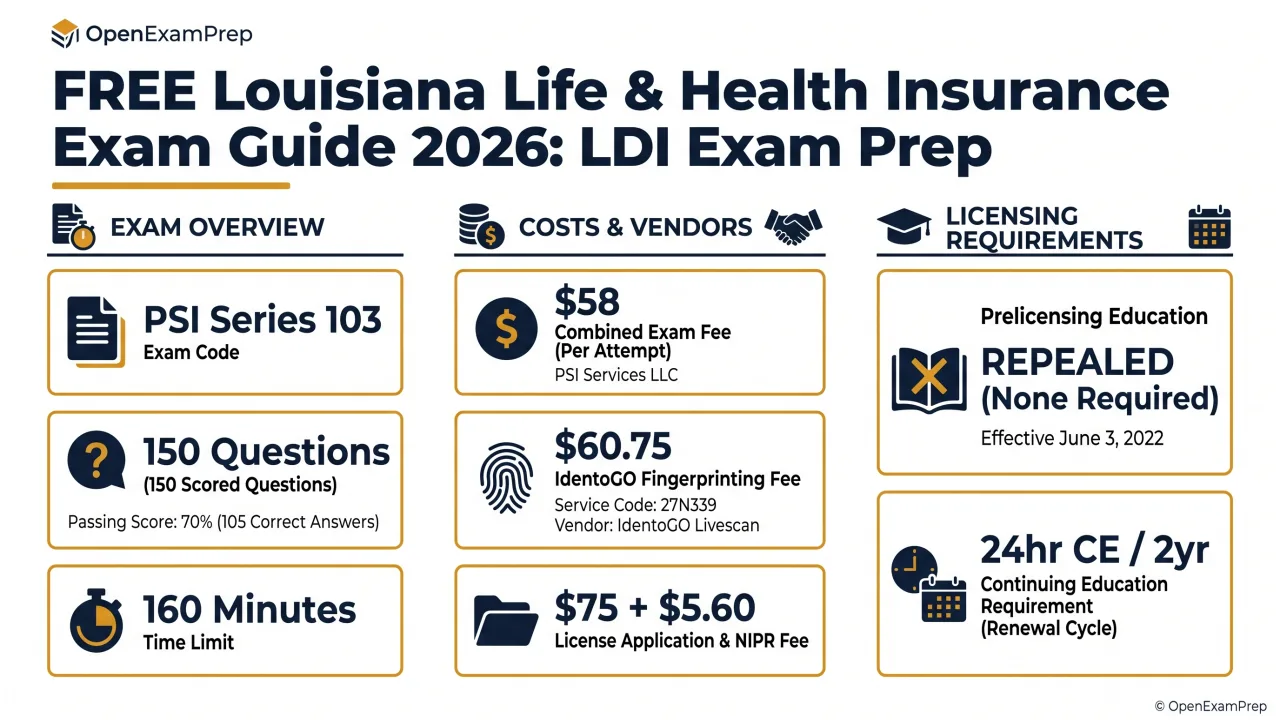
The Louisiana Life, Health and Accident Insurance License Exam is administered by PSI Services LLC on behalf of the Louisiana Department of Insurance (LDI). The combined exam is officially labeled Series 103 - Life, Health and Accident or Sickness Insurance. Louisiana stands out from most states in one important way: effective June 3, 2022, the legislature repealed the prelicensing education requirement for producer and consultant applicants in every major line, so you can register for and sit for the exam without completing a state-approved course first. The exam content did not get any easier, though, so most successful candidates still study from a structured prep course or a thorough self-study program.
Louisiana's insurance market also has unusual state-specific depth. The state runs Medicaid expansion through the Healthy Louisiana managed care program, administers LaCHIP for children, and continues to rebuild its coastal and New Orleans markets. Hurricane exposure, Medicaid managed care, and Title 22 producer law all show up on the state portion of the exam.
Exam Format at a Glance
Louisiana offers the Life and Health license as either two single-line exams or one combined exam. Most candidates take the combined exam.
| Component | Details |
|---|---|
| Combined Exam (Series 103) | 150 questions / 160 minutes (2 hours 40 minutes) |
| Life Only (Series 101) | 100 questions / 120 minutes |
| Accident & Health Only (Series 102) | 100 questions / 120 minutes |
| Passing Score | 70% (105 correct on the combined exam) |
| Testing Vendor | PSI Services LLC |
| Combined Exam Fee | $58 per attempt |
| Single-Line Exam Fee | $38 per attempt |
| Prelicensing Education | Not required (repealed June 3, 2022; recommended) |
| Remote Proctoring | Not available (ended July 8, 2024; in-person only) |
All exams are computer-based, multiple-choice, and delivered at PSI testing centers in Louisiana (Alexandria, Baton Rouge, New Orleans, Bossier City, and Lake Charles). Schedule through PSI Exams or by calling 800-733-9267. Exam scores are valid for 12 months from the date you pass.
Start Your FREE Louisiana Life & Health Exam Prep
Our comprehensive, completely free Louisiana Life & Health prep covers every topic on the PSI Series 103 outline, with practice questions, explanations, and AI-powered study help.
You can also jump straight into timed drilling with our Free Louisiana Life & Health Practice Test.
Official PSI Series 103 Content Outline
The exam is built from the official PSI content outline, developed with LDI and an industry review committee. The combined Life, Health and Accident exam is weighted as follows. This is the real blueprint - use it to allocate your study time rather than guessing.
| Content Area | Questions | Weight |
|---|---|---|
| Louisiana Insurance Regulation (Title 22) | 35 | 23% |
| Life, Health, and Accident Insurance Basics | 21 | 14% |
| Life Insurance Policy Provisions, Options, and Riders | 20 | 13% |
| Types of Life Insurance Policies | 12 | 8% |
| General Insurance Concepts | 10 | 7% |
| Annuities | 10 | 7% |
| Individual Health and Accident Insurance Policy Provisions | 10 | 7% |
| Health Insurance for Senior Citizens and Special Needs Individuals | 10 | 7% |
| Disability Income and Related Insurance | 6 | 4% |
| Medical Plans | 6 | 4% |
| Group Health Insurance | 5 | 3% |
| Federal Tax Considerations for Life and Health Insurance | 3 | 2% |
| Licensing and Regulation (Federal) | 1 | 1% |
| Total | 150 | 100% |
The largest single section is Louisiana Insurance Regulation at 23% - 35 questions on Title 22 producer licensing and maintenance, the commissioner's authority, appointments, replacement rules, advertising, unfair trade practices, the Life and Health Insurance Guaranty Association, and continuing education rules. Candidates who under-prepare for the state section routinely fail even when they know the national product material cold.
Louisiana-Specific Life Insurance Provisions
These provisions are set by Louisiana statute (La. R.S. 22:931) and are tested in the Life Insurance Policy Provisions section. Know the exact numbers, because the exam rewards the candidate who distinguishes a Louisiana rule from the national default.
| Provision | Louisiana Requirement | Source |
|---|---|---|
| Free Look Period | 10 days from receipt of the policy | La. R.S. 22:931(10) |
| Grace Period | 30 days, or one month at the insurer's option | La. R.S. 22:931(1) |
| Incontestability | 2 years from date of issue | La. R.S. 22:931(2) |
| Suicide Exclusion | 2 years (standard) | La. R.S. 22:931 |
| Misstatement of Age | Adjustment of benefits | La. R.S. 22:931 |
The Louisiana Life and Health Insurance Guaranty Association is a recurring exam topic. It pays covered claims (up to statutory limits) on life, health, and annuity contracts if a licensed Louisiana insurer becomes insolvent, and there are strict rules about how agents may advertise or disclaim it.
Healthy Louisiana and LaCHIP
Louisiana administers Medicaid expansion through Healthy Louisiana, a managed care program run by the Louisiana Department of Health (LDH). As of 2026, five MCOs participate after UnitedHealthcare exited the program effective April 1, 2026. The exit was originally announced for December 31, 2025, but LDH granted a 90-day extension through March 31, 2026 to allow an orderly transition; UnitedHealthcare members were then reassigned to the remaining plans.
The five current Healthy Louisiana MCOs are:
- Aetna Better Health
- AmeriHealth Caritas Louisiana
- Healthy Blue
- Humana
- Louisiana Healthcare Connections
LaCHIP (Louisiana Children's Health Insurance Program) provides no-cost Medicaid coverage to uninsured children under age 19 in families earning up to 217% of the federal poverty level. A separate LaCHIP Affordable Plan extends coverage to children in families earning up to 255% of FPL. There is no asset test for children's coverage. The Healthy Louisiana member hotline is 1-855-229-6848.
2026-2027 Louisiana Medicaid Changes
Federal OBBBA rules and state actions are reshaping Louisiana Medicaid. Be ready for exam questions and client questions about these changes:
- UnitedHealthcare exit: UHC's contract ended March 31, 2026; members reassigned to the five remaining MCOs effective April 1, 2026.
- Six-month eligibility redeterminations: begin December 2026 for expansion adults.
- Work / community-engagement requirements: 80 hours per month for able-bodied adults 19-64 take effect January 1, 2027.
- New 2026 income limits: effective April 1, 2026.
How to Get Licensed: Step by Step
Step 1 - Prepare for and Pass the Exam
Because Louisiana repealed the prelicensing requirement on June 3, 2022, you can register for the PSI Series 103 exam directly. You do not need a course completion certificate. You do need to know the material. Schedule at psiexams.com or by calling 800-733-9267. The combined exam is $58; a single-line Life or Accident & Health exam is $38. You receive immediate pass/fail results at the testing center.
There is no limit on retake attempts within your 12-month eligibility period, but each attempt requires a new exam fee, and same-day retesting is not allowed.
Step 2 - Complete Fingerprinting
Resident applicants must submit Livescan fingerprints through IdentoGO, the state's contracted vendor. Use service code 27N339 to schedule at identogo.com or by calling 844-539-5543. The fee is $60.75 for the combined state and federal background check, paid to IdentoGO at the appointment. Prints are transmitted to the Louisiana State Police and the FBI, with results sent to LDI. You can complete fingerprinting before or after the exam, but LDI will not issue a license until the background check clears.
Step 3 - Apply for Your License
Apply online through the National Insurance Producer Registry (NIPR) at nipr.com or through Sircon. The resident producer application fee is $75 plus a $5.60 NIPR transaction fee. LDI updated several licensing, renewal, and appointment fees effective January 1, 2026, so confirm the current fee schedule on the LDI licensing page before filing. License processing typically takes 7-10 business days after your background check clears.
Step 4 - Get Appointed
To earn commissions, each insurer you represent must file a notice of appointment through NIPR within 15 days of executing your agency contract (La. R.S. 22:1558(B)). The appointment fee is $20 per insurer.
Total Cost to Get Licensed
| Item | Fee |
|---|---|
| Combined exam (PSI Series 103) | $58 |
| IdentoGO fingerprinting (service code 27N339) | $60.75 |
| License application (NIPR) | $75 + $5.60 |
| Total before any optional prep course | about $199 |
A single-line Life or Accident & Health exam is $38 instead of $58, which lowers the total by $20. Optional prelicensing courses, while not required, typically run $150-$400 and are a sensible investment if you are new to insurance.
Nonresident Reciprocity
Louisiana grants reciprocity to producers licensed in another state for the same lines of authority. If you are moving to Louisiana, you can transfer your resident license without retaking the exam or completing prelicensing, provided you apply within 90 days of canceling your previous license and were in good standing in your prior home state. Nonresidents who remain in their home state apply through NIPR and are exempt from Louisiana's exam and prelicensing requirements as long as their home state license is active. Contact LDI's Producer Licensing Division at producerlicensing@ldi.la.gov to confirm the current transfer process.
Continuing Education Requirements
After you are licensed, Louisiana requires continuing education for every renewal except your first. For Life, Health and Accident producers the requirement is 24 hours every 2 years, including 3 hours of ethics. Up to 10 excess hours from the prior period may carry over as general credit; ethics and any line-specific hours must be re-earned each period.
Product-specific training (separate from the 24-hour total, but the hours may count toward it):
- Long-Term Care: 8-hour initial NAIC course before selling LTC; 4 hours of LTC-specific training each renewal cycle thereafter (La. R.S. 22:1575).
- Annuities: Louisiana's Regulation 89 annuity best-interest training (enhanced effective September 20, 2024) before selling annuity products.
- Flood (NFIP): 3 hours of NFIP training is required for Property & Casualty and Personal Lines producers, not Life & Health, unless you also hold those lines.
New for 2027 renewals: Act 29 of the 2025 Regular Legislative Session requires a 2-hour legislative update course as part of the 24-hour total, for renewals due on or after July 31, 2027. Plan ahead so you do not fall short at renewal.
First-renewal exemption: A newly licensed producer is exempt from CE for the first renewal period only. LDI is amending Rule 10 of its CE rules, which may change this exemption and other CE details, so verify the current rule on the LDI site.
Exemptions: Producers age 65 or older with at least 15 years of experience who file the 65A Exemption Form may be exempted from CE for life, though they must still file a renewal application each cycle. Military service waivers are also available.
License Renewal and Reinstatement
Louisiana Life and Health producer licenses renew every even-numbered year, on the last day of the licensee's birth month. The renewal fee is $50, paid through the LDI Producer/Adjuster Portal. Renewal is available the month before and the month of your birthday.
If you miss the deadline, a license can be reinstated within 5 years for $100 ($50 renewal plus $50 reinstatement fee). After 5 years, you must requalify by examination.
Study Timeline for Success
Even without a mandatory course, plan for 60-90 hours of focused study over 5-6 weeks.
| Week | Focus Area | Hours |
|---|---|---|
| Week 1-2 | Life insurance products, provisions, and riders | 15-20 |
| Week 2-3 | Health insurance, disability, and medical plans | 15-20 |
| Week 3-4 | Annuities, LTC, senior health, and federal tax | 12-15 |
| Week 4-5 | Louisiana Title 22 regulation and ethics (23% of exam) | 12-15 |
| Week 5-6 | Full practice exams and weak-area review | 15-20 |
The state regulation section is nearly a quarter of your score. Do not leave Title 22 for the end.
Louisiana-Specific Exam Tips
1. Treat Title 22 as a standalone subject
The 23% Louisiana Insurance Regulation section is the single biggest chunk of the exam. Master producer licensing and maintenance, the commissioner's powers, appointment rules, replacement regulations, unfair trade practices (rebating, misrepresentation, defamation), advertising rules, and the Guaranty Association advertising restrictions.
2. Know these exact Louisiana numbers
| Topic | Louisiana Rule |
|---|---|
| Free look period | 10 days |
| Grace period | 30 days (or one month) |
| Incontestability | 2 years |
| Prelicensing education | Not required since June 3, 2022 |
| CE requirement | 24 hours / 2 years (3 ethics) |
| Carryover | Up to 10 hours |
| License renewal | Even years, last day of birth month |
| Renewal fee | $50 |
| Reinstatement | $100 within 5 years |
| Fingerprinting | $60.75 (IdentoGO, code 27N339) |
| Combined exam fee | $58 |
| Passing score | 70% |
3. Distinguish the Healthy Louisiana MCOs from Medicaid itself
Exam questions reward candidates who can separate the program (Healthy Louisiana / Medicaid) from the carriers (the five MCOs). Know that UnitedHealthcare exited effective April 1, 2026, and that LaCHIP covers children to 217% FPL (255% under the Affordable Plan).
4. Do not assume remote testing is available
PSI discontinued remote proctoring for Louisiana insurance exams on July 8, 2024. Every exam is in-person at a PSI testing center. Plan travel and identification accordingly.
Common Mistakes to Avoid
- Skipping structured study because prelicensing is not required - the pass bar is the same; the repeal just removed the course mandate.
- Under-investing in the 23% Louisiana regulation section - it is the largest single domain.
- Using the wrong fingerprinting vendor or fee - it is IdentoGO with code 27N339 at $60.75, not a PSI fingerprint fee.
- Confusing Healthy Louisiana with Healthcare.gov - one is Medicaid managed care, the other is the ACA exchange.
- Expecting a remote-proctored exam - in-person only since July 8, 2024.
- Forgetting the 2-hour legislative update if your renewal falls on or after July 31, 2027.
Exam-Day Checklist
Before test day, confirm your appointment time, approved identification, and the PSI testing center address. Use the exact legal name from your records on your ID and registration, because mismatches can block check-in. Arrive 30 minutes early. You cannot bring purses, study materials, books, cell phones, or your own calculator into the testing room; calculators are provided. You may not leave the room during the exam without the proctor's permission.
On the exam, answer the question asked before reading extra meaning into the facts. Insurance exams include plausible distractors that are true statements but do not answer the question. Mark long scenario questions and return to them after securing the easier definition and rule points.
If You Do Not Pass
A failed attempt is diagnostic data. Your score report shows weak areas by content domain. Sort them into national product knowledge, Louisiana law, and test-taking process. For product knowledge, rebuild comparison charts. For Louisiana law, verify the current rule from LDI or the PSI outline and drill short recall prompts. For process issues, take timed sets.
There is no retake limit within your 12-month eligibility, but each attempt requires a new $58 fee and you cannot retest the same day. Schedule the next attempt only after your weakest two categories improve in practice.
Official Resources
- Louisiana Department of Insurance: ldi.la.gov | Producer Licensing: (225) 342-0860 | Toll-free: (800) 259-5300 | Email: producerlicensing@ldi.la.gov | 1702 N. Third Street, Baton Rouge, LA 70802 | P.O. Box 94214, Baton Rouge, LA 70804-9214
- PSI Exams: psiexams.com | 800-733-9267
- IdentoGO Fingerprinting: identogo.com | Service code 27N339 | 844-539-5543
- NIPR (applications): nipr.com
- PSI Series 103 Content Outline (PDF): LA Insurance Content Outlines
- LDH / Healthy Louisiana: ldh.la.gov | Member hotline: 1-855-229-6848
How to Use This Guide Without Missing State-Specific Details
Treat this article as your working roadmap, then verify the administrative details against official sources before you schedule. Insurance licensing changes are usually small, but small changes matter on exam day: a vendor switch, a new fingerprinting workflow, a revised candidate handbook, or an updated application checklist can delay a license even when you know the content. Start with the Louisiana Department of Insurance, then confirm your PSI testing account, then check the NIPR state requirements page for the current application flow.
For the content itself, separate national insurance knowledge from Louisiana-specific law. National life and health questions test concepts that transfer across states: contract parties, insurable interest, beneficiary designations, policy riders, annuity phases, health policy renewability, disability income definitions, Medicare supplement basics, group health coordination, and unfair trade practices. The state section asks how those ideas are administered in Louisiana under Title 22. When a question includes a number, deadline, appointment step, replacement notice, continuing education rule, or regulator power, slow down and decide whether it is a national default or a Louisiana rule.
A Practical Study Workflow for the Final Two Weeks
Use the last two weeks to convert recognition into decision speed. On day one, take a mixed diagnostic in /study-guides/la-life-health and tag every missed question by reason: did you miss a definition, confuse two similar products, overlook a state rule, or run out of time? Definitions need flashcards. Similar products need comparison tables. State rules need a short checklist. Timing mistakes need practice blocks with a visible clock.
During the first week, work in focused sets. Do life insurance one day, health insurance the next, annuities after that, and Louisiana law at least every other session. Do not wait until the end to study regulations. Many candidates know term versus whole life but lose points on replacement, advertising, producer authority, unfair claims practices, or what must happen before a license is issued. After each set, rewrite the explanation in your own words. If you cannot explain why the wrong answer is wrong, you have not finished the question.
During the second week, switch to exam simulation. Use full mixed quizzes, then spend more time reviewing than answering. For life insurance, drill policy provisions, riders, beneficiary changes, settlement options, nonforfeiture options, and taxation at a high level. For health insurance, drill renewability, exclusions, disability definitions, long-term care, Medicare supplement rules, group versus individual contracts, and coordination of benefits. For annuities, make sure you can distinguish accumulation from annuitization, fixed from variable, immediate from deferred, and suitability from general sales preference.
Common Life and Health Traps
A common trap is answering from everyday sales language instead of policy language. "Cash value," "premium," "benefit," "owner," "insured," and "beneficiary" have precise exam meanings. Another trap is treating Medicare, Medicare Advantage, Medicare Supplement, and Medicaid as interchangeable. They are different programs or products, and exam questions often reward the candidate who notices which one is actually named.
Replacement questions deserve special attention. The exam may ask what must be disclosed, when notices are required, how existing coverage should be treated, or why twisting is prohibited. Do not memorize replacement as simply "bad." Replacement can be legitimate, but it becomes a compliance issue when comparison, disclosure, or suitability duties are ignored.
Health questions also use similar-sounding renewability terms. Noncancelable, guaranteed renewable, conditionally renewable, optionally renewable, and cancelable policies allocate power differently between insurer and insured. Build a one-page table and practice from both directions: given the term, state the rule; given the rule, name the term.
Best Next Step
Work through the free Louisiana Life & Health materials on OpenExamPrep while keeping the official LDI and PSI pages open for logistics. Use OpenExamPrep's Louisiana Life & Health study guide for content review and the free Louisiana Life & Health practice test for timed drilling. Use LDI, PSI, IdentoGO, and NIPR for current filing, scheduling, fingerprinting, and application steps. That split keeps study time focused and keeps your licensing steps grounded in official instructions.

 Free CE
 Buy on Amazon
 Prep course on Achievable
 Study guide on Mometrix
 Take courses on Udemy