Preparing for the Singapore Nursing Board Registered Nurse Licensure Examination (SNB RN LE) starts with two tasks: obtain SNB authorisation through your prospective employer, and study the current RN test plan. Buying a practice package or creating a Pearson VUE account does not establish eligibility. This guide is for foreign-trained RN applicants; SNB provides a separate EN examination and a separate registration route for graduates of accredited programmes in Singapore.
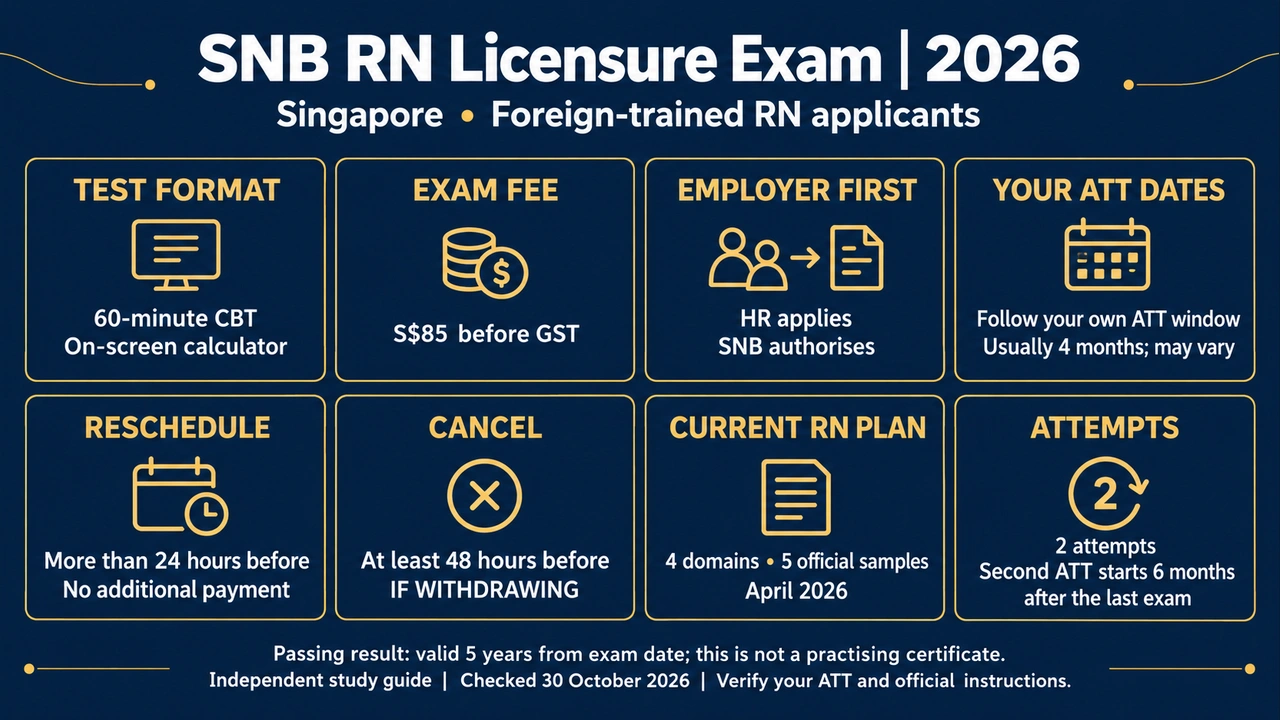
The examination uses computer-based multiple-choice questions at designated Pearson VUE test centres. The published testing time is 60 minutes, with an on-screen calculator. The official documents reviewed on 30 October 2026 do not state a fixed question count, numerical pass mark or domain percentage weights. Use the SNB examination page and the Pearson VUE candidate page as the starting points.
The exam facts that change your preparation
| Question | Current published position |
|---|---|
| Where do I sit it? | Designated Pearson VUE test centres; select an available location after authorisation |
| How long is the test? | 60 minutes; Pearson states that no further time extension is allowed |
| Which syllabus applies? | April 2026 RN test plan, based on the 2023 RN core competencies |
| What is the examination fee? | S$85 before prevailing GST, separate from registration and practising-certificate fees |
| How long is my authorisation valid? | The dates in your own Authorisation to Test (ATT) email control |
| How many attempts are available? | Two attempts at the relevant RN or EN licensure examination |
| Who receives the result? | Employer HR; SNB's FAQ states release within two to three days |
Computer-based delivery began on 28 November 2024. Advice about fixed paper-exam venues or taking your own calculator may describe an earlier process. The current SNB fee schedule and CBT FAQ supply the fee and administrative rules above. A practice site's question inventory is not the number of questions on the actual examination.
First establish the right application route
For foreign-trained applicants, SNB's eligibility page requires an employment offer from an eligible Singapore healthcare institution with inpatient services. It also requires a nursing programme SNB assesses as equivalent to the relevant accredited Singapore programme, registration from the country of training, a current practising licence, and relevant clinical practice in the home country within the past five years. That last condition does not mean every applicant must have five full years of experience.
Employer HR checks the institution's eligibility with SNB and submits the application. Prepare your education and employment records early: the regulator and training institution must send the required registration verification and education transcript directly to SNB. Your transcript needs theory and clinical hours or weeks. Documents in another language require a certified English translation. Ask HR to resolve name differences across your passport and records before booking.
An agent's assistance with recruitment does not replace employer HR's application. A qualification title such as BSc Nursing does not by itself prove that SNB will approve the individual file. Graduates of Singapore-accredited programmes should follow the Local Graduates instructions, which have different application arrangements. Do not apply this foreign-trained exam workflow indiscriminately to all nurses.
Booking, costs and the two different appointment deadlines
Read the individual ATT before choosing a date
After SNB authorises the examination, Pearson VUE sends your ATT. HR submits the exam application through NRS1.5; you then use Pearson VUE to schedule the authorised examination. The FAQ says the ATT is usually four months, but can differ between candidates. Record your own start and expiry dates. A voucher's validity is a separate matter and does not extend your ATT.
Book early enough to leave room for travel arrangements or a change of appointment. Availability is year-round, but each centre determines its dates, times and seats. If a centre has no suitable slot, check another authorised location rather than assuming SNB has a single national examination date. Account or booking problems go to Pearson VUE; incorrect identity details should go through HR to SNB.
Budget for the examination separately
SNB lists the Pearson VUE examination at S$85 before prevailing GST. Payment can be made by debit or credit card, or an employer-purchased prepaid voucher. Confirm the checkout total and any card charges. The current schedule separately lists S$60 for a foreign-trained registration application, S$55 for RN registration, and S$55 per year for a non-APN RN practising certificate. These are different fee categories, not alternative prices for the exam. Ask HR which costs the employer covers.
Rescheduling is not the same as withdrawing
The linked CBT FAQ makes a distinction that can affect your payment:
- Reschedule: Q17 says no additional payment is required when you reschedule more than 24 hours before the original appointment. The new appointment must remain within your ATT period.
- Cancel because you will not proceed: Q20 requires cancellation at least 48 hours before the appointment. Do not infer a refund guarantee from that sentence; prepaid vouchers are expressly non-refundable under Q25.
For a hypothetical appointment on Wednesday 18 November 2026 at 10:00, in the appointment's local time, the stated no-new-payment rescheduling condition requires action before Tuesday 17 November at 10:00. Exactly 24 hours is not “more than 24 hours.” Cancellation meets the stated 48-hour timing condition by Monday 16 November at 10:00. Act earlier, complete the online change, and retain confirmation; do not rely on merely sending a message.
Missing an appointment can forfeit the fee. If your ATT expires before you obtain an appointment, the FAQ requires a fresh HR application and payment. Do not treat a long-valid voucher as permission to book outside the dates SNB authorised.
Test-day checklist and what happens afterwards
Use your original, unexpired passport, issued by the government of your country of citizenship. Its information must appear in English, including your full name, date of birth, a recent recognisable photograph and your signature. The details must exactly match your SNB examination registration. Photocopies and digital passport images are not accepted. Take a printed booking confirmation and any further documents listed in that confirmation. Arrive 30 minutes early. The FAQ says arrival more than 15 minutes late leads to refused admission and forfeited fees; that is a consequence, not permission to plan a late arrival.
At the computer, accept the non-disclosure agreement within five minutes or the examination terminates. Use the tutorial to learn the interface, including the on-screen calculator. Follow the centre's rules for personal belongings. During the 60-minute examination, use the information actually displayed to manage pace rather than assuming an internet claim about the item count is correct.
SNB releases results to HR, and the employer informs you; Pearson does not issue the SNB result directly to candidates. A passing result remains valid for five years from the examination date. It is not a five-year practising licence. If you fail the first attempt, HR must decide whether to support a fresh application. The second ATT period starts six months after the last examination date; you cannot simply pay Pearson to retest immediately. See CBT FAQ Q2, Q3, Q22 and Q32.
Turn the April 2026 RN test plan into a study checklist
The current RN test plan has four domains. Unpublished percentage weights do not mean equal weighting or an “unweighted” exam. Cover the whole plan and allocate extra practice to demonstrated weaknesses.
Legal and Ethical Nursing Practice covers legal accountability, ethical care and cultural appropriateness. Professional Nursing Practice contains the 20 categories below. Collaborative Practice and Teamwork includes collaboration, delegation and supervision. Continuing Professional Education and Development concerns maintaining competence and currency.
The following is an editorial revision checklist, with shortened category labels in the official order. The practice tasks are suggestions, not additional SNB syllabus rules.
| Plan category | A useful way to practise it |
|---|---|
| 2.1 Quality and holistic care | Identify an outcome that would show whether a team improvement helped patients |
| 2.2 Health education | Explain a care task clearly and check the learner can demonstrate it |
| 2.3 Environment safety | Match the stated hazard to a practical risk-reduction measure |
| 2.4 Clinical reasoning | Explain why one problem deserves attention before another |
| 2.5 Nutrition, fluids and electrolytes | Interpret intake/output information alongside the assessment |
| 2.6 Communication | Replace assumptions with listening, clarification and a focused handover |
| 2.7 Emergencies | Recognise deterioration and identify the appropriate escalation pathway |
| 2.8 Palliative care | Relate symptom relief and the care plan to the patient's goals |
| 2.9 Mental health | Distinguish observed findings from an unsupported diagnostic label |
| 2.10 Respiratory care | Combine respiratory observations with symptoms and treatment response |
| 2.11 Elimination | Review continence needs and appropriate catheter-care decisions |
| 2.12 Assessment and reassessment | Compare baseline findings with changes after an intervention |
| 2.13 Surgical care | Identify the observations required around a procedure and recovery |
| 2.14 Wounds | Describe a wound consistently so subsequent assessments can be compared |
| 2.15 Diabetes | Connect glucose monitoring, foot assessment and patient education |
| 2.16 Safety and comfort | Individualise assistance while protecting dignity and comfort |
| 2.17 Infection prevention | Select precautions for the stated exposure or transmission risk |
| 2.18 Medicines and pharmacology | Check the order, allergy information, dose calculation and response |
| 2.19 Older adults | Consider function, communication needs and the person's usual baseline |
| 2.20 Mobility | Match assistance and equipment to the assessed ability to move |
Use the RN Core Competencies and Generic Skills (2023) to deepen this checklist. Its skills include assessment, medication calculation, infection precautions, emergency response and evaluation of care. A list of skills is not a substitute for the clinical protocol, authorisation and demonstrated competence required to perform them.
What the current official samples actually teach
Page two of the April 2026 plan contains five examples. In summary, their keyed choices identify breakthrough pain, team involvement in improving care, pelvic-floor exercise for stress incontinence, tracheal deviation as the most serious listed trauma finding, and attentive listening with restatement. Read the full stems and alternatives in the official PDF before applying those answers elsewhere.
These examples reward interpreting the question's specific cue. Pain despite a recent regular opioid dose should not automatically be dismissed as addiction. An improvement question asks about better care outcomes, rather than simply whether an individual follows instructions. A serious trauma sign requires prioritisation, but a sample answer does not authorise an untrained nurse to perform an invasive emergency procedure.
Older RN sample documents contain a different pair of scenarios. The tracheostomy and cancer-weight-loss examples previously circulated online are not the five April 2026 samples. Our quiz below contains original practice items, not recalled questions from a live SNB examination.
Practise RN judgement, not isolated slogans
For every scenario, write down the cue that changes the decision, the appropriate nursing action, and the reassessment or communication needed afterwards. This makes it harder to choose a familiar-sounding answer that does not fit the patient.
Consent example: An adult with decision-making capacity refuses a non-emergency procedure after an informed discussion. Family agreement does not replace that person's decision. Respect the refusal, clarify concerns without coercion, document the discussion and inform the treating team. If capacity is uncertain, the facts and applicable decision-making process change. The SNB Code for Nurses and Midwives (2018) distinguishes autonomy, confidentiality, safe practice and accurate records; these are not interchangeable rules.
Delegation example: An EN reports an unexpected change while carrying out delegated observations. Finishing the routine task is not enough: the RN needs to assess the significance, arrange appropriate review and clarify what must be reported next. Match delegated work to the person's role and competence, with suitable supervision. The RN remains accountable for the delegation decision; the EN remains accountable for their own practice. The 2023 scope document describes those separate responsibilities.
Scope example: Being asked to administer an unfamiliar specialist treatment does not establish competence. Raise the concern and arrange suitable qualified assistance and training. Do not attempt it solely because you watched a demonstration or pass the task to another person whose competence has not been established.
Singapore's Nurses and Midwives Act, section 19 gives the Board disciplinary powers, including suspension of registration/enrolment for up to two years and a financial penalty up to S$2,000 under subsection (2). These are statutory limits, not an automatic penalty for every error. For preparation, understand the conduct and accountability issue before memorising a number.
Three calculation habits worth rehearsing
Drug calculation appears in the RN generic skills. For educational examples, assume the order and supplied concentration have already been checked; arithmetic alone does not establish that a medicine is safe for a particular patient.
- Keep the concentration units together. A prescribed 450 mg with stock 150 mg in 5 mL requires mL. Check backwards: mg. The number 150 is not a concentration of 150 mg/mL.
- Convert time before setting a pump rate. For a stated 480 mL over four hours, mL/hour. If time is supplied in minutes, convert consistently before using the formula.
- Use the stated equipment factor for gravity infusion. With 480 mL over four hours and a specified 20 drops/mL set, drops/minute. Do not transfer that drops/minute value into a pump expecting mL/hour.
Practise entering the calculation, checking units and estimating whether the result is plausible. Follow the prescription, equipment instructions and institutional rounding policy in actual care.
A four-week preparation cycle you can adapt
This is an optional study schedule, not an SNB requirement or a promise of readiness in four weeks. Shorten or extend it based on your baseline, available time and authorised appointment.
- Week 1: establish the route and baseline. Save the ATT dates and current official documents. Try a mixed set from the SNB RN practice bank. Label errors as knowledge, interpretation, calculation or rushing. Review consent, confidentiality and scope in the study guide.
- Week 2: work across the professional categories. Use the 20-category checklist to identify omissions. Pair assessment with reassessment, medication questions with calculations, and safety questions with the reason a precaution applies. Do not let a favourite specialty occupy every revision session.
- Week 3: join the domains. Practise cases involving a deteriorating patient, a delegation decision or a communication problem. Explain why each rejected option fails in that particular situation. Use the flashcards for recall, then apply the fact to a fresh case.
- Week 4: rehearse timing and logistics. Use unfamiliar mixed sets, review mistakes, and practise with an on-screen calculator. For a self-selected 30-question, 30-minute drill, the average budget is one minute per item; this is a training design, not an official SNB question count. Confirm travel, passport and printed appointment details.
When reviewing an answer, ask what new finding would make a different option appropriate. A correct guess needs review too. On exam day, use the actual instructions and remaining workload to set your pace; a fixed “45 seconds per question” rule cannot be justified without knowing the number presented.
Passing, registration and ongoing competence are separate
Passing satisfies an examination component. SNB may also require competency assessment and/or provisional registration or enrolment. Follow the outcome communicated through your employer. You need a valid practising certificate to practise, and any conditions on registration still apply.
Domain four also deserves practical study: identify a skill gap, plan relevant learning and show that your practice improves. SNB's CPE framework specifies 15 points per qualifying period for RNs, with the period running 1 September to 31 August. Its 21 July 2026 notice explicitly permits PC renewal for 2027 despite insufficient current-period points while directing continued learning for 1 September 2026 to 31 August 2027. Do not turn that transition provision into a permanent exemption. APNs have separate requirements. SNB's CPE FAQ excludes temporary and provisional registrants from accumulating CPE points. Provisionally registered nurses may attend learning events, but they do not need to record or accrue points during that registration period.
OpenExamPrep provides independent study material and is not SNB or Pearson VUE. Start with the official plan, use practice to expose a specific weakness, and return to the controlling source whenever an answer depends on a regulatory rule.
Official sources to keep with your notes
- SNB licensure examination hub, updated 20 April 2026: current RN and EN document links.
- RN test plan and five samples, April 2026: categories and keyed examples.
- CBT FAQ, internally updated 25 April 2025: the active linked document for ATT, appointment changes, attempts and results; the URL's May date is not the document's printed revision date.
- Pearson VUE SNB candidate instructions: booking, passport, NDA, timing and calculator.
- SNB current fees: distinguish examination, application, registration and practising-certificate charges.
- SNB standards hub: the 2018 Code, 2023 RN competencies and scope documents.
- SNB CPE notice and linked FAQ: current transition instructions and point requirements.
