ASE G1 Study Guide 2026: Study the Decision, Not Just the Part
The ASE G1 Auto Maintenance and Light Repair test is broad, but it is not an A1–A8 overhaul exam squeezed into one appointment. It tests whether you can perform common maintenance and light-repair work safely, use the right service information, inspect or measure before acting, and choose the next appropriate step. That distinction should control how you study.
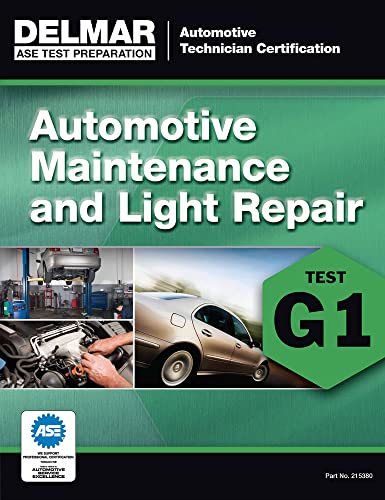
Start with the official 2026 ASE G1 study guide. Its task list is the source of truth for content. Use this article to turn that list into a study order, a repeatable question-solving method, and a readiness decision.
The current G1 format—and an official-page conflict to know about
ASE's G1-specific 2026 PDF lists the initial certification test as 55 total questions, 45 scored questions, and 90 minutes. Ten questions are research questions that do not count toward the score, and ASE does not identify them. The same guide lists the G1R recertification test as 28 questions in 45 minutes.
There is a genuine discrepancy on ASE's website: its general test-times table has continued to show G1 as 65 questions in 90 minutes. The exam-specific 2026 guide is newer and more specific, so this guide uses its 55-total/45-scored format. Still, confirm the appointment details shown in myASE when you schedule. Whichever count appears, answer every question because you cannot identify the research items.
The 90-minute limit gives you about 98 seconds per question under the 55-question format. That is enough time if you make a first pass, flag genuinely uncertain items, and avoid turning one diagnosis into a five-minute shop debate.
Do not build your plan around a supposed 70% passing score. ASE's current G1 guide does not publish a passing percentage. A practice target is useful, but it is a readiness buffer—not an official cut score.
What G1 certification actually requires
You may take G1 before completing the experience requirement. Passing the test alone, however, does not immediately make you certified. ASE requires both a passing test result and approved relevant work experience. Its current work-experience instructions assign G1 to the one-year Repair Technician category: one year full-time, or the part-time equivalent. Eligible formal education or training can substitute for some of that requirement under ASE's published rules.
For a single G1 order, ASE currently lists a $34 registration fee per order plus a $62 general test fee, or $96 before any applicable sales tax. After purchase, ASE gives you 90 days to schedule and take the test. Verify current prices and deadlines on the official registration page before paying.
The current ASE remote-testing page says remote delivery is for recertification tests and excludes G1. Plan to take the initial G1 at a Prometric test center unless myASE specifically offers you another eligible option. This is another rule worth checking at booking rather than relying on an older prep page.
The official ASE G1 blueprint
The 2026 task list allocates the test across seven content areas:
| Content area | Questions in specification | Weight |
|---|---|---|
| Suspension and Steering | 13 | 24% |
| Brakes | 11 | 20% |
| Engine Systems | 9 | 16% |
| Electrical | 8 | 15% |
| Manual Drive Train and Axles | 6 | 11% |
| Automatic Transmission/Transaxle | 4 | 7% |
| Heating, Ventilation, and Air Conditioning | 4 | 7% |
Suspension and Steering plus Brakes account for 44% of the specification. Add Engine Systems and Electrical, and the top four areas account for 75%. That does not justify skipping the smaller domains; it tells you where the largest share of your first study blocks should go. A four-question domain can still decide a close result.
The listed domain counts describe the test specification. The initial test also contains unscored research items, and you will not know which individual questions count. Treat every domain and every question as live.
The G1 scope boundary: maintenance and light repair
A common preparation mistake is studying major internal repair because the exam mentions an engine, transmission, or steering system. G1 is centered on common service, inspection, replacement, measurement, and limited diagnosis. The official task verbs reveal the expected depth: verify, inspect, test, measure, retrieve and record, service, replace, and determine necessary action.
That last phrase matters. Sometimes the competent light-repair decision is not to disassemble further. It is to verify the concern, consult service information, make the prescribed check, compare the result with specification, and identify the next action.
Use this five-step G1 decision ladder on scenario questions:
- Verify the concern or service need. Do not repair an assumption.
- Protect people and the vehicle. Stabilize the vehicle, observe warnings, and follow system-specific safety procedures.
- Use current service information. Specifications, fluid type, torque, test points, and reset procedures are vehicle-specific.
- Inspect, measure, or test before replacing. Choose the check that separates the plausible causes in the prompt.
- Take the least assumptive supported action. Service, adjust, replace, document, or refer for deeper diagnosis as the evidence requires.
This ladder is more useful than memorizing a favorite shop shortcut. ASE says its questions have one best answer and enough information to choose it. The best answer is usually the one that follows a defensible service sequence without inventing a symptom or specification.
How to study each G1 content area
Suspension and Steering: build a symptom-to-measurement map
This is the largest domain. Organize it into four clusters: steering and suspension inspection; power-steering service; alignment; and wheels, tires, and TPMS. You should be able to connect tire-wear patterns and handling complaints to the next inspection or measurement, not merely define camber, caster, and toe.
Practice identifying what a visual inspection can establish, what requires a measurement, and what requires service information. Review wheel removal and installation, tire sizing and service, TPMS procedures, bearing or hub checks, ride-height-related concerns, and steering linkage inspection at the level listed in the official task list. Do not let alignment vocabulary consume the entire domain; the blueprint reaches much further.
Brakes: separate inspection evidence from repair assumptions
Build a sequence for hydraulic checks, disc brakes, drum brakes, parking brakes, power assist, and basic ABS-related tasks. Know which tool or observation supports a decision: visual condition, leakage, thickness, diameter, runout, or another manufacturer-specified measurement.
When reviewing a missed brake question, write down the evidence that would justify machining, indexing, adjustment, replacement, bleeding, or further diagnosis. If your explanation says only that a component is “probably bad,” you have not finished the review. Brake-fluid handling and contamination also deserve attention because small procedural details are easy to overlook.
Engine Systems: think routine service plus first-level diagnosis
The official list includes leaks and abnormal noises; oil and filter service; cooling-system inspection and service; belts, tensioners, pulleys, hoses, thermostats, and water pumps; air-induction and filter service; warning indicators; DTC retrieval; spark-plug and secondary-ignition inspection; exhaust and EVAP inspection; external fuel filters; and DEF checks.
Notice the boundary. Retrieving and recording a DTC is in scope; assuming the code proves a component has failed is not a sound diagnostic method. Likewise, selecting a fluid or procedure from memory is weaker than using the manufacturer specification given or implied by the question.
Electrical: master the circuit before chasing the module
Focus on batteries, starting and charging checks, lights and indicators, horns, wipers and washers, fuses, relays, connectors, and basic wiring service. For every electrical problem, practice stating the circuit's source, protection, load, control, and ground. Then identify which test would isolate the fault.
G1 questions reward basic electrical discipline: verify the complaint, inspect obvious conditions, use the correct test, and avoid condemning a part from a single ambiguous symptom. If you are weak here, draw simple circuits and explain voltage, resistance, current, and voltage drop in your own words before doing more multiple-choice sets.
Manual Drive Train and Axles: learn inspection pathways
Review clutch and manual-transmission service points, lubricants, drive shafts, universal joints, CV joints and boots, axles, differentials, transfer cases, and related leak or wear inspections from the task list. Build comparison cards for symptoms that change with vehicle speed, engine speed, steering angle, load, or coast. The goal is not to perform a complete overhaul; it is to recognize the next valid inspection or service action.
Automatic Transmission/Transaxle: specifications first
This smaller domain emphasizes fluid level and condition, leaks, basic service, cooler lines, filters or pans where applicable, and service-information-driven procedures. Modern fluid-check conditions vary, so reject any universal shortcut that ignores temperature, engine state, selector position, or manufacturer instructions. Four questions are enough to punish casual assumptions.
HVAC: service safely and stay inside the listed tasks
Review operating checks, vent temperature and airflow, compressor and fan engagement, refrigerant identification, recovery and recharge according to manufacturer specifications, visible leak checks, condenser airflow, cabin filters, belt condition, and evaporator drains. Distinguish ASE G1 knowledge from any separate legal credential required to service mobile A/C refrigerant. A G1 result does not replace EPA Section 609 certification.
A four-week, blueprint-weighted G1 plan
Use study blocks rather than pretending every candidate needs the same number of hours. One block can be 45 to 75 focused minutes. If a diagnostic shows that you already meet a block's objective, move it to a weaker task cluster.
Week 1: map the blueprint and own the largest domain
- Download the official PDF and mark every task confident, uncertain, or unfamiliar.
- Take a mixed diagnostic without notes. Tag each miss by official domain and task—not just by question number.
- Spend three blocks on Suspension and Steering: inspection, alignment and tire wear, then wheels/tires/TPMS.
- Spend one block explaining the five-step decision ladder aloud with real shop examples.
Week 2: brakes and engine systems
- Use two or three blocks for brake measurement, hydraulic service, and disc/drum decision sequences.
- Use two blocks for engine maintenance, cooling, air induction, ignition service, emissions inspection, and DTC retrieval.
- End the week with a mixed set weighted toward these three largest domains. Review every correct guess as if it were wrong.
Week 3: electrical, driveline, and HVAC
- Use two blocks for batteries, starting/charging, and basic circuit diagnosis.
- Use one block each for Manual Drive Train and Axles, Automatic Transmission/Transaxle, and HVAC.
- Make a one-page “service information needed” list: fluid specifications, test conditions, torque, measurement limits, reset or relearn steps, and safety requirements. The lesson is not to memorize imaginary universal numbers; it is to recognize when the correct answer must consult the vehicle procedure.
Week 4: timed decisions and weak-task repair
- Complete at least three timed mixed sets on separate days. Under the 55-question format, train at 90 minutes or less.
- After each set, classify every miss as a knowledge gap, sequence error, unsupported assumption, prompt-reading error, or pacing error.
- Return to the official task list and repair the exact weak cluster before taking another full set.
- In the final two days, rehearse logistics and review your error log. Do not replace a proven plan with a new pile of resources.
The error log that makes practice questions useful
A score alone cannot tell you what to fix. For each missed or guessed question, record five things:
| Field | What to write |
|---|---|
| Official task | The closest G1 task-list item |
| Evidence in prompt | The symptom, measurement, or condition that mattered |
| Your error type | Knowledge, sequence, assumption, reading, or pacing |
| Why the correct option wins | The service principle or evidence |
| Why the tempting option loses | The missing step, contradiction, or out-of-scope assumption |
Then repeat a short set from the same task cluster two or three days later. This closes the loop. Re-reading an explanation immediately after a miss can feel fluent without proving that you can make the decision later.
Handle ASE-style wording without playing guessing games
The official G1 sample questions include direct procedure questions, an illustrated tire-wear item, a Technician A/Technician B item, and an EXCEPT question. Use a consistent method:
- Restate the stem as a specific job: “Which choice is supported by this condition?”
- For Technician A/B, evaluate each statement independently before looking at the combined options.
- For EXCEPT, identify the three true members and the one outsider; do not rely on the word that merely looks unfamiliar.
- When specifications are absent, do not invent them. Prefer the answer grounded in service information or a valid inspection step.
- Answer every item. If uncertain, eliminate unsupported choices, select the best remaining answer, flag it, and continue.
ASE's test-center overview explains that you can flag questions and return to them before submitting. Once you submit the test for scoring, you cannot go back.
A practical readiness gate
ASE does not label the following thresholds as a passing score. They are a conservative study decision for this plan. Schedule—or keep—your appointment when all of these are true:
- You score at least 80% on three fresh, timed mixed sets completed on different days.
- No domain is repeatedly below 70%, including the two 7% areas.
- You finish a 55-question simulation within 80 minutes, leaving about 10 minutes for flagged items.
- For every miss, you can explain why the best option is supported and why the strongest distractor is not.
- You have revisited every official task marked uncertain or unfamiliar and can state the next inspection, measurement, or service step.
If you miss one bar, do not simply repeat full tests. Repair the failed task cluster, run a short delayed check, and then return to a mixed set. That is faster than collecting another hundred unexplained answers.
Registration, test day, and recertification
Create or verify your myASE account, submit work-experience documentation, buy G1, and schedule within the displayed 90-day window. For an in-person appointment, ASE advises arriving about 30 minutes early with the required current government-issued photo ID. Follow the rules in your appointment confirmation because policies can change.
During the test, keep moving. Answer, flag, and return. Do not leave a question blank, because your score is based on correct answers and the research questions are indistinguishable.
After a pass or fail result, ASE's current Terms and Conditions require a wait of 30 full days before you may purchase and schedule the same test again. A new order means paying the applicable fees again. Turn the score report into a domain-level repair plan rather than trying to reconstruct confidential test questions.
ASE credentials are valid for five years. Candidates who have previously passed G1 can use the shorter G1R recertification test; the 2026 G1 guide lists 28 questions and 45 minutes. Recertifying early starts a new five-year period from the recertification date rather than preserving unused time from the old credential.
Use the blueprint as your final checklist
The best ASE G1 study guide is not the one with the most automotive facts. It is the one that keeps you inside the official job scope and turns each weak task into a correct service decision. Prioritize chassis and brakes because the blueprint does, but keep all seven areas alive. Use service information instead of invented universal specifications, inspect or measure before replacing, and make your practice score prove repeatable judgment—not short-term answer memory.
When your timed results, domain floor, pacing, and explanations all meet the readiness gate, you have evidence to test. Until then, the official task list tells you exactly where the next study block belongs.

 Buy on Amazon