Best Body Fat Calipers for Personal Trainers: Complete 2026 Buying Guide
Video
A new client completes the PAR-Q+ and answers "Yes" to having been diagnosed with high blood pressure. What is the personal trainer's most appropriate next step?
Ace Client Onboarding
Question · Easy
Week 1 vs week 12
Short
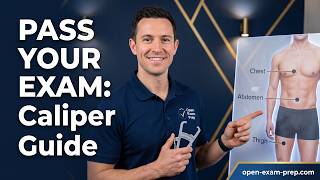
In-depth guide to the best skinfold body fat calipers for NASM-CPT, ACE-CPT, ACSM-CPT, and CSCS certification candidates. Covers Jackson-Pollock 3-site and 7-site protocols, caliper technique, Accu-Measure vs Sequoia TrimCal comparison, and why body composition assessment is tested on every major fitness certification exam in 2026.
Blog
Which of the following is considered a positive cardiovascular disease (CVD) risk factor according to established risk-stratification guidelines?
Question · Medium
Introduction & Exam Overview
1.1 Current Exam Facts
Study guide
A 52-year-old male client reports a family history of heart disease. His father had a myocardial infarction at age 50. He also has a resting blood pressure of 136/88 mmHg and a BMI of 31. Which risk factors does this client have for CVD?
Question · Hard
NASM-CPT Hardest Domains Ranked + Study Order (2026)
What is the primary purpose of a health history questionnaire in the client onboarding process?
Best Body Measuring Tapes for Personal Trainers: Complete 2026 Buying Guide
In-depth guide to the best body measuring tapes for NASM-CPT, ACE-CPT, ACSM-CPT, and CSCS certification candidates. Covers circumference measurement protocols, waist-to-hip ratio calculation, proper technique for consistent readings, analog vs smart Bluetooth tape measures, and why body composition assessment is tested on personal trainer certification exams in 2026.
An apparently healthy 30-year-old female wants to begin a vigorous-intensity exercise program. According to the current ACSM pre-participation screening algorithm, what is the recommended course of action?
Blood sugar 62: the 15-15 rule
FREE ACE CPT Study Guide 2026: 12-Week Plan, Blueprint, and Exam-Day Strategy
Master the ACE CPT exam with this free 2026 study guide. Get domain weights, a realistic study schedule, exam-day tactics, and free practice resources.
Which of the following is considered a negative (protective) CVD risk factor that can negate one positive risk factor?
1.2 Blueprint, Scoring, and Score Reports
During the initial consultation, a client mentions they take beta-blockers for hypertension. How should this information influence the trainer's approach?
A client tells her trainer, "I know I should exercise, but I'm just not ready to start a program right now." According to the Transtheoretical Model (TTM), which stage of change is this client most likely in?
Which NASM-CPT domains are hardest in 2026? Full difficulty ranking, optimal study order by domain weight, and a 10-week plan to pass on your first try.
A personal trainer asks a client, "On a scale of 1-10, how confident are you that you can exercise 3 times per week for the next month?" The client responds with a "4." Which concept is the trainer assessing, and what should the trainer do next?
Which of the following is the best example of a SMART goal for a new client?
1.3 ACE IFT Model and Mover Method
A client has been exercising consistently for 8 months. According to the Transtheoretical Model, which stage of change is this client in, and what is the trainer's primary role?
During motivational interviewing, a trainer should use open-ended questions to help a client explore their ambivalence about change. Which of the following is the best example of an open-ended question?
A client in the Preparation stage of change tells the trainer she has purchased new workout shoes and researched local gyms. According to the Transtheoretical Model, which strategy is most appropriate for the trainer to use?
During a static postural assessment, a trainer observes that a client has an excessive anterior pelvic tilt. Which of the following muscle imbalance patterns is most likely contributing to this posture?
Client Intake and Communication
2.1 Rapport and Intake Interviews
While performing an overhead squat assessment, a client's heels rise off the floor as they descend. Which compensatory pattern does this most likely indicate?
During a pushing movement screen, a client demonstrates significant scapular winging. Which muscles are most likely underactive?
A trainer performs a single-leg stance test with a client who cannot maintain balance for more than 5 seconds without significant trunk sway. What does this assessment primarily indicate?
During a bodyweight squat assessment, a trainer observes that the client's knees cave inward (valgus) at the bottom of the squat. Which combination of muscles is most likely overactive and underactive?
2.2 Communication Across Age, Culture, and Ability
What is the primary purpose of conducting a movement screen (such as an overhead squat or hurdle step) before designing a client's exercise program?
A trainer uses the YMCA submaximal cycle ergometer test to estimate a client's VO2max. During the test, the client's heart rate must reach steady state within each stage. What defines steady state in this protocol?
A trainer wants to assess a client's body composition. The client is a 40-year-old female who is uncomfortable with skinfold measurements. Which alternative method would be most practical and appropriate in a gym setting?
During a skinfold body composition assessment, a trainer takes three measurements at each site and records the median value. At the chest site, the three measurements are 12 mm, 14 mm, and 18 mm. What should the trainer do?
2.3 Dietary Evaluation and Eating Patterns
A client reports an RPE of 6 on the 0-10 scale during a treadmill walking assessment. Which description best matches this rating?
A trainer wants to assess muscular endurance in a new client. Which of the following tests would be most appropriate?
A trainer administers the Thomas test on a client who is lying supine on a table. When the client pulls one knee to the chest, the opposite thigh rises off the table and the knee extends. What does this finding indicate?
A sedentary client has been cleared for exercise and wants to improve cardiovascular fitness. According to the ACE Integrated Fitness Training (IFT) Model, which cardiorespiratory phase should the trainer begin with?
Ace Program Design
Health Screening and Risk Stratification
3.1 PAR-Q+ and ACSM Preparticipation Screening
In the ACE IFT Model, Phase 2 (Aerobic Efficiency) cardiorespiratory training introduces intervals at or just above VT1. What is the primary purpose of training at this intensity?
A trainer uses the Talk Test to determine a client's VT1. During a progressive treadmill walk, the client can speak comfortably at 3.5 mph but begins to struggle to talk at 4.0 mph. What does this indicate?
In the ACE IFT Model's muscular training component, what is the focus of Phase 1 (Stability & Mobility Training)?
A client has been training consistently for 4 months, can maintain proper form during loaded movements, and wants to start training for a local 10K race. According to the ACE IFT Model, which cardiorespiratory and muscular training phases would be most appropriate?
3.2 Medical Clearance, Contraindications, and Referrals
Which of the following best describes the training zone between VT1 and VT2?
In Phase 3 (Anaerobic Endurance) of the ACE IFT Model's cardiorespiratory training, intervals are performed at or above VT2. Which client would be the most appropriate candidate for this phase?
Loading more…