Tennessee Life & Health Insurance License Exam Overview
The Tennessee Life & Health Insurance License Exam is administered by Pearson VUE on behalf of the Tennessee Department of Commerce and Insurance (TDCI). Pearson VUE's current Tennessee Insurance Licensing Candidate Handbook (publication #124300, revised August 2025) and the official Content Outlines (publication #124301, effective October 15, 2025) are the authoritative blueprints for the 2026 exam, and every fact in this guide is checked against them.
Two things make Tennessee attractive for new insurance producers. First, Tennessee has no state income tax on wages or salaries (the Hall tax on investment income was fully repealed effective January 1, 2021), so agents keep more of their commissions. Second, the Nashville metro is one of the country's largest healthcare-industry clusters, anchored by hospital systems like HCA Healthcare and Community Health Systems, which drives steady demand for life, health, and benefits-focused producers.
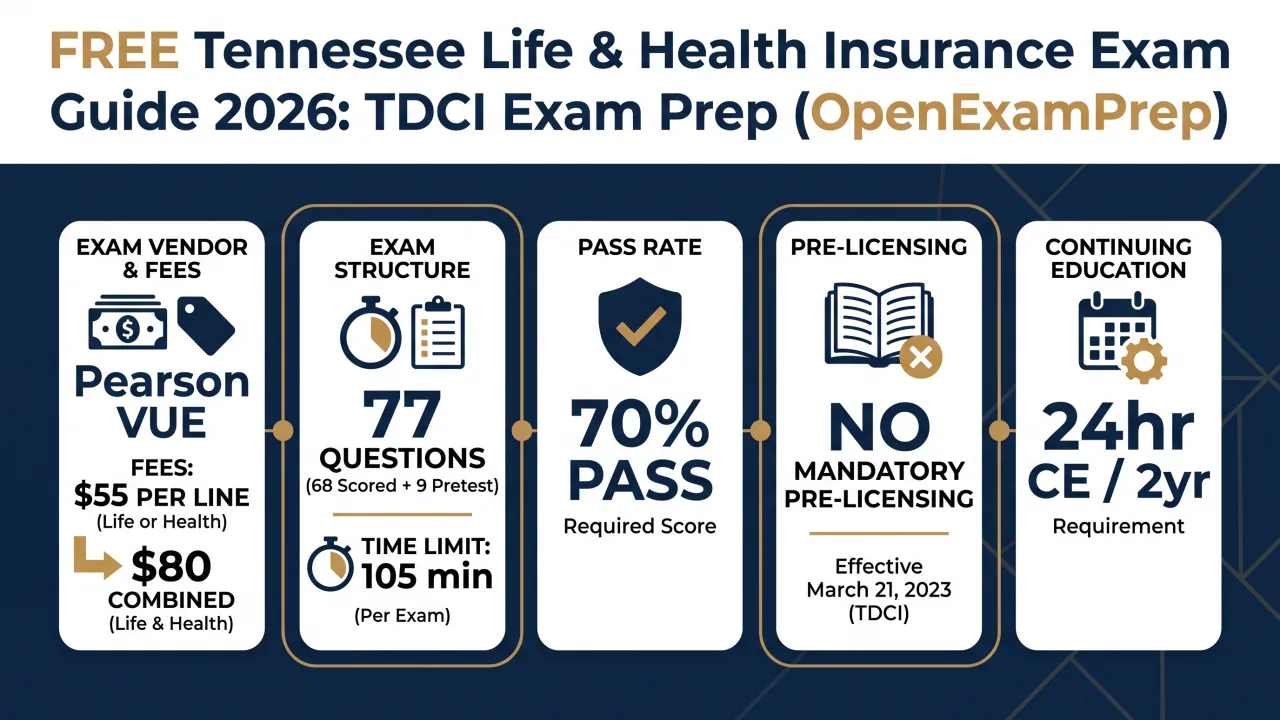
One licensing rule surprises candidates from other states: Tennessee does NOT require state-mandated pre-licensing education (effective March 21, 2023). Self-study is legally allowed, and you can schedule the Pearson VUE exam without first completing a course. Exam prep courses are still strongly recommended, but they are not a TDCI prerequisite.
Exam Format at a Glance
Tennessee tests Life and Accident & Health as separate exams. You can take them one at a time or back-to-back as a single combined reservation.
| Component | Life Exam | Accident & Health Exam |
|---|---|---|
| Scored Questions | 68 | 68 |
| Pretest Questions | 9 | 9 |
| Total Questions | 77 | 77 |
| Time Limit | 105 minutes (1 hour 45 min) | 105 minutes (1 hour 45 min) |
| Passing Score | 70% | 70% |
| Exam Fee | $55 | $55 |
| Testing Vendor | Pearson VUE | Pearson VUE |
| Online Proctoring | OnVUE available ($55) | OnVUE available ($55) |
Combined exam option: Register for Life and Accident & Health together for $80 (a $30 savings versus taking them separately). The combined reservation runs both 77-question exams in one session.
Pretest questions are mixed in with scored questions and are not identified. They do not count toward your score; Pearson VUE uses them to validate future exam questions.
Official sources: Pearson VUE Tennessee Insurance, Candidate Handbook (PDF), Content Outlines (PDF).
Start Your FREE Tennessee Life & Health Exam Prep
Our comprehensive, completely free Tennessee Life & Health exam prep covers every topic on the official Pearson VUE content outline.
Start FREE Tennessee Life & Health Study Guide or jump straight into FREE TN Life & Health Practice Questions.
Official Content Outline and Topic Weights
The exam is built directly from the Pearson VUE Tennessee Insurance Content Outlines effective October 15, 2025. The percentages below are the real blueprint weights, not estimates. Study to these proportions.
Life Exam Outline (68 scored questions)
| Content Area | Questions | % of Exam |
|---|---|---|
| Types of Policies (term, whole, universal, variable, annuities, combo plans) | 15 | 22% |
| Policy Riders, Provisions, Options, and Exclusions | 15 | 22% |
| Completing the Application, Underwriting, and Delivering the Policy | 12 | 18% |
| Retirement and Other Insurance Concepts | 8 | 12% |
| TN Laws Common to Life, A&H, Property, and Casualty | 14 | 21% |
| TN Laws Pertinent to Life Insurance Only | 4 | 6% |
Accident & Health Exam Outline (68 scored questions)
| Content Area | Questions | % of Exam |
|---|---|---|
| Types of Policies (disability, AD&D, medical, Medicare supplement, group, LTC) | 16 | 24% |
| Policy Provisions, Clauses, and Riders | 15 | 22% |
| Social Insurance (Medicare, Medicaid, Social Security) | 6 | 9% |
| Other Insurance Concepts (COBRA, coordination of benefits, tax, subrogation) | 5 | 7% |
| Field Underwriting Procedures | 8 | 12% |
| TN Laws Common to Life, A&H, Property, and Casualty | 14 | 21% |
| TN Laws Pertinent to Accident & Health Only | 4 | 6% |
The state-specific section is 22 questions on each exam and references Tennessee Code Annotated (TCA) Title 56 and the Department Rules in Chapter 0780. Roughly two-thirds of the state questions test laws common to all lines (producer licensing, unfair practices, guaranty association, Commissioner powers), and one-third test line-specific rules.
Tennessee-Specific Laws and Regulations
These are the tested Tennessee statutes and concepts, taken from the official outline references.
TCA Title 56 and Department Rules (0780-1, 0780-01-86):
- Powers of the Commissioner of Commerce and Insurance (TCA 56-6-112): hearings, investigations, penalties, license suspension/revocation.
- Insurance producer definitions and license requirements (TCA 56-6-101 through 56-6-126): resident and nonresident licensing, temporary licenses, agency appointments, license renewal.
- Unfair trade practices (TCA 56-8-104 to 105): false advertising, defamation, boycoting/coercion, unfair discrimination, rebating, and unfair claims settlement practices.
- Continuing education (Dept. Rule 0780-1-56; TCA 56-6-107).
Tennessee Life and Health Insurance Guaranty Association (TNLIGA, TCA 56-12-201 through 220):
- Life insurance death benefit: up to $300,000
- Life insurance cash surrender value: up to $100,000
- Health insurance benefits (basic hospital, medical, surgical, major medical, for insolvencies after Jan 1, 2010): up to $500,000
- Disability and long-term care insurance: up to $300,000
- Present value of annuity benefits (insolvencies after June 30, 2009): up to $250,000
- Overall aggregate cap: $300,000 per person per insolvent insurer (raised to $500,000 for basic hospital/medical/surgical)
- Surplus lines insurance is NOT covered. Agents are prohibited from using guaranty association coverage as a sales inducement.
Life-specific Tennessee rules (TCA 56-7-2305, 2307, 2308; Dept. Rule 0780-1-40; Replacement Rule 0780-1-24):
- Required policy provisions, definitions, and disclosure requirements.
- Replacement regulations: producer duties, exemptions, and the consumer's-best-interest standard when replacing existing life insurance or annuities.
- Annuity suitability and best-interest standards (Dept. Rule 0780-01-86).
Accident & Health-specific Tennessee rules (TCA 56-26-108, 56-26-125 through 129; Dept. Rule 0780-1-58, 0780-1-61):
- Required provisions, policy cancellation and renewal rules.
- Group policies, blanket or franchise school insurance, school accident coverage.
- Medicare supplement insurance: policy terms, prohibited provisions, minimum standards, eligibility.
- Long-term care insurance (TCA 56-42-101 through 111).
- Mandated coverages and offerings (TCA 56-7-1002, 1003, 2301 through 2368, 2601 through 2606).
- External review (TCA 56-61-113, 116).
- Affordable Care Act: federally facilitated marketplace, essential health benefits, employer notification, mental health/substance use parity, pediatric and preventive services.
Health Insurance Programs Tested on the Exam
The Accident & Health outline tests how federal and state health programs interact in Tennessee. Know these by name and role.
Federally facilitated marketplace (Healthcare.gov): Tennessee does NOT operate a state-based exchange. Individuals and small employers buy ACA-compliant coverage through Healthcare.gov during open enrollment (typically November 1 through January 15). Premium tax credits and cost-sharing reductions flow through the federal platform.
TennCare: Tennessee's Medicaid program. Tennessee is a non-expansion state and did not adopt the ACA Medicaid expansion, so eligibility is narrower than in expansion states. TennCare covers children, pregnant women (with 12-month postpartum coverage), parents (within historically limited income thresholds), seniors, and people with disabilities. Apply through TennCare Connect.
CoverKids: Tennessee's Children's Health Insurance Program (CHIP) for uninsured children and pregnant women whose families earn too much for TennCare but still need affordable coverage, with income limits well above TennCare thresholds.
Medicare supplement (Medigap): Tennessee regulates Medigap policy terms, prohibited provisions, minimum standards, and eligibility under Dept. Rule 0780-1-58. Open enrollment and guaranteed-issue windows are heavily tested.
Long-term care: Tested under TCA 56-42. Know the levels of care, eligibility triggers, and the partnership program interaction with Medicaid.
Pre-Licensing Education: Not Required, But Recommended
Tennessee is one of the few states with no formal, state-mandated pre-licensing education requirement for insurance producers (effective March 21, 2023). You can register for and pass the Pearson VUE exam entirely through self-study.
That said, the exam is not trivial, and TDCI, Pearson VUE, and every major prep provider strongly recommend a structured course. Most candidates complete a 40-hour Life & Health exam prep course ($200-$400) before testing, even though TDCI does not require it. Our free study guide and practice questions cover the same content outline without the cost.
Start the FREE Tennessee Life & Health Study Guide to work through every outline topic, or drill with FREE TN L&H Practice Questions.
Step-by-Step Licensing Process
- Study the official content outline. Download the Content Outlines (PDF) and make sure your prep covers every listed topic.
- Schedule the exam with Pearson VUE. Register online at pearsonvue.com/tn/insurance or call 800-274-4957. Book at least 24 hours in advance. Walk-ins are not accepted. Choose a test center or OnVUE online proctoring.
- Pay the exam fee by credit card, debit card, or voucher at reservation time. $55 per single line, $80 for the combined Life and Accident & Health exam. Fees are nonrefundable unless you cancel at least 48 hours ahead.
- Pass the exam. You need a 70% scaled score. You receive immediate pass/fail notification and a printed score report. Exam scores are valid for 12 months from the date received by TDCI.
- Wait 48 hours, then apply through NIPR. Tennessee requires a 48-hour wait between passing the exam and submitting your license application. Submit electronically at nipr.com and pay the $50 application fee. NIPR verifies your exam before allowing submission.
- Submit fingerprints via IdentoGO. Tennessee requires a fingerprint-based criminal background check for resident license applicants. Register at identogo.com, choose Tennessee, and use service code ORI # TN920680Z (Transaction Type IP). The Tennessee Bureau of Investigation (TBI) processes the results. Email the signed Fingerprint Policy and Acknowledgement Form to ce.agent.licensing@tn.gov.
- Receive your license and get appointed. After TDCI reviews your application and background check, your resident producer license is issued. Then obtain carrier appointments with the insurers you intend to represent.
Retake rules: If you fail, you must wait 10 days before retaking (first failure) and 30 days after each subsequent failure, with a 24-hour wait before you can reschedule. OnVUE online testing is limited to 2 attempts per exam line; further attempts must be taken at a Pearson VUE test center.
Nonresident reciprocity: Tennessee participates in NIPR reciprocity. A nonresident already licensed and in good standing in their home state can obtain a Tennessee nonresident license through NIPR without taking the Tennessee exam.
Continuing Education and License Renewal
After licensing, Tennessee requires continuing education on a biennial cycle.
| Requirement | Tennessee Standard |
|---|---|
| CE hours | 24 hours every 2 years |
| Ethics CE | 3 of the 24 hours must be ethics |
| Renewal date | Last day of your birth month, every 2 years |
| Renewal fee | $60 flat (covers any number of major-lines licenses) |
| Carryover | Up to 12 excess hours carry to the next cycle (ethics do not carry) |
| Course repetition | Not allowed within 24 months of original completion |
| Reporting fee | Approximately $1.00 per credit hour |
| CE exemption | Producers continuously licensed since January 1, 1994 |
Special product training (counts toward the 24-hour total):
- Annuity Best Interest Training: one-time 4-hour course before selling, soliciting, or negotiating annuity products.
- Long-Term Care Training: 8-hour initial course before selling LTC, plus a 4-hour refresher every 24 months.
- Flood Insurance (NFIP): one-time 3-hour course for producers selling federal flood policies.
Renew your license through NIPR. CE must be completed before submitting the renewal application.
Tennessee-Specific Numbers to Memorize
| Topic | Tennessee Requirement |
|---|---|
| Life exam scored questions | 68 (plus 9 pretest) |
| Accident & Health exam scored questions | 68 (plus 9 pretest) |
| Time limit per exam | 105 minutes (1 hour 45 min) |
| Passing score | 70% |
| Single-line exam fee | $55 |
| Combined Life and A&H exam fee | $80 |
| License application fee | $50 (NIPR) |
| License renewal fee | $60 flat (biennial) |
| CE per cycle | 24 hours (3 ethics) |
| Pre-licensing education required | No (recommended only) |
| Fingerprinting vendor | IdentoGO (ORI # TN920680Z) |
| Exam score validity | 12 months |
| Retake wait (first failure) | 10 days |
| Retake wait (subsequent) | 30 days |
| Post-exam application wait | 48 hours |
| State income tax | None |
| TNLIGA death benefit limit | $300,000 |
| TNLIGA cash surrender limit | $100,000 |
Study Timeline for Success
| Week | Focus Area | Hours |
|---|---|---|
| Week 1-2 | Life products, riders, provisions, application and underwriting | 12-15 |
| Week 2-3 | Health products, provisions, social insurance, field underwriting | 12-15 |
| Week 3-4 | Annuities, retirement concepts, taxation, MECs | 8-10 |
| Week 4-5 | Tennessee laws, TCA Title 56, TNLIGA, unfair practices, replacement | 10-12 |
| Week 5-6 | Mixed practice exams, weak-area drilling, timed simulations | 10-12 |
Total recommended study time: 50-60 hours using our free materials, even though no state-mandated course is required.
Tennessee-Specific Exam Tips
1. Master the state-specific section
Roughly one-third of each exam (22 of 68 scored questions) is Tennessee law. The common-to-all-lines block (Commissioner powers, licensing, unfair practices, guaranty association) appears on every line exam, so studying it once pays off across both Life and A&H.
2. Know the federally facilitated marketplace
Tennessee does not run a state exchange. ACA marketplace questions reference Healthcare.gov, essential health benefits, premium tax credits, and employer notifications, not a state-based platform.
3. Drill replacement and annuity suitability
Tennessee replacement regulations (Dept. Rule 0780-1-24) and annuity best-interest standards (Dept. Rule 0780-01-86) are recurring exam topics. Know producer duties, the consumer's-best-interest standard, and disclosure requirements.
4. Separate national from state knowledge
National questions test concepts that transfer across states: contract parties, insurable interest, beneficiaries, riders, annuity phases, health renewability, disability definitions, Medicare supplement basics, and coordination of benefits. State questions ask how those ideas are administered in Tennessee under TCA Title 56.
Common Mistakes to Avoid
- Assuming pre-licensing is required. It is not, but skipping all preparation is the fastest way to fail. Use a structured prep course or our free study guide.
- Confusing the fee. The exam fee is $55 per line (or $80 combined), NOT a single flat fee. The separate $50 NIPR application fee is paid after you pass.
- Underestimating the time limit. 77 questions in 105 minutes is about 82 seconds per question. Practice with a visible clock.
- Forgetting the 48-hour application wait. Submitting your NIPR application too soon after passing gets it rejected.
- Using the wrong fingerprinting service. Tennessee uses IdentoGO (service code ORI # TN920680Z), not the vendor used in some other states. Results go to the TBI.
- Skipping the state-specific outline. The Tennessee section is 21%+ of each exam and is where out-of-state test-takers lose the most points.
- Not preparing for OnVUE limits. If you test online, you only get 2 attempts per line online before you must switch to a test center.
After Passing Your Exam
Once licensed, Tennessee producers benefit from a tax-friendly environment (no state income tax) and a growing healthcare and logistics economy centered on Nashville, Memphis, and Knoxville. Common career paths include:
- Life and annuity producer serving the Nashville metro's retirement-minded population.
- Health and benefits producer supporting small employer groups and ACA marketplace enrolgants.
- Multi-line producer adding Property & Casualty after earning the L&H license.
Tennessee nonresident licenses are recognized nationwide through reciprocity, so a Tennessee resident license is a strong home base for agents who later expand into neighboring states like Kentucky, Georgia, Alabama, Virginia, and the Carolinas.
2026 Updates to Know
- Content outline revision effective October 15, 2025 (the current 2026 blueprint). The Life and A&H outlines each carry 68 scored questions plus pretest, with the topic weights shown above.
- No mandatory pre-licensing education remains in effect (since March 21, 2023). Verify current rules on the TDCI Insurance Division page before scheduling.
- Pearson VUE continues as the testing vendor for Tennessee insurance exams, both at test centers and via OnVUE online proctoring.
- Federal OBBBA Medicaid changes (2025-2026) affect TennCare eligibility redeterminations and work requirements for expansion populations in other states; Tennessee remains a non-expansion state, so monitor TDCI guidance for any spillover effects.
- ACA enhanced premium tax credits are subject to congressional reauthorization; monitor Healthcare.gov for 2026 open enrollment dates and subsidy status.
Official Resources
- Pearson VUE Tennessee Insurance - schedule, reschedule, and cancel exams
- Tennessee Insurance Licensing Candidate Handbook (PDF) - fees, rules, retake policies
- Tennessee Insurance Content Outlines (PDF) - the exam blueprint
- TDCI Insurance Division - state regulator
- NIPR Tennessee - license applications and renewals
- IdentoGO Tennessee - fingerprinting appointments
- NAIC State Insurance Department Directory
TDCI Agent Licensing Section contact: 500 James Robertson Parkway, Nashville, TN 37243-1134. Phone: (615) 741-2693 or (888) 416-0868. Email: ce.agent.licensing@tn.gov.
Best Next Step
Work through the free Tennessee Life and Health materials in OpenExamPrep while keeping the official regulator and Pearson VUE pages open for licensing logistics. Use OpenExamPrep for practice, explanations, and routing; use TDCI, the candidate handbook, and NIPR for current filing requirements. When you are ready to test under exam conditions, run timed sets in the FREE TN L&H Practice Question Bank. That split keeps your study time focused and keeps your licensing steps grounded in official instructions.
How to Use This Guide Without Missing State-Specific Details
Treat this article as your working roadmap, then verify the administrative details against official sources before you schedule. Insurance licensing changes are usually small, but small changes matter on exam day: a vendor switch, new fingerprinting workflow, revised candidate handbook, or updated application checklist can delay a license even when you know the content. Start with the TDCI Insurance Division, then confirm the Pearson VUE Tennessee account, then check the NIPR Tennessee licensing flow. The NAIC state insurance department directory is a practical starting point when you need the current regulator website.
For the content itself, separate national insurance knowledge from Tennessee-specific law. National life and health questions test concepts that transfer across states: contract parties, insurable interest, beneficiary designations, policy riders, annuity phases, health policy renewability, disability income definitions, Medicare supplement basics, group health coordination, and unfair trade practices. The state section asks how those ideas are administered in Tennessee under TCA Title 56. When a question includes a number, deadline, appointment step, replacement notice, continuing education rule, or regulator power, slow down and decide whether it is a national default or a Tennessee rule.

 Free CE
 Buy on Amazon
 Prep course on Achievable
 Study guide on Mometrix
 Take courses on Udemy