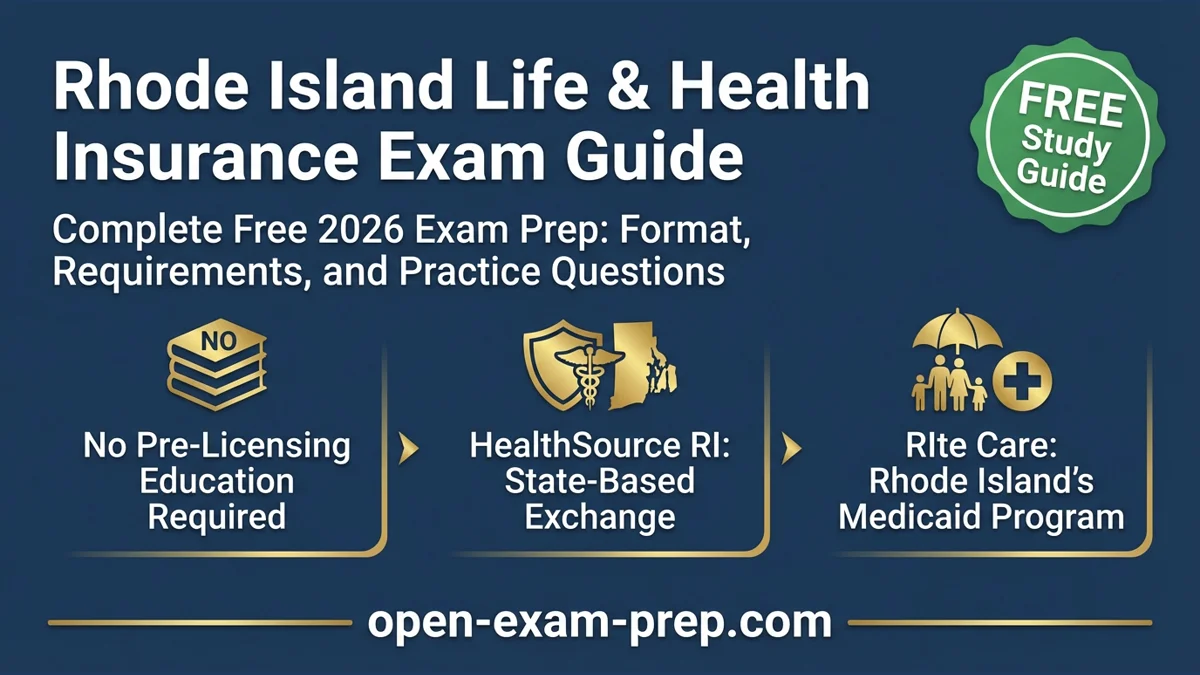
Rhode Island Life & Health Insurance License Exam Overview
The Rhode Island Life & Health Insurance License Exam is administered by Pearson VUE on behalf of the Rhode Island Department of Business Regulation (DBR). Rhode Island operates HealthSource RI, one of the nation's most successful state-based health insurance exchanges.
Important: Rhode Island does not offer a combined Life & Health exam. You must take the Life Insurance and Accident & Health Insurance exams separately. The good news? Rhode Island does not require pre-licensing education, making it one of the fastest states to get licensed.
Exam Format at a Glance
| Component | Life Exam | Accident & Health Exam |
|---|---|---|
| Total Questions | 80 scored questions | 80 scored questions |
| Time Limit | 2 hours | 2 hours |
| Passing Score | 70% | 70% |
| Testing Vendor | Pearson VUE | Pearson VUE |
| Exam Fee (In-Person) | $80 | $80 |
| Exam Fee (OnVUE Online) | $50 | $50 |
| Pre-licensing Education | Not required | Not required |
Note: You can take both exams in one session at a test center for a single $80 fee. Each exam actually delivers 95 total questions on screen — 60 general-knowledge items (50 scored + 10 unscored pretest) and 35 Rhode Island-specific items (30 scored + 5 unscored pretest) — but only the 80 scored questions count toward your result, and results are reported pass/fail immediately at the test center. After passing, you have 1 year to complete licensing (application, fingerprinting, and fees) before the exam result expires and you'd need to retest.
Why Get Licensed in Rhode Island?
- State-based exchange — HealthSource RI is a successful, user-friendly marketplace
- No pre-licensing required — Fastest path to licensure in New England
- Wealthy population — High net worth clients seeking life insurance and annuities
- Dense market — Concentrated population means efficient prospecting
- Boston proximity — Easy access to regional insurance markets
- Small state advantage — Build reputation and referral network quickly
Start Your FREE Rhode Island Life & Health Exam Prep
Our comprehensive, completely free Rhode Island Life & Health exam prep covers everything you need to pass both exams on your first attempt.
Key Topics Covered on the Exams
1. Life Insurance (Life Exam)
Types of Life Insurance Products:
- Term Life (level, decreasing, renewable, convertible)
- Whole Life (ordinary, limited pay, single premium)
- Universal Life (fixed, indexed, variable)
- Variable Life (requires securities license)
- Group Life Insurance
Rhode Island-Specific Life Insurance Provisions:
| Provision | RI Requirement |
|---|---|
| Grace Period | 31 days |
| Incontestability Period | 2 years |
| Suicide Exclusion | 2 years |
| Free Look Period | 10 days |
| Misstatement of Age | Adjusts benefits |
| Reinstatement | Standard policy provision (typically within 3 years of lapse, subject to insurer approval and proof of insurability) |
2. Health Insurance (Accident & Health Exam)
Major Coverage Types:
- Major medical insurance
- Disability income insurance (short-term and long-term)
- Long-term care insurance (30-day free look period)
- Medicare supplement insurance
- Dental and vision coverage
Rhode Island Health Programs:
- HealthSource RI — State-based health insurance marketplace
- Rhode Island Medicaid — Coverage for low-income residents
- RIte Care — Rhode Island's CHIP program for children and pregnant women using managed care
- Rhody Health Partners (RHP) — Medicaid managed care for adults 21+
- Current MCOs (since 7/1/2025) — Neighborhood Health Plan of RI (NHPRI) and UnitedHealthcare Community Plan; Tufts Health Plan's Medicaid contract was not renewed and its RIte Care/RHP members transitioned to the other two plans
Health Insurance Grace Periods (RI-Specific):
| Premium Payment | Grace Period |
|---|---|
| Weekly policies | 7 days |
| Monthly policies | 10 days |
| All other policies | 31 days |
3. Annuities (Both Exams)
Rhode Island's older population creates strong annuity opportunities:
- Fixed vs. variable annuities
- Immediate vs. deferred annuities
- Indexed annuities
- Surrender charges and fees
- Annuity suitability requirements
Special Rhode Island Requirements:
- 4-hour Annuity Best Interest Training — One-time requirement (effective 4/1/2021) before selling annuity products
4. Rhode Island Insurance Regulations
Key Rhode Island Statutes:
- Rhode Island General Laws Title 27 — Insurance
- Chapter 27-4 — Life Insurance Policies and Reserves
- Chapter 27-18 — Accident and Sickness Insurance
- Chapter 27-34.2 — Long-Term Care Insurance
Department of Business Regulation Authority:
- Producer licensing and regulation
- Market conduct oversight
- Consumer protection enforcement
- Rate and form review
Agent Requirements:
| Requirement | Details |
|---|---|
| Pre-licensing | Not required |
| CE requirement | 24 hours every 2 years |
| Ethics CE | 3 hours per renewal |
| Fingerprinting | Required (BCI from RI Attorney General) |
| Background Check | State BCI must be less than 30 days old |
5. Ethics and Producer Responsibilities
- Fiduciary duties to clients
- Needs analysis and suitability
- Disclosure requirements
- Premium handling procedures
- Unfair trade practices
Free Practice Questions Available
Test your knowledge with hundreds of free practice questions designed specifically for the Rhode Island Life and Accident & Health exams.
Study Timeline for Success
| Week | Focus Area | Hours |
|---|---|---|
| Week 1 | Life insurance products and provisions | 10-12 |
| Week 2 | Health insurance fundamentals | 10-12 |
| Week 3 | Annuities and long-term care | 8-10 |
| Week 4 | Rhode Island regulations and HealthSource RI | 8-10 |
| Week 5 | Practice exams for both Life and A&H | 10-12 |
Total recommended study time: 45-55 hours
Since Rhode Island doesn't require pre-licensing education, self-study is your primary preparation method.
Rhode Island-Specific Exam Tips
1. Master HealthSource RI
Rhode Island's state-based marketplace is unique:
- Understand enrollment periods and special enrollment triggers
- Know how Medicaid eligibility is determined through HealthSource RI
- Be familiar with plan metal tiers and subsidy calculations
- RIte Care and Rhody Health Partners coordination
2. Know These Rhode Island Numbers
| Topic | RI Requirement |
|---|---|
| Pre-licensing education | Not required |
| CE per renewal cycle | 24 hours |
| Ethics CE required | 3 hours |
| Grace period (life) | 31 days |
| Grace period (monthly health) | 10 days |
| Free look period (standard) | 10 days |
| Free look period (LTC) | 30 days |
| Passing score | 70% |
| Exam fee (in-person) | $80 |
| Exam fee (OnVUE) | $50 |
3. Understand Special Product Training
Rhode Island requires additional training for specific products:
- Annuity Training — 4-hour one-time course before selling (effective 4/1/2021)
- Long-Term Care Training — 8-hour initial course, then 4 hours every 2 years
- Flood Insurance — 3-hour one-time National Flood Insurance Program course
Common Mistakes to Avoid
- Assuming combined exam exists — Life and A&H are separate exams in Rhode Island
- Ignoring HealthSource RI details — State-based exchange is heavily tested
- Forgetting different grace periods — Weekly, monthly, and other policies have different requirements
- Underestimating A&H exam — Health insurance is complex, don't neglect it
- Missing 24-hour wait for retakes — You must wait at least 24 hours before retaking
After Passing Your Exams
- Wait 3-5 days — Exam results must load into NIPR system
- Get fingerprinted — Through the RI Attorney General's process; the fingerprinting fee is $45
- Obtain BCI background check — From RI Attorney General (report must be less than 30 days old when submitted, and the full application must be filed within 60 days of fingerprinting)
- Submit to DBR — Email BCI results with your NIPR transaction number to dbr.inslic@dbr.ri.gov
- Apply through NIPR — Submit electronic application at NIPR.com
- Pay license fee — $120 for resident producers ($130 non-resident), due at application and again at each 2-year renewal
- Receive license — Typically 1-2 weeks after approval
- Obtain carrier appointments — Begin selling with approved insurers
2026 Rhode Island Updates
For 2026, be aware of:
- New CE compliance requirement — Must be met for 2026 and 2027 license renewals (per DBR Insurance Bulletin 2024-7)
- HealthSource RI enrollment — 2026 open enrollment ran November 1, 2025 - January 31, 2026 (December 23, 2025 was the deadline for January 1, 2026 coverage)
- Enhanced subsidy expiration — The enhanced ACA premium tax credits expired January 1, 2026 after a Senate extension bill failed to advance; expect A&H exam scenarios and client conversations about higher marketplace premiums and lower enrollment through HealthSource RI
- Medicaid managed care change — Tufts Health Plan's Rhode Island Medicaid contract was not renewed effective July 1, 2025; RIte Care and Rhody Health Partners are now administered only through Neighborhood Health Plan of RI and UnitedHealthcare Community Plan
Start Your Rhode Island Insurance Career Today
Rhode Island's combination of no pre-licensing requirements, a state-based exchange, and a concentrated, affluent population creates excellent opportunities for insurance professionals. With proper preparation and our free study materials, you can pass both exams on your first try.
Our free study materials include:
- Complete topic coverage for RI Life and A&H exams
- Practice questions with detailed explanations
- Rhode Island statute and regulation summaries
- HealthSource RI and RIte Care program focus
- AI-powered study assistance
Get licensed faster with 100% FREE prep materials.
How to Use This Guide Without Missing State-Specific Details
Treat this article as your working roadmap, then verify the administrative details against official sources before you schedule. Insurance licensing changes are usually small, but small changes matter on exam day: a vendor switch, new fingerprinting workflow, revised candidate handbook, or updated application checklist can delay a license even when you know the content. Start with your state insurance department, then confirm the testing vendor account, then check the National Insurance Producer Registry licensing flow if your state uses it. The NAIC state insurance department directory is a practical starting point when you need the current regulator website, and NIPR state requirements can help you verify application steps after the exam.
For the content itself, separate national insurance knowledge from Rhode Island-specific law. National life and health questions test concepts that transfer across states: contract parties, insurable interest, beneficiary designations, policy riders, annuity phases, health policy renewability, disability income definitions, Medicare supplement basics, group health coordination, and unfair trade practices. The state section asks how those ideas are administered in Rhode Island. When a question includes a number, deadline, appointment step, replacement notice, continuing education rule, or regulator power, slow down and decide whether it is a national default or a Rhode Island rule.
A Practical Study Workflow for the Final Two Weeks
Use the last two weeks to convert recognition into decision speed. On day one, take a mixed diagnostic in /study-guides/ri-life-health and tag every missed question by reason: did you miss a definition, confuse two similar products, overlook a state rule, or run out of time? Definitions need flashcards. Similar products need comparison tables. State rules need a short checklist. Timing mistakes need practice blocks with a visible clock.
During the first week, work in focused sets. Do life insurance one day, health insurance the next, annuities after that, and Rhode Island law at least every other session. Do not wait until the end to study regulations. Many candidates know term versus whole life but lose points on replacement, advertising, producer authority, unfair claims practices, or what must happen before a license is issued. After each set, rewrite the explanation in your own words. If you cannot explain why the wrong answer is wrong, you have not finished the question.
During the second week, switch to exam simulation. Use full mixed quizzes, then spend more time reviewing than answering. For life insurance, drill policy provisions, riders, beneficiary changes, settlement options, nonforfeiture options, and taxation at a high level. For health insurance, drill renewability, exclusions, disability definitions, long-term care, Medicare supplement rules, group versus individual contracts, and coordination of benefits. For annuities, make sure you can distinguish accumulation from annuitization, fixed from variable, immediate from deferred, and suitability from general sales preference.
Common Life and Health Traps
A common trap is answering from everyday sales language instead of policy language. "Cash value," "premium," "benefit," "owner," "insured," and "beneficiary" have precise exam meanings. Another trap is treating Medicare, Medicare Advantage, Medicare Supplement, and Medicaid as interchangeable. They are different programs or products, and exam questions often reward the candidate who notices which one is actually named.
Replacement questions deserve special attention. The exam may ask what must be disclosed, when notices are required, how existing coverage should be treated, or why twisting is prohibited. Do not memorize replacement as simply "bad." Replacement can be legitimate, but it becomes a compliance issue when comparison, disclosure, or suitability duties are ignored.
Health questions also use similar-sounding renewability terms. Noncancelable, guaranteed renewable, conditionally renewable, optionally renewable, and cancelable policies allocate power differently between insurer and insured. Build a one-page table and practice from both directions: given the term, state the rule; given the rule, name the term.
Exam-Day Checklist
Before test day, confirm your appointment time, approved identification, remote-proctoring rules if applicable, calculator policy, and reschedule deadline from the testing vendor. Use the exact legal name from your licensing and exam records. If your ID and registration do not match, content knowledge will not help at check-in.
On the exam, answer the direct question first before reading extra meaning into the facts. Insurance exams often include plausible distractors that are true statements but do not answer the question asked. Mark long calculation or scenario questions and come back after securing the easier definition and rule points. If you are stuck between two options, identify which answer is broader, which is more specific, and whether the question asks for an exception. Exceptions are where many state-law points hide.
If You Do Not Pass on the First Attempt
A failed attempt is useful data if you treat the score report correctly. Do not simply reread the same chapter. Sort weak areas into national product knowledge, Rhode Island law, and test-taking process. For product knowledge, rebuild comparison charts. For state law, verify the current rule from official regulator materials and then practice short recall prompts. For process issues, take timed sets and force yourself to explain why each wrong answer was attractive.
Schedule the next attempt only after your weakest two categories have improved in practice. A good target is not just a passing average; it is consistency. When you can pass several mixed sets in a row without relying on memorized question wording, you are closer to exam readiness.
Best Next Step
Work through the free Rhode Island Life and Health materials in OpenExamPrep while keeping official regulator pages open for licensing logistics. Use OpenExamPrep for practice, explanations, and routing; use the state department, candidate handbook, and NIPR for current filing requirements. That split keeps your study time focused and keeps your licensing steps grounded in official instructions.

 Free CE
 Prep course on Achievable
 Study guide on Mometrix
 Buy on Amazon
 Take courses on Udemy