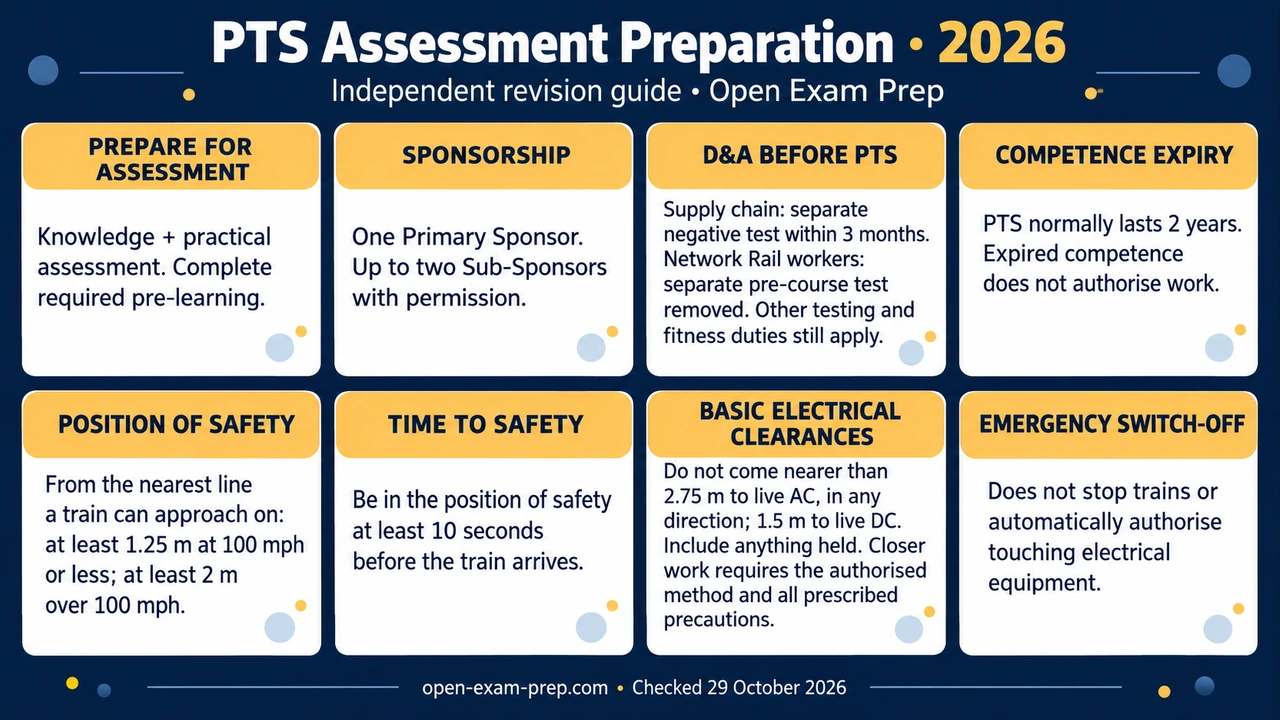
Preparing for the Network Rail Personal Track Safety (PTS) assessment means preparing to apply a safe system of work, not just memorising a multiple-choice paper. Arrange the course through your sponsor, complete the required pre-learning, and practise explaining what you would do around trains and electrification. Initial training normally includes classroom learning and a practical track visit; recertification checks both current knowledge and eligibility to renew.
This independent guide was checked on 29 October 2026. It separates four things that revision pages often blur: your Sentinel record, your PTS competence, protection from train movements, and electrical safety arrangements. None automatically substitutes for the others. Use the current instructions supplied by your sponsor and trainer when preparing for the actual assessment.
Before booking: confirm the course and your evidence
PTS is the foundation competence for authorised access on or near Network Rail lines. It does not, by itself, authorise you to work alone, supervise a group, operate plant or perform electrical work. The location and task determine whether you also need the AC or DCCR element and any additional competence.
Approved providers commonly advertise two-day initial courses and one-day recertification courses. Those are course durations, not a universal timed examination. Confirm whether your booking includes DCCR and what pre-learning, knowledge assessment and practical assessment it requires. A practice site's question-bank size is not the number of questions on your assessment. The public sources reviewed for this guide do not establish one national question count, test duration or percentage pass mark to promise every candidate.
Use this booking checklist with your Primary Sponsor:
- Confirm that your Sentinel profile exists, your identity details are correct and the sponsor is authorised for the required activity.
- Check your medical status and any restrictions. A valid record does not remove a restriction that applies to you.
- Confirm the drugs and alcohol requirements for your workforce and course. The three-month rule is not universal.
- Complete the assigned PTS e-learning and pre-learning assessment; retain the evidence your provider requests.
- Obtain the correct handbooks, joining instructions and PPE for the practical session.
- For recertification, have the sponsor and provider check your actual workplace-experience records before the training date.
Network Rail's Issue 8 drugs and alcohol briefing, effective 7 June 2025, explicitly removed the requirement for Network Rail workers to pass a D&A test within the three months before PTS training. It retained that requirement for the Network Rail supply chain. This is a course-entry distinction, not an exemption from fitness, testing or drugs and alcohol rules. Do not confuse it with Sentinel's separate pre-sponsorship screening provisions.
Sentinel: the card is only one part of access
Sentinel Scheme Rules v5.1, July 2025 allow one Primary Sponsor and up to two Sub-Sponsors, subject to the Primary Sponsor's permission. Carry your physical or virtual card and provide it for swipe-in before work. Your sponsor must check the competences and restrictions relevant to the job; a card by itself is not permission to enter any railway worksite.
Under rule 3.2.3, the Primary Sponsor pays for training, assessment and recertification of Sentinel competences that it uses. The rule also allows an individual to fund development outside the sponsor's competence requirements, and a Sub-Sponsor to fund a competence the Primary Sponsor does not use. Ask what is included before booking: a commercial course quote is not a centrally fixed national exam fee.
The PTS handbook explains these profile symbols:
| Symbol | Meaning | Preparation consequence |
|---|---|---|
| Green square | Newly qualified in PTS and receiving learning support | Follow the sponsor's mentoring arrangements; newly qualified workers wear a blue helmet during this period. |
| Red triangle | Must be accompanied on the infrastructure | Do not treat permission to walk alone as overriding this restriction. |
| Blue circle | Colour vision defect | Some competences are restricted; have the sponsor explain the restrictions relevant to the proposed role. |
Do not treat a fixed number of months as automatic release from mentoring. Your experience and sponsor's arrangements matter. Likewise, a card's physical validity does not extend an expired competence recorded against it.
Recertification: check evidence before the expiry date
PTS competence normally lasts two years. Some providers admit candidates to a recertification course within eight weeks after expiry. That is a course-admission rule, not permission to work using expired PTS. Arrange renewal early and check the live Sentinel record before work.
NSAR Briefing Note 26 explains that workplace experience must be genuinely recorded and endorsed, including the date, location and protection under which the person worked. It also explains that insufficient endorsed experience makes a person ineligible for recertification and requires initial training. A swipe-in alone should not be confused with recording the use of a particular competence.
Do not rely on an undated “eight entries in 24 months, four in 12” summary. Public provider guidance contains transition dates and different admission descriptions. For example, AtkinsRéalis' training page describes a 2025–2026 transition and later requirements. The full current NR/L2/CTM/021 wording was not available to verify a universal count for every October 2026 candidate. Have your sponsor and provider confirm the requirement applicable to your course date and review the accepted electronic records and any eligible older paper evidence before booking. This is more useful than arriving with a count that the provider cannot accept.
Learn each distance with the hazard it controls
Handbook 1 Issue 9 is the issue in force on this guide's review date. Issue 10 comes into force on 5 December 2026. A publication date and an in-force date are different; prepare using the issue applicable to your course and work.
Under HB1, on or near the line includes the line itself and being within 3 metres where no permanent fence or structure separates you from it. On a station platform, engineering or technical work within 1.25 metres of the edge falls within that definition. Crossing at a level crossing is specifically excluded from the definition. These are access definitions, not a substitute for a briefed safe system.
| Situation | Required distance or timing | What to check in a question |
|---|---|---|
| Position of safety, maximum line speed 100 mph or less | At least 1.25 metres from the nearest line on which a train can approach | Use the maximum permissible line speed, not your guess of the approaching train's speed. |
| Position of safety, maximum line speed over 100 mph | At least 2 metres | Consider every line that can expose you to an approaching train. |
| Approaching train | Reach the position of safety at least 10 seconds before arrival | Distance alone is insufficient if you move too late. |
| Basic live AC working clearance | 2.75 metres in every direction, including anything held | This is an electrical rule, not the position-of-safety distance. |
| Basic live DC equipment clearance | 1.5 metres, including anything held | The separate 300 mm provisions do not replace this general rule. |
For example, a question specifying 110 mph uses the over-100 mph position-of-safety category: at least 2 metres, with the required warning time. A long tool can still breach electrical clearance while your feet remain in a position of safety. Always identify what the distance is measured from and which hazard the question describes.
Walking, working and lookout warnings
PTS alone does not authorise working alone. HB1 permits certain walking-alone arrangements, such as a route agreed and briefed by the COSS to or from a group, or a method authorised in company instructions. The person must follow the relevant instructions and have the required local knowledge. When walking alone under those arrangements, look up at least every five seconds; move to a position of safety and stand still before using a mobile phone.
For group work, understand the COSS briefing before signing the safe-work briefing form. Know the route, work limits, open and blocked lines, warning method and position of safety. If the route is obstructed or the arrangement changes, tell the COSS instead of inventing a detour onto an open line.
Current Handbook 7 Issue 10 places cumulative restrictions on lookout warning. It is not enough to obtain director-level approval. No alternative safe system may be available; the arrangement must be planned and authorised; approaching trains must have a permissible speed of no more than 25 mph; the group must not need to cross an open line or walk more than 25 metres to safety; and required warning time must be no more than 45 seconds, while still allowing everyone to be safe at least ten seconds before arrival.
The remaining sighting, route, audibility, staffing and lookout-duty conditions also apply. Lookouts must not be used during darkness, poor visibility, or in or near a tunnel. An old worked example calculating a human lookout's sighting distance for a 90 mph line is therefore not a valid current authorisation. As a PTS holder, your job is to understand and follow the briefed system and raise a problem; these limits do not qualify you to design one yourself.
AC and DC: keep the procedures separate
Handbook 16 Issue 7 and Handbook 17 Issue 6 have been in force since 6 June 2026. AC overhead line equipment (OLE), pantographs and roof equipment differ from DC conductor rail equipment (CRE) and shoe gear. Do not transfer an exception from one system to the other.
Basic clearance and authorised closer work
For live AC equipment, closer work than 2.75 metres requires the applicable method statement or company instruction, all specified precautions in place, and those precautions followed. Carry long items horizontally and obtain help where necessary. For DC equipment, closer work than 1.5 metres requires an authorised method statement and electrical risk assessment, with all specified precautions implemented and followed.
Where company instructions permit live DC activity nearer than 300 mm, HB17 says to place a conductor-rail shield if possible before the activity. It also has specific mandatory shielding provisions for particular tasks. Neither an ordinary safety boot nor an improvised insulating object authorises closer work. Never step between the conductor rail and adjacent running rail, and keep out of floodwater that may contact live equipment. Flooding above sleeper level must be reported promptly to the ECO with its depth, extent and subsequent changes.
Switch-off, isolation and Form C are different
An emergency switch-off does not stop trains. Do not assume that hearing “switched off” gives general permission to approach or touch electrical equipment. Obtain the required assurance and follow its limits. HB16 requires continued contact until the OLE has been made safe to approach but not touch, or other arrangements have been made. This is different from the isolation, earthing and documentation required for specified work.
An overhead line permit, Form C, identifies the equipment isolated and earthed and the work limits. The Nominated Person issues it to the COSS or designated person. The COSS must understand the conditions, observe the required test-before-touch process, sign and brief the group. It does not stop train movements. On COSS relief, the permit may pass to the replacement COSS: both sign, the conditions must be understood, and the new COSS tells the NP, directly or through the ECO. Moving to another part of the OLE requires the test-before-touch process again before work there.
Rescue questions require the complete conditions
For AC rescue of a person within 2.75 metres, the normal requirement is isolation and earthing. HB16's exception requires all four conditions: electricity switched off; a living person reachable from ground level; the casualty more than 600 mm from the equipment and anything touching it; and the rescuer and anything held not coming within 600 mm of that equipment or anything touching it. Dry material is not an exception allowing rescue beside live OLE.
For DC rescue, the 300 mm figure describes the casualty's proximity to CRE. Switch-off is required unless all five conditions hold: the person is alive; the CRE cannot be switched off at the time; the casualty can be pulled clear using non-conducting gloves or other dry insulating material; the rescuer can stand on dry non-conducting material; and no metal objects are used. One favourable condition does not replace the rest. Keep train-movement protection separate throughout.
A revision method that prepares you for the practical assessment
Use four short practice sessions as an editorial study plan, adjusting them to your trainer's instructions rather than treating them as a guaranteed pass timetable.
- Explain the access decision. Use an imaginary worker's record to distinguish sponsorship, competence expiry, medical restrictions and site briefing. Say what must be resolved before entry.
- Sketch the hazards. Mark the running rail, position of safety, OLE and conductor rail separately. Practise naming the reference point and limitation for each distance.
- Talk through a changed situation. A blocked walking route, a lost permit or an electrical incident needs the correct person and arrangement, not a memorised shortcut.
- Practise communication aloud. Begin an emergency call with “This is an emergency call.” Give your identity, exact location, affected lines and the hazard. Address both the signaller's train-movement responsibilities and the ECO's electrical responsibilities where applicable.
Use the free PTS practice questions to identify weak topics, then review the PTS study guide, flashcards and cheat sheet. Explain why each wrong answer fails; a high practice score alone does not prove practical competence or authorise railway access.
Fitness remains part of preparation. Report medication, fatigue and excessive travel to your sponsor. Sentinel rule 3.4.8 prohibits reporting for duty after work within the preceding 12 hours unless the Primary Sponsor has approved a risk assessment and implemented suitable controls. It also requires the shortest applicable legal, infrastructure-manager or sponsor working-hour limit. Do not turn a generic shift table into a personal entitlement to work longer. If work is unsafe, use Network Rail Worksafe: stop, move to safety and raise the concern so the safe arrangement can be resolved.
Source checks and next steps
Use Sentinel information and the application guidance for the sponsor route, and the linked current RSSB catalogue records for handbook editions. Your sponsor should provide the applicable handbooks and briefings. This article is independent revision support; it is not a Network Rail course certificate or an instruction to enter the operational railway. Before your course, confirm the booking, evidence, applicable editions and practical-session requirements together.
