Life Insurance Exam Study Guide 2026: Start With Your State
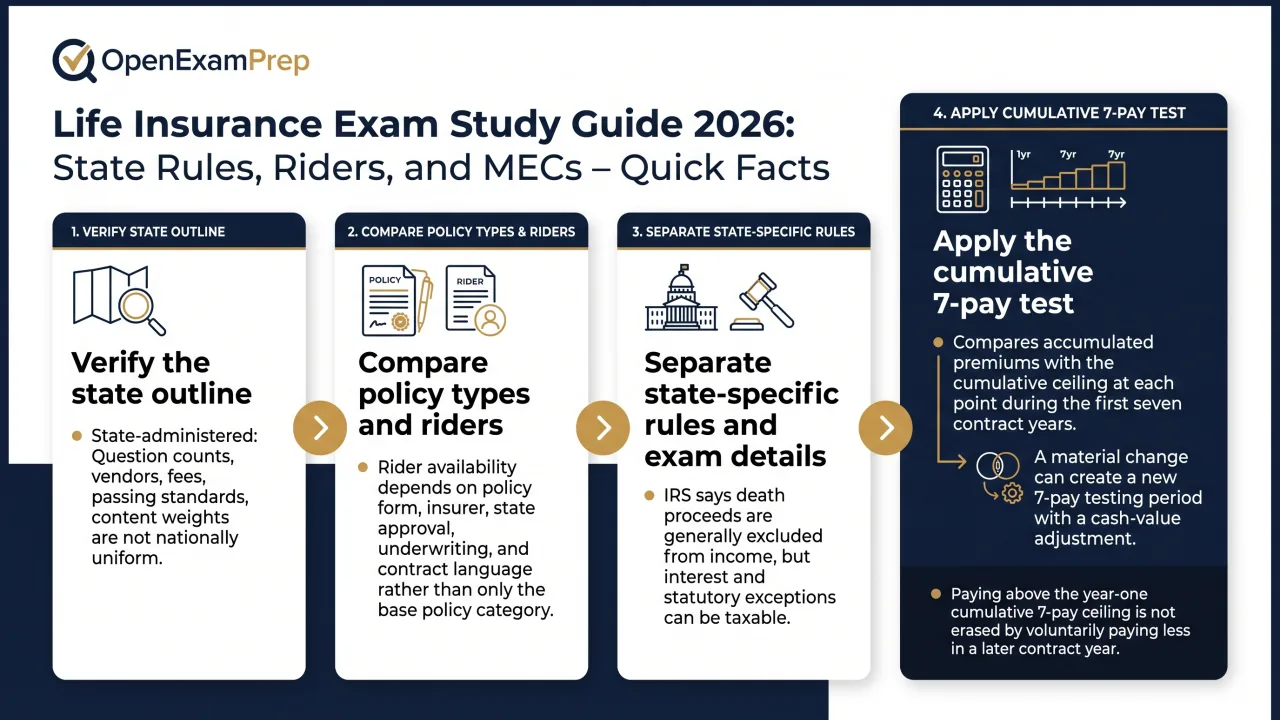
There is no single national “life insurance exam” with one question count, time limit, fee, vendor, passing score, or topic-weight table. Insurance producers are licensed by state regulators. Each state selects its lines of authority, examination vendor, candidate handbook, content outline, administrative rules, and state-law questions.
That means the first study step is not memorizing a generic 100–150 question format. It is downloading the current outline for the state and line of authority on your registration.
Use the NAIC state insurance department directory to find the regulator, then use NIPR's state requirements for current application routing. The NAIC explains that state regulators license producers and issue their own continuing-education and sales-practice rules.
Build Your State-Specific Exam Card
Before studying, fill in this card from the official candidate handbook and content outline:
| Field | What to record |
|---|---|
| State and line | Life only, Life and Health, or another exact line name |
| Vendor | The vendor named by the state; do not assume Pearson VUE or Prometric |
| Questions | Scored and unscored counts, if the handbook distinguishes them |
| Time | Official testing time and any tutorial time |
| Passing standard | The state's score or scaled-score language |
| Fee | Current first-attempt and retake fee |
| Delivery | Test center, remote option, or both |
| Outline | Every national and state-law section with its official weight |
| Prelicensing | Required hours, provider rules, or exemption, if any |
| After passing | Application, fingerprints, appointment, and license steps |
This one-page card prevents a recurring error in national prep articles: turning one state's handbook into a rule for every state.
Core Product Knowledge
Term life
Term insurance provides death protection for a stated period and ordinarily has no policy cash value. Know level and decreasing term, renewability, convertibility, the difference between the policy term and premium guarantee, and what happens at expiration.
Whole life
Whole life is permanent insurance with contractually defined premiums, death benefits, and cash values. Study nonforfeiture options, policy loans, dividends on participating policies, settlement options, and how ownership differs from being the insured or beneficiary.
Universal life
Universal life separates policy charges, interest crediting, and flexible premium funding inside a permanent contract. Flexible does not mean optional without consequence: insufficient value can cause lapse. Know death-benefit options, cost-of-insurance charges, credited interest, surrender charges, and how an indexed policy's crediting method differs from direct stock ownership.
Variable life and variable universal life
Variable products use separate-account investment options and shift investment risk to the owner. They involve securities regulation in addition to insurance licensing. Distinguish fixed general-account guarantees from variable separate-account performance, and do not describe a variable subaccount as a guaranteed cash value.
Which Riders Go With Which Policy?
Availability depends on the insurer, policy form, state approval, underwriting, and contract language. Exams test the rider's function, but a rider should not be presented as universally available on every product.
| Rider or feature | Term | Whole life | Universal life | Variable life / VUL | What to remember |
|---|---|---|---|---|---|
| Waiver of premium | Often | Often | Often, sometimes structured as waiver of charges | May be available | Trigger, waiting period, age limit, and what is actually waived are contract-specific |
| Accelerated death benefit | Often | Often | Often | Often | Advances part of the death benefit after a qualifying event and reduces what remains |
| Accidental death | Often | Often | Sometimes | Sometimes | Pays only when the contract's accidental-death definition and exclusions are met |
| Children's term | Often | Often | Often | May be available | Adds term coverage on eligible children; conversion rules vary |
| Guaranteed insurability | Sometimes | Common | Product-specific | Product-specific | Allows specified additional coverage without new evidence of insurability |
| Long-term-care or chronic-illness rider | Uncommon on basic term | Product-specific | Common on some products | Product-specific | Benefits, tax qualification, reimbursement/indemnity design, and effect on death benefit vary |
| Return of premium | Available on some term | Not usually described as a separate whole-life rider | Uncommon | Uncommon | Typically raises term premium and pays only if contract conditions are met |
| Term rider on another insured | N/A on basic single-life term | Common option | Common option | Product-specific | Adds temporary coverage without creating a separate permanent cash value |
For exam questions, use the policy described in the stem. If a question asks what a rider does, answer the contractual function; if it asks whether a client can buy it, remember that carrier and state availability control.
Policy Provisions: Separate Concepts From State Numbers
Grace periods, free-look periods, reinstatement windows, replacement notices, suicide exclusions, and incontestability rules often contain state-specific numbers or model-law variations. Learn the concept first, then memorize the exact number from your state's outline.
- A grace period keeps coverage in force for a specified time after a premium is due, subject to the contract and applicable law.
- Incontestability limits how an insurer may contest a policy after the stated period; it is not a promise that every kind of fraud or nonpayment is irrelevant.
- A suicide provision limits the insurer's obligation during the contract's stated exclusion period.
- A free-look period lets the owner return a policy under the applicable contract and state rule.
- Reinstatement restores a lapsed contract only when its conditions are met, which can include evidence of insurability, overdue premium, and interest.
Do not use a generic “30 days, 2 years, 10 days, 3 years” list unless those values match the state material you will be tested on.
The 7-Pay Test and MECs: A Correct Worked Example
The modified endowment contract rule is a federal tax concept under Internal Revenue Code Section 7702A. A policy fails the 7-pay test when the accumulated amount paid at any time during the first seven contract years exceeds the accumulated net level premiums allowed by the test at that same point.
Suppose the carrier calculates a simplified 7-pay premium of $6,000 per year. The cumulative ceilings would be:
| End of contract year | Simplified cumulative ceiling |
|---|---|
| 1 | $6,000 |
| 2 | $12,000 |
| 3 | $18,000 |
| 4 | $24,000 |
| 5 | $30,000 |
| 6 | $36,000 |
| 7 | $42,000 |
If the owner pays $10,000 in year one, the relevant comparison is $10,000 paid versus the $6,000 year-one cumulative ceiling, not versus the eventual $42,000 seven-year total. Paying only $2,000 in year two does not retroactively erase the year-one failure. This is why “the owner must pay $42,000.01 within seven years” is incorrect.
Section 7702A provides limited treatment for a premium the insurer returns with interest within 60 days after the end of the contract year. The Code also has insurer correction procedures for certain failures. A consumer should contact the carrier immediately; simply planning a lower later premium is not a self-directed cure.
Once a contract is a MEC, distributions are generally taxed income-first, policy loans are generally treated as distributions, and a taxable amount may face the additional 10% tax before age 59½ unless an exception applies. The IRS's MEC guidance explains those consequences.
What about premiums in year 8 or later?
The original test generally looks at the first seven contract years. An ordinary premium after that window does not automatically cause the original seven-year test to restart. But that does not turn a life policy into an unlimited short-term savings account.
Under Section 7702A(c)(3), a material change in benefits or other contract terms can cause the contract to be treated as newly entered into on the change date for 7-pay testing, with adjustments for existing cash surrender value. The statute specifically includes many benefit increases and provides exceptions for certain increases. Other federal life-insurance qualification limits, carrier funding limits, contract charges, surrender charges, lapse risk, and state suitability duties still apply. A policy already classified as a MEC does not simply lose that status after year seven.
For a real policy, use the carrier's illustration and MEC limit, and ask the carrier to confirm in writing how a planned payment or benefit change will be treated. This article is exam preparation, not individualized tax advice.
Tax Rules Worth Knowing Carefully
The IRS says life-insurance proceeds paid to a beneficiary because of the insured's death are generally excluded from gross income. Interest paid on retained proceeds is taxable, and transfer-for-value, employer-owned policy, estate, and other exceptions can change the result. “Death benefits are always tax free” is too broad.
Cash-value growth is generally tax deferred while the contract remains qualified and in force. A surrender gain can be taxable. Loans can create tax consequences if a contract lapses or is surrendered, and MEC loans receive different distribution treatment. Exam questions usually give enough facts to choose the rule; do not import an exception that the stem does not support.
A Four-Step Study Workflow
- Map the official outline. Turn every outline heading into a checklist and allocate time by the state's actual weights.
- Build comparison tables. Compare term, whole, universal, indexed universal, variable life, annuities, riders, settlement options, and nonforfeiture options.
- Separate national and state law. Keep one deck for product concepts and another for state-specific numbers, notices, regulator authority, and prohibited practices.
- Practice explanations, not wording. For every missed question, explain why the correct option fits the contract and why each distractor fails.
Spend the final week on mixed, timed sets and state-law recall. Use the actual vendor rules for identification, rescheduling, remote-proctoring, and permitted materials.
Official Sources
- NAIC state insurance department directory
- NAIC producer licensing overview
- NIPR state requirements
- IRS life-insurance proceeds FAQ
- 26 U.S.C. Section 7702A


 Buy on Amazon
 Prep course on Achievable
 Online course on Mometrix
 Take courses on Udemy